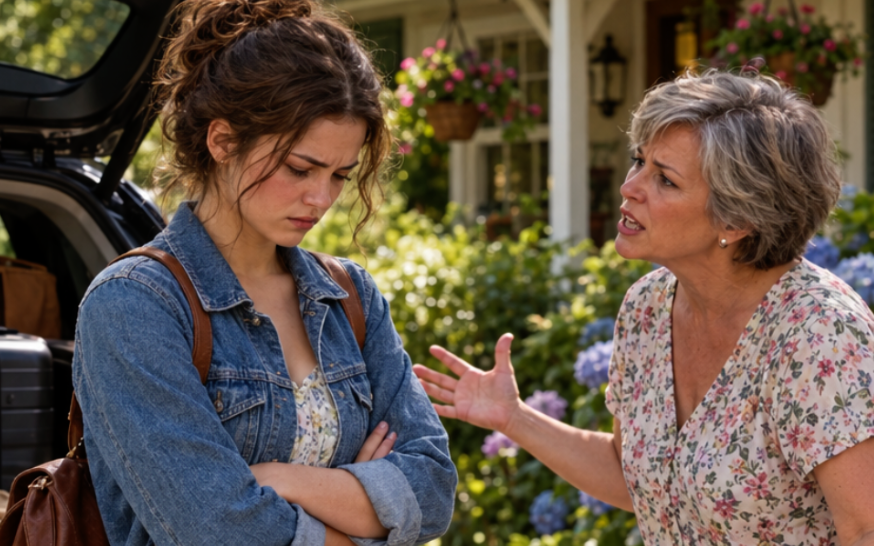
Did you happen to see the keys to the dacha settlement on the nightstand?
Vadim was bustling around in the hallway, peeking under the shoe rack and shuffling a stack of unpaid utility bills from place to place.
Polina stood in the kitchen doorway, a cup of tea in hand, silently watching these frantic searches.
“The keys are in my dresser, in the inner drawer,” she answered calmly, taking a small sip. “And that’s where they’ll stay, because we weren’t planning on going out of town this weekend. I have two shifts back to back, and you said you were going to change the oil in the car.”
“They’re not for me,” her husband smiled sheepishly, smoothing his messy hair at the back of his head. “Mom called half an hour ago. Her blood pressure shot up again, it’s impossible to breathe in the city, the asphalt is melting. She asked if she could stay for a couple of days. Says she’ll sit in the shade on the veranda, brew some herbal tea, and breathe the fresh air in peace. Come on, why not? The house is empty anyway.”
Polina set her cup on the edge of the counter. A familiar sense of unease stirred in her chest. Her mother-in-law’s habit of falling ill whenever she needed a favor had long become routine in their family.
“Vadim, we settled this back in May,” she reminded him, doing her best to sound steady and controlled. “Your mother thinks that just because the plot is fenced off, she can do whatever she wants there. For three years, I paid for that land and house with my own savings, well before we ever got married. Just last week, I finished planting rare hydrangeas along the path and sowed the lawn. She’ll bring her tomato seedlings again and start digging up the flower beds.”
“What tomatoes? What are you even talking about!” Vadim protested, throwing up his hands. “She can barely walk in this heat—can’t you try to understand an elderly woman? No vegetable beds, I made her promise. She’ll arrive by taxi Saturday morning, I’ll come pick her up Sunday evening. No guests, no gardening, just peaceful rest in the fresh air.”
Polina hesitated. She didn’t want to argue for the tenth time about the same thing. The endless paperwork for the half-year accounting had drained her, and with two tough days at the computer ahead, spending her remaining energy on another discussion seemed pointless.
“Fine,” she finally said, looking her husband straight in the eye. “There’s a spare set, the remote for the automatic gates is with it. Make sure you explain clearly: the house must be left spotless. The upstairs bedroom is off-limits; it’s locked. And most importantly—no outsiders on the property. This is a gated dacha community, neighbors appreciate peace and quiet, and we don’t make noise here.”
“Of course, absolutely!” Vadim exhaled with obvious relief, kissed his wife on the cheek, and darted to the dresser for the keys. “Thank you so much. I’ll call her right now and repeat every rule, point by point—she’s smart, she’ll get it.”
Mother-in-law threw a party at my dacha. I had to cut the power and lock the gate.
On Saturday morning, Polina left for work. The city was stifling in the oppressive heat, with hot air hanging over the roads in a thick haze. Thinking about her mother-in-law simply sitting in a wicker chair among the pine trees actually brought Polina a little relief. After all, a tense peace is better than endless battles over personal boundaries.
By two in the afternoon, Polina’s phone started to vibrate on her desk. The caller was Galina Sergeevna, her neighbor at the dacha, a meticulous and very strict woman when it comes to the settlement’s rules.
“Polina dear, good afternoon,” the neighbor’s voice sounded not just dry, but openly indignant. “I’m sorry to bother you on the weekend, but we have noise regulations here in the village. Why did your guests block the entire common road along the fire lane with their cars? We can’t get the sewage truck to our property.”
Polina froze, pen in hand, over an open invoice. The air conditioner hummed steadily in the office, but inside she felt an icy chill.
“What cars, Galina Sergeevna?” she asked, straightening her back. “There should only be Vadim’s mother there, by herself. She arrived by taxi.”
“What taxi!” the neighbor scoffed into the phone. “There are two foreign cars parked on your lawn and some old wreck blocking my hostas. There’s music blasting from a huge speaker so loud it rattles my windows. Smoke from the grill is pouring straight into our house. There must be fifteen people by now, singing at the top of their lungs for the whole cooperative to hear. Do something, or I’m calling the chairman and getting security over there.”
“Don’t call anyone,” Polina replied dully, feeling a cold, calculating anger start to rise. “I’ll be there in forty minutes. I’ll handle it myself.”
She closed her spreadsheets, shut her work laptop, and dialed her husband’s number. The phone rang endlessly before Vadim finally answered amidst the background noise of the auto shop.
“Vadik, where are you?”
“I’m at the garage, we’ve got the car on the lift, the mechanic’s checking the suspension,” he shouted over the whine of the pneumatic tools. “What’s up? Did something happen?”
“Your dying mother is currently hosting a crowd of guests at my place. With loud music, a grill, and three strange cars on the lawn. The neighbors are already threatening to call security.”
A short pause hung on the line, broken only by the clanging of metal in the background.
“Hold on… Maybe her friend stopped by for tea?” her husband tried to smooth things over as usual, sounding unsure. “Don’t get upset, she’s a social person. Maybe a cousin came to visit when she heard your mom was out there. Don’t make a scene out of nowhere, I’ll be free in a couple of hours and I’ll come by to check it out.”
“In two hours, there’ll be nothing left of my garden,” Polina retorted. “I’m heading there right now.”
She hung up, grabbed her purse, and headed out to the staff parking lot. The drive to the country village took just over half an hour, but it was enough time for Polina to cool off completely and come up with a clear plan. She wasn’t about to yell, wave her arms, or start a street brawl with a drunken crowd. Talking to those people had been pointless from the very start.
As she approached her street, Polina realized her neighbor hadn’t exaggerated the disaster at all. The heavy bass of some trashy chanson music could be heard all the way from the gate of the village. Right in front of her wrought iron fence was a battered blue sedan, its bumper pressed into a decorative shrub, and two more cars were parked on the driveway, their tires flattening her fresh, emerald-green lawn.
The automatic gates were wide open and blocked with a wooden beam so they couldn’t close.
Polina turned off her engine at the entrance, got out, and slowly made her way into the yard.
The scene was impressive. On the brand new larchwood terrace, which had only been oiled two weeks ago, a long table was cobbled together from outdoor furniture and a couple of kitchen stools. The table was piled with plastic plates smeared with greasy meat, an army of empty bottles from cheap cognac and semi-sweet wine, torn chip bags, and pieces of sliced bread.
In the corner of the terrace stood a meter-high black speaker with flashing lights, blasting rough chords across the neighborhood. Two unknown women in colorful robes lounged in deck chairs, legs sprawled, loudly arguing about sugar prices. By the grill, a burly, balding man in boxers and an open Hawaiian shirt methodically fanned the coals with a piece of packing cardboard.
Her mother-in-law sat proudly at the head of the table, wearing a silk wrap and sunglasses. No sign of paleness, shortness of breath, or pre-stroke symptoms—instead, her face was flushed with health, and she held a tall glass confidently in her hand.
My mother-in-law had thrown a party at my cottage, and judging by the way she was surveying the place, she now felt like the full rightful owner of the estate.
“Oh look, the daughter-in-law finally showed up!” one of the women in the deck chairs shouted, shading her eyes from the sun. “Toma, look! Your folks are here!”
Her mother-in-law slowly turned her head, gave Polina an appraising look, and waved her hand graciously, as if inviting a late servant to join the party.
“Come on in, come on,” she said loudly, trying to speak over the speaker. “Why are you standing there like a stranger? It’s Kolya’s birthday today—sixty years! Sitting in an apartment in this heat would be pure suicide. So I suggested we gather here as a family out in the fresh air. Go, there are cucumbers in the fridge; wash them and slice them for the table. And bring out some real plates from the house—eating off this plastic is just uncomfortable.”
The man by the grill grinned widely and waved his meat tongs at Polina.
Hey, hostess! The meat will be ready in ten minutes—it’s finger-licking good! Can you bring out the crystal shot glasses? Toma’s been saying your service here is top-notch!
Polina didn’t move toward the house. She stood in the middle of the path, feeling the broken stems of young hydrangeas beneath her feet—someone had mercilessly crushed them with heavy shoes.
“Turn off the music,” she said quietly but so firmly that the man by the grill instinctively put down his tongs.
“Oh, come on, sweetheart, let the people celebrate!” the second guest slurred drunkenly, adjusting the strap that had slipped off her shoulder. “We’re having a quiet time, relaxing with class, not bothering anyone.”
“Turn the music off. I won’t say it again,” Polina repeated, looking only at her mother-in-law.
Her mother-in-law sighed heavily, showing her guests the full extent of her patience for the younger generation’s quirks. She reluctantly nodded toward the speaker. The man pressed a button on the panel, and finally, relative silence settled over the yard, broken only by the sizzle of fat on the coals.
“Why are you making a scene in front of our guests?” her mother-in-law pursed her lips and removed her dark glasses. “Can’t you just pass out the plates? We’ve got decent people here—my old colleagues from the motor pool, my brother and his wife came all the way from the region. Are you saying we should sit outside like vagrants? My son has a cottage, but his own mother doesn’t get a say?”
“Your son doesn’t own a single square meter here,” Polina replied, her voice calm. “This land and this house belong to me. I allowed one elderly woman with high blood pressure to come for tea on the veranda. I did not invite a barbecue party and a booze fest here.”
An awkward silence immediately fell over the table. The guests exchanged nervous glances, while the birthday boy Nikolai frowned and stuffed his hands into his shorts pockets.
“How dare you talk to me like that?” her mother-in-law’s face grew crimson. “I’m your husband’s mother! You’re trying to humiliate me in front of my family? We just put the meat on, no one’s even had a hot meal yet! We’re not going anywhere until the celebration’s over. I’m calling Vadim right now—he’ll straighten you out fast. Listen to her, all high and mighty, lording over a patch of land!”
She dramatically reached for her phone, which was lying next to a plate of sausage.
Polina realized that any further arguing would devolve into a petty village brawl, with each new point louder and more pointless than the last. It was beneath her to argue with insolent drunk guests on her own property.
Spinning on her heels, she strode quickly toward the fence.
On the pole near the main entrance hung the central power panel, encased in anti-vandal metal. It housed the main disconnect switch that powered the whole house, the well pump, outdoor outlets, and the property’s lighting system. The key for the box hung on a ring in her jacket pocket.
Polina opened the metal door, found the black sixty-three amp main switch, and sharply flipped it down.
There was a dull click. Instantly, the colorful lights of the garland wrapped around the terrace railing went out, the fridge on the summer kitchen fell silent, and the speaker gave a pitiful beep before finally dying as its battery ran out. The pump in the well also shut off with the power, cutting off all water to the taps.
“Hey, where did the lights go?” growled the birthday host from the veranda. “The fridge is off, the meat will spoil!”
Polina didn’t respond. She walked up to the wooden beam propping the gate, kicked it out forcefully, and tossed it into the ditch. The heavy gate swung open with a slight creak. Then she walked to the terrace steps, climbed up, and grabbed the set of keys to the front door, which her mother-in-law had carelessly left next to her purse.
“Alright, dear guests,” Polina announced loudly and clearly, sweeping the now-silent party with a cold look. “You have exactly fifteen minutes to pack your bags, get into your cars, and leave the property. There will be no more power here. No water either. The house is now off-limits.”
“You’ve lost your mind!” her mother-in-law jumped up from her chair, almost knocking over a bottle. “I have things and expensive medicine in my bedroom! You can’t kick us out, I’ll call the police!”
“Please do,” Polina replied calmly, slipping the house keys into her pocket. “And while you’re at it, explain to the officers why a group of unauthorized guests entered private property, parked illegally on the lawn, and are violating sanitary and fire safety regulations. The fine for open flames less than five meters from a residential building here is twenty thousand rubles. Shall we start filing a report?”
The women lounging on deck chairs were the first to move. At the word “police,” their drunkenness disappeared instantly. They hurried to stuff leftover snacks and bread into plastic bags.
“Toma, I think we’ll head out,” muttered the birthday man’s brother, pulling some greasy track pants over his underwear. “Forget this dacha, we’ll sit on a bench in the city courtyard rather than endure this shame. Come on, Lucy, pack up our things.”
“Kolia, wait! Where are you going?” the mother-in-law rushed around the terrace, grabbing relatives by the sleeves, but her authority evaporated in a second. “We agreed to stay until night!”
“You deal with your own daughter-in-law,” the birthday man grumbled, scooping up a bunch of skewers with half-cooked meat. “You picked the wrong place to bring people. Invited us under false pretenses, and now we’re being kicked out like puppies.”
After ten frantic minutes of packing, filled with angry whispers and car trunk slamming, the guests’ cars one by one rolled out beyond the property. Polina stood by the fence, arms crossed, silently watching each vehicle leave.
Only her mother-in-law was left on the property. She stood in the middle of the trampled lawn, clutching her large travel bag, breathless with helpless anger.
“You’ll pay for this,” she hissed, her bloodshot eyes fixed on her daughter-in-law. “You’ll be crawling on your knees, begging my son for forgiveness. I’ll make sure he divorces you. You’re not a woman, you’re a heartless wolf! You left your husband’s own mother without bread or water in broad daylight!”
“It’s two kilometers on foot to the main road,” Polina replied calmly, swinging the gate open. “Or you can call a taxi right here, cell service works perfectly. But only outside my fence.”
Her mother-in-law spat demonstratively at her feet, grabbed her bag, and—hobbling much less than she had the day before when complaining about blood pressure—marched heavily down the gravel path toward the village gate.
Polina didn’t waste time on emotions. She turned off the lights and locked the gate with a hefty padlock that usually stayed in the shed for long absences. The heavy metal shackle snapped shut with a dry click.
Only then did she return to the yard and survey the battlefield.
The sight was depressing. Greasy stains from marinade covered the light decking, rare hydrangea shoots crushed under car tires, cigarette butts mashed straight into the mulch around the apple trees, a heap of ash by the decorative fence. It was going to take all of next weekend just to put things back in order.
She took out large black bags from the shed and silently began clearing garbage from the table.
The phone rang twenty minutes later, just as the first bag was tied up tightly and set by the bin. Her husband’s photo appeared on the screen.
Polina wiped her hands on her work gloves and pressed the speaker button.
“Have you lost your mind?” Vadim’s voice was shaking with fury. “My mother is calling from a bus stop, in tears, having a meltdown—she says her heart hurts! What did you do? You kicked everyone out, turned off the lights, humiliated her in front of the whole family! Uncle Kolya already told me what he thinks of me! Do you realize what you’ve done?”
Polina placed the phone carefully on the veranda railing.
“I’ve done something?” Her voice was remarkably quiet, but so cold it made her husband stumble on the other end. “Vadim, your mother dragged a caravan of fifteen people onto my property. They tore up the lawn with their cars, covered the patio in grease, and destroyed my flower beds. They shouted criminal songs under the neighbors’ windows. You promised she’d be alone with chamomile tea. Does your word mean anything at all?”
“She made a mistake, got carried away!” her husband yelled, less confident but still insistent. “She just wanted to please her brother—it’s a once in a lifetime anniversary! You could have waited until evening, endured it, then had a calm talk at home! Why cut the power and lock them out? That’s just madness!”
“Madness is treating someone else’s property like your own public thoroughfare,” Polina snapped. “And using someone’s milestone birthday as an excuse for their rudeness. I don’t have to put up with this pigsty on my land for even one second. Not for your mother, not for any of her relatives I’ve never even met.”
“She’s an elderly person! You have to respect your elders!”
“Respect is earned by behavior, not by the number on your passport,” Polina snapped. “Here’s how it’s going to be. I’m going to clean up, take out the trash, and then I’m heading back to the city. I’ll only turn the electricity and water back on when I feel like it.”
“Polina, stop this circus…”
“Let me finish,” she cut off her husband’s attempt to take control. “Tomorrow morning, a cleaning service will arrive to do a deep-clean on the terrace boards. That’ll cost twelve thousand. And a gardener from the nursery is coming to replace the broken bushes — that’s about fifteen thousand more. I’ll leave the bills on your desk. You’ll pay for them yourself, straight from your salary. Until you do, your things will stay in bags in the entryway. You can live at your mom’s place for now; maybe help her manage her blood pressure.”
“You’re honestly willing to tear the family apart over some bushes?” Vadim yelled, his voice cracking into a falsetto.
“The people destroying this family are the ones who think a wife should bend to shameless relatives,” Polina replied calmly. “I’ve taken the keys to the dacha. Your mother won’t set foot here again. Whether she has blood pressure issues or not. This is the end of the discussion.”
She hung up before he could answer and blocked her husband’s number for the next 24 hours, just to avoid listening to his endless excuses and accusations.
Polina spent the entire evening meticulously scrubbing the veranda floor with soapy water, cleaning out the grill, and tying up the bushes that could still be saved. The only sounds breaking the countryside’s quiet were the rustling of wind through tall pines and the songs of birds at dusk.
When evening fell and twilight cloaked the yard, she locked every door, stepped outside the property line, and checked that the chain on the gate was secure.
On Monday evening, Vadim came home quiet and unusually compliant. Without a word, he placed an envelope with cleaning money on the shoe cabinet, took his shoes off, and carefully peeked into the kitchen where Polina was packing up their freshly made dinner. He never once brought up his mother’s blood pressure or the ruined anniversary again.
And the heavy locked padlock on the dacha gate stayed in place, reminding everyone who loves an easy country life exactly where someone else’s kindness ends.