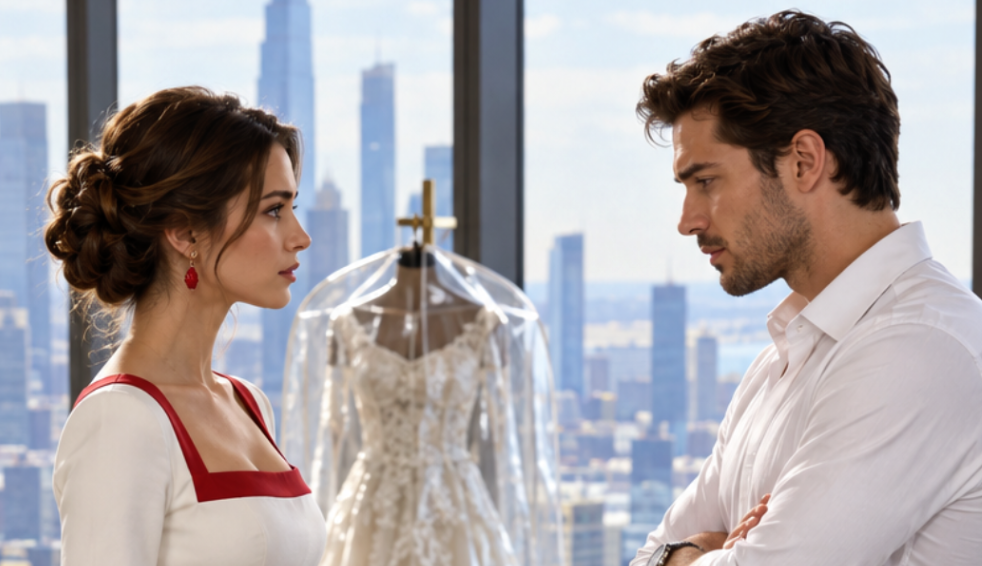
“The man is the head of the family. You’d better start getting used to listening now,” Arthur declared, leaning back in his chair as if the matter was settled.
Varvara didn’t answer right away. She was sitting across from him in the kitchen of his rented apartment, the table cluttered with printouts of the seating chart, the restaurant contract, and a to-do list for the final week before the wedding. Through the open window drifted the sounds of a warm July evening: teenagers laughing in the courtyard, a car door slamming somewhere, and someone wheeling a child’s bike out of the neighboring entrance.
There were just seven days left until the wedding.
Varvara stared at Arthur for several seconds, so intently it was as if she was seeing his face for the first time without his usual smile, without the polite tone, without the careful courtesy he always displayed with her mother, friends, or the registry office staff. He wasn’t joking. He wasn’t testing her reaction. He wasn’t trying to soften his words.
He truly thought what he said was normal.
“Say it again,” she asked calmly.
Arthur smirked.
“Say what exactly?”
“The whole thing. With the same expression.”
He frowned but repeated it:
“The man is the head of the family. Start getting used to listening now. You’ll have to adjust after the wedding anyway.”
Varvara slowly took off her engagement ring. She didn’t yank it, didn’t throw it, didn’t hurl it at him. She carefully placed it on the edge of the restaurant contract, right next to the clause about the non-refundable deposit. The gold band made a soft click on the paper.
At first, Arthur didn’t even realize what had happened. Then he straightened up.
“What are you doing?”
“Marking the moment our wedding ended before it even began,” Varvara replied.
He laughed, but the sound was dry and short.
“Varya, don’t turn this into a drama.”
“I’m not. I’m closing a project.”
Arthur blinked. He was used to Varvara using her businesslike tone for work, documents, contractors, or household matters. Now she was looking at him the same way she looked at an unreliable supplier who’d just admitted to breaking the rules.
“What project?” he asked irritably.
“Our wedding. Seven months of planning, twenty-eight guests from my side, twenty-four from yours, a restaurant booked for Saturday, host, photographer, decor, a shuttle for your grandmother, rooms for those coming from out of town. Starting this minute, it’s no longer a celebration, just a damage control mission.”
“Are you crazy?” Arthur leaned forward. “Over one comment?”
Varvara picked up her phone, opened her notes, and scrolled through the screen.
“No. Not just one.”
He suddenly stopped talking.
In recent weeks, Arthur really had been changing. At first Varvara thought it was just pre-wedding nerves. He rescheduled the meeting with the host on his own, even though they’d agreed to go together. Then he complained that her friend Yana was too loud and should sit far from the bride and groom. Later, without asking, he called the restaurant and tried to swap out some dishes for his mother’s favorites. When Varvara asked why he made the change himself, Arthur said, “I’m the groom, I have the right to participate.”
Participating is one thing. Canceling agreed plans is another.
Then he started talking about life after the wedding. Not in a dreamy or warm way, but like someone creating a rulebook for a subordinate. He said Varvara should travel for work less often. After they got married, they’d need to ‘coordinate’ her time with single friends. Her apartment was too big for one person, so his mother could come and ‘stay for a week or two now and then.’ Of course, she would take his last name, because ‘otherwise, what’s the point of marriage.’
Back then, Varvara didn’t argue harshly. She just asked questions, sought clarification, and tried to see where his awkward bravado ended and his real character began.
Today, Artur made everything clear.
“You gave me your instructions in advance,” she said. “I heard them.”
“What exactly did you hear?” he demanded, slapping his palm on the table, but then quickly pulling his hand away when Varvara glanced at his fingers. “I’m talking about a normal family. About order.”
“Order means two people make decisions together. Submission is when one commands and the other stays silent. It’s clear you want the second.”
“I want my wife to respect her husband.”
“Respect isn’t handed out after the marriage certificate is signed. It’s earned before that.”
Artur stood up abruptly, paced around the kitchen, and stopped by the window. He was wearing a light-colored T-shirt and the expensive watch he had bought just for the wedding, with the expression of a man wronged by an unfair denial of an obvious privilege. Varvara looked at him without regret. She felt uncomfortable, but not as hurt as she would have a year ago. It was as if a wall built itself inside her—on one side, her past plans, and on the other, cold calculation.
She stood up and started gathering paperwork into a folder.
“Don’t touch that,” Artur said. “Those are our documents.”
“Not anymore. The restaurant contract is in my name. The host—also in my name. The photographer, too. I paid for the dress myself. You bought your suit, so that’s your problem.”
“Are you seriously going to cancel everything right now?”
“I’m not going to. I’ve already started.”
Artur grabbed his phone.
“I’m calling your mother.”
“Go ahead. But before you do, think about what you’re actually going to say. That your fiancée left because she refused to obey you in advance?”
He froze. Varvara noticed the tension in his jaw. Artur really cared about the impression he made on others. He could be blunt in private, but around people he became attentive, noble, slightly ironic. He liked it when acquaintances told Varvara, ‘You’re lucky, he’s a serious man.’ He’d spent years building an image of someone with whom a woman should feel safe.
But Varvara realized: he wasn’t interested in protecting her, he wanted to protect his own right to make decisions for her.
“You’ll regret this,” he said quietly.
“Maybe. But I’d regret marrying you a lot more.”
She picked up her bag. Artur stepped toward the door.
“We’re not done talking.”
“We’re finished. You made your position clear, and I’ve made my decision.”
“Varya, the wedding is in a week! Do you realize how humiliating this is?”
Varvara stopped right in front of him.
“What’s humiliating is getting married just because you’re afraid of what the guests will think. Calling off the wedding now is just good hygiene.”
He looked at her with growing irritation. In the past, she would’ve tried to smooth things over, find a neutral phrase, or steer the conversation away. But now, she wasn’t facing a beloved man going through a hard time. Before her stood someone who had taken her agreement to get married as an agreement to submit.
“Step away from the door,” she said.
“And if I don’t?”
Varvara took out her phone and unlocked the screen.
“Then I’ll dial 112 and tell them I’m being prevented from leaving my apartment. Do you really want to start the week before our canceled wedding with a visit from the police?”
Artur stepped aside—not out of remorse, but out of calculation. He knew all too well the neighbors would hear, there would be explanations required later, and his mother would learn a different version than the one he’d planned to tell.
Varvara walked out into the hallway without slamming the door. The staircase felt stuffy. She went down from the fourth floor on foot, even though the elevator worked. She needed movement, something clear and simple: step, another step, turn, handrail, exit.
Outside, the July air smelled of hot asphalt, linden trees, and dust. Varvara got into her car, placed a folder on the passenger seat, and only then allowed herself to slowly stretch her fingers. They were stiff from gripping her bag’s handle so tightly.
There were no tears, no shaking. There was anger—a dense, focused, and useful anger. It didn’t break her; it switched her mind on.
Varvara worked as a cost engineer at a construction firm and was used to calculating everything: deadlines, risks, expenses, consequences of others’ carelessness. She wasn’t some romantic girl who believed that “everything would get better after the wedding.” She was thirty-two. Behind her—a mortgage paid off early without anyone’s help, renovations in her own apartment, several complicated projects, and one long story with a man who’d promised for three years to “be ready” while she alone carried the relationship for both of them.
With Artur, things began differently. He was attentive, charming, and a good listener. They hadn’t met in a café or at work, but in line at a service center, both dropping off phones damaged in a heavy downpour. Artur gave her his spot at the counter, later helped her find a taxi since the city was flooded, and two days later sent her a new phone case by courier with a note: “For the next flood.” That made Varvara laugh, and she agreed to meet up.
For a year and a half, he seemed mature, reliable, never petty. He didn’t pressure her, cause scenes, or meddle in her finances. That’s exactly why she said yes to his proposal. He gave her the ring in early spring on a riverfront viewing platform. It was beautiful, calm, no crowds, no cheap theatrics. Varvara said “yes” not out of fear of being alone, but because she truly believed they were partners.
The first signs of trouble showed up after they submitted the marriage application. It was as if the simple fact of the upcoming wedding switched something in Artur’s head. He stopped saying “we’ll decide” and started insisting “I think.” Not “whatever works for you,” but “this will be best.” Varvara wasn’t naive. She didn’t argue right away; she wanted to understand how deep the problem went. One incident is an accident. Two is a habit. Five is a system.
Today, the system named itself.
At home, Varvara put her bag down on the floor, turned on the hallway light, and the first thing she did was take out her laptop. Her apartment was in a brand new building by the park—it was bought before she met Artur and belonged solely to her. Artur was supposed to move in after the wedding, but she never gave him a key. He would joke about it, sometimes get offended, and say that Varvara liked to control everything too much. Now, she made a mental note to herself—she was especially grateful for that decision.
No keys given— that saved nerves, the lock, and the need for awkward explanations.
She opened the wedding planning spreadsheet. One column had the vendors’ contacts, another listed advance payments, and a third explained the cancellation policies. Varvara didn’t call anyone in a panic. First, she organized everything.
Restaurant: part of the deposit is lost, but some can be applied to another banquet within three months.
Photographer: deposit is non-refundable, but it can be switched to a solo photoshoot.
Host: keeps a small portion, the rest will be refunded.
Florist: flowers haven’t been purchased yet, so cancellation is possible.
Dress: finished, paid for, could be sold or kept.
Invitations: already sent, reputation takes a bit of a hit, but she’ll survive.
Varvara drafted a short message for her guests:
“Dear friends, the wedding is canceled. This decision is final. I won’t be discussing details and ask for your understanding. If anyone had expenses for travel or accommodation, please message me directly and we’ll sort it out.”
She read it over three times, trimmed any extra words, and sent it to her mother first.
A minute later, Nadezhda Sergeyevna called.
“Varya, what happened?”
Her mother’s voice was anxious but not hysterical. Varvara respected her for that. Her mom could worry intensely, but she rarely lost her composure.
“Artur said that in the family, the man is in charge, and I should get used to obeying him ahead of time.”
There was a silence on the other end.
“He said it just like that?”
“Word for word.”
“Where are you?”
“At home.”
“Is he there with you?”
“No. And he doesn’t have any keys.”
“Good,” her mother said after a pause. “I’m coming over.”
“You don’t need to. I’ll be fine.”
“I know you’ll be fine. But I’m coming anyway. Not to save you—just to be with you.”
Varvara closed her eyes for a moment. This is why she loved her mother: she never tried to take the wheel away from Varvara, even when the road got tough.
“Come over,” she said.
While her mom was on her way, Varvara sent messages to the vendors. Her wording was polite, precise, and she didn’t bother with excuses like “it just didn’t work out.” Then she texted Yana, her closest friend: “There won’t be a wedding. I’m okay. Artur brought out his future family rulebook a bit early.” Yana replied almost instantly: “Should I come over?” Varvara wrote: “Not now. Help me call the guests tomorrow if they start asking questions.” Yana just sent back, “Proud of you.”
Artur called forty minutes later. Varvara just stared at the screen until the call ended. Then he texted: “You’re acting like a child.” Next: “We’ll talk when you’ve cooled off.” Then: “My mom already knows, she’s in shock.” Another minute later: “Do you even realize what people will say?”
Varvara opened the chat and started typing:
“This is my final decision. I’ll only be in touch about canceling the wedding and returning belongings. Tomorrow at 12:00, I’ll send you a list. No need for personal conversations.”
Arthur replied instantly:
“You can’t make this decision on your own.”
Varvara glanced at the message and smirked. Just yesterday, words like that might have upset her. Today, they only confirmed she was making the right choice.
She typed back:
“I have the right to withdraw my consent to marry at any moment before the registration. And I’ve decided to use that right.”
With that, she turned off notifications.
Her mother showed up carrying a bag of apricots and a bottle of mineral water. She didn’t rush to hug Varvara. First, she took off her shoes, walked to the kitchen, washed her hands, and started arranging the fruit in a bowl. Watching her, Varvara suddenly felt grateful for this simple, normal moment. The world hadn’t ended—she was just canceling a wedding with a man who had shown too early what kind of person he intended to become after they married.
“Start from the beginning,” her mother said.
Varvara told her everything. No embellishments, no tears, no attempts to paint Arthur as a monster. Just the facts: changes in his behavior, decisions made without her, discussions about last names, his mother in her apartment, and the words he’d said today.
Nadezhda Sergeyevna listened without interrupting. Only once, as she cut an apricot, did she grip the knife so tightly that the pit snapped against the cutting board.
“It’s good this is happening now,” she finally said.
“I think so too.”
“Relatives will talk.”
“Let them talk.”
“His mother might come over.”
“She can try. I never invited her into my apartment and I won’t.”
Her mother nodded.
“Good. He never got a set of keys, right?”
“No.”
“Do any of your important documents happen to be with him?”
“Nothing important. Maybe a passport copy with the event organizer for the contract, but not with Arthur. I’ll check tomorrow.”
“Well done.”
For the first time that evening, Varvara gave a tired smile.
“Mom, the way you’re talking, it sounds like I just passed a fire safety inspection, not canceled my wedding.”
“Well, it was an inspection—only this time it wasn’t the restaurant burning, it was your future life.”
Varvara barely slept that night. Not because she had doubts—there were none. But her mind kept racing: who to notify, how to get money back, how to stop Arthur from twisting the story to the guests. She knew he would try. People like him don’t keep quiet when they lose control. They start telling everyone the woman just had a fit, overreacted, or was afraid of responsibility.
Varvara got up at seven in the morning. She took a shower, put on a light linen dress, tied her hair in a low ponytail, and opened her call list. First, she contacted the restaurant. When the administrator heard about the cancellation, she spoke carefully, with an almost sympathetic tone. Varvara quickly steered the conversation toward business.
“Can we use part of our deposit for another event?”
“Yes, within the next three months.”
“Great. In that case, let’s not cancel everything. Let’s reformat. Is it possible to have a dinner for twenty people on the same date?”
“Yes, in the small hall.”
Varvara looked out the window. Summer was bright and sunny, almost bold. The Saturday they had picked for the wedding no longer seemed like a black hole on the calendar.
“Reserve the small hall,” she said. “The format: a family dinner. No wedding decorations. I’ll adjust the menu today.”
When she hung up, she was surprised by how much she liked that decision. Why should she lose money and hide at home on the day that was supposed to be her wedding? Why should the restaurant go to waste, and Artur be satisfied thinking he ruined her celebration?
No. She wouldn’t get married. But she would gather her people and celebrate her lucky escape from a mistake.
When Yana heard the idea, she was silent for a moment, then said:
“Varya, this is savagely beautiful.”
“It’s financially wise.”
“No, it’s just savagely beautiful. I’ll wear my best dress.”
“Just no funeral speeches.”
“Of course. There’ll be a toast to taking off the ring just in time.”
By lunchtime, Artur had started his attack. First, his mother Inessa Viktorovna called. Varvara didn’t answer. Then a long message came: “You’re ruining my son’s life out of your pride. A woman should be wiser. Artur lost his temper, and instead of smoothing things over, you staged a public humiliation.”
Varvara read it and forwarded it to Yana with the note: “It’s begun.” Then she replied to Inessa Viktorovna:
“The wedding is canceled. The decision is final. I see no point in discussing my character. Artur will receive details about the organizational expenses separately.”
Ten minutes later, her Aunt Galina called, the one who always considered herself a relationship-saving expert.
“Varenka, what’s wrong with you? Men say stupid things sometimes. You have to let it go.”
“I let it go. Right past my life.”
“But it’s the wedding! Guests have been invited!”
“The guests will get a message.”
“And the dress?”
“The dress is fine.”
“And the love?”
Varvara looked at the folder with the contracts.
“Love ended where the rules for obedience began.”
Aunt Galina sighed as if civilization were collapsing before her eyes.
“You’re being too harsh.”
“Today, that’s a compliment.”
By evening, Artur came to her house himself. Varvara saw him from her window: standing at the entrance in a white shirt, holding a bouquet of cream-colored roses. He looked exactly the way you’d expect for random onlookers: a heartbroken groom coming to make peace. He dialed her number. Varvara answered, looking down at him from above.
“I’m at your entrance,” he said.
“I see you.”
“Come outside. Let’s talk calmly.”
“No.”
He lifted his head toward her window, but it took him a moment to spot where she was.
“Varya, I came with flowers.”
“I didn’t order any.”
“Are you completely cold-hearted?”
“No. But bringing flowers doesn’t erase what you said.”
Artur abruptly lowered the bouquet. His face changed: the soft mask dropped, revealing angry impatience.
“Do you realize how much you humiliated me?”
“I don’t have to get married just to save your reputation.”
“I already told everyone you lost it because of nerves.”
“You shouldn’t have. On Saturday, my guests will hear the real reason.”
He went silent.
“What do you mean—on Saturday?”
“I’m not canceling the restaurant entirely. There’ll be a dinner for my loved ones.”
“Are you mocking me?”
“No. I’m just making use of what’s already been paid for.”
Artur fell silent for a few seconds. Varvara could see him trying to adjust. He expected tears, pleas, chaos—but instead, he got a spreadsheet of expenses and a brand new event concept.
“So, you decided to embarrass me?”
“Arthur, you’re overestimating your importance. This dinner isn’t about you. It’s about proving my life didn’t fall apart just because the wedding was cancelled.”
“I’m coming up.”
“I wouldn’t do that if I were you. I won’t let you into the apartment. If you start making a scene, I’ll call the police. There won’t be any conversation at the door either.”
He gripped the bouquet so tightly that a few petals fell onto the pavement.
“You were always ridiculously independent.”
“And you just realized, too late, that marriage doesn’t cure that.”
She turned off her phone’s ringer.
Arthur stood at the entrance for fifteen more minutes. Then he threw the bouquet in the trash can and left. Varvara snapped a photo from the window—not out of spite, but for herself. Just in case he later tells people he simply brought flowers and she caused a scene.
Everything sped up in the days that followed. Varvara sent out messages, cancelled all the wedding arrangements, and changed the restaurant reservation. She picked up her dress from the salon and hung it in her closet—not selling it right away. Not out of sentimentality, but because she thought it wise not to get rid of something expensive in a rush. The photographer agreed to switch the wedding shoot to a portrait walk at the end of August. The host refunded part of the money. The florist almost sounded relieved, saying she hadn’t bought the flowers yet.
Rumors started circulating from Arthur’s side. People carefully repeated them to Varvara: he was saying she ‘got scared of family responsibilities,’ that her ‘personality isn’t fit for marriage,’ and that she was ‘too used to living alone and being in charge.’ Varvara didn’t offer any explanations. She would only say this to those who asked her directly:
“He said that a man is in charge and that I needed to get used to obeying. I decided not to get used to it.”
That was enough. People would either go silent, laugh awkwardly, or simply say, “Got it.” Women always understood the quickest.
Two days before the would-be wedding, Arthur demanded she return half of the prep expenses. Varvara expected this. She opened her spreadsheet where every payment was already logged: who paid, when, for what, under which contract. Arthur had covered part of the suit, the rings, and some of the videographer’s services. She offered to send the rings back to him via courier and contacted the videographer separately. The suit was his to keep. He had no grounds to claim her share of the payments.
She replied:
“Send over proof of the expenses you personally paid that were for shared services. We’ll discuss compensation with documentation. I won’t consider expenses without supporting evidence.”
Arthur wrote back: “You even turn a breakup into accounting.”
Varvara smirked but didn’t reply. He wanted drama, but instead found order—and that maddened him more than any outburst ever could.
On Saturday morning—the day she was supposed to become a bride—Varvara woke up early. Sunlight poured confidently through the windows, as if the city had no idea today was meant to be dramatic. She brewed coffee, opened her closet, and picked out not a wedding dress, but a dark-blue pantsuit without any extras. She put on garnet earrings—the ones she bought herself after completing a difficult project. The woman in the mirror wasn’t a jilted bride. She was a woman who had read all the small print in time.
Her mother arrived at two o’clock.
“You’re beautiful,” she said.
“Isn’t that a bit strict?”
“It’s just right. Like the director of her own destiny.”
The restaurant greeted them with cool air conditioning, the scent of fresh fruit, and polished wood. The small hall felt calm: one long table, summery bouquets without any wedding fuss, light napkins, pitchers of water with lemon. Not everyone had arrived yet, and that suited Varvara just fine. Her mother was there, along with Yana, her cousin Egor and his wife, Aunt Galina who decided to support her after all, a few close friends, and her colleague Lidia Pavlovna—a woman with a sharp mind and a habit of telling the truth without sugarcoating it.
At the beginning of dinner, everyone was cautious. No one said the word “wedding.” Then Yana raised her glass of lemonade.
“I’d like to make a toast. Not for what didn’t happen, but for what happened at the right time. For Varvara, who heard the words ‘get used to obeying’ and didn’t wait to see how much worse things could get after the registry office.”
Someone chuckled, others seemed to breathe easier. Varvara lifted her glass.
“Thank you. But I want to add something. I don’t see myself as a victim. No one left me, no one duped me at the altar, no one saved me. I was shown the terms ahead of time. I chose not to sign.”
Lidia Pavlovna nodded approvingly.
“Now that’s what I call a smart break-up.”
Aunt Galina turned her glass in her hands.
“But what if he was just nervous?”
Varvara looked at her, not irritated.
“A nervous person says, ‘I’m scared,’ ‘I’m tired,’ ‘let’s think this over.’ Not that someone must obey. Those are very different things.”
Egor chimed in:
“Arthur’s always liked to be in charge. He just used to disguise it as caring. Remember, at the dacha, he assigned everyone their seat around the fire? He even made the host change spots.”
“Back then I thought he was just organized,” Varvara said.
“He is organized,” Egor replied. “He just wanted to organize your whole life, too.”
The atmosphere at the table grew livelier. People stopped worrying about saying the wrong thing. Varvara could see the tension lifting from everyone. The broken-off wedding was turning, not into shame, but into a story about common sense.
That was when Arthur appeared in the doorway to the small hall.
He wasn’t alone. Next to him stood Inessa Viktorovna in a light-colored suit, her face set like a woman on a mission to restore justice. The manager trailed after them, clearly unsure if she should step in.
Conversations at the table broke off.
Arthur looked at Varvara. There was a flicker of satisfaction in his eyes—now there were witnesses, now this was a scene, now she wouldn’t be able to avoid the conversation.
But Varvara didn’t get up right away. She calmly placed her napkin next to her plate, just as she had set down her ring a week before. Then she turned to the manager.
“These people are not on my guest list for this event.”
Arthur smirked.
“Your event? It was supposed to be our wedding, you know.”
“It was supposed to be. But it isn’t.”
Inessa Viktorovna stepped forward.
“Varvara, you’re at least obligated to listen to Arthur. You publicly humiliated my family.”
Varvara stood up. Her voice was soft, but the room was quiet and every word could be heard.
“Inessa Viktorovna, your son told me a week before the wedding that I should get used to obeying. After that, the wedding was called off. Tonight there’s a private dinner for my loved ones. You’re not invited.”
“How dare you?” Inessa Viktorovna’s face went pale with shock. “Arthur poured his heart into this!”
Yana quietly snorted, but Varvara didn’t even turn her head.
“He can take his heart with him. The financial matters will be settled according to the documents.”
Arthur flushed red.
“Did you invite everyone here just to talk about me?”
“No. You came yourself because you wanted to be seen.”
That hit the mark. Several guests exchanged glances. Arthur quickly realized the situation wasn’t going his way. He had hoped for her embarrassment, his mother’s pressure, or at least the guests’ confusion, but instead got a clear rejection in front of witnesses.
“Varya,” he changed his tone, becoming softer. “I admit I spoke harshly. But you know I love you. I just wanted a normal family.”
“A normal family doesn’t start with warnings about submission.”
“That’s not what I meant.”
“That’s exactly what you meant. You said it twice.”
Inessa Viktorovna quickly turned to her son. It seemed she hadn’t known about him repeating it.
“Twice?” she asked in almost a whisper.
Arthur shot his mother an irritated look.
“Mom, not now.”
Varvara saw that look and felt completely calm. Everything was as it should be. He didn’t just disrespect his future wife—he only respected people as long as they sided with him.
“Leave,” Varvara said. “Now.”
“And what if I don’t?” Arthur asked quietly.
The administrator turned pale. Egor stood up from his seat. Lidiya Pavlovna set down her fork and looked at Arthur in such a way that even Yana stopped smiling.
Varvara took out her phone.
“Then the management will call security or the police. You’ve come to a private event without an invitation and are refusing to leave. Think about it, Arthur. Is that really the last photo you want to have?”
He stood for a few more seconds, then abruptly turned and headed for the exit. Inessa Viktorovna lingered a moment longer.
“You’ll realize what you’ve lost someday.”
“I already have,” Varvara said. “That’s why I’m not picking it back up.”
After they left, nobody spoke for several seconds. Then Lidiya Pavlovna picked up the carafe and calmly poured herself some water.
“Nice dinner,” she said. “With a program, too.”
The laughter didn’t start right away, but when it did, it finally eased the tension. Varvara smiled, too—not loudly or dramatically, but just feeling the last of the weight leave her.
After dinner, they stepped outside into the summer night. The sun was already setting, orange light reflecting off the glass buildings. Yana took Varvara’s arm.
“You know, this was the best non-wedding of the year?”
“Just as long as it’s the only one.”
“Agreed. Still, you set the bar high.”
Varvara’s mother walked silently beside her. As they reached the car, she suddenly said:
“I’m proud of you. Not because you left, but because you left without chaos.”
Varvara looked at her.
“Chaos would have suited him.”
“Did you know that right away?”
“Yes. If I’d yelled, he would have called me hysterical. If I cried, people would have pitied him. If I begged, he would have bargained. That’s why I kept calm.”
Nadezhda Sergeyevna nodded.
“You’re tough, you know that.”
“No, just normal. Just on time.”
A month later, Varvara learned from mutual friends that Artur quickly started dating another woman—a quiet, young girl, the kind who laughs at every joke a man makes on the first few dates and never interrupts. Varvara didn’t feel a hint of jealousy. Only a brief pang of sympathy for the stranger, and a hope that she too would one day hear the right words at the right moment.
Artur collected the ring via courier. Varvara never met him in person. She settled all the financial matters through signed receipts and transfers, without any drama. She sold the dress in August to a girl who arrived with her mother and spun in front of the salon mirror for ages. Varvara handed it over calmly. Someone else’s wedding wasn’t to blame for her own not coming true.
She still did a photoshoot—not in a wedding gown, but in city clothes: a white shirt, wide trousers, her hair pulled back, a calm smile on her lips. The photographer captured her on a bridge over the river at the end of summer, when the wind lifted the edges of her shirt and the city glowed behind her. In one shot, Varvara looked straight into the camera. Not gentle, not harsh—just clear.
Later, she set that photo as the wallpaper on her laptop.
It wasn’t a reminder of the man she walked away from. It was proof to herself: sometimes a life-changing decision looks completely everyday. No dramatic music, no tears at the altar, no fleeing in the rain. Just a woman taking off her ring, setting it on the restaurant contract, and realizing her self-respect won’t cost less just because the wedding is paid for.
In the fall, Varvara bumped into Artur by chance outside a shopping center. He was alone, talking on his phone and looking irritated. When he saw her, he broke off mid-sentence. Varvara could have walked on by. But she paused for a second.
“Hi,” she said.
Artur lowered his phone from his ear.
“Proud of yourself?”
She studied him carefully. The question was just like him—not really about her, but a way to try and force her to feel guilty.
“Yes,” Varvara replied. “Very.”
And she walked away.
He said something after her, but she didn’t catch it and didn’t turn around. A normal evening lay ahead: shopping, going home, tomorrow’s plans, a work report, a phone call to her mother, meeting Yana on the weekend. No grand finale. No villain punished by fate left behind. Just life, from which she’d wisely crossed out someone who decided to make himself the main character.
And that was the real victory.
Not becoming a wife at any cost. Not keeping up a pretty picture for the guests. Not proving to everyone how strong she was.
Just quietly choosing herself in the very moment someone tried to get her used to someone else’s control.
Varvara didn’t choose to tolerate. She didn’t wait for Artur to lock down the rules with married life, shared keys, relatives, and talk of duty after the wedding. She didn’t let him into her apartment, her money, her decisions, or her future.
Sometimes the most calculated choice a woman makes can look like harshness to those around her.
But really, it’s just an accurate assessment of risk.