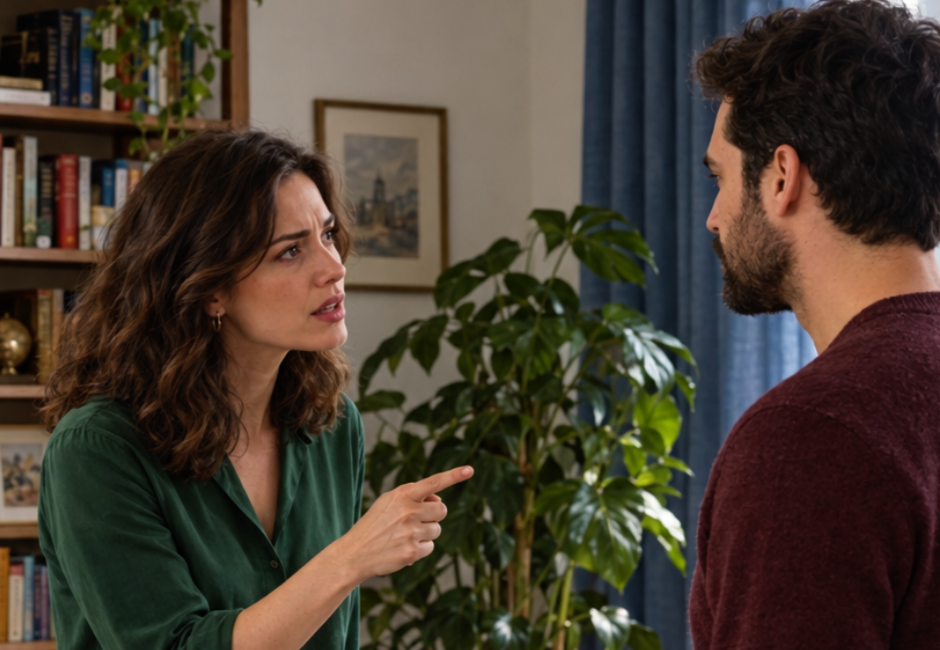
“Do you even realize what you’ve done?!” Igor’s voice shattered the silence in the hallway while Vera silently pulled off her wet sneakers. “My mother has now spent two days glued to her blood pressure monitor, and you, I see, don’t even bother to call and apologize!”
Vera straightened up like a spring that had been held down too long. Only one dim bulb lit the hallway, making her husband’s face look crumpled and foreign, as if someone had hastily molded it from gray clay.
“Apologize?” she whispered the word, but in the quiet corridor, it sounded louder than a scream. “For daring to say I was tired? Or for walking out instead of waiting for your darling sister to call me ‘the tenant’ for the fourth time tonight?”
Igor yanked his jacket off the hook even though he had nowhere to go—he just needed something to do with his hands.
“You’re twisting things! Zhenya was just joking, that’s just her way. You know that.”
“I know, Igor,” Vera said, walking to the kitchen without even glancing at him and clattering the kettle down, “that for ten years, your family has called me the village girl, then a kept woman, and now the tenant. And you never even flinch. Even though, by the way, we live in my apartment—the one my grandma left me, in case you forgot.”
The kettle started to hum, picking up steam, and Vera stood over it, watching the old linden sway outside the window. Suddenly, a cold realization pierced her: he really had forgotten. He genuinely didn’t remember whose apartment this was, or who had been paying the bills the past six months while he stayed unemployed, working on his “brilliant project” for some mythical startup. In Igor and his mother’s world, it all seemed simple: there’s a woman—she’s supposed to be convenient, clean the floors, give them grandchildren, be quiet, and if she causes trouble, she’ll be shown the door. Even in her own apartment.
“Vera, you know Mom’s old-fashioned,” Igor sat down on a stool, folded his hands on the table like a model student. Now he spoke quietly, more intimately, as if sharing a dark secret. “That’s just how she was raised—a woman is the keeper of the home, she holds everything together. She loves you in her own way, she just… expresses it a little weirdly.”
“Weirdly—like when she says in front of guests, ‘Vera’s a simple girl from the sticks, they’ve only ever seen pineapples in pictures’?” Vera gave a small laugh as she spooned tea into the pot, surprised to find her hands were steady. “Or like last year, when she gave me that book ‘How to Be a Good Wife in 30 Days’ for my birthday? Is that love, Igor? Seriously?”
“She’s just worried!” he snapped, his Adam’s apple twitching with nerves. “You know she’s been divorced twice—she’s afraid we’ll fall apart, too. She’s trying to help, in her own way.”
Vera spun around sharply, bracing her hands on the countertop. The kettle had clicked off already, but she didn’t pour the tea. She needed truth right now, not tea—just something solid to hold onto.
— Help? Then tell me, darling, why, when you lost your job in January, your mom came over and said: “Verochka, you’ll have to tighten your belts, Igor needs to think about his future, not where to find money for your yogurts”? Why is help always one-sided? I get advice on how to save money, while you get envelopes full of cash, which you hide in the car’s glove compartment?
He turned pale and flinched as if she’d slapped him. She had known about the envelopes for three months now, but had kept quiet, saving up the information like a prosecutor stashing evidence. Today, there was no point in waiting any longer.
— You went through my things? — Igor’s voice was hoarse and accusatory.
— I found it by accident when I was reaching for the spare tire, — Vera cut him off. — You asked me to go to the tire shop that day, remember? So I went. And you know what’s funny? You spent a month complaining we didn’t have money for me to take advanced courses, but there were eighty thousand rubles sitting in your glove compartment. Eighty, Igor! And you spent it on your so-called “business lunches” with your friends.
Igor jumped up, knocking over the stool. The crash echoed through their tiny kitchen like the first thunderclap before a real storm. Vera didn’t move, just watched him, her eyes dry and fearless — only showing the icy, frozen contempt of a woman who had finally added up every number in this endless account of humiliation.
— You don’t understand, — he started quickly, words tumbling out, — I needed to maintain connections! That’s essential in my field! I couldn’t embarrass myself in front of partners when we met at restaurants. And you would have made a scene if I told you the truth, so I had to take money from my mother.
— I would have made a scene? — Vera actually laughed, and her laugh sounded like a shattered cup. — Igor, I’ve been working two jobs for four months. Mornings as an accountant at the firm, evenings doing reports for private clients at home. My back is constantly aching, and by night my eyes are red like a rabbit’s. All so you can “maintain connections” and have lunches with your buddies downtown? Have you ever once asked how I’m doing?
He stayed silent, staring at the floor. He picked up the stool, set it back, but didn’t sit down, instead standing beside it like a soldier awaiting his sentence. In the hallway, his phone rang — the melody he set just for calls from his mother: a deafening segment from Vivaldi’s “The Four Seasons.” Vera looked at her husband and saw panic, irritation, frustration on his face — everything but shame.
— Answer it, — she nodded toward the door. — Tell her that “Operation: Reform The Lazy Daughter-in-Law” is temporarily suspended due to technical difficulties.
— Please stop, — he quietly pleaded. — Mom has nothing to do with this. She’s just worried.
The phone kept ringing, then finally fell silent, and in the sudden quiet you could hear pigeons shuffling on the windowsill, and, a few blocks away, a car alarm wailing in the distance. The modern Russian soundtrack.
“Do you know what your mom said when we visited her last week?” Vera slowly walked over to the table, sat down across from Igor, and folded her hands like a teacher ready to school a failing student. “She said, ‘Verochka, you’ve put on weight again. Girls with your figure need to watch what they eat or Igor will start looking at someone younger.’ She said this in front of your sister, her husband, and even the neighbor they invited for tea. You were right there, just munching on a chicken leg, like she was only talking about the weather.”
Igor rubbed the bridge of his nose—a gesture that for him meant he was utterly exhausted and just wanted to hide from this unpleasant conversation.
“That’s just how they talk, Vera. You take everything too personally. In their family, honesty and directness are the norm. You’re just not used to it; in your family you were all so delicate.”
“In my family,” Vera said crisply as she stood up, “we didn’t insult people at the dinner table. In my family, husbands didn’t secretly take money from their mothers to pretend they were business tycoons while their wives worked late. In my family, if times were tough, we talked about it openly and figured a way out together. But your family, Igor, is not a family at all. You’re just a little cult devoted to Tamara Eduardovna.”
He flinched at the mention of his mother’s name, spoken so calmly yet so devastatingly. He opened his mouth to object, but just then the doorbell rang—short, commanding, insistent—the way only someone who expects to be answered right away would ring.
“Speak of the devil,” Vera remarked and went to open the door without even checking the peephole.
Standing at the door was Tamara Eduardovna herself—a sixty-two-year-old woman with a caramel-colored perm and a mink jacket she wore even in April because, as she said, “fur needs to get out.” Behind her hovered Zhenya, Igor’s younger sister, a plump thirty-three-year-old who always dressed in leopard print and wore a permanent pout.
“Well hello, Verochka,” Tamara Eduardovna sang out, brushing past her like she was furniture. “We’ve come for Igoryochka. We have every right to check on our son after the circus you pulled yesterday.”
“Mom, why are you…” Igor sputtered as he came into the hallway, trying to either hug his mother or block her way—it was unclear which. But his mother and sister had already made their way into the living room, leaving wet footprints from the spring slush on the laminate floor.
Vera closed the door and leaned against it for a few seconds, just watching: Tamara Eduardovna settled into an armchair like royalty, Zhenya immediately reached for the candy bowl, and Igor darted around like a server, unsure who should get slippers first.
“Alright then,” Vera’s voice was surprisingly loud, even to herself. “Let’s make this clear right now. Tamara Eduardovna, this is my apartment. I didn’t give you a key, and I won’t, and if you show up unannounced again, I just won’t open the door. Or I’ll open it—and call the police.”
An electric silence filled the room. Zhenya froze with a candy halfway to her mouth. Igor turned so pale that his freckles stood out in stark, brown contrast across his nose.
“How dare you?!” Igor’s mother shot up, the sides of her fur-lined coat spreading out like the wings of an angry hen. “I am the mother of this house! I have put up with your antics, your cheap habits, your constant inability to keep the house for ten years, and now you think you can tell me when and where I’m allowed to visit?!”
“Put up with?” Vera stepped away from the door to stand in the center of the room, arms crossed tightly. Her voice was steady, but inside she was buzzing like a live wire. “Let’s clarify what exactly you’re putting up with. Is it the fact that I took your son in after his first wife left him? Or that I moved into this apartment with just a suitcase and, in five years, renovated it entirely with my money? Or is it that I held my tongue while you listed my flaws at every family gathering as if reading an indictment?”
“Mom, Zhenya, maybe this really isn’t the best time…” Igor squeaked, but his voice was drowned out by his sister’s angry snort.
“An indictment!” Zhenya threw up her hands. “Just look at her! Mom wants the best for her, and she’s here putting on a whole performance! Vera, do you really think you’re some kind of prize? Even Lyudka from the next building has been eyeing Igor for a year now. She’s got the figure, cooks like a restaurant chef, and would’ve found common ground with Mom in no time!”
“Zhenya, shut up,” Igor said suddenly, catching everyone off guard into stunned silence.
Vera looked at her husband, feeling a flicker of hope deep in her chest, almost extinguished but not gone. Maybe, just maybe, he could finally take her side. Just once, after all these years?
“Don’t insult her in front of me,” Igor continued, his voice dull and uncertain. “We’ll sort out our family matters ourselves.”
“‘Our family matters!’” Tamara Eduardovna mocked him. “So now we’re not family? That Lyudochka, by the way, has a teaching degree, comes from a good family, and her mother is an old university friend of mine! And what about her? She came here from her forgettable little town, dragging with her the manners of a dorm girl, and now she wants to tell me what to do?”
“Mom, you’re taking this too far,” Igor tried again, but Vera wasn’t hearing him anymore.
She looked at Tamara Eduardovna and, for the first time, saw her without the filter of ‘I have to tolerate her, she’s my mother-in-law, my husband’s mother, it’s just tradition.’ Instead, she saw simply a bitter, worn out woman, who made herself feel important by tearing down anyone she thought beneath her—just because she was born in Moscow and had a 30-year-old university diploma.
“Are you done?” Vera asked, once the silence had grown unbearable.
“No!” Tamara Eduardovna even stomped her foot. “I demand an apology! You ruined my birthday yesterday. You showed up with that disgraceful supermarket cake, knowing full well I expected a proper present. You sat there all evening with a sour expression, like a serf forced into labor, then left without even saying goodbye! You humiliated me in front of the guests! In front of Marya Alexeyevna, who still remembers my own wedding!”
Vera remembered last night and exhaled slowly, very slowly, trying to suppress the sarcasm bubbling inside her.
She had spent two weeks preparing for her mother-in-law’s birthday. She baked the very honey cake that Tamara Eduardovna had praised five years ago—at least, until she learned that her daughter-in-law had made it, not bought it from a trendy bakery. Vera also bought elegant little sapphire earrings, because her mother-in-law adored blue. She made three salads, a meat roulade, and aspic using a recipe she got from her mother’s friend—the exact dish the birthday girl loved. Vera arrived an hour ahead of the guests, ready to help set the table.
And then the fun started. First, Zhenya eyed the food and asked dramatically, “Vera, where did you get the meat? I hope it wasn’t from Pyatyorochka?” Then Tamara Eduardovna opened the earring box, pursed her lips, and said, “Well, for a first try it’s quite lovely, though you know I prefer gold with diamonds—not sapphires, they don’t suit me.” Next, neighbor Marya Aleksevna tasted the aspic and remarked, “That’s quite a recipe, Tamara dear, did you make this yourself?” “No, it was Verochka’s effort—she’s got experience with district parties, coming as she does from the sticks,” replied her mother-in-law, making everyone burst out laughing.
Vera sat there smiling. She was very good at smiling when all she wanted was to cry.
Then came the toasts. Igor said something about “our wonderful mom, who is the light in all our windows.” Zhenya recited her own poem about a “guardian angel in a skirt.” Zhenya’s husband, Denis, mumbled something about a mother-in-law who could outdo any young woman. But when it was Vera’s turn, Tamara Eduardovna cut her off in the middle of her speech and announced loudly, so all could hear, “Verochka, forgive me, but we hear your toasts every year. My friend Vera (yes, your namesake), she hasn’t spoken yet. Vera, the floor is yours!”
So Vera sat down. She put her glass down and took her seat. And she stayed that way for the next two hours, while the guests talked about politics, neighbors, new utility rates, and old gossip. No one spoke to her. Even Igor stared off somewhere else. At ten o’clock, when the dancing started up to the old cassette player, she simply stood up, put on her jacket, and left. She walked across the whole city, under wet snow, with the taste of bland aspic on her lips and a leaden heaviness inside.
“You want an apology?” Vera repeated now, snapping out of her memories to the living room where the unwanted guests were still standing. “For what, exactly? For leaving quietly without causing a scene? For not throwing compote in your friend Vera’s face and saying you’re a manipulative hypocrite?”
“How could you say such a thing!” gasped Tamara Eduardovna. “Igor, did you hear what she just said to your mother?!”
Igor was silent, head down like a man who had bet on the wrong horse and was now watching his fortune run off in the opposite direction around the racetrack.
“You know, Igor,” Vera turned to her husband, her voice suddenly casual, tired, almost indifferent, “I’m about to say something I should have said ten years ago, right after we got married. I’m done. I won’t ask for your permission to spend my own salary anymore. I won’t be calling your mother to approve the menu when we have guests over. I won’t keep carving pieces out of my own life to make room for her precious advice. And I’m finished listening to how I’m some ‘small-town girl’ who should be grateful to be allowed into a Moscow family.”
“What are you talking about?” Igor whispered, though it was clear from his eyes that he understood everything.
“I’m talking about leaving, Igor. This is my apartment, and I’m asking your relatives to pack up and leave immediately before I call the police. You can stay or go with them—it’s your choice. But I will not keep living like this anymore.”
The room fell into that classic movie silence—the one right before the big showdown. Zhenya slowly finished her candy. Tamara Eduardovna opened her mouth, closed it, opened it again—and then let out a sound like a deflating balloon.
“It’s just nerves,” Igor fussed. “Mom, take your pill, your blood pressure is up. Zhenya, get some water. Vera, do you see what you’ve done?”
“I’ve done nothing,” Vera replied, watching the scene with a strange, almost clinical calm. “Your mother feels just fine—she’s staging her ‘Killer Daughter-in-Law’ show. Tamara Eduardovna, if you want, I’ll call the ambulance myself. And the police too, so they can record who exactly showed up in someone else’s apartment uninvited and put on this circus.”
“No ambulance needed,” her mother-in-law said quickly, instantly stopping her act—and her cold, calculating eyes drilled into Vera with such hatred that it felt like the curtains might burst into flame at any moment. “Alright, Verochka. If this is what you want—this is what you get. Igor, get your things. We’re leaving. Let’s see how she manages here alone, without you or our support. She has nothing and no one, her mother lives on a pension in her village—who’s going to help her? She’ll be crawling back on her knees in a month!”
Igor darted between his wife and his mother like a ping-pong ball. He gasped for air, tried to speak, but the words just broke apart before making any sense. Finally, he stopped and looked at Vera with an expression she had least expected—hurt. The deep, childlike hurt of someone who felt betrayed.
“Do you really want me to leave?” he asked quietly, and in that whisper there was more reproach than in all his mother’s shouting.
“I want you to choose, Igor,” Vera replied. “Just once. Right now. Either you stay here, and we try to build a relationship without your mother acting like a chief prosecutor. Or you leave with them—and then it’s over.”
He hesitated for exactly four seconds. Vera counted to herself: one, two, three, four. Then Igor lowered his head and spoke to the floor:
“I can’t leave her. She can’t survive without me. You don’t understand, she’s done so much for me. I have to.”
And at that very moment, something inside Vera—the thing that had been pulled tight for ten years like a string—finally snapped. There was no sound, no pain. It just vanished, leaving behind a hollow space, ringing and pure, like the winter sky after a snowfall.
“Then go,” she said.
Tamara Eduardovna rose from the armchair, leaning on her daughter’s arm. The hem of her coat swept up again as she strode to the door, like a general who had just won a decisive battle.
“You’ll regret this,” Zhenya shot back at the threshold. “You know how many women there are like you? A dime a dozen. But I’ve got only one brother.”
“I’ll be sure to remember that useful bit of information,” Vera nodded. “Igor, the apartment keys. Leave them on the nightstand.”
He froze, already reaching for his jacket. Then slowly, as if in a dream, he pulled the keychain from his jeans, took off two keys—the ones for the front door and the intercom—and placed them on the nightstand. His hands were shaking, and the keys clinked against the wood with a plaintive, final sound.
“I’ll call you tomorrow,” he said, not looking up.
“Better make it a week,” Vera replied. “Or better yet—think about what you really want to say first.”
The door closed. The hallway became quiet and spacious. Vera stood for a few seconds with her forehead pressed to the cold wall, then walked to the kitchen, brewed fresh tea, and sat by the window, watching the lights go out in the neighboring buildings and the wind chase last year’s poplar fluff across the asphalt.
It was terrifying. So terrifying, it twisted her stomach and made her want to run after them, apologize, beg Igor to come back, tell him she overreacted and that she was willing to put up with it all. But Vera knew: if she did that, she would die. Not physically, of course—she’d keep going to work, paying bills, maybe even smiling sometimes, but there would be nothing alive left inside. She would turn into a function, an accessory to someone else’s family, into just one more ‘tenant’ to be bossed around, because she’d have nowhere else to go.
But she did have somewhere to go. She had her own apartment. Her own salary. Her own name and her own story, one that didn’t start with ‘I’m Igor’s wife’ or end with ‘I’m Tamara Eduardovna’s daughter-in-law.’ She was thirty-four, and suddenly realized she couldn’t remember the last time she bought herself a dress without worrying if her husband would approve. Or went to a movie she wanted to see, instead of the one chosen at a family meeting. Or just slept in on a Sunday, not jumping up in a panic thinking, ‘I need to make lunch, Igor’s mother is coming today!'”
The tea had gone cold. Vera took a sip, winced at the bitterness, and poured the rest down the sink.
The first days of loneliness were deafening. She woke up in an empty apartment and automatically listened for the sound of water in the bathroom, for Igor making noise with the coffee maker. But the bathroom was silent, the coffee maker untouched, and Vera brewed coffee just for herself—one cup only, not caring about anyone else’s preferences. She discovered she liked it with milk and cardamom. Igor always made a face at cardamom and called it a “frivolous indulgence.”
On the third day, her mom called—not her mother-in-law from Moscow, but her real mom from a small town near Ryazan.
— Verunya, how are you doing over there?—her mom asked, and from her tone Vera could tell the rumors had already reached the far corners of Ryazan. — Igor called me. Said you kicked him out. He was crying right into the phone.
— I didn’t kick him out, Mom. He left on his own. Or rather, he didn’t choose me. He picked Tamara Eduardovna and her brooch instead.
— Vera,—her mom hesitated, and Vera could hear something hissing and bubbling on the stove through the phone,—maybe you were too hasty? Well, a mother-in-law is a mother-in-law. Everyone’s mother-in-law is difficult. You should have put up with it, and maybe soon you’ll have kids and everything will work out. Ruining a family should always be the last resort.
— Mom,—Vera squeezed the phone between her ear and shoulder and picked up a sponge to clean the stove,—do you remember when you left Dad, when I was ten? Remember what you told me then?
There was silence on the other end.
— I remember,—her mom’s voice was softer, older,—I told you it’s better to be alone than with someone who doesn’t value you.
— Exactly. I just remembered that lesson. Late, but I remembered.
Her mother sighed, and Vera heard the clink of a pot lid—her mom always cooked when she was nervous.
— Alright, honey. You’re grown now. Just don’t disappear, call me. I’ve already started imagining all sorts of things…
— Don’t imagine things. Everything’s fine. I’m okay. Or, I will be okay,—Vera added, then hung up.
She wasn’t okay right away. A week after Igor left, it finally hit her. She was coming home from work, bought his favorite squid at the neighborhood shop to make his favorite salad, and only at the register remembered there was no need for squid anymore. He wasn’t there. She just stood at the register, gripping the pack of frozen squid, tears streaming down her cheeks, while the cashier—a middle-aged woman with a name tag reading ‘Nina’—looked at her with sympathy and understanding.
— Man left you, huh, honey?—Nina asked as she turned off the scanner.—Don’t worry, you’ll heal. Not with squid though. But you’ll heal.
Vera nodded, placed the pack back on the belt, and walked out of the store, gulping down the raw April air and thinking that Nina probably saw women like her every day. Tired, betrayed, holding a bag of unnecessary squid and shattered dreams. She was just part of the statistics, but that didn’t make it any easier.
Then, slowly, day by day, it started to get easier. She rearranged the bedroom. Moved the bed to another window. Took down the photos from the wall with her and Igor smiling against the backdrop of a Turkish all-inclusive and put them away in a box on the closet shelf. She bought a bright red plaid blanket and tossed pillows with fringe all over the sofa—the ones Igor always called ‘gypsy stuff.’ She started listening to jazz in the mornings—loud, without headphones. It turned out no one made her turn the volume down, and no one grimaced, ‘Those wails again.’
Three weeks later, Igor called. His voice was guilty, cautious, yet demanding—like someone who wanted to be forgiven right away without getting into details.
— Vera, let’s meet. Neutral ground. The ‘Romashka’ café on the riverfront. Remember where we first had coffee?
“I remember,” she said. “Tomorrow at seven. I have half an hour.”
He arrived first, sitting by the window in the sweater she had given him two years ago, holding a bouquet of yellow chrysanthemums—her favorite. This thoughtful gesture almost melted her, but she quickly reminded herself: he also knows she loves chrysanthemums and does it deliberately. Igor had always been a master of grand gestures.
“You look amazing,” he said, kissing her on the cheek and pushing the bouquet toward her. “You’re simply glowing.”
“I just got some sleep,” she replied, sitting across from him. “And now I cook only what I love. Turns out, it’s quite convenient.”
He looked a little deflated, but quickly regained his composure.
“Vera, I’m here to tell you that I’ve done a lot of thinking. For weeks. I realize I’ve been… well, I was wrong. I shouldn’t have let my mom interfere. I should have protected you. And I want to try again. Without Mom. Without Zhenya. Just the two of us.”
She looked at him, trying to figure out what she felt. Where love, tenderness, and hurt used to live, there was now a strange emptiness, as if the old apartment had been cleared out and the new furniture hadn’t been brought in yet.
“You say ‘without your mom,’ Igor. But what does that look like in practice? Where are you living right now?”
“With my mom,” he looked away. “Temporarily. Until we figure things out.”
“So,” she picked up her fork and spun it between her fingers, not looking at her husband, “you want to come back to my apartment, live there with me, but your mom will still know everything about our life because you’re still sleeping at her place? Do you seriously think that’s ‘without your mom’?”
“I’ll move out!” he said passionately. “As soon as we make up, I’ll move out right away. But I need to know there’s a chance for us. I can’t just walk into the unknown. You understand?”
“And when I kicked you out, Igor, I was stepping into the unknown,” Vera said softly. “I didn’t have a spare mom I could crash with. Just the apartment and me. And I managed.”
He reached for her hand, but she withdrew her fingers.
“Vera, I love you. I really do. And I know I messed up. But we’re family! We have to fight for our family!”
“Fight,” she repeated, and something clicked in her mind like a switch on an old tape recorder. “You know, I fought for ten years. I fought for your mom to accept me. Fought for you to notice me. Fought not to lose my mind from all those ‘advice’ and ‘jokes.’ And I won, Igor. I won myself. But you… you lost. Because even now, you didn’t come for me, but for the idea that having a wife is convenient. Meals, comfort, sex, organized closets. And no one nagging you.”
“That’s not true!” he raised his voice, and the couple at the next table turned to look. “That’s not true! I love you, not just the role you play!”
“Then answer me one question,” she leaned in and met his eyes, like a doctor checking a pupil’s reaction to light. “If I say I’m willing to try again, but on one condition—you stop all contact with your mother for at least a year until we rebuild our relationship—what would you say?”
Igor opened his mouth. Closed it. Opened it again. His eyes darted around, searching for an escape, a loophole, a compromise.
“You can’t expect me to turn my back on my mother,” he finally said. “That’s cruel. She’s old, and has a heart condition.”
“She’s sixty-two, two years younger than your boss,” Vera reminded him. “And her heart is perfectly healthy—she had a full checkup last year. But that’s not the point. The real issue, Igor, is that you’re not ready. You still cling to your mom’s hand and you’re afraid to take a step on your own. And I don’t want to be your co-pilot anymore. I want to be the captain—at least of my own life.”
She stood up. He jumped to his feet too, tried to stop her, grabbed her sleeve—and the gesture was so pitiful that she almost felt pain for him.
“Vera, please. Give me a chance. Let me prove myself.”
“Prove it,” she gently freed her arm. “Live apart from your mom. Get a real job—not just ‘projects’. Show me you can be a grown man. Maybe then I’ll believe you’ve changed. But as long as you live with her, eat her borscht and listen to her stories about what a villain I am, that’s all just talk, Igor. Only words.”
She walked out of the cafe without looking back. Outside, it was already getting dark, the embankment smelled of the river and damp earth, and somewhere in the bushes crickets were singing. Vera sat down on a bench by the water and watched for a long time as the circles from a stone someone had thrown spread over the dark surface. She didn’t cry. She felt sad, but not like before—not that suffocating, hopeless despair, but a light, almost enlightening sadness, like you feel at the end of a long, hard book that you’ve finally finished.
A month passed. Then another. Vera changed jobs—she became chief accountant at a small construction company, earning twice as much as before, and in a team where no one cared which province she was from. She signed up for swimming classes. She spent a weekend visiting her mom and realized she could sit with her on the porch, sipping tea with blackcurrant leaves and chatting about nothing, without constantly thinking, “What would Tamara Eduardovna say about this?”
One evening, as she was watering her balcony flowers, the doorbell rang. She glanced at the clock—almost eleven, pretty late for visitors. On her doorstep stood Zhenya. No mother, no husband, none of her usual leopard-print confidence. Just Zhenya—in a crumpled windbreaker, eyes red either from the wind or from tears, and holding a small cardboard box in her hands.
“May I come in?” she asked so quietly that Vera hardly recognized her voice.
“Come in.”
Zhenya walked into the living room, sat on the edge of the couch without taking off her coat, and put the box on her knees. Vera stayed silent, waiting for an explanation. When none came, she finally asked:
“Would you like some tea?”
“No, thank you. I won’t stay long,” Zhenya swallowed, and her round face twisted like a child about to cry. “Vera, I came… to apologize. For everything. For that night, for the ‘lodger’ thing, for all this circus. I was an idiot. I just copied what Mom did, you know? I thought it was right. Mom said it—so she must know best.”
Vera sat in the armchair across from her and folded her arms. It felt strange to hear all this, but she wasn’t going to make things any easier for Zhenya.
“Why now?” she asked.
“Because Mom set her sights on me,” Zhenya let out a laugh that sounded more like a sob. “After you left, she celebrated at first. Every day, she’d say, ‘I warned Igor, that girl will ruin him, good thing he finally came to his senses.’ But then Igor started drinking. He was drunk for a week straight. Mom hovered around him like a nurse. Then he sobered up and left to live with a friend in Vladimir. He said he wanted to live his own life. And Mom was left with me.”
“That’s tragic,” Vera said neutrally.
“It gets worse,” Zhenya opened a box, and Vera saw it was filled with old photos, envelopes, and a couple of postcards. “Mom decided that since Igor ran away, she’d take over raising me. And then she started working on Denis. Every single day: ‘Denis, you’re the provider, you need to earn more, Zhenya has gotten so lazy.’ Or: ‘Denis, look, Zhenya’s useless, she’s not a wife, she’s like luggage you can’t carry or leave.’ And do you know what happened next?”
“What?” Vera asked quietly, already suspecting.
“Denis left two weeks ago. He said, ‘I can’t do this anymore, your mother is driving me crazy.’ And he left. Went to live with his own mom in Podolsk. And I’m left here. With Mom. Alone. Now every single day I listen to how I’m a useless, fat fool who couldn’t keep her husband. And then it hit me, Vera. Not instantly, not at once—but just two days ago, when she told me, ‘Well, at least now you won’t pretend to be a princess, maybe you’ll get a part-time job since you have no husband.’ And I realized—it’s the same thing she did to you. Word for word. Before, it was about you, and I just sat there and nodded along.
Vera stood up, walked to the window, and pressed her forehead to the cool glass. A strange feeling twisted in her chest—not gloating, no, but a kind of bitter, almost sisterly sympathy for this foolish, flashy, angry woman, who was only now realizing she’d spent her whole life serving not her mother, but her mother’s endless need to control everything.
“What do you want from me?” Vera asked, without turning around.
“I want to ask you: how did you survive? How did you make up your mind? I’m scared, Vera. I’m really scared. I don’t have anyone else. Denis is gone. Igor is in Vladimir. My friends are all Mom’s friends. There’s no one for me to talk to, except her. And every time I do, she says things that make me lie awake and cry at night.”
Vera turned around. She walked over to the sofa and sat down next to Zhenya—for the first time in all the years they’d known each other, within arm’s reach.
“You’ll make it,” she said. “You’re stronger than you think. You have an education, you have a job—you’re still employed at your salon, right? There you go. Rent an apartment. Even a room, if you have to. And leave her. Before she completely destroys you.”
“I can’t,” Zhenya whispered, and finally the tears broke through, smudging her mascara down her cheeks. “She’s my mom. She raised me. She tells me she’ll die without me.”
“She told Igor the same thing,” Vera reminded her. “And he believed her. I believed her too. Now he’s in Vladimir, I’m here, and she’s still alive. Do you see? It’s all manipulation. She won’t die. She’ll find another victim. Maybe she’ll rope in Aunt Verochka – you know, the one with the birthday. But you’re a real person, not just a crutch for her ego.”
Zhenya wiped her face on her jacket sleeve, clumsy and childlike, and looked at Vera with a desperate hope she’d never felt before, not while she was still shielded behind the armor of her mother’s approval.
“Do you really forgive me? After everything?”
“I’m not holding a grudge, Zhenya,” Vera shook her head. “You were part of the system. We all were. You just realized it two years after I did. Now, forgiveness isn’t what matters—it’s what you do next.”
They talked until one in the morning. Zhenya shared things Vera had never known: that Tamara Eduardovna had also suffered humiliation in her youth, that her first husband—Igor’s father—was a tyrant, that her second husband, her stepfather, ran away and left her with debts, and that she swore to herself to ‘never be weak again’. And she did become strong. So strong that she broke the spirit of everyone around her.
“But that’s not an excuse,” Vera said, pouring them a second cup of tea. “Everyone has their own trauma. But you can’t heal your own wounds by hurting others.”
Zhenya left at dawn, making Vera promise they’d meet again. And they did. Three days later, Zhenya called saying she’d rented an apartment on the edge of town, and when her mother heard, she threw a fit, called an ambulance, but the doctors said it was just a ‘vegetative crisis’ and left. Meanwhile, Zhenya packed her things and moved out. As she walked through the yard, she heard her mother screaming after her from the second floor window: “You’re just like that country bumpkin of yours!”
“That was the best compliment I’ve ever received,” Zhenya said. On the phone, she sounded like she was laughing—or maybe crying.
A month later, Vera received a letter—a real paper letter with a stamp and a Vladimir postmark. The handwriting was Igor’s. He wrote that he’d found a job in furniture manufacturing, was living in a dormitory, had stopped drinking, started reading psychology books, and that he’d ‘only now realized what kind of hell you lived in all those years.’ The letter ended with: “I’m not asking you to come back. I just want permission to write you sometimes. And if one day you think I’ve changed, let me know.”
Vera read the letter three times. Then she put it in a box, where photos from a Turkish beach and that gold-rimmed china set—bought on sale and never used—already lay. She didn’t reply, but she didn’t throw it away either. She decided: let it sit for a while. Sometimes you have to let things rest before you can know their true value.
A couple of weeks later, Mari Alekseevna—Tamara Eduardovna’s neighbor, an elderly woman with white curls and a piercing gaze—rang her doorbell. Vera opened the door, bracing for anything: curses, accusations. But Mari Alekseevna just handed her a jar of raspberry jam and said:
“I saw everything that night, at the name day party. And I kept silent. I’m ashamed now. Please forgive this old fool.”
And Vera began to cry. For the first time throughout this ordeal, she wept openly, not hiding, and the old woman stood in the doorway, gently patting her shoulder with her dry, warm hand.
“It’s all right, really. You’ve done so well. I couldn’t have handled all this at your age,” the woman said.
Some more time passed. Autumn turned to winter, and winter gave way to spring. Vera no longer jumped whenever the phone rang late at night. She stopped scanning the crowds for Igor’s face. She bought a year-long swimming pool pass and started painting again—just for herself, watercolors, quirky little still lifes of apples and mugs. And one morning, looking in the mirror, she suddenly saw not a victim, not an exile, not someone’s former wife, but simply Vera—a thirty-five-year-old woman, standing tall with a steady gaze, living her own life and determined not to let anyone reduce her to a side note in their story.
Her phone buzzed. A message from Igor: “I’m in town. If you’ll let me, I’d like to stop by tomorrow. I’ll come empty-handed. I just want to talk.”
Vera typed out a reply, deleted it, started again. Then her eyes fell on the watercolor pinned to her fridge with a magnet—a funny green apple that looked like a frog—and she smiled.
“Come by. But just so you know: I have a new tea set. And I won’t tolerate anyone calling it tacky anymore.”
There was a long pause from the other side, and then a single word appeared:
“Deal.”
And at that moment, she understood—no matter what happened tomorrow, she would be okay. Because she had already fought and won the hardest battle. Not with him. Not with his mother. But with herself: with that part of her that spent ten years believing she had to earn the right to exist by receiving someone else’s love. Turns out, her own love was enough.
The end.
“Stop lying about your business. I saw your bank statements. If there’s no money by tomorrow, I’m leaving for my mom’s,” Nadya yelled.