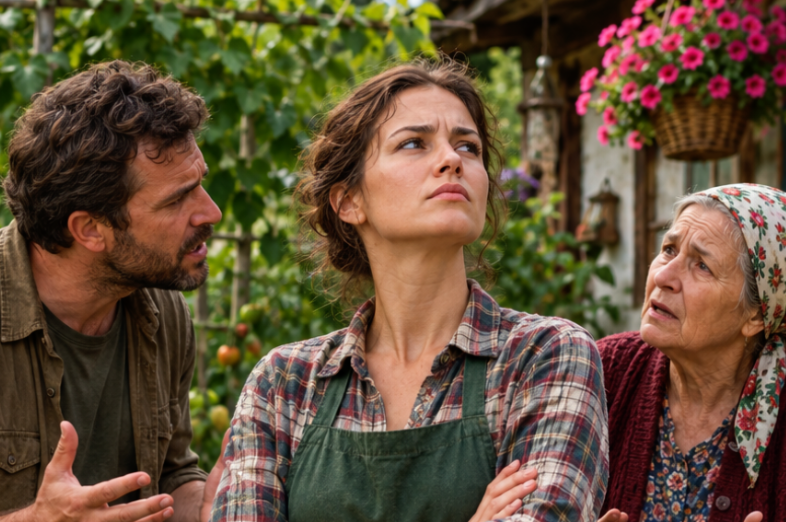
Svetlana counted the last bill and folded the money in half.
“That’s one hundred and sixty thousand,” she said. “Exactly what Nikolai Andreevich quoted for materials and installation.”
Pavel took the bundle without even looking at her and slipped it into his jacket’s inner pocket.
“Will you call the crew tomorrow?” Svetlana asked.
“I will,” he replied. “It’s just that my mind is on other things right now, as you know.”
“Like what exactly?”
“Just different things. Work’s been tough.”
Svetlana looked at her husband a little longer than usual.
“Pavel, I’ve been saving this money from my job at the flower shop for three years. Every month, five or ten thousand at a time. Do you remember in January when I didn’t buy a new jacket because I was saving for the fence?”
“I remember,” he said. “I’ll take care of everything.”
“As soon as the workers arrive, call me right away. I want to be at the property that day.”
“Alright.”
Pavel went to the kitchen to put the kettle on, and Svetlana heard a spoon clink against the mug. The sound was as ordinary and homely as ever, but something about his recent tone left her uneasy. It was as if he had answered a completely different question.
Svetlana worked as a florist at a small shop on the corner of Lesnaya and Zarechnaya. In the mornings, she made bouquets, in the evenings she tallied the day’s sales, and every Saturday she went to her dacha, inherited from her grandmother. The land was registered in Svetlana’s name. The documents were kept in the top drawer of the dresser. Sometimes she’d take out the folder just for peace of mind, to double-check that everything was in order.
The plot was six hundred square meters—a long, narrow strip stretching along a ravine. There were neighbors’ properties on both sides, and at the roadside, where an old wooden fence once stood crooked, there were wide gaps. Through these gaps, other people’s chickens would wander into the garden beds. One spring, the neighbor’s dog dug up her tulip bed.
Svetlana wanted to put up a solid fence. Not just a lightweight mesh or a decorative border, but a sturdy wall made from corrugated metal, complete with a gate and a locking wicket.
A week went by. Svetlana asked about the workers again.
“I called,” Pavel answered. “They have lots of orders right now. They said they’ll call us themselves next week.”
Another week passed.
“So, what’s going on with the fence?” Svetlana asked on Saturday morning as they got ready to leave.
“Nikolai said he’s busy on another job. We’ll have to wait a bit.”
“How long is ‘a bit’?”
“Sveta, I can’t rush him. There’s a line, everyone is working.”
She said nothing and started packing the seedlings into her bag.
It was a peaceful day at the dacha. Pavel’s mother, Tamara Viktorovna, showed up closer to noon in her own car. She had brought jars for preserves and a big pot of borscht.
“Pavlik, help me bring this in,” she said from the doorway, not even greeting Svetlana.
The greenhouse was behind her.
Pavel went out to meet her, took the heavy pot, and Tamara Viktorovna headed to the veranda. There, she settled on a stool and looked over the plot through the window.
“What’s going on with your fence?” she asked, eyeing first her son, then her daughter-in-law.
“Nothing yet,” Svetlana replied. “We’re waiting on the workers.”
“Why do you need a solid wall here? Everyone knows each other, it’s a shared yard—everything’s out in the open.”
“It’s not shared, Tamara Viktorovna. This is my land.”
“How can you say it’s not shared?” her mother-in-law chuckled. “You’re family! Pavel has rights here too—he’s your husband.”
Svetlana set her mug down on the table.
“Pavel can live here with me, but I’m the one whose name is on the deed.”
“Oh, please, don’t start,” Pavel interjected. “Mom, no one’s taking anything away or disputing anything. Sveta just wants a fence.”
“A fence is a good thing,” Tamara Viktorovna agreed. “But if I were you, I’d take care of something more urgent first. The greenhouse needs to be replaced—the old one is in bad shape. Last summer, I almost fell through it.”
“The greenhouse doesn’t concern me right now,” Svetlana replied. “I have one goal: to put up a fence.”
“A goal’s a goal,” her mother-in-law drawled and turned to stare out the window.
The conversation ended, but Svetlana couldn’t forget the way Tamara Viktorovna had said the word “goal”—as if it were some silly whim unworthy of attention.
A month passed. There was still no new fence.
Svetlana decided to contact the craftsman herself. She found Nikolay Andreyevich’s number in an old conversation with Pavel and called him during her lunch break. She was sitting in the storage room at the shop, surrounded by empty buckets where cut roses used to stand.
“Hello, my name is Svetlana. I’m Pavel Kuznetsov’s wife. In the spring, we discussed a fence for our dacha in Beryozovka.”
“Yes, I remember you,” the man replied. “But we canceled that order back in March.”
“What do you mean, canceled?”
“Pavel Sergeyevich called and said your plans had changed. The money was needed for something else, so we freed up the day and took another job for a neighbor.”
Svetlana thanked him and ended the call. Working with water and flowers had left her fingertips dry and peeling in places. She found herself rubbing her palms together, staring at the storage room wall.
That evening, she didn’t confront anyone. Instead, she waited until Saturday, when she and Pavel went to the dacha alone—without Tamara Viktorovna.
“I spoke with Nikolay Andreyevich,” Svetlana said as she set trays of cucumber seedlings on the veranda windowsill.
Pavel said nothing. He was in the shed, arranging tools.
“He told me the order was canceled back in March—by you.”
“Sveta, I meant to explain everything, I just haven’t had the time.”
“Explain now.”
Pavel came out of the shed with pruning shears and set them on the workbench.
“Mom really wanted to deal with the greenhouse. She said the old one was falling apart, and we might lose the whole harvest. I decided the greenhouse was more urgent.”
“That was my money, Pavel. I saved it for the fence.”
“I know. I was planning to pay you back, I swear. It just happened this way…”
“What exactly happened?”
“I’ve already placed an order for the materials. The company’s called Severplast—they have thick polycarbonate and a reinforced steel frame. The workers will come on Monday to start installation.”
Svetlana stood by the window, seed packet in hand, looking at her husband as if he was describing a stranger’s life, not her own.
“How much did that greenhouse cost?”
“A hundred and forty thousand. That covers the frame, the panels, delivery, and assembly.”
“I had a hundred and sixty.”
— The remaining twenty will go toward new equipment. Mom said we need a cultivator.
Svetlana set the small bag on the windowsill, carefully aligning it with the edge.
— You took all my savings and spent them on a greenhouse with a cultivator. You didn’t even ask me.
— I didn’t think you would react like this.
— And how did you expect me to react?
— The greenhouse is for the dacha, for both of us. You’ll benefit from the harvest too.
— I needed a fence. Then the neighbor’s chickens wouldn’t wander through the beds, and the dog wouldn’t mess with the flowers. That’s what I asked for, that’s what I gave you the money for, that’s what I decided.
Pavel looked away and started wiping the pruners with a cloth. The tool was already clean.
— Mom thinks the plot belongs to both of us. We can’t keep dividing everything as yours and mine.
— According to the documents, I’m the owner. That’s not your mother’s opinion, it’s a legal fact.
— Sveta, stop bringing up paperwork. We’re a family.
— Being a family doesn’t mean my wishes can be set aside, she said and walked off the porch. Outside, it was cooler, and the air from the neighbor’s garden smelled of fresh grass.
On Monday, just as Pavel had promised, workers arrived at the plot with materials from Severplast. Svetlana was at the shop that day, arranging a bridal bouquet with white roses and eucalyptus, picturing in her mind how they were now installing the foundation for a greenhouse she never asked for on her land.
That evening, Svetlana called her friend Natalia.
— Can you believe it, he set up a greenhouse instead of a fence, she said, sitting in the kitchen with a cup of long-cold tea.
— With your money?
— With mine.
— So what did you do?
— Nothing yet. I’m just watching.
— Sveta, you’re acting way too calm.
— I’m not calm, Natasha. I just don’t want to yell. Shouting won’t bring the money back, and it won’t solve anything.
— So what will change then?
— I don’t know yet. I’m thinking.
Two days later, the installation was done. On Wednesday evening, Svetlana arrived in Beryozovka and saw the new building right in the spot where she’d wanted to put a gate and run a fence along the road. The white polycarbonate sheets glowed with a gentle, milky shine in the sun. The green frame looked sturdy, and the door closed with a soft click.
Tamara Viktorovna was at the plot too. She was walking around the greenhouse, gently stroking the wall with her hand.
— What do you think, Svetochka? she asked with obvious satisfaction. Now the cold won’t get to the tomatoes, and you can plant the cucumbers earlier.
— It looks neat, Svetlana replied evenly.
— See? And you kept holding on to the idea of a fence. The greenhouse is much more necessary.
— I didn’t ask you to decide what I need, Tamara Viktorovna.
Her mother-in-law snorted with annoyance and turned toward the beds.
— Pavel, come here, she called. I’ll show you where it’s best to put the seedlings.
Pavel followed her, leaving Svetlana by the new building. She ran her finger along the seam of the sheets, feeling the cool plastic under her skin.
There was still no fence. Every morning, chickens wandered onto the plot and scratched the soil by the steps. Once, they ate all the petunias that Svetlana had planted by the veranda.
Two weeks went by. Svetlana didn’t bring up money, didn’t create any drama, and didn’t call her friends every day to complain. On Saturdays, she still came out to the dacha, worked on the garden beds, watered the greenhouse plants with everyone, and had dinner with Pavel—and sometimes even Tamara Viktorovna—all at the same table.
On the surface, everything seemed the same as before.
But Svetlana had started keeping track of expenses. She opened her notebook that she usually used for the flower shop and set aside a clean page.
“Fencing, spent, zero. Greenhouse, spent, one hundred forty. Cultivator, spent, twenty. That totals one hundred sixty from my money.”
Underneath, she wrote:
“First option, demand a refund. Second option, wait and save again. Third option, sell the greenhouse.”
Svetlana circled the third point twice with her pen.
That Saturday, Pavel left to go fishing with a friend, and Tamara Viktorovna didn’t come. So Svetlana was alone and carefully examined the structure from all sides. Then she took out her phone and began looking up ads from people buying used greenhouse frames, metal profiles, and polycarbonate panels.
She found a gardeners’ forum where people were discussing prices. A frame made of profile pipe—even if used only a month—could be sold for about half its original price, as long as it was disassembled carefully. Ten-millimeter thick panels were also in demand, as long as there were no scratches and the manufacturer was considered reliable.
Svetlana wrote in her notebook:
“Find out dismantling cost. Sell the frame separately, panels separately.”
She contacted three companies that handled dismantling greenhouses and utility buildings. Two told her that no workers would be available for at least a month. The third company, “Tepliy Uchasok” (“The Warm Plot”), offered to come in two weeks, inspect the greenhouse, and—if it was in good condition—buy the removed materials on the spot.
“How much do you charge for dismantling?” Svetlana asked.
“Depends on the size, but usually eight to fifteen thousand,” the man replied. “If the metal and panels stay with us, we can charge less for labor and deduct that from the purchase sum.”
“So you keep the materials, and I pay less for the dismantling?”
“That’s right. We’ll come, take a look, and give you an exact amount.”
Svetlana marked the visit date in her phone’s calendar and simply named the note “Beryozovka, meeting.” She didn’t want Pavel to see what it was about if he happened to pick up her phone.
The next two weeks went as usual. Svetlana went to the dacha, cared for the tomatoes, and picked the first cucumbers. Thanks to the new shelter, they really did ripen earlier. She had to admit: the greenhouse itself was solid, well-built, with no shoddy shortcuts.
But the issue wasn’t the greenhouse. The real issue was that the decision was made by someone who shouldn’t have made it alone.
“You’ve been awfully quiet lately,” Pavel said one evening. They were washing dishes together after dinner at the dacha.
“I’m the same as always,” Svetlana replied.
“No, you’ve changed. You never say anything anymore.”
“I’m just tired. The shop’s really busy now—weddings one after another.”
“Alright,” he said, dried his hands with a towel, and went to the other room to watch TV.
Svetlana rinsed the last plate and glanced out the window. The final rays of sunshine were hitting the greenhouse. The frame cast long checkered shadows over the garden beds.
Tamara Viktorovna started visiting more often, almost every weekend. She would bring seedlings, discuss future planting plans with Pavel, and explain which tomato varieties would do best under film or plastic. Svetlana was rarely included in these conversations.
“Sveta, which cucumbers do you like—self-pollinating ones or the usual kind that need bees?” her mother-in-law asked one day at the table. From her tone, it was obvious she wasn’t expecting a detailed answer; she just wanted to show off her knowledge.
“Doesn’t matter to me. I work with flowers, not veggies.”
“See?” Tamara Viktorovna said to her son. “There was so much talk about fencing. You can’t eat a fence, but cucumbers are always ready for the table.”
Svetlana stayed quiet and took her plate away.
That night, Pavel was already asleep. Svetlana stepped onto the porch with her laptop and compared prices for steel pipes and polycarbonate at different shops. She needed to figure out how much she could realistically get for used materials.
The calculations looked pretty good. The frame alone could bring in about sixty thousand, and the sheets roughly fifty if they were dismantled carefully.
That made around one hundred and ten thousand total, after paying the workers.
It wasn’t one hundred and sixty, but it was still most of the amount. And most importantly, after taking it apart, the plot would finally be free and ready for a fence.
Svetlana closed her laptop and sat on the porch for a bit longer. In the garden, the old apple tree creaked softly.
A week later, two men from the company “Warm Plot” arrived in a cargo van. They inspected the greenhouse, measured the pipes with a tape, and tapped on the panels.
“The material is fresh and good,” said the older one, who introduced himself as Roman. “Forty by forty profile, good condition. The polycarbonate is nice, too—Severplast, that’s a well-known brand, ten millimeters thick.”
“How much can you offer?” Svetlana asked.
“Sixty-five for the frame, fifty-five for the panels. That’s one hundred and twenty total. Dismantling costs ten thousand, but since we’re taking the materials, we’ll only charge five for the work.”
“So, you’ll transfer one hundred and fifteen to me?”
“Yes. Cash or transfer, whichever you prefer.”
“Transfer, please.”
“When can we start?”
Svetlana paused for a moment to think.
“Would next Thursday work?”
“That works.”
She wrote down Roman’s number and said goodbye to the workers. Alone again, she circled the greenhouse one last time, touching every panel as if saying farewell to something she’d never truly felt close to.
On Thursday, Svetlana took a day off and told her boss she needed to take care of things at the dacha. Pavel was working in the city and wouldn’t be back until the evening. Svetlana purposely chose a weekday to make sure none of his relatives were around.
The workers arrived right at 9:00 AM, just as scheduled. Roman and his partner Yuri started from the roof, removing the polycarbonate panels one by one, carefully unscrewing the fasteners with a power drill.
The work moved along steadily. The tool buzzed for a moment, then fell silent, then buzzed again. The removed panels were stacked by the neighbor’s boundary, with cardboard placed between them to protect the surfaces from damage.
By lunchtime, all the siding had been removed. The remaining frame stood empty, with green pipes reaching upward, resembling the skeleton of a giant cage.
“Now let’s get to the base,” Roman said, wiping his forehead. “It’ll take about two more hours.”
Svetlana sat on the veranda watching. Sometimes she came closer to see how the workers disconnected the next part. She didn’t feel any joy—more a sense of relief. The task that had weighed on her for weeks was finally moving forward and coming to an end.
By four o’clock, the frame was fully dismantled. The pipes were neatly packed into the truck bed along with the polycarbonate sheets. All that was left on the spot was compacted earth and several holes from the concrete posts.
“Should we remove the concrete too?” Yuri asked.
“Yes, please. I want the ground to be level.”
The workers dug out the remaining bases, filled the holes with soil from the compost pile, and leveled the surface with rakes.
Roman took out his phone and started calculating something on the calculator.
“So that comes to one hundred and fifteen thousand to transfer, including the cost for dismantling. Can you give me the card details?”
Svetlana gave him her card number. A few minutes later, she received a message on her phone confirming the deposit.
“Thank you, you did everything very neatly,” she said.
“Feel free to contact us again,” Roman replied and got behind the wheel.
The van drove away, leaving a fine trail of dust on the road. Svetlana remained, looking at the empty spot where, just that morning, the sturdy ‘Severplast’ greenhouse had stood.
She took out her phone and wrote to Pavel:
“The greenhouse is gone. I sold it along with the metal parts and construction sheets. The money is back on my card. We’ll talk this evening.”
No reply came. Svetlana managed to walk around the property and started thinking about where it would be best to place the new fence posts and where to put a gate.
Around seven in the evening, Pavel arrived at the dacha. He parked at the gate and quickly walked over to where the greenhouse used to stand.
He stopped on the empty plot and looked around, as if he still couldn’t believe the structure had really disappeared.
“Did you really do it?” he asked, not looking at Svetlana as she came up to him.
“I did.”
“Sveta, that was money invested in the property and the house.”
“It was my money. You spent it without my permission on something I never asked for.”
“Mom is going to lose her mind,” he said, running his hand through his hair. “She spent so much time helping pick out materials, consulting with the neighbors.”
“Your mother never asked if I wanted a greenhouse instead of a fence.”
“You could’ve at least given a warning!”
“I did warn you. A month ago, I said I needed a fence, not a greenhouse. You didn’t listen.”
Pavel sat down on the veranda steps and hid his face in his hands.
“So what now?”
— Now I’ve got money again. One hundred and fifteen thousand is back on my card, plus what I managed to save this past month. I’ll order the fence, just like I originally planned.
— What if Mom finds out?
— She will. There’s no way to hide it, the lot is open and the neighbors can see everything.
Pavel lifted his head.
— Do you realize what she’s going to say?
— I do. But that’s not going to change my decision.
He didn’t say another word. He just sat on the steps, staring at the empty patch of earth where the greenhouse pipes had been.
That night, Svetlana heard Pavel speaking with his mother in the other room. He spoke quietly, but she caught a few words: “mom,” “I didn’t know,” “she made the decision herself.”
In the morning, Pavel packed his bag.
— I’ll stay at Mom’s for a while, he said. We both need time to think.
— Alright.
— You’re not even going to ask me to stay?
— Why should I? You’ve already made up your mind, packing so quickly.
Pavel froze for a second with the bag in his hand, then left, closing the door noticeably louder than usual.
Svetlana was left alone in the apartment. She brewed some tea, sat down at the kitchen table, and took out her notebook with her calculations. She crossed out the line “greenhouse, minus one sixty” and wrote next to it: “refund, one fifteen.”
There was still a forty-five thousand gap between the starting sum and what she’d gotten back. She hadn’t managed to recover everything, but she was much closer to her goal than before.
The following Saturday, Svetlana called Nikolai Andreyevich’s crew—the same team Pavel had first talked fencing with.
— Hello, this is Svetlana Kuznetsova. Remember we talked in the spring about a fence in Beryozovka?
— Yes, of course. You’re Pavel Sergeyevich’s wife.
— I’d like to resume the order. Materials, work, everything as previously planned.
— Back then it was one sixty. Now the prices have gone up, it’ll be one seventy-five.
— That’s fine. When can you come to take measurements?
— Next Tuesday.
Svetlana added the date to her phone, set it on the table, and gazed out the kitchen window. All she could see was the wall of the neighboring house and a narrow strip of gray sky.
It had been a month since Pavel left for his mother’s house. During that time, he’d come by a few times to pick up more things, papers, and some winter clothes. Their conversations were brief, calm, and without any harsh words.
— How’s the dacha? Pavel asked one day while picking up a box of books.
— The fence is up, Svetlana answered. Green profiled sheets, the gate and the entrance lock properly.
— Does it look good?
— I like it.
— Mom says you rushed into it. That you could have come to an agreement calmly.
— We tried for two months, Pavel. Talking led nowhere.
He nodded, didn’t argue, and took the box out to the car.
Svetlana kept going to the dacha on Saturdays, now on her own. Along the new fence, she planted jasmine and three apple trees. She bought the saplings at the local market with what little was left after selling the greenhouse.
Chickens no longer snuck onto the property. The flower beds stayed intact.
One day while Svetlana was weeding the garden beds right up against the fence, her mother-in-law, Lyudmila Sergeyevna, arrived. She brought a jar of homemade jam and decided to lend a hand.
For a while, they worked in silence. Then they sat down on the bench near the veranda.
“How are you, daughter?” Lyudmila Sergeyevna asked, carefully stretching her lower back.
“I’m fine, Mom.”
“Did Pavel call this week?”
“He did. He asked about the papers for the tax office.”
“And what next? Are you two going to separate?”
Svetlana glanced at the neat rows of seedlings, then shifted her gaze to the new fence. It cast a tidy shadow across the garden beds.
“I haven’t decided yet,” she replied. “But living apart suits both of us. He stayed with Tamara Viktorovna, and I’m here, on the property.”
“So, you put up the fence after all.”
“I did.”
“Was it hard to decide to remove the greenhouse?”
“No,” Svetlana said, brushing the dirt off her knees. “There just wasn’t any other choice left.”
Lyudmila Sergeyevna nodded and took a sip of water from a bottle resting in the shade of the bench.
“Then, so be it,” she said.
Svetlana looked at the sun, already dipping toward the evening, at the neat rows of seedlings and the fresh green fence, enclosing her plot from all sides. Then she picked up the hoe again.