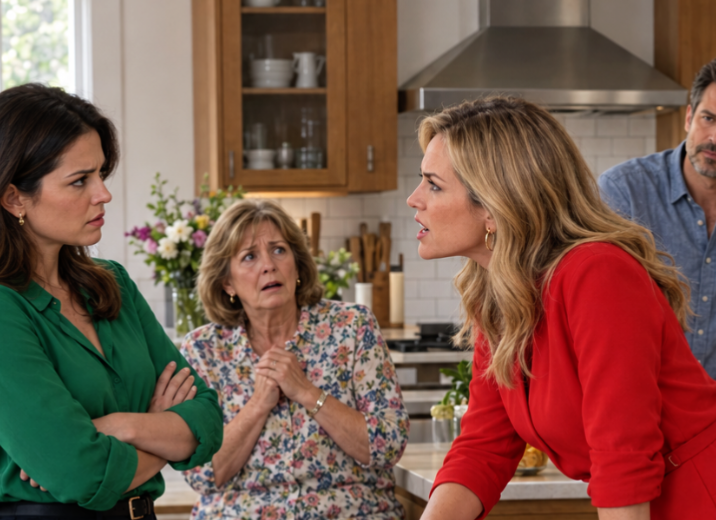
“Are you serious right now? Are you actually saying this to me?”
Vera didn’t even turn around. She stood at the stove, stirring sauce in a small pot and watching last year’s leaves blowing around in the yard outside the window. Her husband’s question hung in the air, heavy and sticky, like steam rising from boiling coffee.
“Vera!”
“I heard you, Zhenya. And yes, I meant what I said. You don’t have to repeat it every thirty seconds.”
Evgeny stood in the middle of the kitchen, legs apart like he was bracing himself for battle. His old t-shirt, faded around the collar, was stretched over his shoulders. He looked confused, even afraid, with a lost, almost childlike expression—a look that, just a year ago, would have made Vera soften, step closer, put her hand on his chest and say, “Alright, let’s talk about it.” But not now. Now that face only stirred a deep, settled exhaustion inside her.
“You’re selling the car,” Zhenya said slowly, drawing out each syllable as if explaining something obvious to a clueless child. “Our car. Without talking to me first. Just springing it on me. You think that’s okay?”
Finally, Vera turned around. She set the spoon down on the stand, wiped her hands on a kitchen towel, and looked her husband directly in the eyes.
“Zhenya, I’m not selling ‘our’ car. I’m selling the car I bought three years ago with my own money. I paid off the loan for it last month. It’s registered in my name. I’m letting you know because we live together, not because I’m asking for permission.”
“What difference does it make whose name it’s in!” he threw up his hands. “We’re a family! Everything’s supposed to be shared! Or have you forgotten that too?”
Vera gave a small, strained smile. It wasn’t cheerful—it was crooked, almost chewed up.
“Shared, you say? When you got that bonus at work last year and bought yourself a new laptop, did you consult me? Or when you borrowed money from your mother to fix the garage? Did we discuss those ‘as a family’? I don’t remember that.”
Zhenya paused. The muscles in his jaw tightened. He was clearly searching for a decent comeback, but all he could feel was hurt—a pure, almost childlike resentment that his wife had suddenly stopped being agreeable.
This conversation didn’t start today. Not even yesterday. It had been brewing for years, festering like a sore that sometimes quieted, sometimes flared up, but never truly healed. And this morning, over breakfast, Vera had simply mentioned that she’d found a buyer for her Volkswagen, and Zhenya had almost choked on his sandwich.
The event that set everything off was almost laughably ordinary. No cheating, no crime, nothing dramatic. Vera, an accountant at a construction company, decided it was finally time to renovate their apartment. Not just a simple touch-up, not just new wallpaper—she wanted a full overhaul. She had been saving up for it for two years. In fact, that’s why she was planning to sell their car—to free up money without touching their main savings. Vera had been working two jobs for the past five years, handling freelance accounting in the evenings and on weekends, taking on small businesses for outsourcing, and every penny in their house was earned by her sweat. Zhenya worked as a sales manager at a car dealership. It was a stable but modest income. His salary was just enough for the bills, groceries, and his own little wants: a new phone every year, winter tires for that same car Vera wanted to sell, and regular nights out with his friends at the bar. He didn’t have any savings. So when Vera mentioned the renovation, he was happy at first: “Finally, the bathroom tiles are falling off anyway.” But when he found out she planned to sell the car to fund it, he froze. Not because he really needed the car, but because the very fact that she was making decisions about their property without even asking him hit a nerve. And deeper than that, something else was brewing: his mother and sister saw Vera as someone who should always share. If she was selling the car for a renovation, that meant she must have plenty of money. And if she had plenty, where was it all going? Why wasn’t she helping her husband’s family out more?
continued in the comments
Zhenya hadn’t said anything about this yet. But Vera knew—he’d call his mother that evening, and tomorrow, everything would begin.
To really understand how Vera got to this point, you have to wind back ten years. She and Zhenya met when she was twenty-six and he was twenty-eight. Vera had just bought out her apartment—a two-room flat in a nine-story building on the outskirts, inherited from the state since she was an orphan. Her parents had died in a car accident when she was twelve. The apartment was public housing at first, then came privatization, then years of court battles, and by twenty-five, Vera finally owned those forty-six square meters. She renovated it herself: hanging wallpaper at night after work, prepping walls, hauling bags of plaster up five flights of stairs with no elevator. Nobody helped her. Her father’s sister, the only living relative somewhere in Novosibirsk, called once to congratulate her and then disappeared. So when Vera met Zhenya—a simple, friendly guy with dimples and always ready to help with a shelf—she thought: this is it, a real family. The kind where she wouldn’t be alone anymore.
Zhenya moved in with her after six months. A year later, they got married. He introduced her to his family. Alina Sergeevna, his future mother-in-law, lived in the next neighborhood, in a roomy three-bedroom apartment left by her late husband, with her daughter Svetlana. Svetlana was five years older than Zhenya, twice divorced, with two kids from different marriages, and absolutely sure that the world owed her something. When visiting, Vera tried to be modest and make a good impression—she even baked a cake the night before and brought it along. Alina Sergeevna tasted the cake, complimented it, but then, when Vera slipped into the bathroom, she overheard what Alina said to Zhenya through the thin door:
“She’s a real go-getter, that one. Owns her apartment, has a car, works non-stop. Careful she doesn’t run you ragged. Women like her—rising from nothing to something—end up with their noses in the air.”
Vera pretended not to hear any of it. She kept quiet. And she stayed silent for ten whole years. She said nothing when her mother-in-law gifted her books about family happiness and womanly wisdom at every holiday. She stayed quiet when Svetlana would turn up unannounced and start going through her closets, gasping, “Oh, Vera, where’d you get this blouse? Must’ve bought it at that boutique, the one that never has discounts?” Vera kept silent when Alina Sergeevna would host family dinners, seating Vera at the very end of the table and putting Zhenya at the head next to herself. Vera endured it, thinking every family has its quirks—they’ll get used to her, appreciate her one day. She even kept helping them, not out of obligation, but because she truly believed that if someone’s family to her husband, they were family to her, too.
Vera paid for Sveta’s massage courses when Sveta decided to try a new profession—fifty thousand, handed over without blinking. Sveta quit after a month, saying it was boring and not for her. She never returned the money or even mentioned it. When Alina Sergeevna’s washing machine broke, Vera bought a new one—not expensive, but nice, for over twenty thousand. Her mother-in-law accepted it with an attitude like a favor had been done for her: “Well, you could’ve gotten a more expensive one, but thanks anyway.” Every New Year, Vera brought bags of groceries—caviar, red fish, quality sausage, candy. Alina Sergeevna would lay it all out and comment: “Did you get this caviar from the supermarket? It’s always fake there. Next time, buy it at the market from trusted people.” In ten whole years, not once—not a single time—did Vera hear a simple “thank you.” Instead, she always got a new serving of advice and thinly veiled disregard.
About three years ago, Vera started her own business, managing accounting for several small firms. It was a massive effort—working at the office by day, private clients in the evenings, reports at night. She lost weight, looked tired, her eye twitched from constant lack of sleep. But it paid off. Decent money started coming in. Vera bought herself a car to visit clients. Furnished her apartment with real, custom-made oak furniture, not IKEA. And from that moment, her relatives’ attitude shifted for good. If before it was just condescension, now it became thick, sticky, dark envy.
One day, Svetlana dropped by with her kids and spotted the new kitchen—light wood, stone countertop, matching extractor fan—and let out a low whistle.
“Wow. Vera, did you rob a bank or something? Or does Zhenya make that much money for you?”
“Zhenya has nothing to do with it,” Vera replied calmly. “I work for myself, Sveta.”
“Sure, sure…” Svetlana walked around the kitchen, running her finger along the countertop. “That’s what happens when you don’t have kids—you get to spoil yourself.”
Vera stayed silent then. She clenched her teeth, smiled, and offered some tea. But that night, she lay awake, staring at the ceiling, replaying the words—”you don’t have your own children.” That line hurt more than anything else ever could. Because it was true—Vera couldn’t get pregnant. The doctors just shrugged—no medical issues, but it simply wasn’t happening. Five years of trying, saving up for hormone therapy, tears into her pillow while Zhenya slept by her side. And Zhenya… He never supported her. Not once. “Well, if there aren’t any, there aren’t any,” he’d say, flipping through TV channels. “Guess it’s just not meant to be. Chill out, you need to let it go.” He didn’t care. But she did. And Sveta knew that. She knew it and hit where it hurt most, without hiding it.
Two days after that conversation about selling the car, her husband’s family came to visit. Vera hadn’t expected them, but she wasn’t surprised either. She had already noticed a pattern: whenever she was about to make an important decision, Alina Sergeevna and Svetlana would show up at her door, as if they sensed it. Most likely, Zhenya had called to complain. And they always came—not to support, but to ‘sort things out,’ meaning they’d calmly, gently, and oh-so-family-like pressure her.
The three of them sat in the living room. Alina Sergeevna took the armchair like a throne. Svetlana curled up on the couch. Zhenya loitered by the window, pretending none of this involved him. Vera came in, poured everyone tea, and set out a dish of candies. The conversation started off neutral: weather, health, Sveta’s kids—”terrible math grades, the teachers are idiots, we need a tutor”—the usual. Then, as she stirred her tea, Alina Sergeevna smoothly shifted the topic:
“Verochka, Zhenya told us you’re selling the car. My, you are so practical. Are you asking a good price?”
“Market price,” Vera replied, feeling tension coil inside her. “It should go for about eight hundred thousand.”
“Eight hundred!” Svetlana exclaimed, raising her hands. “Wow! Listen, would you consider… maybe putting some of that money into the family? You see, we’re in a bit of a bind right now. Kiryusha has a knee problem and needs surgery. It’s a sports injury—they don’t cover it through the public healthcare, only privately. Two hundred thousand. I’ve tried everything… Zhenya said you guys have some money to spare. Would you consider helping us out?”
Vera slowly turned to her husband. He was staring down at the floor, apparently finding the carpet pattern deeply fascinating.
“Zhenya,” she said quietly. “Did you tell Sveta that we have spare funds? What exactly did you say?”
“Well…” he hesitated, scratching the back of his head. “I just mentioned you’re selling the car for eight hundred. And that you could probably do the renovations cheaper. Then whatever was left… why not? It’s family, after all.”
Vera laughed, but it came out dry, like sandpaper scraping.
“Zhenya, the renovations we’ve planned will cost six hundred thousand. I crunched the numbers. We have to replace the pipes, redo the wiring, remodel the bathroom from top to bottom. That leaves two hundred thousand. I want to save it as a safety net, because we don’t have one. Because you never save. What ‘spare funds’ are you talking about? Do you even get what you’re doing right now? You promised my money to your sister behind my back.”
“Why are you calling it ‘your’ money already!” Svetlana protested. “You’re married—that’s shared money! Zhenya has a say too!”
Vera turned fully to her husband, ignoring Svetlana completely. “Zhenya, do you honestly believe that your nephew’s surgery is more important than fixing our own house? Our bathroom pipe leaks so badly we’re flooding the neighbors downstairs?”
Zhenya looked up, pain flickering in his eyes—not from guilt, but from being put on the spot and forced to choose.
“Lera, it’s a child. You get that, right? Kiryusha is suffering. The renovation can wait. The pipes haven’t burst yet. You’ve always been so kind, always helped out. What’s happened to you?”
And in that instant, something inside Vera snapped.
“What’s happened to me?” she echoed, rising to her feet as her chair scraped across the floor. “You want to know what’s happened? Ten years have happened, Zhenya. Ten years of your mother telling me how to live. Ten years of your sister coming into my home and scrutinizing my things. Ten years of me paying for classes, for washing machines, for birthdays, and what do I get in return? ‘You could’ve spent more.’ Ten years you’ve all been riding my back, in my apartment, as if that’s just how it’s supposed to be!”
Svetlana jumped up from the couch.
“Oh, so that’s what you think? We’re freeloaders and you’re the queen, huh?! You’re just some orphan who lucked into a free apartment and now you think you’re better than us! You think we don’t know how you treat Zhenya? You don’t think he tells us? You’re always unhappy, always complaining, always acting like we owe you!”
“Shut up, Sveta!” Vera stepped forward, her eyes burning with a dry, unshed fury. “Don’t even start about my apartment. Your mother got her three-bedroom from her husband and has been supporting you and your two kids ever since. In ten years you haven’t held a steady job once. You live off alimony and your mom’s pension! What right do you have to judge me? What right?!”
Alina Sergeyevna struggled to her feet from the armchair. Her voice trembled—not from weakness, but pure outrage.
“I knew it. I knew it from day one. You’re not right for us. Just a commoner. No matter how much you feed a wolf—it’ll turn on you. I told Zhenya not to marry you, you’re devious, you’ll eat him alive. And look, I was right. She’s got the money, imagine that! And who are you, to have money? You crawled out of an alley and we’re a decent family! My late husband—Zhenya’s father—was an engineer, we’re respectable people, and you… You’re a nobody, and the only thing you ever got was a handout from your aunt. Otherwise, you’d be scrubbing floors for life!”
This wasn’t just an insult—it was a slap to the soul. Vera froze. Everything she’d bottled up for ten years—loneliness, the pain of being childless, the feeling that she didn’t belong, that her efforts meant nothing, that she was just being used—all of it exploded inside her, an overwhelming flash of blinding white. But she didn’t scream. Instead, her voice dropped to a whisper, low and terrifying.
“You will now leave my house. All of you. You, Alina Sergeyevna; you, Svetlana; and you, Zhenya. You too. Because now I want to see what your ‘respectable family’ has really taught you.”
“Are you serious?!” Alina Sergeyevna gasped.
“Leave. Right now. Or I’ll call the police. This is my apartment, I’m the only one officially registered here. You’re nobody here. Even you, Zhenya. You just lived here—as a guest. Only a guest is supposed to pay rent, and you never even did that.”
Zhenya turned pale. He stared at his wife and didn’t recognize her. She had always been gentle, always willing to wait, to give in, to keep quiet. Now she stood in front of him—straight as a taut string, and in her eyes was something he’d never seen before: complete, absolute indifference.
“Lera, you’re overreacting… This is my mom, my sister…” he stammered.
“Out,” Vera repeated, heading to the hallway to open the front door.
Alina Sergeevna swept by with regal dignity, not even glancing back. Svetlana, grabbing her bag, hissed in Vera’s face, “You’ll regret this. He’ll leave you, and you’ll be all alone with your precious apartment. You’ll die here, and no one will even bring you a glass of water.” Zhenya hesitated in the hallway, hoping his wife would reconsider, but Vera silently pointed to the door. So he left. Out in the corridor, his mother immediately wailed, dramatically and loudly: “Oh, my heart… call an ambulance… she’s driven me to it, the witch!” Vera locked the door behind them.
Silence echoed through the apartment. Vera leaned her forehead against the cold wood of the door and, for the first time in many years, cried—silently, with fat tears streaming down her cheeks, leaving wet tracks. She wasn’t weeping over this fight. She was mourning ten lost years.
The next few days passed in a heavy, muffled quiet. Zhenya didn’t call. Vera suspected his mother had forbidden it—let her chase after you, let her realize what she’s losing. But Vera had no intention of chasing anyone. On the third day, she called her contractor and confirmed the renovation would start Monday as planned. On the fourth, she sold her car. The buyer was good and paid on the spot. On the fifth day, Zhenya finally called. His voice was tired, kind of drained.
“Lera, what are you doing? Mom says you need to apologize to her and Sveta. They’re really offended. Sveta even said she’ll never set foot in your house again until you say sorry.”
“And what exactly am I supposed to apologize for?” Vera asked, holding her phone with her shoulder while stirring plaster in a bucket.
“Well… you kicked them out. Said some harsh things. Mom’s bedridden now with high blood pressure, Sveta’s in tears. Why would you do that? We’re a family. Just apologize and everything will go back to normal. I’ll come back. We’ll live like before.”
Vera stopped stirring. She looked out the window. Down in the courtyard, two old ladies sat on a bench beside a young mom with a stroller. Ordinary life, an ordinary day. But her own life was no longer ordinary. Something had shifted, something had broken.
“Zhenya, I’m not going to apologize. Your mother called me a zero, nothing. Sveta wished I’d die alone. You just stood there and said nothing. You always stay silent, Zhenya. You never defend me. You choose them because it’s easier—let them hurt me, just so long as they don’t touch you.”
Lera, don’t make such a big deal out of it! Mom just lost her temper, she’s getting older. It’s her age. And Svetka—well, you know she’s an idiot. What else did you expect? Just apologize, show some generosity. You’re the strong one here, you can handle anything.
“I’m tired of being strong,” Vera said quietly. “You know, I was thinking… If all I am to you is a strong woman who carries everything and forgives everything—why do you need a wife? You could just hire an accountant and a housekeeper. It would be cheaper and simpler. I’ll text you the lawyer’s address. We need to file for divorce.”
“Vera, what are you saying?!” he shouted into the phone. “You want to break up our family over a silly argument?!”
“Family?” Vera repeated. “What family? The one where I owe everyone everything, but no one owes me a thing? The one where my husband hands me off to his sister like a discount coupon? No, Zhenya. I don’t want that kind of family. I’d rather be alone.”
She hung up the phone. Her hands weren’t shaking. Her heart beat steady.
The divorce went smoothly. There was nothing to split: the apartment was hers from before the marriage, the car had been sold, no joint bank accounts. Zhenya tried to argue, mentioning ‘joint assets,’ but Vera’s lawyer quickly shut him down: the only things they‘d acquired together were some home appliances, which Vera generously left for him. “Take the TV and the washing machine I gave your mother,” she said at their last court meeting. He took them—and moved back in with his mom.
Vera kept working on her renovations. It became her therapy. As she stripped old wallpaper, it felt like she was peeling away her old life. Patching up the walls, she was mending holes in her own soul. After the workers left, she would sit on the windowsill in the freshly painted, empty room, watching the sun set behind the tall apartment blocks. She felt sad, but it was a clean kind of sadness. There was no humiliation in it.
About six months went by. One evening, as Vera was finishing the final floor cleaning—the renovation finally complete, the apartment gleaming, smelling of fresh wood and a new life—someone rang the doorbell. She wiped her hands, peeked through the peephole, and saw Svetlana’s tear-stained, gaunt face. Vera didn’t really want to open, but Svetka had already noticed the light in the peephole and started rambling right at the door:
“Vera, please open the door! I’m alone… I really need to talk. I won’t stay long.”
Vera sighed and opened the door. Svetlana entered, taking off her shoes in the hallway, and stopped to look around at the transformed corridor.
“Wow… It’s so beautiful…” Svetlana breathed out. “Vera, listen… I came here… Please don’t kick me out right away, okay? I came to say that you were right.”
Vera leaned against the wall, crossing her arms over her chest. She stayed silent.
“I’ve had so many thoughts over these past months,” Svetlana spoke quickly, words tumbling out. “When you kicked Zhenya out, Mom was actually happy. She thought he’d be with us again, like everything was before. But he just sat on the couch and hasn’t worked for six months. Mom nags him constantly, her pension isn’t enough, and he doesn’t even try to find a job. Mom tells me, ‘It’s your fault, you should’ve been gentler with Vera.’ And I told her, ‘You were the one who called her a zero!’ That was the first time we really fought, can you imagine? For real. Then Kiryukha asked, ‘Where’s Aunt Vera, isn’t she coming to see me?’ And that’s when it hit me… My God, I realized we lost you because of our own stupidity. You were the only truly decent person in our family. You carried us, and we… we hated you for being better than us. It was jealousy. Plain, ugly jealousy. Now, when I look at this fool, my brother, he’s nothing without you. Mom’s going to eat him alive, he’ll end up drinking himself into oblivion or losing his mind. You were strong enough to get through it, but he wasn’t. He’s weak. You left, and everything fell apart.”
continued in the comments
Vera stayed silent. She listened as these overdue confessions echoed through the quiet of her new apartment. She didn’t feel sorry for Svetlana. She didn’t feel triumphant for being right. She just listened, like someone who has swum across a wild river and made it to shore, looking back at those still struggling on the other side. They’re floundering, shouting. But you’re already on dry land. And the bridge is burned.
“I’m not going back to him, Sveta,” she said at last. “And I’m not going to help you anymore. I have a different life now.”
“I know,” Svetlana wiped her nose with her sleeve. “I’m not asking you to. I just wanted you to know: you’re not to blame. For anything. And what I said about the kids… Forgive me, Vera. It was the meanest thing I’ve ever said in my life.”
Vera nodded. She walked Svetlana to the door and locked it behind her. Going back to her room, she curled up on her new cream-colored sofa with its textured upholstery. The streetlights outside flickered on, filling the room with a soft orange glow. On the coffee table lay her open planner—tomorrow a new project was beginning, three major companies, and a business trip to St. Petersburg in a week. Life was rushing on, calling her forward.
She realized the divorce was never really about selling that car. Or fighting with his family. The real cause was the emptiness she had tried to fill for years with other people’s noise. With money, with patience, with forgiveness. But the emptiness only grew. The divorce didn’t destroy her family—it just exposed what had never been there. And now, in her own apartment, in her new, clean, bright life, Vera didn’t feel loneliness. She felt freedom. Having her own roof wasn’t about the walls; it was finally being home. Home in herself. And no one could ever kick her out or deceive her again.
The end.