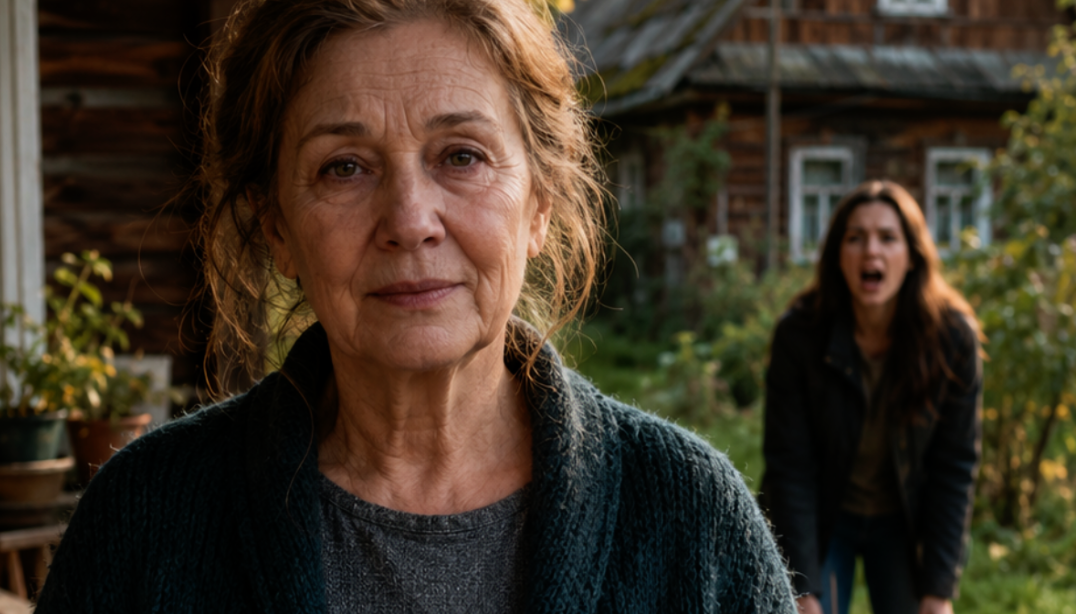
Mom, why are you just standing there? Sign here and here—and clear out of the dacha by Sunday. It’s mine now.”
Nastya shoved the papers under my nose with the kind of face people make when you’ve counted their change wrong at the store. Not a daughter—a tax inspector. I slowly wiped my hands on my apron—it smelled of dill and currant leaves; I had just been canning cucumbers—and looked at her for a long moment.
And I thought to myself, “Well, finally. I’ve been waiting.”
Because I had papers in the pocket of my housecoat too. My own. And they were far more interesting than hers.
It all began six months earlier…
In February, I got a call from the notary, Valentina Sergeyevna. We’d known each other for about twenty years; I had even looked after her late husband at the clinic. I spent forty years working as a nurse.
“Galina, are you sitting down? Your Sasha left a will. I’ve only just gotten around to sorting through his safe deposit box.”
Sasha was my brother. My older brother. He had died three years earlier, a lifelong bachelor, no children. I thought all he had left behind was a two-room apartment in Voronezh, which had been divided legally among the heirs back then: one third to me, the rest to our cousins.
“Valya, what will? We already settled everything.”
“Are you sitting down or not? His dacha in Romashkovo. Twenty hundred square meters. With a house. He left it to you alone in a separate will back in 2020. I’m shocked myself—it was in a different folder. My former secretary mixed it up.”
I sat down on the little stool right there in the hallway. My ears started ringing. A dacha in Romashkovo—right near the new highway they built last year. Land there costs a million per hundred square meters. Twenty of those—do the math yourself.
“But… why didn’t he tell me?”
“Read the note. He left one.”
I went to Valya that same day. Inside the envelope from Sasha was a torn sheet of graph paper with his crooked handwriting:
“Gal, this is for you. Only for you. Not Nastya. She didn’t come to visit me in the hospital once in two years, even though I asked. And you fed me with a spoon. Don’t share the money with her—she’ll burn through it and not even notice. Let it be your nest egg for old age. Sanya.”
I sat there and cried. Not because of the money. Because my brother had noticed. My brother, lying there with tubes in him, had noticed that I was a human being, not service staff.
I raised Nastya alone from the time she was six. My husband left me for a cashier from Pyaterochka—may he live happily with her. I carried two people on my shoulders: my daughter and my bedridden mother. Then I buried my mother, Nastya grew up, and she married Igor—a decent guy overall, but completely under her thumb.
And you know how it goes? As soon as a mother is no longer needed every day, she becomes needed “on demand.” Watch the grandchildren. Fry up a batch of cutlets. Lend money “until payday” — they paid it back twice in ten years.
Nastya considered my dacha—the one my late husband and I had built together—to be hers. Well, whose else would it be? “Mom, we’ll come for the May holidays, heat up the bathhouse.” “Mom, we’re leaving Kostik with you for the whole summer.” “Mom, paint the fence for Igor; he doesn’t have time.”
I didn’t argue. I’m a quiet woman. Forty years as a nurse teaches you not to fight. You smile and give injections.
I didn’t tell Nastya about Sasha’s inheritance. Not a word. I don’t even know why—something tugged at my heart. I handled everything through Valya, quietly, without fuss. I hid the documents in the sideboard, behind the dinner set Nastya can’t stand.
And a month later, strange phone calls began.
“Mom, did you know Uncle Sasha had another dacha?”
I froze with the phone pressed to my ear. I was standing in the kitchen, peeling potatoes.
“What makes you say that, Nastyusha?”
“Igor got talking to some guy at work. He lives in Romashkovo. He says Uncle Sasha’s plot still hasn’t been registered. Mom, that’s inheritance! That’s… that’s ours! We need to hurry up and register it before someone grabs it!”
The key word was “ours.” Not “yours, Mom.” Ours.
“Nastya, I’ll sort it out.”
“Mom, you don’t understand paperwork at all! I’ll handle everything myself. You just need to sign a power of attorney for me—to conduct the inheritance case. My friend is a lawyer; she says it’s easier that way.”
That was when something clicked in my head. Quietly. Like the lock on a safe.
I’m her mother. I know her. A “power of attorney to conduct the case” on my behalf meant she would register everything and transfer it to herself. I’m no lawyer, but I listened to hospital gossip for forty years. People pulled schemes there that would make your head spin.
“All right, sweetheart. Come on Saturday. I’ll sign it.”
I hung up. Sat down. Looked at the potatoes. And for the first time in many years, I laughed—at myself, out loud, in an empty kitchen.
On Saturday, Nastya didn’t come alone. She came with Igor and her “lawyer friend,” a girl of about twenty-five, sharp as a needle, wearing a suit that didn’t fit her properly.
“Mom, this is Lera. She’ll help with the documents.”
Lera spread the papers across my table like a fan of playing cards.
“Galina Petrovna, so, here is the general power of attorney, here is the consent to registration, and here is the waiver of preferential right…”
“What exactly am I waiving?” I asked slowly, studying my work-worn hands.
“Well… it’s just a technical paper,” Nastya said, smiling at me with the same smile I had taught her as a child—the charming one, for teachers.
“Nastya,” I said, raising my eyes. “Tell me honestly. Do you want Sasha’s dacha to go to me or to you?”
A pause fell over the room. Igor coughed and buried himself in his phone. Lera pretended to look for a pen.
“Mom, what difference does it make to you? It’s all going to be mine after you anyway. Why should you, at your age, deal with taxes?”
“At your age.” I’ll remind you, I’m fifty-five. They still keep me at work part-time because the young nurses don’t know how to give old people injections without leaving bruises.
“Let’s do this,” I said quietly. “I’ll think about it. Until next weekend.”
Nastya pressed her lips together but didn’t show it too much.
“Fine. Just don’t think too long. Registration takes six months.”
When they left, I took my documents out of the sideboard. I ran my fingers over the official seal. Then I called Valya.
“Valya, dear. Let’s prepare one more document.”
What happened next still sends a chill through me when I remember it.
Three days later, Nastya called, her voice already metallic.
“Mom, I found out everything. Uncle Sasha made a will in your name. You knew?!”
“I knew,” I answered calmly, stirring jam.
“And you kept quiet?! Mom, are you out of your mind?! That’s millions! Were you planning to grab everything for yourself?!”
“Nastya. My brother left it to me. Personally. With a letter.”
“What letter?! Show me!”
“No.”
One word. A short one. “No.” I don’t think I had ever said it to my daughter in my entire life.
“You… you’ve lost your mind. We’re coming on Saturday. And you’re going to sign everything over to me. Like a mother. Like a normal mother, not a selfish woman!”
Then the line went dead.
My hands were shaking, I won’t pretend otherwise. I sat down and stared out the window for a long time. I thought: maybe I’m wrong? Maybe she’s my own flesh and blood, maybe she…
And then I remembered Sasha in the hospital. How he held my hand and said, “Gal, you’re a good person. Everyone uses you, but you’re good.”
And I stopped shaking.
On Saturday, the three of them showed up—Nastya, Igor, and that Lera. Nastya entered without so much as a hello and immediately slapped her papers onto the table.
“Mom, why are you just standing there? Sign here and here—and clear out of the dacha by Sunday. It’s mine now.”
I wiped my hands on my apron. Took my folded paper out of my housecoat pocket. Unfolded it. Laid it beside her stack.
“What is that?” Nastya narrowed her eyes.
“That, Nastyusha, is a deed of gift. From me. For the dacha in Romashkovo.”
Her cheeks even turned pink.
“To me?!”
“No, sweetheart. To the Voronezh Children’s Hospice. It’s already registered with Rosreestr. Has been for two weeks. Call and check—Valentina Sergeyevna Mokshina, notary, her number is in the directory.”
Silence. The kind of thick silence where you can hear a fly beating against the window.
“You’re… joking.”
“No.”
“You… you gave… millions… to strangers?!”
“I gave it to children who are dying. Not to a grown woman who remembers her mother once a month when the cucumbers run out.”
Behind her, Igor suddenly covered his face with his hand. I think he was ashamed. At least someone in that family was.
“You… you’re sick! You crazy old woman! I’ll… I’ll take you to court! I’ll have your mental capacity checked!”
I smirked. Quietly. Just with one corner of my mouth.
“Go ahead, sweetheart. I have a certificate from a psychiatrist too. Valya insisted I get one before the transaction. Preventive measure. Just in case. Do you know for what kind of cases? Exactly this kind.”
Lera the lawyer silently began gathering her papers. She understood everything faster than anyone.
“Nastya, let’s go,” she muttered. “There’s… nothing to be done here.”
“And I’ll transfer this dacha too,” I said to their backs. “To my grandson. To Kostik. With a condition: he receives the rights when he turns eighteen. Until then, it’s mine. You want to bring him here for the summer—bring him. But like decent people. Not, ‘Mom, take the kid, we’re going to Turkey.’”
Nastya turned around in the doorway. Her face was as white as my kitchen tiles.
“You are no longer my mother.”
“Fine,” I said. “And you are no longer my cashier.”
The door slammed. A car roared in the yard. I stood there for a minute. Then I went back and finished cooking my jam. Blackcurrant. Sasha’s favorite, by the way.
Three months have passed. Nastya doesn’t call. Igor writes sometimes—quietly, saying, “Forgive us, Galina Petrovna, she’ll come to her senses.” Kostik came for the autumn break—to bake pancakes with his grandmother, meaning with me. Without his parents. Igor brought him himself and picked him up.
There was no lawsuit. She didn’t dare. She knows she’d lose—certificates, witnesses, the notary, and most importantly, Sasha’s letter, which I did eventually show. To Valentina Sergeyevna. On the record.
The hospice sent me a photograph. They now have a new playground on the grounds. A plaque reads: “With gratitude to Galina Petrovna M. and Alexander Petrovich M.”
I hung that photo on the refrigerator. Next to Kostik’s drawing.
And the dacha… The dacha is still standing. Mine. For now, mine. The apple trees bloom, the currants bear fruit, the bathhouse is heated.
Only now, I heat it for myself.
Can you imagine? For the first time in fifty-five years—for myself.