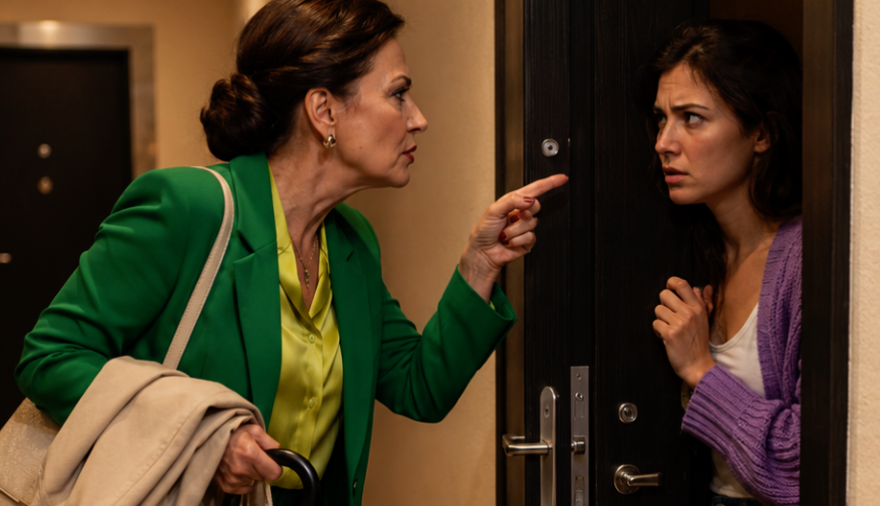
“Changed the locks, did you? Well, never mind, my son will be here soon and he’ll open everything,” her mother-in-law declared confidently from the other side of the door.
Kristina stood barefoot in the hallway, a cup of unfinished coffee in her hand, staring at the new, shiny lock cylinder. The metal still looked unfamiliar. Yesterday evening, the locksmith had clicked his tools, checked the keys, asked her twice to lock and unlock the door herself, then put the old hardware into a bag and said the old keys were now good for nothing except keepsakes.
Kristina had only nodded then.
And today, that “keepsake” was already being forced from the other side of the door.
First came the doorbell. One short ring, then immediately a second one—long, irritated. Then someone knocked with their knuckles, not as if asking to be let in, but demanding an immediate answer. Kristina had managed only a few sips of coffee after a sleepless night when voices came from behind the door.
She recognized Valentina Sergeyevna’s voice at once.
Her mother-in-law never spoke quietly. Even on the stairwell landing, she managed to talk as if addressing a full auditorium.
“She’s home, she’s home. Where else would she be this early?” Valentina Sergeyevna snapped at someone beside her. “She’ll open now.”
Kristina slowly lowered the cup onto the small cabinet in the hallway. She didn’t slam it down as she once would have when her hands began trembling. She placed it carefully and set her phone beside it, within reach. She had no intention of hiding, and no intention of pretending no one was home. For the first time in years, she simply did not hurry to the door.
Before, she had always opened quickly. Out of surprise, confusion, and the habit of not angering Valentina Sergeyevna. Her mother-in-law came whenever she wanted: morning, evening, weekends, in the middle of a workday. Sometimes alone, sometimes with her sister, sometimes with a neighbor from her building, and once even with a second cousin’s niece and her little son, whom Kristina had never seen before that day.
“We won’t stay long,” her mother-in-law would say, already taking off her shoes in the hallway.
And that “not long” stretched into hours.
At first Kristina endured it. Then she tried to talk. Then she asked Pavel to take the keys back from his mother. Then she stopped asking and began demanding. But every time, her husband found a convenient explanation for why it was not the right moment to start a scandal.
“She’s not a stranger,” he would brush her off.
Kristina had forbidden herself to tolerate that phrase too. Because it was under that very phrase that Valentina Sergeyevna opened someone else’s door with her own key, rummaged through kitchen cabinets, checked the refrigerator, peered into the bathroom, rearranged jars of cream on the shelf, carried boxes of shoes into the corridor, and said that the apartment “needed to be put in proper order.”
The apartment belonged to Kristina.
It was not shared property, not Pavel’s, not “family property” in the sense her mother-in-law loved to put into that word. This two-room apartment had come to Kristina from her grandmother before the marriage. The documents were kept in a separate folder, and Kristina knew every page. Pavel lived here, but he was not the owner. He was still registered at his mother’s address because he himself had once insisted it was more convenient that way. Back then Kristina had not paid much attention to it. Now she saw it as one of the few lucky things in their marriage.
The handle was pulled again from the other side.
Sharply. Irritably.
Kristina could even picture Valentina Sergeyevna standing on the landing in her long down coat, with two bulky bags that surely contained something “for her son,” wearing the expression of a woman to whom everyone already owed something simply because she had arrived.
“It won’t open,” someone beside her said.
The voice was female, younger. Svetlana, her sister-in-law. So her mother-in-law had not come alone.
Kristina straightened. She had almost expected that. After yesterday’s scandal, Valentina Sergeyevna had probably decided to bring a witness. Or support. Or someone who would gasp in the right places and repeat how ungrateful Kristina was.
Yesterday everything had started because Kristina came home earlier than usual.
She worked as a technologist at a small packaging production company and sometimes brought part of her reports home so she would not have to sit in the office until late evening. That day, a meeting had been unexpectedly canceled, and Kristina ended up home almost two hours early.
Already on the stairs, she heard laughter. Loud, foreign, confident laughter. She opened the door with her key and froze in the hallway.
There were six people in her apartment.
Valentina Sergeyevna was sitting in the kitchen at the head of the table like the mistress of the house. Beside her, Svetlana was laying out containers she had brought. Svetlana’s husband stood by the window, and their younger son was racing through the corridor with a toy car and had already managed to leave a long gray streak from the wheels on the light-colored cabinet. Pavel was sitting in the kitchen corner with the look of a man trapped between two doors, unsure which one would be more profitable to exit through.
“And here’s Kristina,” her mother-in-law announced cheerfully. “We decided to gather at your place. It’s cramped at Svetochka’s, and you have plenty of room.”
For a second, Kristina’s lips went dry. She slowly took off her jacket, hung it on the hook, and looked first at Pavel, then at his mother.
“At our place?” she asked.
“Well, we weren’t going to sit on the stairs,” Valentina Sergeyevna snorted. “I opened with my keys. My son didn’t mind.”
Pavel lowered his eyes to the table.
That was when Kristina understood that she was not tired of her mother-in-law. Not of her bags, her intrusions, or her commanding tone. She was tired of her husband, who remained silent every single time until the exact second his mother left. And then he would spread his hands and say he hadn’t wanted to make things worse.
Yesterday Kristina did not shout. She simply asked everyone to gather their things and leave.
“Are you throwing us out?” Svetlana asked, so sincerely surprised that one might have thought she had been caught not in someone else’s apartment, but in her own entrance hall.
“Yes,” Kristina replied. “Exactly.”
Pavel jumped up then, finally came alive, and began saying that they could discuss it calmly, that they had already come, that it was awkward in front of people. Kristina looked at him for a long time, without tears, without pleading, without the familiar hope that he might suddenly understand.
“I am awkward in front of myself, Pavel,” she said. “Because for so many years I allowed all of you to treat my apartment like a public passageway.”
Valentina Sergeyevna turned blotchy red. Her fingers began running over the handles of her bags.
“You’ll regret this, girl.”
“I am thirty-seven years old,” Kristina replied. “Look for girls somewhere else.”
After they left, she locked the door, stood in the silence, and for the first time in a long time did not do what was “necessary for peace in the family,” but what was necessary for her. She found the locksmith’s number, called him for the morning, then changed her mind and asked him to come that evening. The locksmith arrived within an hour. Pavel, meanwhile, was sitting in the car outside the building because after the scandal he had gone to walk his mother and sister out and was in no hurry to come back.
When he returned, the locks were already new.
“What is this?” he asked, looking at the keyring in his wife’s hand.
“New keys,” Kristina answered calmly. “One is mine. The second is a spare. I’ll give one to you only after we talk.”
“What talk?”
“About why your mother will no longer enter here without an invitation.”
Pavel smirked, but the smile quickly vanished from his face. For the first time, Kristina did not justify herself. She did not overexplain, did not try to choose soft words so he would not be offended. She sat across from him at the kitchen table and spoke briefly.
“This is my apartment. Your mother has no right to open it with her key. Your sister has no right to gather relatives here. You have no right to allow people to come here without asking me.”
“I live here,” Pavel reminded her.
“You live here. But you don’t own it. And if it’s hard for you to tell the difference, it’s time you learned.”
He was silent for a long time. Then he said Kristina was going too far. Then he went to sleep on the sofa. She did not stop him and did not smooth over the conversation. In the morning, Pavel left early. She still had not given him the new key.
And now Valentina Sergeyevna was standing at the door, trying to turn an old key in a new lock.
Kristina stepped closer.
“Kristina!” her mother-in-law called louder. “Open up. We know you’re home.”
Kristina pressed the intercom handset button so the sound from the landing would be clearer, but she did not open the door.
“I am home, Valentina Sergeyevna. What do you need?”
For a second, it became quiet behind the door.
“And why are you talking through the door? Open properly.”
“No.”
That short word seemed to strike the walls of the stairwell. Svetlana snorted quietly.
“Did you hear that, Mom? She said no.”
“Kristina, don’t put on a circus,” her mother-in-law’s voice dropped lower. “My hands are full. I brought groceries for Pavel.”
“Pavel isn’t home.”
“That’s all right. We’ll wait inside.”
“You will not be waiting inside.”
The handle jerked again. This time stronger, with an offended demonstration: the door might be yours, but we will still try.
“Have you completely lost your mind?” Valentina Sergeyevna no longer restrained herself. “I am your husband’s mother.”
“I remember.”
“Then open.”
“No.”
On the other side, bags rustled. Her mother-in-law had apparently shifted them from one hand to the other. Kristina imagined her drilling the door with her eyes and, unexpectedly, almost smiled. Before, that tone had made her breath falter. She immediately began searching for words that would protect herself without hurting anyone. Now the words were simple.
“Valentina Sergeyevna, you came without an invitation. I was not expecting you. You will not enter the apartment.”
“So you’re keeping me on the stairs?”
“You came to the stairs yourself.”
Svetlana gasped indignantly behind the door.
“Well, there it is. Mom, I told you she did it on purpose.”
“Of course I did it on purpose,” Kristina answered loudly. “Locks do not get changed by accident.”
Silence again. So dense that she could hear the entrance door slam somewhere below and someone begin climbing the stairs.
Valentina Sergeyevna was the first to break the silence.
“Changed the locks, did you? Well, never mind, my son will be here soon and he’ll open everything.”
Kristina looked at her reflection in the mirror by the entrance. Her hair was carelessly tied back, her face paler than usual after a sleepless night, but her eyes were calm. Not empty, not frightened, but attentive. She seemed to herself like a different woman. Not the one who had accepted another woman’s rules in her own apartment for years.
“He won’t open,” Kristina said.
“And why is that?”
“He doesn’t have the keys.”
Something thudded dully behind the door. It seemed Valentina Sergeyevna had dropped one of her bags.
“You left your husband without keys?” her mother-in-law’s voice rose into a shrill note. “Sveta, do you hear that? She won’t let my son into his own home!”
“This is not his own home,” Kristina replied. “And it is not yours.”
“He’ll come now, and we’ll see.”
“We’ll see.”
She took her phone and opened her chat with Pavel. There were already three missed calls from him and one message: “Mom called. What is going on?”
Kristina did not answer. Let him come. Since the conversation had clearly become inevitable, it was better to have it once and in front of witnesses, so later no one could retell a convenient version.
Meanwhile, on the landing, Valentina Sergeyevna was already calling her son. She spoke loudly, with pressure, so Kristina would hear every word.
“Pavlik, come immediately. Your wife changed the locks. Yes, we’re standing at the door right now. No, she isn’t opening. What do you mean, ‘talk’? Come and open.”
Kristina went into the kitchen. The coffee had gone cold, but she did not drink it. She poured it into the sink, rinsed the cup, and placed the spoon beside the drying rack. The simple action helped occupy her hands. On the stove stood a pot of porridge she had made that morning for herself. In the refrigerator were groceries she had bought. In the cabinet were her documents, her things, her life, which for too long had been opened by someone else’s key.
About twenty minutes later, it became noisier at the door. Pavel had arrived quickly.
Kristina heard his steps, then his voice:
“Mom, what have you done?”
“What have I done?” Valentina Sergeyevna was outraged. “This is what your wife has done. We came like normal people, and she’s keeping us behind the door.”
“You came without warning,” Kristina reminded them from inside the apartment.
Pavel knocked now not with his fist, but with his knuckles, more cautiously.
“Kris, open up. Let’s talk.”
She went to the door.
“Talk.”
“Not through the door.”
“Exactly through the door. Until everyone calms down.”
“Are you mocking me?”
“No. I am establishing order in my apartment.”
Valentina Sergeyevna immediately interfered.
“Do you hear that, Pavlik? In her apartment! And what are you then? A temporary tenant?”
Pavel did not answer. Kristina knew that silence. He always did that when his mother pressured him in front of others. He became gray, awkward, convenient. He waited for the storm to pass by itself.
Only today, she was not going to let it pass.
“Pavel,” Kristina said evenly. “Were you in the apartment yesterday when your mother brought people here without my consent?”
“I was.”
“Did you know I had not allowed it?”
“Kris, well, they had already come…”
“Answer.”
He exhaled heavily.
“I knew.”
“Did you let your mother think she could open my door with her key?”
“I didn’t specifically let her think that. The keys were just for emergencies.”
Kristina smiled with only her eyes. That phrase was Pavel’s favorite loophole. “For emergencies.” With it, anything could be justified: unexpected visits, cabinet checks, lunches with relatives, the nephew’s overnight stay, the one who had once scribbled on the edge of her desk with a marker.
“The emergency happened yesterday,” she said. “And it ended with the locks being changed.”
Svetlana could not hold back again.
“And who are you, anyway, to keep your husband’s mother on the stairs?”
Kristina turned her head toward the door, though she could not see her sister-in-law.
“I am the owner of the apartment. That is enough.”
“Oh, here we go. The owner. Waving your papers around?”
“The papers are in a folder. I do not need to wave them around.”
Pavel said sharply:
“Sveta, be quiet.”
Behind the door, Svetlana sucked in an offended breath.
Kristina understood that Pavel was no longer so sure of himself. Before arriving, he had probably thought he would insert the key, open the door, his mother would come in, his wife would grumble, and then she would accept it. Now he stood next to two women from his family and could not do the simplest thing: open the door to the apartment where he had lived for the past few years.
“Kristina,” he began more quietly. “Give me the keys. I’ll talk to Mom. She won’t come like this anymore.”
Valentina Sergeyevna hissed:
“Pavel!”
“Mom, wait.”
Kristina did not move.
“You already said that.”
“This time it will be different.”
“No. This time only the lock is different.”
Pavel slapped his palm against the door. Not hard, more out of helplessness than anger.
“And what do you want? For me to sleep on the stairs?”
“I want you to finally choose like an adult. Either you live with me and respect my boundaries, or you go back to where your boundaries are defined by your mother.”
“Ah, so that’s what this is!” Valentina Sergeyevna laughed almost triumphantly. “You’re throwing him out!”
Kristina opened the door on the chain.
Not fully. Just enough to see their faces.
Valentina Sergeyevna stood closest. Her face was red, her chin lifted, two bags in her hands. One of them had torn on the side, and a loaf of bread peeked out from it. Beside her stood Svetlana in a light jacket, phone in hand. She was clearly filming or about to film, but when she saw Kristina’s gaze, she quickly lowered the camera. Pavel stood behind them, hatless, with a tired face and the familiar irritation around his eyes.
“Put the phone away, Svetlana,” Kristina said. “I did not give consent to be filmed in my apartment or at my door.”
“As if I need to,” her sister-in-law muttered, but she put the phone away.
“Pasha,” Valentina Sergeyevna turned to her son, “do you hear the tone she’s using with us? Are you a man or what? Tell her.”
Pavel looked at Kristina.
“Open the door.”
“No.”
“Kristina.”
“No.”
He clenched his jaw. The muscles moved in his cheekbones. On an ordinary day, Kristina would already have begun to soften. She would have thought that the neighbors could hear, that it would be awkward to meet them in the elevator later, that Pavel was uncomfortable, that her mother-in-law was an elderly woman. Today, all those familiar arguments lay somewhere far away, like old receipts that should have been thrown out long ago.
“Then I’ll take my things,” Pavel said.
Valentina Sergeyevna turned sharply toward him.
“What things? What are you saying?”
“Mom, enough.”
“No, not enough! She’s putting you out, and you’re just standing there?”
Kristina opened the door wider, but remained on the threshold.
“You may come in alone, Pavel. To take the things you need. Valentina Sergeyevna and Svetlana stay on the landing.”
“How dare you!” her mother-in-law stepped forward.
Kristina raised her hand, stopping her with the gesture.
“One more step, and I call the police. Not to talk, but to document attempted unlawful entry and threats at my door.”
For the first time, something resembling doubt flashed across Valentina Sergeyevna’s face. She quickly looked at Svetlana, then at Pavel.
“Will you allow this?”
Pavel ran a hand over his face.
“Mom, stay here.”
He entered the apartment. Kristina immediately closed the door, leaving her husband’s mother and sister on the other side. The lock clicked. Indignant noise rose on the landing, but she did not turn around.
Pavel stood in the hallway and looked at her as if he were seeing her for the first time.
“Are you really ready to call the police on my mother?”
“If she tries to force her way into my apartment—yes.”
“She wasn’t forcing her way in.”
Kristina silently pointed at the door handle.
“She was pulling at the door with someone else’s key, then demanding to be let in, then declaring that you would come and open everything. To her, I am not the mistress of this home. And you supported that.”
Pavel took off his jacket, then changed his mind and picked it up again.
“You pushed everything to the extreme.”
“No. For too long, I never pushed anything to its conclusion.”
He went into the room. Kristina followed, but kept her distance. Not because she was afraid. Simply because she did not want him to later say she had prevented him from taking his things.
In the bedroom, Pavel had very few personal belongings: clothes, chargers, documents in a separate folder, a few books, a sports bag. Everything else had been bought by Kristina or brought from her earlier life. The apartment had not become theirs just because Pavel had once brought in slippers and a razor.
He opened the closet, took out the bag, and began packing. Carelessly, with sharp movements. T-shirts were crumpled, socks fell to the floor, documents were shoved into a side pocket.
“Happy now?” he asked without turning around.
“No.”
“You look like it.”
Kristina leaned her shoulder against the doorframe.
“I am not happy, Pavel. I am simply tired of persuading you to be a husband instead of your mother’s representative in my apartment.”
He froze for a second, then continued packing.
“You could have given me time.”
“I gave you years.”
Pavel sharply zipped the bag closed.
“My mother is not your enemy.”
“Perhaps. But she behaves like a person who has decided to take my place in my home.”
He wanted to answer, but from the landing came a loud:
“Pavlik! How long are you going to be in there? Don’t leave her alone, she’ll come up with something else!”
Kristina looked at her husband. He closed his eyes for a couple of seconds, then opened them and picked up the bag.
“I’ll talk to her,” he said, now without his earlier confidence.
“Talk. But not here.”
He went toward the exit. Kristina opened the door and immediately stood in such a way that Valentina Sergeyevna could not step inside.
Her mother-in-law saw the bag in her son’s hand, and her face twisted.
“Are you really leaving?”
“For now,” Pavel said.
“There is no ‘for now.’” Kristina extended her hand. “Keys.”
He looked at her.
“I have the old ones.”
“All old keys you have. To the apartment, to the mailbox. And the spare one you kept in the car.”
Pavel hesitated.
“What does the mailbox have to do with anything?”
“It has to do with the fact that Valentina Sergeyevna once already took my letters out of it so they ‘wouldn’t get lost.’”
Svetlana snorted quietly, but immediately fell silent when Kristina shifted her gaze to her.
Pavel reached into his pocket, removed the old apartment key from the keyring, then the mailbox key. Then, after a pause, he took one more key from a compartment in his bag.
Kristina took them and placed them on the small cabinet behind her.
“If you need your things, we will agree on a time. You come alone.”
“And if I want to come back?” he asked.
Kristina looked at him carefully. At the man she had lived with for six years. At the person who could be funny, kind, caring—until his mother appeared nearby. At the husband who had not cheated, had not drunk, had not raised a hand against her, but day after day handed their life over to be torn apart by someone else’s habits.
“Then you will not come with a key,” she said. “You will come with the understanding that the mistress of the home opens the door.”
Valentina Sergeyevna threw her chin up.
“Did you hear that? She is humiliating you.”
Kristina turned to her.
“No. I am returning words to their meaning. The owner is the one who owns and is responsible. A guest is the one who has been invited. A relative is not someone who enters without asking, but someone who respects the door.”
“You will regret this,” her mother-in-law hissed. “Pavlik is my only son. I won’t allow some woman to throw him out of my life.”
“I am not throwing him out of your life. I am removing your set of keys from mine.”
Pavel winced, as if that phrase had hit exactly the place he himself had tried not to touch.
“Let’s go, Mom,” he said wearily.
But Valentina Sergeyevna had no intention of leaving. She placed the bags on the floor and suddenly stepped closer to the door.
“Kristina, open fully. I want to talk to you woman to woman.”
“No.”
“Why do you keep saying ‘no’ and ‘no’?” Her mother-in-law’s voice became sticky, almost affectionate. “You’re nervous. Things happen in marriage. You can’t destroy a home over trifles.”
Kristina slowly inhaled. There it was. Now another performance would begin. Not shouting, but pity. Not pressure, but feigned wisdom. This was even more dangerous because before, she had often fallen for it.
“These are not trifles,” she said.
“They are trifles, Kristinochka. Well, we came. Well, we sat for a while. Did it take anything away from you?”
“Yes. It did.”
Her mother-in-law blinked.
“What?”
“It took away peace. It took away respect for my husband. It took away the feeling of home. Every time you opened the door with your key, I had less desire to return here. To my apartment.”
The words hung in the stairwell, heavy and unexpected. Even Svetlana stopped pretending to be bored and outraged.
Kristina spoke quietly, but clearly.
“You came without calling. You opened the door if I did not reach it in time. You brought people. You looked into rooms. You made comments. Once you let a washing machine repairman in without my consent because you decided I ‘didn’t understand anything anyway.’ He walked through my bathroom while I was not home. And then you were offended when I objected.”
“I wanted to help!”
“You wanted to manage things.”
Valentina Sergeyevna opened her mouth, but Kristina did not let her insert a word.
“When Svetlana’s water was shut off at home, you brought her and her children to me, even though I had said on the phone that I was busy. When your nephew came to town, you offered him a place to sleep at our apartment without asking me. When I was sick, you opened the door with your key and entered with a neighbor because she was curious to see our kitchen. That is not care. That is the habit of treating someone else’s property as your own.”
Pavel stood with the bag and looked at the floor. This time the silence was different. Not convenient, but heavy. Kristina could see him remembering everything she had listed. He could not say it had not happened.
Valentina Sergeyevna turned pale, but quickly pulled herself together.
“I see you’ve been collecting grievances. Counting everything?”
“Yes,” Kristina said. “I counted. And I counted money too. For the groceries bought for your sudden gatherings. For damaged things. For the repairman you called without my consent, whom Pavel then asked me to pay because it was ‘awkward in front of the man.’ I paid for the new lock too. And it is the most useful expense I have had recently.”
Svetlana grimaced.
“Oh, how petty.”
Kristina looked at her calmly.
“Petty is coming to someone else’s apartment with containers and expecting the hostess to be grateful for the intrusion.”
Her sister-in-law opened her mouth, but Pavel said sharply:
“Sveta, enough.”
At that moment, the door to the neighboring apartment opened slightly. Elderly neighbor Tamara Ilyinichna looked out onto the landing. She had lived next door for a long time and had more than once seen Valentina Sergeyevna enter Kristina’s apartment with her own key.
“Is everything all right?” the neighbor asked, looking specifically at Kristina.
“Yes, Tamara Ilyinichna. Thank you. The relatives are leaving.”
The word “leaving” affected Valentina Sergeyevna like a fresh slap.
“We will decide for ourselves when we leave.”
Kristina picked up the phone from the cabinet.
“Then I am calling.”
Pavel quickly stepped toward his mother.
“Mom, let’s go.”
“Don’t touch me.”
“Let’s go, I said.”
He rarely spoke to his mother in that tone. Valentina Sergeyevna even stepped back half a step. Svetlana picked up the bags, angrily rustling the handles.
“Of course, let’s go,” she threw out. “Let her sit alone in her fortress. We’ll see who suffers more.”
Kristina said nothing. She stood by the open door and did not lower her gaze. She did not need to win the argument with a final phrase. She needed to close the door.
Pavel lingered for a second.
“I’ll call in the evening.”
“Write. I may not answer calls.”
He nodded, as if he wanted to say something else but could not find the words. Then he turned and followed his mother and sister down the stairs. Valentina Sergeyevna was still saying something to him in a sharp whisper, but the words were already blending with the footsteps.
Kristina waited until the sounds faded.
Tamara Ilyinichna was still standing in her doorway.
“It was long overdue,” the neighbor said quietly.
Kristina turned her face toward her.
“Was it very audible?”
“Enough. But sometimes it needs to be audible.”
The neighbor closed her door, and Kristina closed hers. This time calmly. Without slamming. She simply turned the key in the new lock and listened to the silence for several seconds.
The silence felt unfamiliar. Not empty, but clean.
She went into the room. Pavel’s shirt, which he had forgotten, hung over the back of a chair. His book lay on the shelf. His razor remained in the bathroom. Traces of another person’s life did not disappear after a single morning conversation, but for the first time they did not feel like a sentence.
Her phone vibrated almost immediately.
A message from Pavel: “Mom is crying. Is that what you wanted?”
Kristina read it and placed the phone screen-down. A minute later, she picked it up again and typed a reply:
“I achieved the fact that no one will enter my apartment without my permission anymore. The rest depends on you.”
She sent it.
Then she opened the hallway closet and took out a small box. Into it she placed the old keys: Pavel’s, the mailbox key, the spare one he had kept in the car, and two more keys found yesterday in the kitchen drawer. One Valentina Sergeyevna had once “forgotten to return,” and the second, as it turned out, Svetlana had taken in case she “needed to pop in.”
Kristina smirked. Pop in. Like into the shop downstairs.
She closed the box and put it on the top shelf. Not because the keys could open anything anymore. She simply wanted to see proof of how many people had considered her door theirs.
The day passed strangely calmly.
Kristina did not go to work, having informed her supervisor in advance that she would take a day at her own expense for personal reasons. She did not explain the details. Then she washed the hallway floor where the guests had tracked dirt yesterday, wiped the cabinet with the streak from the toy car, and cleared the kitchen table. All of Pavel’s things that remained in sight she put into a separate bag: the shirt, the book, the charger, the razor, the documents from the drawer that he had not managed to take.
In the evening, he wrote again.
“Can I come tomorrow for the rest? Alone.”
Kristina replied ten minutes later:
“Yes. At 12:00. For one hour. Alone.”
He sent a short: “Okay.”
At noon the next day, Pavel came alone. He rang the doorbell. He did not knock, did not try to open the door, did not call his mother in front of her. He stood there with an empty bag and looked as if he had lost several years of sleep in one night.
Kristina opened.
“Come in.”
He entered carefully and stopped on the mat.
“I’m alone.”
“I see.”
“Mom wanted to come.”
“That is why you have one hour.”
Pavel nodded. This time he did not argue. He went into the room and began collecting the remaining things. Kristina did not follow him on his heels, but she stayed in the apartment. She had already decided: no empty conversations, no pity embraces, no promises spoken in a rush.
Half an hour later, Pavel came out of the bedroom with two bags.
“I didn’t think everything would go this far,” he said.
Kristina stood by the kitchen window, looking out into the courtyard.
“I know. You tried not to think at all.”
He sat at the table without asking whether he could, but now it did not irritate her. For now, he was still her husband. For now, the conversation was not finished.
“Mom said all night that you destroyed the family,” he said.
“And what did you say?”
Pavel ran his thumb along the edge of the table.
“At first, nothing. Then I said she really had gone too far.”
Kristina turned to him.
“Not gone too far, Pavel. Crossed the line. Those are different things.”
He nodded.
“Yes.”
That “yes” came late. Very late. But it came all the same.
“I don’t know how to fix it,” he said.
“Do you want to fix it?”
He raised his eyes.
“I do.”
Kristina looked at him for a long time. She wanted to believe him. The habit of believing Pavel was strong, like an old cord tied into knots many times. But now she understood: believing words was not enough.
“Then start with something simple,” she said. “Your mother never gets keys. Your sister does not come without an invitation. Any guests only after my consent. If you promise someone an overnight stay or a meeting in my apartment without asking me, you pack your things the same day. If your mother insults me, you do not stay silent. Not later in the kitchen. Immediately.”
Pavel listened attentively, without his earlier smirk.
“And one more thing,” Kristina added. “You are not getting a new key now.”
He tensed.
“What does that mean?”
“Until we decide whether we are staying married. You may come by agreement. If we go to a family psychologist or a lawyer, we will discuss it. If we decide to divorce, we will do it legally. My apartment cannot be divided. You know that.”
“I wasn’t planning to divide it.”
“You weren’t. But your mother has said more than once that a man should not leave empty-handed from a home where he lived.”
Pavel winced.
“She says a lot.”
“And you stay silent a lot.”
He lowered his head. This time, he found no objection.
In the hallway, Pavel’s phone rang again. The screen showed “Mom.” He looked at the call, then muted it and placed the phone face-down.
Kristina noticed. She did not praise him. She did not smile. She simply noted it to herself: a small action. Not yet a heroic deed, but already not the old obedience.
“I’ll rent a place for a while,” Pavel said. “Or stay with a friend. I won’t go to Mom’s.”
“Why?”
He gave a tired half-smile.
“Because if I go to her, in a week I’ll be sure you’re to blame for everything. And I don’t want to start thinking in her words again.”
For the first time in two days, Kristina felt her face relax slightly.
“That already sounds like an adult answer.”
Pavel stood.
“I really didn’t understand how it looked to you.”
“I don’t believe that.”
He froze.
“What?”
“I don’t believe you didn’t understand. I think it was convenient for you not to understand.”
He picked up the bags. His shoulders dropped, but he did not argue.
“Probably.”
She walked him to the door. He stopped on the threshold.
“Can I write to you tonight?”
“You can.”
“Will you answer?”
“If there is something to answer.”
Pavel nodded and left. Kristina closed the door. Turned the key. Pressed her palm to the cool metal of the lock—not helplessly against the entire door, but like a person checking whether it held.
It held.
The next two weeks were not easy, but they were surprisingly clear. Valentina Sergeyevna tried calling Kristina from different numbers. Once she sent a long message accusing her of cruelty, ingratitude, and wanting to turn mother and son against each other. Kristina read the first two lines and blocked the number. Svetlana wrote in the family group chat that some women considered square meters more important than people. Kristina left the chat without explaining herself.
Pavel wrote every evening. Awkwardly at first: asking how things were, whether she needed anything bought, whether he could help. Kristina answered rarely. Then he sent a photo of a lease agreement for a small studio on the other side of the district. Without complaints, without hints that things were hard for him.
“I rented it for three months. I want to figure myself out,” he wrote.
Kristina looked at the message for a long time. Then she replied:
“That is right.”
He did not ask for keys. He did not pressure her. He did not bring his mother. A week later, he suggested meeting in a neutral place to talk. Kristina agreed, but chose not a café, but a small park near the cultural center. The benches were far apart, people walked around them, and the conversation did not turn into a domestic trap where one person pressed and the other could not leave.
Pavel came with a folder.
“What is that?” Kristina asked.
“My documents. I checked my registration, loans, everything that could concern the apartment. I have no claims and will have none. I wrote a statement saying I have no keys to your apartment and did not give them to third parties after the locks were changed. Maybe it doesn’t have much legal force, but I want you to have at least some confirmation.”
Kristina took the sheet. Read it. The text was simple, without strange wording, without nonexistent notarial promises. Just the date, full name, passport details, a list of the keys, and a signature. Pavel had even attached a copy of his registration at his mother’s address.
“Did you write this yourself?”
“I spoke with a lawyer at work. Without details. I just asked how to properly record the transfer of keys and lack of access.”
Kristina put the sheet back into the folder.
“That is reasonable.”
Pavel exhaled carefully.
“I also talked to my mother.”
“And?”
“She thinks I’m a traitor.”
“As expected.”
“Yes. But I told her I will no longer discuss your apartment with her. And if she comes to your door, I won’t come to open it. Because I have nothing to open it with, and because I have no right.”
Kristina looked at the path in front of her. A boy with a scooter walked along it, his father hurrying after him. An ordinary scene, quiet, almost unnoticeable. Before, she would already have completely softened in such a moment. Now she did not hurry.
“That’s good, Pavel. But a conversation with your mother does not repair our marriage.”
“I understand.”
“I’m not sure I want to repair it.”
He nodded. His fingers were clasped on his knees, white at the knuckles.
“I was afraid you would say that.”
“And I used to be afraid to say it.”
They sat side by side for almost an hour. Without loud confessions, without beautiful promises. Kristina talked about how tired she was of being the villain in other people’s stories when all she had done was defend her door. Pavel said that all his life he had been used to calming his mother with silence, and then had carried that skill into marriage. It was bad, painful in places, but honest.
At the end of the meeting, he asked:
“What happens next?”
Kristina put the folder into her bag.
“Next, I will live alone. In my apartment. Without your things, without your mother, and without waiting for the door to open with someone else’s key. And you will live separately and decide who you want to be without Valentina Sergeyevna’s constant prompting.”
“And then?”
“Then we’ll see.”
He accepted it. Not joyfully, not easily, but he accepted it.
A month passed.
During that time, the apartment became different, although Kristina had not deliberately changed anything in it. She did not buy new furniture, did not rearrange the rooms, did not make dramatic gestures for the sake of feeling a new life. She simply removed the unnecessary. She cleared out the second bathroom shelf Pavel had once occupied and forgotten about. She freed a drawer in the dresser. She took down the magnet from the refrigerator that Valentina Sergeyevna had brought from some excursion and presented with the words: “Let it hang, otherwise your place is empty like a hotel.” She put the magnet into the bag with Pavel’s things.
The most important change remained the sound of the lock.
Every evening, returning home, Kristina opened the door with her new key and felt a simple, almost childlike joy: no one would enter after her without asking. No one would be in the kitchen before her. No one would say from the room, “We decided to gather here.”
One Saturday, Valentina Sergeyevna came after all.
Alone.
Kristina saw her through the peephole and was not surprised. Her mother-in-law stood without bags, in a dark coat, with a handbag on her elbow. Her face was stern, but no longer as victorious as on that day.
Kristina opened the door on the chain.
“Hello.”
Valentina Sergeyevna looked over the chain and smirked crookedly.
“Still afraid?”
“No. That is why I opened.”
Her mother-in-law narrowed her eyes.
“I came to talk.”
“Talk.”
“Through the crack again?”
“Yes.”
Valentina Sergeyevna tightened her grip on her handbag. For several seconds, she struggled with herself. It was clear how much she wanted to order, demand, shove the door open with words. But something stopped her. Perhaps Pavel. Perhaps the new lock. Perhaps the understanding that her former power was over.
“Pavel has become distant,” she finally said.
“That is your conversation with Pavel.”
“He rented an apartment.”
“I know.”
“Because of you.”
Kristina calmly adjusted the chain, although there was no need.
“No. Because for too long, he did not know how to live separately from your decisions.”
Her mother-in-law shook her head.
“You’re hard.”
“I’ve become precise.”
“You used to be different.”
“I used to be more convenient for you.”
Valentina Sergeyevna looked away toward the window on the stairwell landing. Suddenly, fatigue appeared on her face. Not theatrical, not demonstrative. The ordinary fatigue of a woman who had commanded everyone around her for too long and one day discovered that the command was no longer being obeyed.
“I didn’t think you would explode like this over keys.”
“It is not about the keys.”
“What is it about?”
“You did not knock on my life. You opened it.”
Her mother-in-law was silent. For the first time in all that time, she had no quick answer.
Kristina did not try to finish her off. She did not need to see Valentina Sergeyevna defeated. She needed her to understand: the door was no longer hers.
“I will not apologize for changing the locks,” Kristina said. “And I will not return access to you. If Pavel and I ever decide to invite you as a guest, you will come as a guest. You will call in advance. You will wait for an answer. You will enter if you are let in. There will be no other option.”
Valentina Sergeyevna slowly nodded, but there was more resentment in that nod than agreement.
“Tell Pavel I came by.”
“Tell him yourself. I will no longer be your corridor to your son.”
Her mother-in-law looked sharply at her. Her cheeks twitched, but she held back another barb. She turned and went toward the stairs.
Kristina closed the door.
She did not slam it. She did not celebrate. She simply closed it.
By evening, Pavel wrote:
“Mom said she came by. Are you okay?”
Kristina replied:
“Yes. She did not come in.”
He sent:
“Thank you for not making a scandal.”
Kristina smirked and typed:
“It would have been a scandal if she had tried to come in.”
Pavel typed for a long time. Then a message appeared:
“I understand.”
Maybe he really did. Maybe he had only begun to.
Kristina built no illusions. She was no longer the woman who expected one conversation to repair years. But she had become the woman who knew how to stop someone else’s hand on her door handle.
Three months later, she and Pavel filed for divorce through the court, because at first Pavel still hoped to save the marriage and was not ready for a joint application through the registry office. They had no children, and there was no serious dispute over shared property, but one spouse’s disagreement meant the matter had to go through the court. Kristina prepared calmly: the documents for the apartment, proof of ownership, an extract from the registry, receipts for the lock replacement, and the correspondence where Pavel acknowledged he had no keys. The lawyer she consulted said the apartment was clear: it was her property, received before marriage, and was not subject to division.
Pavel behaved quietly in court. He did not demand the impossible, did not repeat his mother’s words, did not try to portray himself as an offended owner. When the judge clarified his position regarding the property, he said:
“I make no claim to the apartment.”
Kristina sat beside him and, for the first time in a long while, did not expect a trick hidden behind every breath he took.
After the hearing, they went outside. It was a gloomy day, wet asphalt shining underfoot, people hurrying about their business. Pavel stopped by the steps.
“I ruined everything, didn’t I?”
Kristina buttoned her coat.
“We both spent a long time pretending nothing terrible was happening. Only you stayed silent, and I endured. That is a bad pair of habits.”
He nodded briefly.
“I won’t go back to living with Mom.”
“That is no longer my concern, Pavel.”
“I know. I just wanted to say it.”
She looked at him without anger. Strangely, the anger had left earlier than the love. What remained was fatigue and a quiet regret that a good person could be a bad husband if he never separated his life from someone else’s will.
“Take care of yourself,” he said.
“You too.”
They went in different directions.
That evening, Kristina returned home. She climbed to her floor and took out her keys. The landing was quiet. No bags by the door, no voices, no handle jerking from outside. Only her door and the new lock, no longer shiny, but familiar.
She entered, locked herself inside, and went to the kitchen. She placed the court documents on the table, and the keys beside them. She poured herself some water, opened the window to air out the room, and stopped in the middle of the kitchen.
The apartment had not become larger. It had not become richer. It had not turned into a picture from someone else’s beautiful life. But finally, it had the most important thing: her permission for everything that happened there.
Kristina went to the hallway and checked the lock once more. Not out of fear. Out of respect for the version of herself who had once heard that confident voice behind the door say, “My son will come now and open everything,” and had not stepped back.
The son came.
But he did not open it.
And on that day, someone else’s habit finally ended where it should have always ended — at the threshold of her apartment.