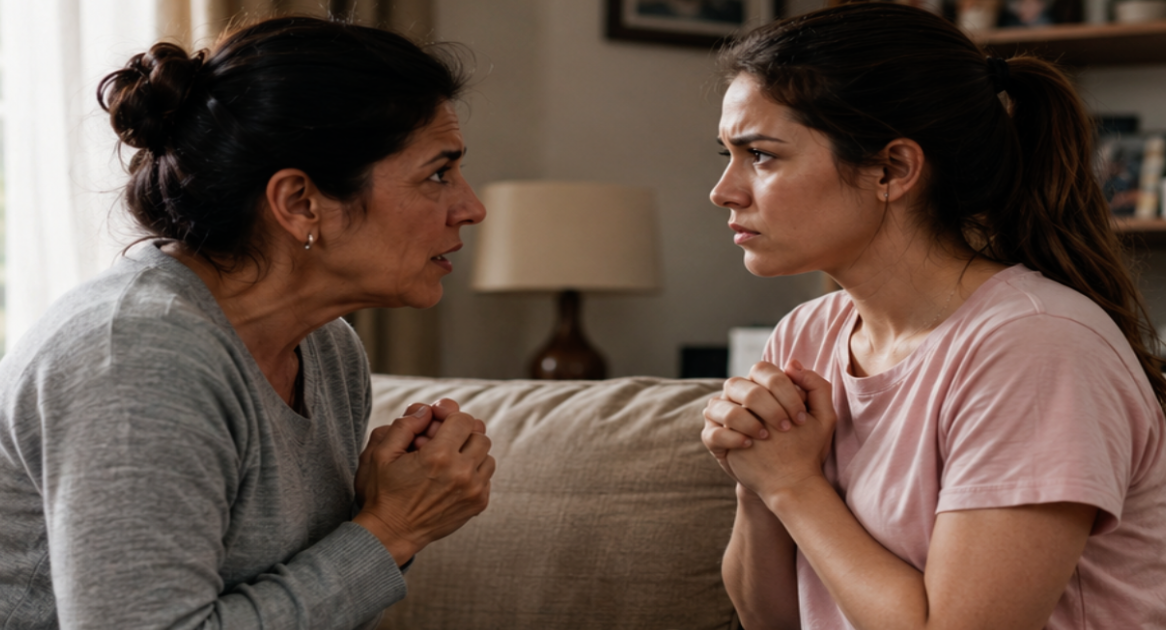
“My clever boy, he got the divorce finalized and took the apartment too!” the mother-in-law gloated. “And that one… she didn’t even make a scene…”
“My clever boy, he got the divorce finalized and took the apartment too! And that one… she didn’t even make a scene…” Maria Petrovna, the mother-in-law, was practically singing as she paced around the spacious living room of her son’s new apartment. Her voice rang with triumph mixed with bewilderment. Every now and then she adjusted her perfect hairstyle and cast victorious glances at the impeccably arranged furniture — furniture that, only yesterday, had belonged to another woman.
Sergei, her only son, sat in a deep armchair, lazily flipping through the pages of some magazine. There was neither joy nor relief on his face, only the slight weariness of a man who had just completed a difficult but necessary task. He remained silent, allowing his mother to enjoy her moment of triumph. For Maria Petrovna, this day was the culmination of a long war she had waged quietly, methodically, and mercilessly. A war for her son, for his attention, for his life — which she considered her own property.
“I told you, Seryozha, I warned you!” she continued, now shifting into a softer, conspiratorial tone. “That Lena… she was suffocating you. Did you not see the way she looked at me? As if I were the outsider in my own home. And now look: clean, bright, no one telling us where the vase should stand or where the painting should hang. And the apartment is ours, our own. No division of property, no court cases dragging on for years. Just a signature, and that’s it. Brilliant!”
Sergei finally lifted his eyes from the magazine. They were cold, like the glass of a winter window.
“Mom, enough. It’s done. Why talk about it again?”
“Why? So you understand what a fine job you did! So you appreciate how I helped you. Without my advice, you’d now be living in some rented dump, handing half your salary over to her for alimony. And her? Ha! She didn’t even say a word against it. ‘Take everything, Sergei, I don’t need anything.’ Can you imagine? A normal person would have fought, shouted, cried, demanded a lawyer. But she just packed two bags and left. Strange, don’t you think?”
Maria Petrovna walked over to the window, looking out at the cityscape, which now seemed especially welcoming to her. She liked to think she had saved her son from a youthful mistake. Lena had been too quiet, too unnoticeable. She lacked that spark, that strength of character Maria Petrovna valued in people — meaning, of course, in herself. Lena was like water: clear, useful, but easily replaced. Maria Petrovna, however, was a rock against which any waves of disagreement shattered.
Memories of the final months before the divorce flashed through the mother-in-law’s mind in vivid scenes. She remembered how skillfully she had planted seeds of doubt. A casually dropped remark that Lena cooked poorly. A loud sigh at the sight of her daughter-in-law’s new blouse: “Spending money again? Seryozha will soon be left without trousers.” Sudden “migraines” that required her son’s presence precisely when the young couple had plans. She created an atmosphere of constant tension, in which Lena felt guilty simply for breathing the same air as her.
And most importantly — the apartment. That three-room Khrushchev-era flat, inherited by Sergei from his grandmother, had become the apple of discord. Maria Petrovna had convinced her son that Lena wanted to sue for the apartment, throw him out onto the street, and leave him alone with debts.
“She’s cunning, Seryozha, she’s waiting for the right moment,” she whispered to him over the phone in the evenings. “You need to act first. Put everything in your name before she comes to her senses.”
Sergei, exhausted by his mother’s constant pressure and his wife’s strange silence, gave in to panic. He believed Lena was a hidden enemy preparing to stab him in the back. So he insisted on a marriage contract at the last moment, taking advantage of Lena’s weakness, her desire to preserve peace at any cost. She signed the papers without even reading them carefully, just to stop the endless stream of accusations and suspicious glances.
“You know, Mom,” Sergei said quietly, interrupting the flow of his mother’s memories, “I think there’s something we don’t understand.”
“What don’t we understand?” Maria Petrovna turned sharply, her face twisting with suspicion. “We understood everything correctly. We won. She lost. That’s all the math.”
“She didn’t lose, Mom. She just left. Without a fight. Isn’t that strange for a person who is losing everything? For someone being driven out of her own home?”
Maria Petrovna snorted and deliberately sat down in the armchair opposite her son.
“Strange? That’s called cowardice. Or calculation. Maybe she already found someone else. Maybe she didn’t need this apartment because she had a backup plan. Women are like that, Seryozha. They always think ten steps ahead. Don’t flatter yourself by imagining she’s some holy martyr. Most likely, she’s laughing at us right now somewhere in a cozy little nest that someone gave her.”
But deep inside, somewhere beneath the armored layer of her confidence, a tiny, unpleasant doubt began to stir in Maria Petrovna. Why had Lena not shouted? Why had there been no hysterics, no calls to friends, no threats to go to the police? An ordinary person, when cornered, starts to bite. Lena had simply looked at Sergei with her large, calm eyes, nodded, and said, “All right, if that will make things easier for you.” Those words echoed in the silence of the new apartment, disturbing the idyll of victory.
Days passed. Life in the apartment settled into a routine. Maria Petrovna took full control. She assigned a place to every object, established new rules for meals and the daily schedule. Sergei worked a lot, came home late, trying to spend as little time as possible in a space filled with his mother’s energy. But even at work, he was haunted by a feeling of incompleteness. Lena’s image did not disappear. It was not the image of an offended victim; it was the image of a person who had made a choice and closed the door.
One evening, while Maria Petrovna was absorbed in watching a TV series and loudly commenting on the characters’ actions, Sergei found an old photograph in a desk drawer. He and Lena were standing on the seashore, laughing. The wind had tousled her hair, and her eyes shone with a sincere happiness he had not seen in a very long time. At that moment, he remembered how Lena had defended him in front of his colleagues, how she had supported him when he lost his job five years earlier, how patiently she had listened to his complaints about his mother without ever saying a bad word about her.
“She didn’t even make a scene,” flashed through his mind again.
And suddenly the phrase sounded different. Not as a sign of weakness or cunning, but as a sign of incredible strength. A scene is an attempt to hold on, a cry of despair, a hope that the other person will hear and come to his senses. Lena had not made a scene because she had nothing left to lose in that relationship. She had already left internally long before the legal documents were signed. Her silence was the final sentence she had passed on both of them — on Sergei and on his mother.
Maria Petrovna noticed her son’s pensiveness and immediately reacted.
“Thinking about her again? Stop it, Seryozha. The past must be let go. Look what kind of life we have now! No problems, no nerves. I’ll find you a good girl, a normal one, from our circle. One who values family and respects her elders.”
“Mom,” Sergei interrupted her, and for the first time in a long while, firmness sounded in his voice. “Don’t you think the problem wasn’t Lena?”
“What nonsense are you talking about?” Maria Petrovna flared up, her face turning red. “Of course the problem was her! She didn’t fit into our family, she was dragging you down…”
“No, Mom. The problem is that you can’t let me go. Lena left because she understood there was no place for her here. Because here there is only you and me. And even I sometimes feel cramped here.”
A heavy silence settled over the room. The television continued speaking, but its sounds now seemed foreign and distant. Maria Petrovna stared at her son with wide eyes filled with horror. She had expected gratitude, eternal devotion, but instead she received an accusation.
“You’re ungrateful,” she whispered, her lips trembling. “I gave my whole life to you. I sacrificed everything. And you… you accuse me of loving you?”
“Love shouldn’t suffocate, Mom. Love shouldn’t take housing away from a wife to prove devotion to a son. Lena loved me strongly enough to let go when she saw that I was choosing you. But you… you love me in such a way that you’re ready to destroy everything around me just so I stay close.”
Sergei stood and walked to the window. Beyond the glass, the city darkened. Lights burned in other people’s apartments, where people lived their own lives, solved their own problems, made peace and argued — but did it themselves, without the intervention of all-powerful mothers.
“She didn’t make a scene because she understood how pointless it was to fight windmills,” he continued without turning around. “She saved her nerves and my time. She showed a wisdom we lack so badly. We thought we had won a war by seizing territory. But we lost the most important thing — human decency.”
Maria Petrovna wanted to object. She wanted to shout that he had gone mad, that the woman had bewitched him. But the words stuck in her throat. She looked around: at the perfect cleanliness, the expensive furniture, the emptiness that had suddenly become tangible. The apartment was large and bright, but there was no life in it. There was none of the chaos Lena had brought with her: scattered books, the smell of fresh bread, quiet humming in the kitchen. Here there was only order. Dead, sterile order.
“And what now?” she asked quietly, and for the first time her voice carried the confusion of an old person realizing she had built a fortress in which she herself was locked together with her prisoner.
“Now we’ll have to learn to live again,” Sergei replied. “But without illusions. I won’t look for a new wife to replace Lena. And you will stop looking for a daughter-in-law you can control. We need to understand that Lena was right to leave silently. Sometimes the only way to win in a hopeless situation is simply to leave the game.”
He turned to his mother. Tears stood in her eyes, but they were not tears of repentance. They were tears of resentment over lost control. She could not accept the thought that her strategy, her years-long plan, had cracked not because of outside circumstances, but because of internal emptiness.
“She could have fought,” Maria Petrovna muttered stubbornly. “She could have shown some character.”
“That’s exactly it, Mom. She could have. But she chose dignity. And we chose the apartment.”
The words hung in the air, heavy and undeniable. Maria Petrovna lowered her head. For the first time in many years, she felt small. Her triumph, of which she had been so proud, crumbled to dust under one calm analysis of the situation.
“My clever boy,” she had said earlier.
But who had truly been clever? The one who took the apartment at the cost of destroying a family? Or the one who preserved herself by refusing to fight for something that had already died?
The evening dragged on. The shadows grew longer. Sergei approached his mother and placed a hand on her shoulder. The gesture was more mechanical than warm, but there was an attempt at reconciliation in it.
“Let’s try to start over, Mom. But honestly this time. No wars, no intrigues. Lena left, and she won’t come back. And that’s good. Because if she had stayed, we would have completely destroyed each other.”
Maria Petrovna nodded, unable to say a word. She looked at her hands — well-groomed, strong hands that had done so much, built so much, and destroyed so much. She remembered Lena’s face on that last day. Calm, a little sad, but free. At the time, she had thought it was the face of the defeated. Now she understood: it had been the face of a free person.
The story was nearing its end, but the story of their lives continued. The divorce had been finalized, the apartment taken, the victory won. But the price of that victory turned out to be higher than they could have imagined. They remained together in a large, beautiful apartment, where the silence of the woman who had not made a scene echoed through the rooms. And that silence sounded louder than any shouting, accusations, or excuses. It became an eternal reminder that true strength is not in holding on at any cost, but in having the courage to let go.
Maria Petrovna sighed and turned off the television. Complete silence filled the room.
“Would you like some tea?” she asked quietly.
“Yes, Mom. Thank you.”
They sat in the kitchen, drinking tea from matching cups, and between them lay a gulf that could not be filled with words. Somewhere far away, on the other side of the city, Lena was perhaps also drinking tea. Perhaps she was laughing with friends, reading a book, or simply looking out the window at the stars. She was alone, without an apartment, without a husband — but she was herself. And in that lay her main, undeniable victory, one no legal document could cancel.
And in the apartment where perfect order reigned, two people were learning to understand a simple truth: a home is not walls and not ownership rights. A home is the people with whom you want to share silence. And if those people leave without slamming the door, it means there had not been a home there for a long time.
The mother-in-law finished her tea and looked at her son. She wanted to say something important, something that might fix the situation and bring back warmth. But she only whispered:
“Forgive me, Seryozha.”
“I know, Mom. I won’t forgive myself quickly either.”
They continued sitting there, listening to the city outside the window as it lived its complex, unpredictable life. The story of how the “clever boy” took the apartment, while “that one” did not make a scene, was over.
A new chapter had begun — difficult, painful, but necessary. A chapter of realizing that the quietest departures are often the loudest declarations of one’s own worth. And no titles of victory can drown out that sound in the souls of those who remained.