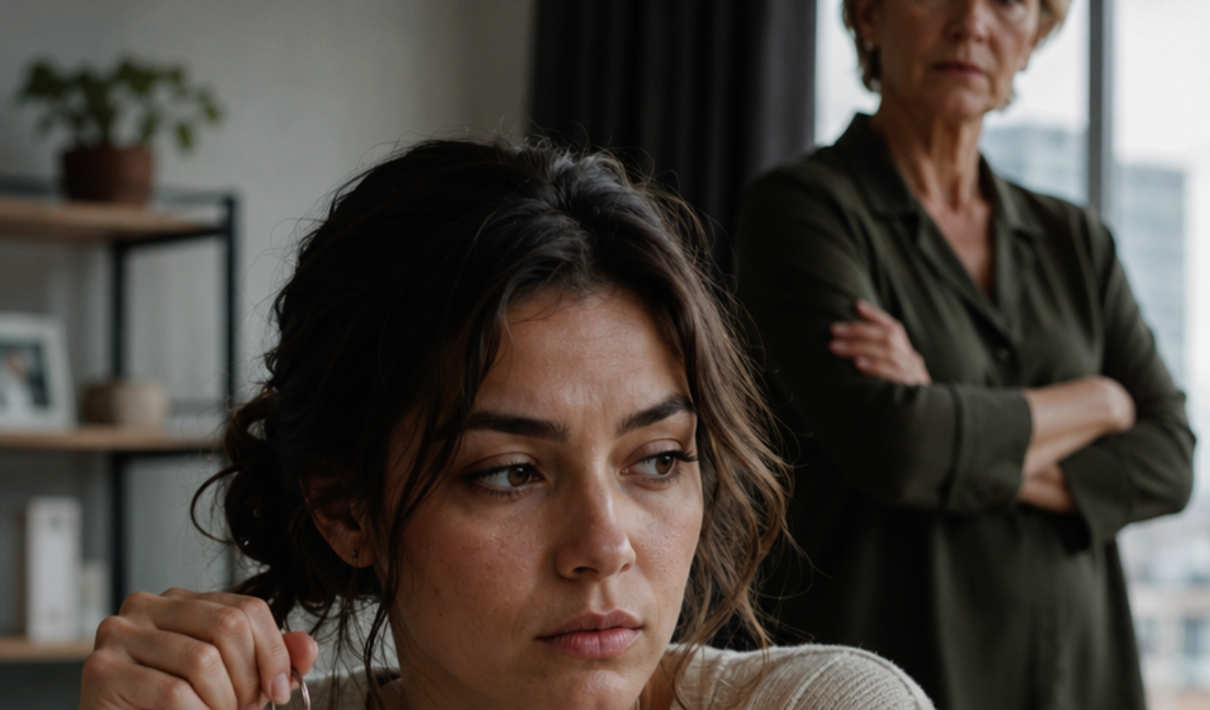
At Her Grandson’s Christening, My Mother-in-Law Announced, “Our Daughter-in-Law Is a Freeloader. She’d Be Starving Without Us.” I Quietly Placed the Keys to Three Apartments on the Table
“ Our daughter-in-law is a freeloader. She’d be starving without us.”
Faina Petrovna did not say it in a whisper. Not into a friend’s ear. Not in the hallway, where no one could hear. She said it at the table, at her grandson’s christening, in front of twenty guests, looking somewhere over my head, as if I were not there at all.
I was sitting across from her. I held a napkin on my lap. Under the table, I clenched my fingers so tightly that my nails dug into my palms.
For twenty-two years, I had been hearing that word.
For twenty-two years, my mother-in-law had said it at different volumes, but always with the same expression on her face. Lips pressed together, gold hoop earrings swaying, her voice like a prosecutor at a hearing. She was not angry. She was stating a fact. As if she were reading out a sentence she had passed long ago, one that was not subject to appeal.
It all began in 2004, when Boris and I got married.
I was thirty. He was thirty-two. The wedding was quiet, in a café for twenty people. Faina Petrovna came in a dark blue suit and gold earrings. Those same earrings. She never took them off — not at home, not at the store, not even at christenings. They were her crown.
The first thing she said to my mother was:
“Well, now we’ll be feeding your daughter.”
My mother smiled. She was not a confrontational person. She worked as an accountant at a clinic and had raised me alone. We had a two-room apartment on Leningradskaya Street, fourth floor, windows facing the courtyard. I grew up there. It smelled of my mother’s face cream and freshly ironed laundry.
Two years later, my mother was gone. Quietly, quickly. She was admitted for tests, and a week later the hospital called.
The apartment passed to me. By inheritance, by law, by documents. At the time, Boris and I were renting a room in a dormitory on the outskirts of town. Sixteen square meters, a shared kitchen, a shower one floor down. We moved into my mother’s two-room apartment that same month.
And then Boris did something I still have not forgiven him for.
He called his mother and said:
“Mom, I got an apartment. A two-room place in Leningradskaya.”
Not “Lida inherited an apartment.” Not “my wife’s apartment.” He said, “I got one.” Briefly and proudly, as if he had stood in line at a housing cooperative and received an official order.
Faina Petrovna hung up happily. Her son was a fine man. Her son was a provider. His wife was attached to him.
I stood in the hallway, leaning against the doorframe. I heard every word. I wanted to correct him. I opened my mouth. Then I closed it. I was thirty-two, I had just lost my mother, and I did not have the strength for a scandal. Not then. Not that day.
“Boris, why did you say that?” I asked him that evening.
“Say what?”
“That you ‘got’ the apartment.”
He shrugged.
“It’ll make Mom calmer. It matters to her to know that I’m doing well.”
“And me?”
He did not answer. He turned on the television.
Twenty years have passed since that day. Faina Petrovna never once asked whose name the apartment was registered under. Why would she? Her son had said it. Boris was the breadwinner. Lidia was the freeloader. The system worked. Why question it?
She came to our home twice a month. Without calling. She opened the door with her own key — Boris had given her a spare set without asking me. I found out when I came home from work and saw unfamiliar shoes in the hallway. Burgundy, low heels. Size thirty-nine. Faina Petrovna was sitting in my kitchen, drinking tea from my cup. My mother’s cup, to be precise. Blue, with a gold rim. The only thing I had left from my mother besides the walls.
“The wallpaper is old,” Faina Petrovna said without greeting me. “Boris, when are you going to renovate?”
That was not addressed to me. I was standing nearby, in the doorway, holding bags from Pyaterochka. But the question was for her son. Because the apartment was supposedly his.
“The curtains are dusty. Have you ever tried washing them?”
That one was for me. Because dust was my area of responsibility. I was the freeloader who could not even wash the curtains.
I would put the kettle on and stay silent. Boris would sit at the table, stirring sugar with a spoon and staring at the wall. When his mother left, he would say:
“Lida, you know what she’s like. Just be patient.”
Twenty-four times a year. For twenty years. Four hundred and eighty visits. I am not exaggerating. At some point, I started marking them on a calendar — on my phone, in an app. Date, time, what she said. Just so I would not begin doubting my own memory. Because when you are told for twenty years that you are nobody, you sometimes start wondering — what if?
No. Not what if.
I am an economist with an honors degree. I worked at two companies, then switched to freelance when Nastya was born. I kept accounts for three sole proprietors. Faina Petrovna knew that, but it did not count.
“She sits at home on the computer” — that was how she phrased it. As if I spent my days scrolling through pictures on Odnoklassniki.
In 2014, Aunt Zoya from Kaluga called me. My grandmother had left me a one-room apartment on Kirova Street. Aunt Zoya lived in her own house outside the city and had no claims to it.
“Take it, Lidochka. Grandma wanted you to have it.”
The notary completed everything in six months. Standard procedure, according to the law. A one-room apartment — forty-one square meters, third floor, freshly renovated. My grandmother had kept the place well in her last years. A nine-meter kitchen, a glazed balcony.
Boris knew. I told him that same evening. He was sitting on the sofa, watching football. I muted the sound.
“I have an apartment in Kaluga now.”
“Mm-hmm.”
“I’m going to rent it out.”
“Go ahead.”
He reached for the remote. I handed it to him and went to the kitchen. He never asked about it again. Not once in twelve years. Not how much rent I received, not how I registered it, not who lived there. Boris was generally uninterested in money unless it was lying in his wallet. It was convenient. And painful. At the same time.
I registered as self-employed. I found tenants — a young couple, quiet, paid on time. Thirty-five thousand a month. Stable. On the fifteenth, a transfer to my account.
Faina Petrovna did not know. Boris did not tell her. Not because he was hiding it — it simply never occurred to him. To him, it was “Lida’s nonsense.” In the same category as laundry, cooking, and parent-teacher meetings.
But every month, I opened my banking app and looked at the number.
Thirty-five thousand.
Mine.
Not Boris’s, not Faina’s, not “ours.” For the first time in a long time, I felt that there was ground beneath my feet. Not shaky. Not borrowed.
Mine.
Five years later, in 2019, I bought a second apartment. A studio in a new building on Sovetskaya Street. Thirty-two square meters, sixth floor, developer’s finish. I had saved from the rent and added my own savings. I registered it in my name. I found tenants — a woman with a school-age daughter. Fifty-five thousand a month.
Total: ninety thousand. Net, after taxes. Two transfers on the fifteenth. To my personal account, which Faina Petrovna had no idea existed.
Because why would a freeloader have an account? A freeloader has no money. A freeloader has a husband who “feeds” her and a mother-in-law who “puts up with” her.
Boris knew about the studio. I told him. He said, “Well done,” and changed the channel. His salary as an engineer at the factory was seventy thousand. My “nonsense” brought in more. But nobody cared.
Faina Petrovna continued coming twice a month. She touched the curtains. Checked the refrigerator. Said, “Boris, when are you going to fix the faucet?” — as if I could not call a plumber myself. Every visit was the same. Twenty minutes of criticism, tea from my mother’s cup, the door slamming shut.
And I stayed silent.
Not out of fear. Out of calculation.
Why did I need a scandal? The apartments were registered in my name. The money was in my account. The documents were in a safe deposit box. Faina Petrovna could say whatever she wanted. Words were air. Air does not pay the mortgage and does not save for retirement.
That was what I thought.
Until the christening.
We have one daughter, Nastya. She is twenty-six, married to Kirill, and gave birth to Timofey in January. The christening was set for March. Nastya asked me to help organize it. I took care of it.
The Kedr restaurant, a hall for twenty-five people. The banquet cost seventy-two thousand. Balloon and flower decorations — twelve. A custom cake, with a little angel and the baby’s name — nine. Total: ninety-three thousand.
Boris contributed twenty.
He said, “I can’t do more, my salary only comes next week.”
I did not argue. I paid the rest — seventy-three thousand. From my own account. From my “nonsense.”
Faina Petrovna did not know. Boris called her and said:
“Mom, I organized everything. The restaurant, the banquet, everything is paid for.”
I was standing in the bathroom, brushing my teeth. I heard it through the door. I spat out the toothpaste. Looked at myself in the mirror. Fifty-two years old. Fine wrinkles around the eyes. Short nails without polish. A straight back — I never slouch. Even when I want to.
On the morning of the christening, I took a dark green dress out of the wardrobe. Four thousand two hundred rubles, bought on sale in November. Not expensive, but good — thick fabric, straight cut, below the knee. I felt comfortable in it. And in it, I was myself. Not someone’s daughter-in-law, not a freeloader.
Just Lidia.
Faina Petrovna arrived at the church by taxi. Burgundy jacket, trousers, and of course, the gold earrings. She walked in, looked me up and down — three seconds, from head to toe — then turned to her close friend Valentina.
“See the dress? Boris probably bought it. She wouldn’t be able to afford anything herself.”
Valentina gave a small snort. She covered her mouth with her hand, as if coughing. But I saw it — it was not polite. She felt awkward.
I was standing two steps away. I heard every word.
I adjusted the bag on my shoulder. Inside, the keys jingled — three sets on one ring. I always carried them with me. A landlord’s habit. Spare keys from both rental apartments, plus my own.
In the church, Faina Petrovna took on the role of organizer. She pushed Nastya away from the baptismal font. She told Irina, Nastya’s friend and the godmother, “Stand here, don’t move.” She even gave instructions to the priest:
“Support his head, Father Mikhail!”
The priest nodded. Apparently, he was used to grandmothers like her.
When Timofey was lifted from the front, Faina Petrovna grabbed him first. Pressed him to herself and announced to the whole church:
“My grandson! Our bloodline!”
Nastya looked at me. Pressed her lips together. I shook my head slightly — not now. Not in church.
I endured it. As I had endured it for twenty-two years. Only this time, the feeling inside me was different. Not the usual dull heaviness. Something sharp and clear. Like when a tooth hurts for a long time and suddenly you realize — it is time to go to the dentist. Enough rinsing.
At the restaurant, the tables were already set. Salads, cold cuts, lemonade for the children. I had checked everything that morning — I arrived at ten, while everyone else was still at church. I adjusted the name cards, moved the vase of tulips closer to the center, asked the waiter to replace a crooked glass. Small things. But a celebration is made from small things.
Faina Petrovna entered the hall and sat at the head of the table. No one objected. Boris pulled out her chair. She looked around the room and nodded.
“Not bad. Boris did his best.”
I sat across from her. I placed my bag on my lap.
The first toast was my mother-in-law’s. She stood, raised her glass, and began speaking. Her voice was loud; without a microphone, you could hear it in the foyer.
“Dear guests! Today is a great day. My grandson Timofey has been baptized. And I want to say a few words about my Boris. He is a fine man. He gave his family an apartment, got everyone on their feet. He carries everything alone. Never complain. Just like his father, Mikhail Sergeyevich — a hard worker, a provider.”
She paused. I looked around the room. Twenty people. Boris’s relatives — Aunt Nyura, his cousin Slava and Slava’s wife. Kirill’s relatives — his mother, his sister. Nastya’s friends. My two former colleagues, Sveta and Olga, with whom I had worked at an auditing firm. They knew how much I earned. They knew about the apartments. Sveta looked at me and raised an eyebrow slightly.
“To Boris!” my mother-in-law finished.
Everyone drank. I took a small sip. Put down my glass. Said nothing.
As I had done four hundred and eighty times before.
Boris looked down at his plate. Twenty-two years of training. Perfect posture with lowered eyes.
Half an hour later came the second toast. Valentina raised her glass.
“To Grandma Faina! The one who holds everyone together and worries about everyone!”
Faina Petrovna blossomed. Her earrings swayed. She accepted the glass, drank, dabbed her lips with a napkin. Then she leaned toward Valentina.
Not in a whisper. No.
In a normal voice. That same voice that could be heard across the entire hall, across the church, across twenty years of my life:
“Our daughter-in-law is a freeloader. She’d be starving without us.”
The room went quiet. Not all of it — the far end of the table kept talking. But our half froze. Nastya stopped with her fork halfway to her mouth. Kirill lowered his eyes. Irina, the godmother, stared at her phone. Sveta and Olga exchanged a quick glance at the same time.
Boris.
Looked.
At his plate.
I placed my napkin on the table. Slowly. Smoothed out a crease.
Twenty-two years. Four hundred and eighty visits. Twenty-four times a year, that word — freeloader. In front of her friends. In front of Valentina. In front of Aunt Nyura. In front of neighbors on the stairwell. In front of the cashier at Pyaterochka, when we ran into each other in line and Faina Petrovna said out loud, “Ah, that’s my daughter-in-law. Without Boris, she’d be lost.”
I would be lost?
With three apartments, ninety thousand a month, and an honors degree in economics?
I would be lost?
I opened my bag. Took out the bunch of keys. Three sets on one ring. I placed them on the table in front of me. The metal clinked against the edge of a plate.
“Faina Petrovna,” I said.
My voice was even. Not loud, but clear.
“Since we’re speaking in front of everyone, may I say something too?”
She turned. Her earrings swayed.
“These keys,” I pointed to the first set, “are for the one-room apartment on Kirova Street in Kaluga. Forty-one square meters. Mine. Inherited from my grandmother. I’ve been renting it out for twelve years. Thirty-five thousand a month.”
Valentina stopped chewing. Aunt Nyura put her glass on the table.
“These,” I pointed to the second set, “are for the studio on Sovetskaya. Thirty-two square meters. Mine. I bought it myself, using the income from the first apartment. I’ve been renting it out for seven years. Fifty-five thousand a month.”
Boris lifted his head. For the first time all evening.
“And these,” I moved the third set closer to my mother-in-law, “are for the two-room apartment on Leningradskaya. Fourth floor. The very one where you have been inspecting my curtains for twenty years. It is not Boris’s, Faina Petrovna. It is mine. Inherited from my mother. The same mother to whom you said at our wedding, ‘Now we’ll be feeding your daughter.’ It is registered in my name. It always has been.”
Faina Petrovna stared at the keys. At the three sets laid out on the white tablecloth next to the salad bowl and the vase of tulips. Then she looked at Boris.
“Boris?”
Her voice was hoarse. Quiet. For the first time in twenty-two years — quiet.
He said nothing. His shoulders slumped, and the collar of his shirt suddenly looked too big. As if he had shrunk right there at the table.
“Ninety thousand a month,” I said. “That is my income. Net. Your son’s salary is seventy. This banquet cost ninety-three thousand. Boris gave twenty. The remaining seventy-three were mine. This dress is mine. Four thousand two hundred rubles, on sale. I bought it myself. Chose it myself. And the freeloader at this table, Faina Petrovna, is not me.”
I gathered the keys from the table. Put them back into my bag. Zipped it closed. My hands were not shaking.
“Would you like me to remind you which of the three apartments you and your son live in? Or do you remember yourself?”
Faina Petrovna sat down.
No — she sank down.
Valentina caught her by the elbow and held her.
The hall was silent. Nastya held Timofey close to her chest. He cooed, not understanding that something around him had just shifted — something that had stood in place for twenty years.
From the far end of the table, Sveta raised her glass and gave me a quiet nod.
Three weeks have passed.
Faina Petrovna does not call. Not me, not Boris at home. Boris goes to see her on Saturdays, alone. He leaves after lunch and returns around nine in the evening. Silently reheat dinner. Silently eat. Silently goes into the room.
We do not argue. We simply do not talk. Not “offended silence” — but the kind of quiet in which each person thinks their own thoughts and does not know how to say them.
Nastya called two days after the christening.
“Mom, Grandma Faina is telling everyone you made a scene. That you disgraced her in front of the parish. That a normal daughter-in-law would never do that.”
“And what do you think?”
“I think twenty-two years is a very long time.”
In three weeks, Boris has not said, “You were right,” or, “Why did you do that in front of everyone?” Not a word. He is silent, just as he was silent for all those twenty-two years. Only before, he was silent when his mother spoke. And now he is silent when he is the one who needs to speak.
Faina Petrovna sent word through Valentina that she would never set foot in “that apartment” again. In my apartment, that is. The very one she had believed was Boris’s for twenty years.
I do not know what hurts her more — that her daughter-in-law turned out not to be a freeloader, or that her son had lied to her for twenty years. Or that everyone knew except her.
The key Boris had given her, she returned through Valentina. In an envelope, without a note.
I put the envelope on the shelf in the hallway. It is still there.
And I sleep peacefully. For the first time in twenty years.
But sometimes, before falling asleep, I wonder: did it have to happen right there? At the christening? In front of twenty people? In front of the priest? It could have been done at home. One on one. Without Valentina, without my colleagues, without Nastya’s friends.
Or maybe it could not have.
I waited twenty-two years for the right moment — and it never came.
Because there is no right moment for the truth.
Did I go too far then? Or did I do the right thing?
How much longer would you have stayed silent?