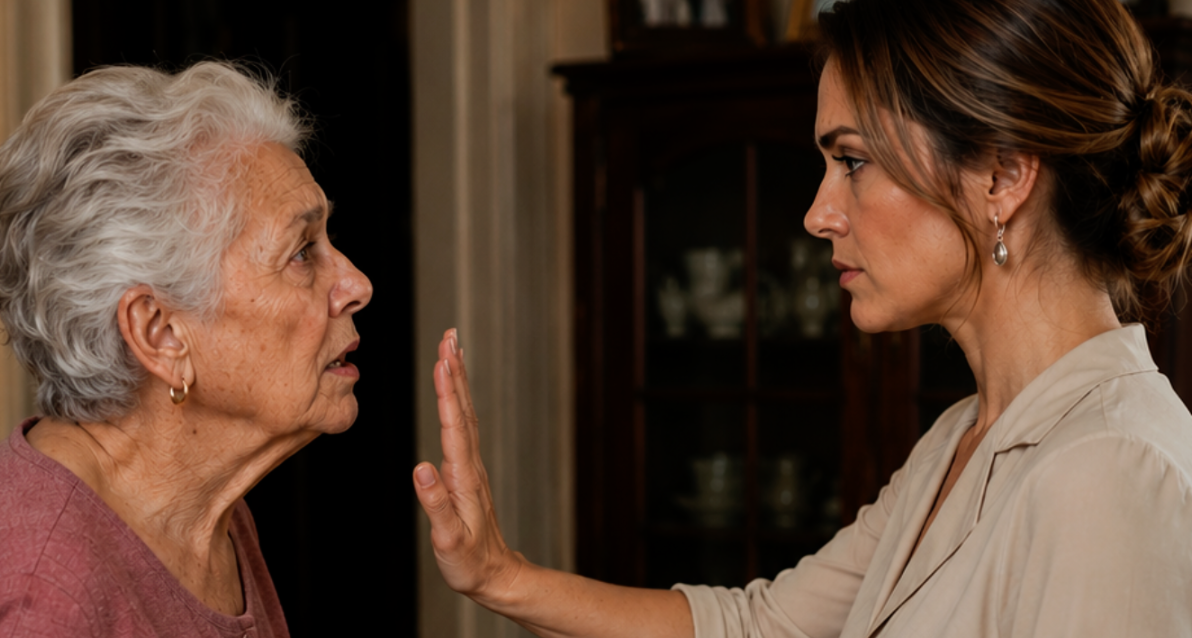
— Your son left you to live with a college student! Go running to her for help! — Katya cut off her former mother-in-law’s impassioned speech.
The lightbulb in the entryway had burned out on Saturday, and all week Katya had been entering the apartment by touch, bumping her shoulder against the coat rack. On Thursday, she finally brought home a pack of three bulbs from Pyaterochka, pushed a stool against the wall—the same one with the shortened leg that they had kept meaning to throw away—and climbed onto it.
The socket was clogged with gray dust. Katya blew on it, squeezed her eyes shut, and sneezed. The burned-out bulb came free with a dry click and remained in her palm, warm from her fingers, with one side blackened like a charred eggshell.
— Sonya, is everything still alive in there? — she called toward the bedroom.
— Alive! — her daughter replied. — Mom, is the Northern Dvina the one that flows into the White Sea?
— Into the White Sea.
— Great. Then I colored it correctly.
The smell of fried onions drifted through the wall. The neighbors’ dinner began at exactly seven and ended at exactly eight every evening; you could set a clock by that smell. Sonya’s mittens were drying on the radiator in the hallway. One lay properly, while the other hung over the edge, dripping onto the linoleum.
Katya was standing on tiptoe and screwing in the new lightbulb when the doorbell rang.
There had been no knock, no message, no phone call beforehand. Just two short, demanding rings, as though the visitor was already in a hurry to go somewhere else.
Katya climbed down from the stool, placed the old bulb on the cabinet, and looked through the peephole.
Nina Pavlovna was standing on the landing.
Katya had seen her only once in the past two years—from a distance at the clinic—and both women had pretended not to notice each other. Now her former mother-in-law stood directly outside the door in a dark-blue padded coat and a knitted hat pulled almost down to her eyebrows. She held an ordinary plastic bag advertising a pharmacy. It was stuffed with documents, the corners of folders pressing against the plastic from inside.
Katya stood there for a second, looking through the round glass. Then she turned the lock.
— Hello.
— Katenka. — Nina Pavlovna took half a step forward, as though she had already been invited inside. — Katenka, please don’t close the door right away, all right? Just listen to me. I understand how this looks. I understand everything; I’m not some kind of fool. I wouldn’t have come at all—you know what I’m like. I’d rather gnaw through something with my teeth than ask anyone for help. But this isn’t even about me. It’s about justice. I worked my whole life. I started at the factory in 1973. Every wall in that apartment, I built with my own hands—
Her voice rose, gathering momentum, and Katya recognized that tone immediately.
That was how Nina Pavlovna had spoken in the kitchen when Sonya was three months old and Katya had not slept for four nights. That was how she had spoken in the car on the way home from the country house while explaining why her daughter-in-law was “not good enough.” That was how she had spoken to Oleg over the phone without lowering her voice, knowing perfectly well that Katya was in the next room.
— And I will not allow them to throw me out of my own home like a dog—
— Nina Pavlovna.
— And I kept thinking, who could I go to, who could I possibly turn to when my son—
— Your son left you to live with a college student! Go running to her for help! — Katya cut off her former mother-in-law’s impassioned speech.
The landing went quiet. Somewhere below, the entrance door slammed and the elevator began to hum.
Nina Pavlovna slowly lowered the bag. Her hands were red and bare, and her fingers gripped the handles so tightly that her knuckles had turned white.
— Yes, — she finally said. — Yes, of course. I deserved that.
She turned toward the stairs.
Katya stared at her back—the dark-blue coat with melting snow on its shoulders—and felt something pull painfully inside her, something unpleasant and sticky.
— Take off your shoes, — she said. — The hallway is dirty. I haven’t washed the floor.
The electric kettle was old. It took a long time to boil and made a noise as though the process hurt it. Katya took out two mugs—her own, with a chipped handle, and the guest mug decorated with cornflowers.
Nina Pavlovna sat on the stool by the window without removing her hat. She stared at the windowsill, where Sonya was growing green onions in an old plastic sour-cream container.
— Sonya is doing her homework, — Katya said. — She doesn’t know you’re here.
— I’m not asking to see her.
— I’m not accusing you of anything. I’m warning you.
— She must have grown.
— She has.
The kettle clicked. Katya poured the boiling water and dropped a tea bag into each mug. The sugar bowl stood on the table, but Nina Pavlovna did not reach for it.
— Talk, — Katya said, sitting opposite her. — Start at the beginning, and spare me the part about how you worked your whole life. I’m not the social security office.
Nina Pavlovna drew in a short breath as though she wanted to object, but she did not.
— He’s selling the apartment, — she said.
— Which apartment?
— Mine. The one on Kirovgradskaya Street.
Katya put down her mug.
— When you say it’s yours, whose name is actually on the documents?
Nina Pavlovna remained silent.
— Nina Pavlovna. According to the documents, who owns the apartment on Kirovgradskaya Street?
— He does, — her former mother-in-law said. — Oleg.
— Since when?
— The year before last.
— So you gave it to him as a gift.
— I did.
Katya leaned back in her chair. From Sonya’s room came a short, cheerful melody from her tablet, which immediately stopped.
— When exactly?
— In March. March second, to be precise.
— March, — Katya repeated. — On March second the year before last, Oleg and I had our second court hearing over the division of property.
— So what?
— Nothing. I’m just confirming the dates.
Nina Pavlovna finally removed her hat. Her hair beneath it was flattened, and the gray roots formed a wide band almost two fingers thick.
— He said, “Mom, put it in my name while that…” — She hesitated. — “While the court case is going on.” He said, “Who knows what she might come up with? What if she tries to claim my share of your apartment?” I said, “Olezhek, my apartment belongs to me. It was privatized in my name. What does she have to do with it?” And he said, “Mom, you don’t understand. Lawyers can do all sorts of things these days. You don’t understand.”
— So you transferred it to him.
— I did.
— Through a deed of gift? An unconditional gift, or were there conditions?
— What kind of conditions?
Katya rubbed the bridge of her nose.
— So it was an unconditional gift. Did the contract preserve your right to live in the apartment for the rest of your life?
— Katya, I don’t understand those words.
— The words are simple. Did the contract contain a clause stating, clearly and in writing, that you retained the lifelong right to live in the apartment?
— They told me that went without saying.
— Who told you?
— Oleg did. And that young woman at the MFC office. She said, “Sign here and here.”
— The young woman at the MFC did not tell you to sign because everything went without saying, — Katya replied. — An MFC employee accepts documents. She does not provide legal advice about the substance of a transaction; she has no right to. She probably said, “Sign the application here, write the date here, and put your signature here.”
— Well, then that must have been what she said.
— Who drafted the contract?
— A friend of his. Some lawyer named Kostya. He sat in our kitchen, drank tea, and then typed it up on his computer.
— How much did he charge?
— Nothing. He did it as a favor.
Katya nodded silently.
— What? — Nina Pavlovna snapped. — Why are you shaking your head?
— It’s nothing. Give me the documents.
The bag lay on the table as Katya took out the papers one at a time.
There was a copy of the deed of gift—two pages, large print, almost no margins. A receipt confirming that the MFC had accepted the documents. An extract from the Unified State Register of Real Estate from two years earlier, listing Kamenev Oleg Viktorovich as the owner. Utility bills for some reason covering eleven months. A medical record. A photocopy of her employment record book, inexplicably included. Her pensioner’s identification card.
Katya spread everything across the table like a game of solitaire and read the contract twice.
— Well? — Nina Pavlovna finally asked.
— The contract is perfectly valid, — Katya said. — Meaning it is completely straightforward. Three substantive clauses, no encumbrances, and no conditions. You gave him the apartment. He accepted it. That’s all.
— What about me?
— Legally, you have nothing. You are registered as living there; I can see the address. But residence registration and property ownership are two completely different things, Nina Pavlovna. Registration does not give you a single square centimeter of the apartment.
— But I live there!
— You live there with the owner’s permission. Oleg is the owner.
Nina Pavlovna turned pale. She picked up her mug, raised it toward her mouth, and put it down again without drinking.
— He told me, “Mom, I will never do anything to you.”
— And he didn’t for two years.
— But now he’s brought her there. — Her voice became hoarse and dropped lower. — On Sunday. He came with her. She took off her boots in my hallway. I have a little mat there that I knitted myself, and she put her wet boots right on it. Then he said, “Mom, we need to talk.” And I understood everything immediately, the moment he said it.
— What did he tell you?
— That the apartment needs to be sold. He said he and Alisa had found a studio in a new building near the bus station and that they would be approved for a mortgage if they could make the down payment. He said I would be better off in a one-bedroom apartment because I couldn’t afford the utilities for a two-bedroom place. He said they would find an option for me. Those were his exact words: “We’ll find you an option.”
— What did she say?
— Nothing. She sat there staring at her phone. She’s twenty-two. Twenty-two, Katya. She is nineteen years younger than my son.
Katya sorted through the utility bills.
— She called me “Nina Pavlovna,” — her former mother-in-law continued. — And addressed me formally. So polite. I thought I was going to hit her.
— It’s good that you didn’t.
— I didn’t.
They were silent for a while.
— Katenka, — Nina Pavlovna said. — This is what you do for a living. You work at Rosreestr. You can reverse it.
There it was, Katya thought. That was the reason for the bag.
— I can’t reverse anything.
— You can. You work there. You have access. You’re a registrar. You can—
— Nina Pavlovna. — Katya placed the bills on the table. — Listen to me very carefully, because I am only going to say this once. I have access to the database. I use it only when it is required for my work. Every action I take is recorded. Every search I perform is visible. If I open the record for your apartment simply because I’m curious, I will face disciplinary action at best. At worst, I could be criminally charged. I will not do it.
— Who would ever find out?
— Everyone would find out. This isn’t a paper archive with a dusty ledger. There is an access log. And even if no one ever found out, I still wouldn’t do it. I have a child, a mortgage, and one professional record that I intend to keep clean for the rest of my life.
Nina Pavlovna turned toward the window.
— So you won’t help me.
— I didn’t say I wouldn’t help. I said I wouldn’t access the database illegally. You can order an extract yourself through the government services portal. An electronic copy costs almost nothing and arrives within twenty-four hours. We need a current one, not this two-year-old document. I need to see what is registered there now.
— What could possibly be there now?
— That’s what we’re going to find out.
Sonya came into the kitchen at half past eight. She was wearing pajamas with reindeer on them and holding her outline maps.
— Mom, what about— — she began, then stopped.
Nina Pavlovna stood up.
— Sonya, — she said.
The girl looked at her and then at her mother.
— Hello, — Sonya said.
— Hello. — Nina Pavlovna suddenly appeared small and fidgety. For some reason, she tugged at the bottom of her sweater. — You’ve grown. You’ve grown so much. You’re eleven now, aren’t you?
— I’ll be eleven in May.
— In May. Yes. I remember it’s in May.
Sonya shifted awkwardly from one foot to the other.
— Mom, I finished the maps. Will you check them?
— Put them on the table. I’ll look later.
Her daughter left. Nina Pavlovna sat down again and suddenly covered her face with her hands, quickly, as though hiding from a bright light.
— Don’t, — Katya said.
— I’m not crying.
— I can see that you’re not crying. Don’t anyway.
Katya stood and poured more hot water into the mugs.
— You haven’t seen her for three years, — she said without turning around. — She called you twice on New Year’s. You didn’t answer.
— I was on Oleg’s side then.
— Sides are for wars. It wasn’t a war. It was a divorce.
— It was a war to me.
Katya put down the kettle.
— I’m going to tell you something unpleasant, — she said. — Sit properly and listen. I’ve been doing this work for twelve years, and I see bags like that one— — she nodded toward the pharmacy bag — two or three times a month. Seventy-year-old people come in carrying copies of deeds of gift and ask how to cancel them. And I have to explain that the law in this area is very brief and very harsh.
— Then explain it.
— A gift can be revoked in three situations. First, if the recipient attempts to kill you or deliberately causes you bodily harm. Second, if the recipient treats the gifted property—which has great nonmaterial value to you—in such a way that it might be irretrievably lost. In ordinary language, that applies to paintings and family heirlooms, not apartments. Third, if the recipient dies before you and the contract expressly states that the gift can be revoked in that situation. Your contract contains no such provision. I checked.
— Is that all?
— That’s all.
— So he can throw me out, and it will be legal?
— He cannot physically throw you out himself. He can file a lawsuit to terminate your right to use the apartment and remove you from the residence register. And yes, he will most likely win. When ownership changes, the former family members of the previous owner lose their right to use the property. You are now considered a former family member of the previous owner, because the previous owner was you.
Nina Pavlovna remained silent for a long time.
— What if I say I didn’t understand what I was signing?
— That is a different legal route. You could challenge the transaction on the grounds of a fundamental misunderstanding, deception, or being in a condition that prevented you from understanding the meaning of your actions. Such cases do exist, and people sometimes win them. But— — Katya raised one finger — the limitation period for voidable transactions is one year. One year from the day you learned, or should have learned, about the relevant circumstances. You signed the contract personally on March second at the MFC. You received your own copy. You signed the receipt. Two years and almost a month have passed.
— But I didn’t know!
— What didn’t you know? That you had given the apartment to your son?
Nina Pavlovna opened her mouth and closed it again.
— Exactly, — Katya continued more gently. — You knew that. What you didn’t know was that he would bring Alisa into the picture. But a court doesn’t ask how you felt. It asks what you signed.
— You’re talking to me like a government official now.
— I’m talking to you as someone who has spent twelve years watching how situations like this end. If you had signed an annuity agreement, things would be different. Under a lifelong maintenance agreement, he would be legally obligated to support you, and if he failed to do so, you could terminate the agreement and take back the apartment. Or you could have used a deed of gift with a clause preserving your lifelong right of residence. Or you could simply have made a will—you would remain the owner while you were alive, and he would inherit the apartment afterward. There were three lawful options, and no one offered you any of them because your document was typed up by Kostya while he drank tea in your kitchen.
— He didn’t mean any harm.
— Who? Kostya or Oleg?
Nina Pavlovna did not answer.
The new extract arrived on Saturday morning.
Nina Pavlovna did not know how to download files, so she came by bus carrying a printed copy. She had gone back to the same MFC and asked the young woman to print it for her, and the young woman had done so.
Katya read it in the kitchen while standing, without removing her apron. Sonya was watching cartoons in her room, and the sound came through the wall—something involving penguins.
Katya reached the section listing encumbrances and stopped.
— All right, — she said.
— What?
— One moment.
She read it again. Then she took out her phone, opened the camera, and photographed the page—not for the database, but for herself.
— Nina Pavlovna, there is a mortgage registered against the apartment.
— What mortgage? He didn’t buy it, he—
— Not the kind of mortgage you’re thinking of. A mortgage is a legal pledge of real estate. It doesn’t necessarily arise when someone buys property. This says it is a contractual mortgage. Registration date: November of last year. The mortgage holder is a private individual, not a bank. A person. Their full name is listed here.
— I don’t understand.
— He borrowed money from a private individual and used the apartment as collateral. Your apartment. The one you live in.
Nina Pavlovna slowly sat down.
— How much?
— The amount isn’t shown in this extract. It only confirms that the encumbrance exists. But it was registered in November. November, Nina Pavlovna. Five months ago.
— He didn’t tell me anything.
— He didn’t tell you about Alisa either.
In the other room, the penguins shouted something enthusiastically in unison.
— All right, — Katya said, sitting down. — Let’s approach this differently. He told you he was selling the apartment to make a down payment on a studio. Correct?
— Correct.
— Now look. If the apartment is pledged as collateral, he cannot sell it without the mortgage holder’s consent. More precisely, it can be sold, but the debt would first have to be repaid from the sale proceeds. That means the apartment is not being sold to buy a studio. It is being sold to pay off the debt.
— What debt? He earns good money! He works for that company. He has always—
— He works for the company, — Katya agreed. — He has always earned money. And for the past seven months, his child-support payments have been three thousand two hundred rubles. I haven’t complained. I’m simply telling you the number.
Nina Pavlovna stared at her without blinking.
— Do you think—
— I don’t think anything. I can see the entry in the register. You will have to do the thinking. You are his mother, after all.
Oleg called on Monday evening. Katya was taking laundry out of the washing machine. Her hands were wet, so she answered with the phone pressed between her shoulder and ear.
— You’ve really outdone yourself this time, — he said instead of greeting her.
— Hello to you too.
— Why are you filling my mother’s head with nonsense?
— She came to me herself.
— She came to you, and what did you tell her? She spent an hour shouting at me over the phone yesterday about some kind of collateral. Where did you even get that information?
— From an extract from the Unified State Register of Real Estate. She ordered it herself, in her own name, through the government services portal. Officially. It cost two hundred ninety rubles. Order one yourself if you want. It will show you the same thing.
There was a pause.
— You accessed the database.
— I didn’t. I didn’t need to. Information about registered encumbrances is publicly available to anyone.
— Katya. — His tone changed. It became warm, almost the way it used to be. — Katya, why are you doing this? You have your life, and I have mine. Mom is my responsibility. I’ll deal with it. You’re interfering and making her nervous. She’s seventy years old.
— Sixty-eight.
— Even more reason to stay out of it.
Katya hung a pillowcase on the drying rack.
— Oleg, you mortgaged the apartment your mother lives in.
— It’s my apartment.
— Legally, yes.
— Not only legally. I invested in it for twenty years. I installed the windows. I enclosed the balcony for her.
— You enclosed the balcony in 2014. I brought sandwiches out to you while you worked.
— Exactly! — He almost sounded delighted. — You remember! So you understand that I’m not going to throw her out onto the street.
— I don’t understand. I stopped understanding what you would or wouldn’t do approximately two years ago.
He exhaled into the phone.
— Listen. I’ll pay everything back. These are temporary difficulties. Alisa and I—
— Don’t.
— What do you mean, “don’t”?
— Don’t tell me about you and Alisa. I’m honestly not interested. I’m interested in only one thing: where your mother will be living six months from now.
— With me, if necessary.
— In the studio near the bus station? Twenty-four square meters, with all three of you?
Silence.
— Katya, are you enjoying this?
She thought about it. She thought honestly for about three seconds.
— No, — she said. — I thought I would. For two years, I imagined her coming to me and what I would say. I even came up with a beautiful line. I said it, by the way. On Thursday, out on the landing.
— And?
— Nothing. It didn’t help.
Nina Pavlovna came again on Wednesday without calling. This time, she brought gifts: a bag of gingerbread cookies and a package of chocolate-coated curd snacks, Sonya’s favorites. Somehow, she remembered.
Sonya took one, said thank you, and returned to her room. Nina Pavlovna watched her leave.
— Is she afraid of me?
— She doesn’t know you. That’s different.
Her former mother-in-law sat on her usual stool by the window.
— I went to see a lawyer, — she said. — A real one. I paid him. Fifteen hundred rubles for an hour.
— And?
— He told me exactly what you did. Almost word for word. He also said that we could try to challenge the transaction on the grounds of misunderstanding, but that the chances were poor. He refused to take the case because he didn’t want to take my money for nothing. He must be a good man.
— He must be.
— I said to him, “Do you understand that I lived in that apartment for thirty-one years?” He said, “I understand.” I said, “I buried my husband while living there.” He said, “I understand, Nina Pavlovna, but the court will have no use for that information.”
She fell silent.
— Do you know what hurts the most? — she said. — Two years ago, I was so certain. I was absolutely convinced that I was doing the right thing. I thought I was protecting my son. From you.
Katya said nothing.
— I said such terrible things about you, — Nina Pavlovna continued. — Things you wouldn’t believe.
— I would believe them.
— I said you had married him for the apartment. I said you had trapped him into marriage. I said you were using Sonya to manipulate him.
— I know. People told me.
— Who?
— Your sister, Raisa Pavlovna. She called me once. For some reason, she was apologizing.
Nina Pavlovna closed her eyes.
— And now I’m sitting here in your kitchen.
— You are.
— And you’re pouring tea for me.
— I am.
— Why?
Katya looked out the window. In the courtyard, a man wearing an orange vest was breaking up the ice near the entrance. The sound of the crowbar reached them with a delay, like thunder following lightning.
— Because I had no one to go to either, — she said. — Back then. And I remember what it felt like.
On Thursday, Katya wrote to Oleg.
She did not call him. She wanted the conversation to remain in writing.
“I propose the following. You remove the mortgage and repay the debt by any means other than selling the apartment on Kirovgradskaya Street. After that, you either sign a gratuitous-use agreement with your mother that preserves her residence registration, transfer the apartment back to her as a gift, or the two of us take her to a notary and arrange what should have been arranged from the beginning. If you fail to do this by the end of May, I will help her file a lawsuit. Not as your former wife. As a person who knows which documents need to be submitted and where.”
He replied two hours later.
“Are you seriously taking her side against me?”
“I am not against you. I am in favor of preventing your mother from ending up in a rented room at the age of sixty-eight.”
“Do you even have the right to interfere?”
“No. I don’t have the right. I’m interfering without one.”
He did not respond. Not that day, and not the next.
On Friday evening, Sonya was making a collage. She was cutting leaves out of colored paper and gluing them onto a sheet of A3 paper. The glue was too watery, the paper kept warping, and Sonya was becoming frustrated.
— Mom.
— Mm?
— That grandmother—is she Dad’s mother?
Katya put down her phone.
— She is.
— Is she going to start visiting us?
— I don’t know.
Sonya glued down another leaf.
— Is she mean?
Katya opened her mouth to give a quick answer, but no quick answer came. She thought about it.
— She’s frightened, — she finally said. — Frightened people often look mean.
— What about Dad?
— What about him?
— Nothing, — Sonya said, pressing the leaf with her palm to make it stick.
Nina Pavlovna called on Saturday at half past ten at night. Her voice sounded strange—flat, far too flat.
— Katya, he came here.
— Alone?
— With her.
— And?
— He brought documents. He says he has found a buyer. He says everything will happen quickly, within a month. He says I need to move out because they have to show the apartment, and I have… — She hesitated. — I have too much clutter. That’s what he called it. Clutter.
Katya stood by the window and looked down at the empty courtyard, at the broken pieces of ice that had never been cleared away.
— Did you sign anything?
— No.
— Are you certain?
— I’m certain. Katenka, I don’t sign anything anymore. I even read my utility bills twice now.
— Good. Don’t sign anything at all, even if he says it’s only a formality. Even if the same Kostya comes with him. Especially if the same Kostya comes.
There was silence on the line.
— Nina Pavlovna?
— I’m here.
— Is there something else?
Katya heard her former mother-in-law take a breath.
— He took my keys, — Nina Pavlovna said. — They were on the table. He said, “Mom, let me keep them for a while so you don’t lose them.”
Katya placed her cup on the windowsill very slowly.
— Where are you now?
— Sitting in the stairwell. On the windowsill between the fourth and fifth floors.
— How long have you been there?
— Since nine.
It was quiet in Sonya’s room. She was already asleep; she had been turning off her own light since she was eight years old.
— Can you call a taxi?
— I have two hundred rubles in my wallet and a bank card, but I forgot the PIN last month and haven’t reset it.
Katya looked at the clock. It was ten forty. The buses were still running, but getting from Kirovgradskaya Street to her apartment required a transfer.
— Stay where you are. Do not leave that windowsill. I’ll order a taxi from my phone and pay with my card. You won’t have to pay anything. You’ll be here in forty minutes.
There was a pause.
— Katya.
— What?
— I feel ashamed.
— So do I, — Katya said. — We’ll survive it.
The taxi arrived at eleven twenty-eight.
Katya stepped out onto the landing in her robe and slippers, with her keys in her pocket. She held the door open because the light in the elevator lobby had burned out again. Only one new bulb remained, and it was still sitting on the cabinet.
Nina Pavlovna came up the stairs on foot.
She was carrying the same pharmacy bag, except that now it contained not only documents but something soft. A knitted green corner protruded from it—apparently the same little mat from her hallway.
She stopped on the final step.
— I’m staying for only one night.
— All right.
— I’ll think of something in the morning. I have Raya. I can go to Raya’s place. She lives in Verkhnyaya Pyshma. There’s a bus.
— All right.
— I won’t become a burden to you, Katya. I have never been a burden to anyone.
Katya stepped aside and allowed her into the dark hallway.
— Take off your shoes, — she said. — I haven’t washed the floor.
She locked the door with two turns of the key, hung the keys on a nail, and went into the kitchen to take out bedding—the blue checked set that had been lying on the upper shelf since the previous winter and smelled like old storage.
Sonya came out of her room barefoot, wearing her reindeer pajamas and squinting sleepily.
— Mom? Who came?
Katya stood holding the bedding and did not answer.
Nina Pavlovna froze in the hallway with one boot removed, holding on to the coat rack.
— Mom, — Sonya repeated. — Is Grandma staying with us?
The phone on the table began to vibrate. Its screen illuminated the dark kitchen with a blue glow, displaying a single word.
“Oleg.”
Katya looked at the phone. Then at her daughter. Then at the woman in the hallway, who was still standing there with one boot on, unable to bring herself to remove the other.
The phone continued to vibrate.