“You Buried Your Mother and Now You’re Already Acting Like the Lady of the House?” My Mother-in-Law Declared After Secretly Using My Apartment as Collateral at the Bank
The call from the bank reached Vera Sergeyevna in the middle of her workday, while she was checking financial statements in the cramped accounting office of the district clinic.
“Good afternoon, Vera Sergeyevna. We are calling to verify the details of a joint application for a consumer loan secured by real estate. The second borrower is Raisa Petrovna Golubeva. The amount is eight hundred thousand rubles. Do you confirm the application?”
The pen slipped from her fingers and rolled across the desk.
The other end of the line was silent except for the distant sound of someone typing. Inside Vera, everything collapsed, as though the floor had disappeared beneath her feet in that stuffy office with its dusty blinds.
“What application?” she asked, her voice trembling despite her efforts to control it. “I didn’t submit anything. Raisa Petrovna is my mother-in-law. You must have made a mistake.”
“The application was submitted online in your name. It includes scanned copies of your passport and the ownership documents for the apartment on Pervomaiskaya Street. Everything matches. You are scheduled to sign the agreement tomorrow.”
Vera slowly lowered herself into her chair.
Pervomaiskaya Street. Her apartment. The two-bedroom apartment she had inherited from her mother, whom she had buried five years earlier. Even now, she could not enter her mother’s former room without feeling a lump rise in her throat.
It was the apartment where every floorboard seemed to remember her mother’s footsteps.
And now someone was using Vera’s passport to try to mortgage it to the bank for eight hundred thousand rubles.
Raisa Petrovna. The mother of her husband, Andrei.
“Do not process anything,” Vera said quietly but firmly. “The application is fraudulent. I will come to the bank today and submit a formal refusal.”
She ended the call and stared for a long time at the wall, where an old calendar with pictures of kittens was hanging. Her heart was pounding so violently that her ears rang.
Who could have taken her passport?
It was kept in a small box in the top drawer of the dresser, together with the apartment ownership certificate. Only one other person had access to it.
Andrei.
They had been married for six years. Andrei worked as a mechanic at an auto repair shop. He had gifted hands and a gentle personality.
Too gentle, as it turned out.
Six months earlier, his mother had moved into their lives with suitcases, boxes, and an unshakable conviction that everything in the apartment would now be done according to her rules.
Vera called her husband. He did not answer immediately.
“Andrei, the bank just called me,” she said, trying to keep her voice steady even though everything inside her was shaking. “Someone applied for a loan in my name using my apartment as collateral. They had scanned copies of my documents. Did you take them?”
A thick, heavy silence hung on the other end of the line. All Vera could hear was his nervous breathing.
“Vera, why are you immediately making such a big deal out of it?” he mumbled in the voice of a guilty schoolboy. “Mom just wanted some security. She needs money for medical treatment, and there’s nowhere else to get it. We would have paid it back gradually. Why are you panicking?”
“You took my passport from the dresser without asking me and gave it to your mother so she could mortgage my apartment. Andrei, that is document fraud. Do you even understand what you’ve done?”
“Oh, stop exaggerating,” he said, his voice growing stronger as he became defensive. “Nobody forged anything. Mom just submitted an application through the online account to see what terms they would offer. She’s trying to help us. She lives with us, cooks for us, and keeps the place tidy. Instead of thanking her, you’re interrogating us again.”
“She has her own apartment on Tikhaya Street!” Vera shouted, no longer able to restrain herself. “She rents it out while living off me and rearranging my belongings however she wants!”
Vera ended the call. Her hands were shaking so badly that she nearly dropped the phone.
Two months.
For two long months, she had endured this nightmare, afraid that one wrong word would destroy her family.
Raisa Petrovna had arrived with an impeccable excuse.
“Verochka, one of my pipes burst and flooded the entire kitchen. The repairs will take at least a month. Could I stay with you for a little while?”
Andrei had looked at Vera pleadingly, and she had given in.
One month turned into two. The repairs at the apartment on Tikhaya Street mysteriously stopped almost as soon as they began, while vigorous changes started taking place in Vera’s home.
Her mother-in-law brought three enormous bags, a box of crystal vases, and an old sewing machine.
She removed the light curtains Vera loved and shoved them into the storage closet. In their place, she hung her own curtains—thick, dark green, and as heavy as the curtains in an old government office.
The room immediately became gloomy and unfamiliar.
Vera’s sweaters and dresses were moved into a cramped corner of the wardrobe.
“You don’t need much space, Verochka. You’re at work all day anyway. I need more room because I own good clothes.”
But the financial situation was even worse.
Vera earned more than her husband, and their household budget depended mostly on her income. Raisa Petrovna began methodically draining that budget.
Every week, there was a new crisis. One week, her joints were aching and she needed an expensive course of treatment. Then it was her teeth. Then she needed glasses costing twenty thousand rubles.
And Andrei silently transferred the money from the same bank account where he and Vera had been saving to replace their old windows.
In two months, more than one hundred thousand rubles had disappeared from the family budget.
Their savings melted away.
Whenever Vera tried to discuss it, Andrei lost his temper.
“You begrudge my mother every last kopeck! She raised me on her own! You’re heartless. Your mother is gone, so you don’t understand what a son’s duty means.”
The words “your mother is gone” always struck the most painful place.
He knew exactly where to hurt her.
Vera would fall silent, swallow her tears, and continue enduring everything, convincing herself that perhaps she really was being too harsh.
But now they had crossed a line.
They had attacked the memory of her mother.
They had tried to take the only thing she had left.
Vera asked to leave work early and went home.
On the minibus, she watched the gray buildings passing outside the window. Instead of fear, a cold, ringing clarity spread through her.
They had simply been using her.
For years, they had molded her into someone convenient, obedient, and permanently guilty.
The apartment smelled of burnt onions and something sour. The entryway was crowded with someone else’s slippers, rubber shoes, and shopping bags.
Vera walked into the kitchen.
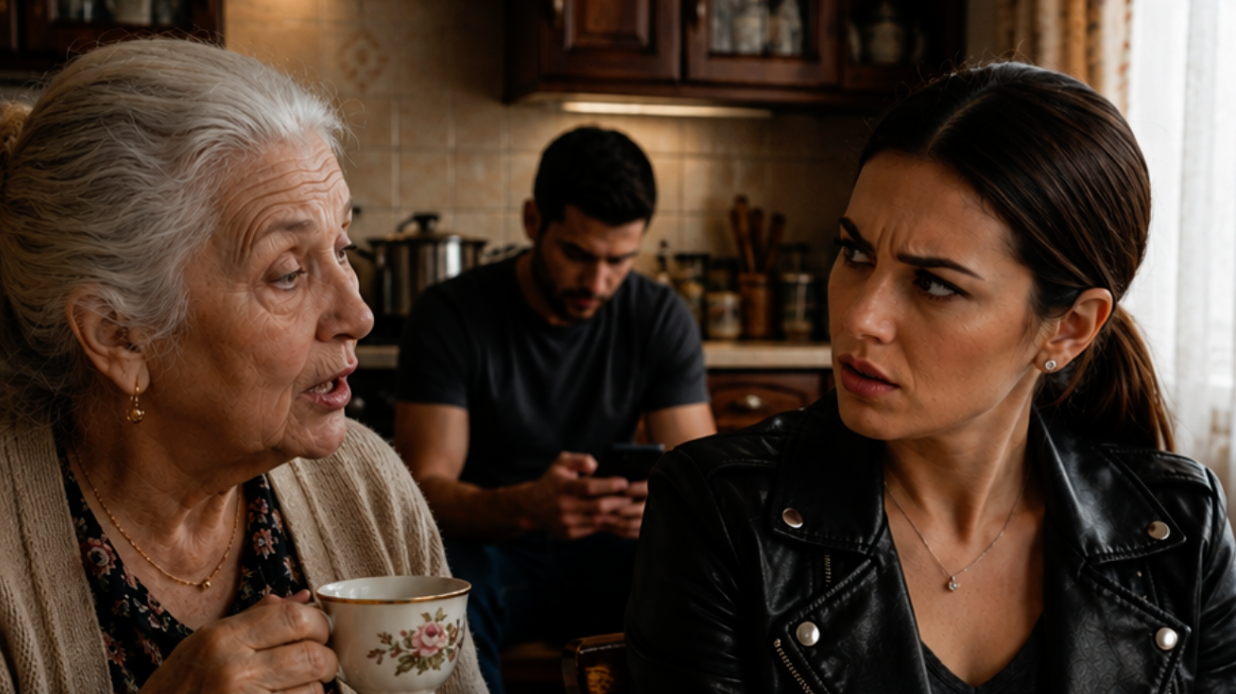
Her mother-in-law was sitting at the table in her usual polka-dot flannel robe, drinking tea from Vera’s mother’s cup—a delicate cup with a gold rim that Vera had specifically asked her not to touch.
A glossy catalog lay open in front of her.
Andrei was perched on a stool in the corner, staring at his phone and nervously bouncing one leg. He did not even raise his head when his wife entered.
“Raisa Petrovna,” Vera said, stopping in the doorway without removing her coat. “The bank called me. Explain to me what gave you the right to take my documents and attempt to mortgage my apartment.”
Her mother-in-law did not flinch.
She slowly took a sip of tea, set the cup down with a sharp clink, and gave Vera her trademark look—heavy and judgmental, combining sugary concern with cold contempt.
“Verochka, why are you shouting from the moment you walk through the door like some market vendor?” she sang sweetly. “I was only making an inquiry. It was purely for information. We’re a family. We have to think about everyone.”
“Who exactly do you mean by everyone?” Vera asked, stepping forward.
“Who do you think?” Raisa Petrovna shrugged. “You’ve been married for six years, and you still don’t have children. You’re always at work and you don’t give Andryusha enough attention. What happens if the two of you separate? Where will my son go? He is registered here, and morally speaking, he has a right to this apartment. As his mother, I have an obligation to protect him.”
“Andrei’s registration is temporary!” Vera’s voice rose. “I inherited this apartment from my mother before we were married. He hasn’t invested a single ruble in it. I pay the utilities. I bought the appliances. Andrei, say something!”
Her husband finally looked up.
There was no guilt or shame in his expression. There was only the dull, stubborn look of a man accustomed to hiding behind his mother.
“Vera, Mom has a point,” he muttered, turning away. “Why are you so possessive about these square meters? I did repairs here. I changed the faucet. Am I some kind of stranger?”
“Your home is on Tikhaya Street!” Vera snapped. “The apartment your mother rents out for forty thousand rubles a month. Raisa Petrovna, you collect rent from tenants, live in my apartment for free, have already taken more than one hundred thousand rubles for your personal needs, and now you want to take my home as well?”
Her mother-in-law changed instantly.
The sugary sweetness fell away like a discarded shell. Her face turned purple, and her lips tightened into an angry line.
She slammed her palm against the table, making Vera’s mother’s cup ring pitifully.
“How dare you count how much I spend?” she screamed loudly enough for the entire apartment building to hear. “I raised my son! I put him on his feet all by myself! And who are you? You have no relatives and no one to support you! You buried your mother and now you’re already acting like the lady of the house! Without my Andryusha, you would be sitting here all alone! A normal wife gives everything to her husband and bows at his mother’s feet! But you’re greedy and empty! You have no warmth, no children—you do nothing except count numbers on your papers!”
Every word struck Vera like a branch whipping across her face.
But the words no longer hurt.
Instead, they made her see everything with absolute clarity.
Vera looked at Andrei. He sat hunched over, picking at a hangnail, clearly agreeing with every word his mother had said.
“All right, then,” Vera said.
She took a deep breath, and an icy calm spread through her.
“Andrei, I saw your messages.”
Both of them froze.
Her husband jerked his head up, his face turning pale.
“You went through my phone?”
“Yes. Because I was tired of not understanding where our money was going. And Raisa Petrovna, I read your wonderful plan. You wrote to your son, ‘We need to mortgage the orphan’s apartment, move the money elsewhere, and gradually force her out. We’ll put the repairs on Tikhaya Street on hold, and later we’ll transfer that apartment to your sister Lena. She needs it more.’ That’s what you discussed, isn’t it?”
“Andryusha!” her mother-in-law roared. “You couldn’t delete the chat, you idiot?”
“Mom, I forgot,” the thirty-year-old man stammered, staring at his mother in terror. “I didn’t think she would figure it out.”
Standing before Vera were two people who had been planning, step by step, to dismantle her life.
They wanted to take the only thing she owned and throw her out onto the street.
“You have two hours,” Vera said quietly, but every word fell like a stone. “I am going to the café across the street. When I return, your belongings must be gone. Leave the keys on the table. If either of you is still here in two hours, I will call the district police officer and file a report for the theft of documents from my dresser and attempted fraud. I have already sent copies of your messages and the recording of my conversation with the bank to a lawyer I know. She knows exactly what to do.”
“You wouldn’t dare!” Raisa Petrovna shrieked, jumping to her feet. “My son is registered here! We’ll take you to court! He has a right to half of this apartment!”
“Go ahead,” Vera replied with a shrug as she opened the door. “I’ll see you in court. Your time starts now.”
She stepped onto the landing and slammed the door behind her.
Immediately, shrieking erupted inside the apartment, followed by a dull thud. Apparently, Andrei had been hit across the back with a bag for failing to finish the job of deleting the messages from his phone.
Vera sat in the café near the bus stop, drinking bitter coffee and staring at the windows of her apartment on the third floor.
Forty minutes later, Andrei emerged from the building, dragging two suitcases behind him. Raisa Petrovna followed with several boxes, hurrying after him and angrily shouting something at his back.
They loaded everything into his old car and drove away.
When Vera returned, the apartment greeted her with an unfamiliar, deafening silence.
They had taken everything they could reach: the new towels, the microwave Vera had bought before the marriage, and the bed linen.
They had torn down the dark curtains along with the hooks.
But the keys were lying on the table.
Her old life was over.
Three weeks later, the real battle began.
Vera’s friend Olga, who was a lawyer, warned her immediately that there would be no quick or beautiful victory. Property division cases dragged on for months, and courts made decisions based on documents, not emotions.
Under pressure from his mother, Andrei filed for divorce and division of marital property.
He did not demand their old television. Instead, his lawyer argued that the apartment on Pervomaiskaya Street should be partially recognized as jointly acquired property.
According to them, during the six years of marriage, Andrei had made “inseparable improvements that increased the value of the property.”
At the hearing, Andrei appeared in a suit his mother had carefully ironed. Wearing a miserable expression, he described how he had supposedly brought his entire salary home, replaced the plumbing and electrical wiring, and refinished the floors.
He claimed that his wife had “destroyed all the receipts after throwing him onto the street.”
He demanded either a share of the apartment or six hundred thousand rubles in compensation.
His mother testified as a witness.
She wept into a handkerchief while describing how her “ungrateful daughter-in-law” had robbed her honest son and thrown him out of his home.
Vera and Olga had an enormous amount of work ahead of them.
There was no miracle. The court did not accept anyone’s word without evidence.
They had to order an independent construction assessment that cost thirty-five thousand rubles. The expert came to the apartment, opened several panels, and inspected the pipes and electrical wiring.
It turned out that the wiring in the hallway was old, with nothing more than a new light switch attached to it.
The faucet was the cheapest model available and was already leaking.
The floors had never been refinished. The old scratches made by Vera’s mother’s furniture were still visible.
The expert report clearly established that the apartment’s value had increased only because property prices in the neighborhood had risen, not because of Andrei’s supposed renovations.
The second battle concerned the money.
Vera submitted bank statements showing that every week she had transferred large amounts to her husband, and that he had sent those same amounts to his mother on the very same day.
But this part of the case ended in a partial defeat.
The court ruled that money transferred between spouses during a marriage was presumed to have been spent on family needs unless there was evidence proving otherwise.
The recording of the kitchen confrontation was admitted into evidence, but the court considered it only indirect proof of the situation within the family.
In the end, the marriage was dissolved, and only property that was genuinely shared was divided.
Andrei kept his old car, while Vera was ordered to pay him twenty thousand rubles for his half of the refrigerator.
However, the court completely rejected his demand for a share of the apartment and compensation for the alleged renovations.
Vera’s ownership of the apartment remained secure.
The legal marathon lasted three months.
Vera lost weight, exhausted herself, and spent all her savings on court fees, the expert assessment, and legal representation.
But when she walked out of the courthouse holding the judgment in her hands, she took a full breath for the first time in six months.
A couple of months later, the predictable consequences arrived.
Raisa Petrovna had become so absorbed in the legal battle that she neglected the tenants in her apartment on Tikhaya Street.
It turned out that the people to whom she had rented the apartment without a formal contract—to avoid paying taxes—had turned it into a storage facility for questionable goods.
An inspection took place.
The apartment was sealed, and Raisa Petrovna received both a fine and a bill for damage to the building’s common property. Her tenants had caused a blockage and flooded the neighbors below.
To pay her debts, Raisa Petrovna had to sell the apartment on Tikhaya Street quickly and at a substantial discount.
After paying the fines, legal claims, and lawyers’ fees, very little money remained.
She and her son moved into a cramped, damp apartment on the distant outskirts of the city, with windows overlooking a row of garages.
Not long ago, Vera was accepting documents from a supplier in the lobby of the clinic when a man wearing a worn jacket walked past her.
It was Andrei.
His face was gray, there were dark circles beneath his eyes, and his hands were trembling.
He no longer spent his time playing computer games. Now he worked double shifts delivering auto parts in order to repay the loans his mother had forced him to take out to cover their debts.
He stopped and awkwardly pressed a folder against his chest.
“Hello, Vera,” he said hoarsely. “I heard they’re promoting you to chief accountant. Congratulations.”
“Thank you, Andrei. How are things? How is Raisa Petrovna?”
“Bad, Vera. Mom has fallen ill, and she complains day and night. She says it’s my fault we lost the apartment because I couldn’t keep my woman under control. My sister won’t speak to us because she was counting on getting that apartment. We live in a tiny hole with windows overlooking garages. There’s no air to breathe.”
He hesitated.
“Vera, maybe we could talk? I miss the apartment on Pervomaiskaya Street. It was quiet and comfortable there. I really do love you. I was an idiot for listening to my mother. Could we get back together? I won’t ask you to register me there again. I promise.”
Vera looked at the thirty-year-old man who had still never learned to take responsibility for himself.
She felt neither satisfaction nor pity.
There was only a clean, peaceful emptiness inside her.
“You know, Andrei,” she said, closing the folder, “you’re right. The apartment on Pervomaiskaya Street is very quiet and comfortable now. I had it properly renovated. I replaced the wiring, leveled the walls, and hung light-colored curtains.
“It smells of coffee and freedom.
“And there will never again be other people’s belongings, stolen documents, or people who look at me as though I were a wallet.
“Goodbye.”
She turned and walked away without waiting for his response.
That evening, the apartment greeted her with the warm glow of a new lamp.
Her mother’s gold-rimmed cup stood on the kitchen shelf—whole, clean, and shining in the rays of the setting sun.
There were no marks from other people’s pictures on the walls, and light tulle curtains moved gently at the windows.
Vera’s life had not ended after the betrayal and the exhausting court battles.
It was only beginning—a life of her own, honest and protected, in which she alone made the rules.