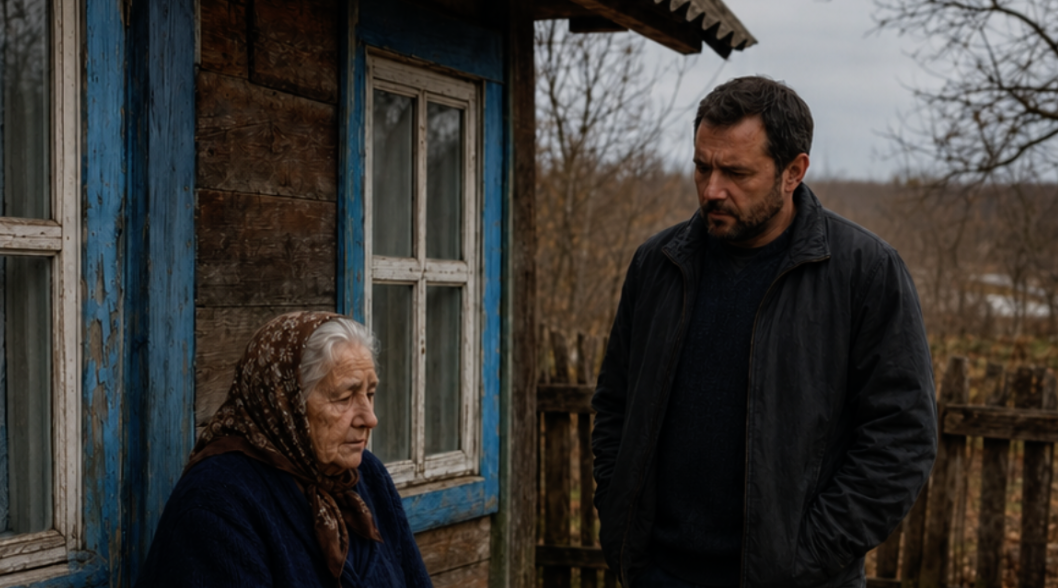
“Why Have You Come Back, Son?” — What a Mother Said to the Son She Had Not Seen at Home for Twenty Years
Aunt Galya called on Tuesday, toward evening, just as Andrei was preparing to close his office.
“Andryusha, you should come. Your mother has become very weak. Her heart is failing badly. The doctor says she may not make it until spring.”
He put down the phone and remained completely motionless for almost another minute. Outside the office window, the streetlights were already glowing. The evening city hummed below, and somewhere in the next room, a telephone kept ringing insistently.
But inside him, something snapped silently, without making a sound, like a tightly stretched string. As though someone had suddenly pulled it—and it had broken.
He had not returned to his native village for twenty years.
Twenty years—almost an entire lifetime.
During that time, he had graduated from a polytechnic institute. He had married. Then he had gone through a painful, drawn-out divorce involving court hearings and the division of their apartment. Later, he married again.
He built a house—not his parents’ old cottage with its slate roof, but a large two-story brick house with a garage spacious enough for two cars. He raised a son, who was now studying at law school. Andrei himself had worked his way up from an ordinary construction foreman to the director of a construction company.
First, he bought one car. Then another. Later, he replaced it with a more expensive model.
In other words, he lived his life.
And all that time, his mother remained in the village.
He sent money regularly. But somehow, he could never find the time to visit.
At first, he called every week. Then about once a month. Later, only at Easter and Christmas. Eventually, he called only when he happened to remember.
He transferred money without fail. Every month, like a mandatory salary payment. As his income grew over the years, so did the amount he sent.
His mother always thanked him briefly, almost apologetically.
“Andryusha, don’t send so much. Even this is more than I need.”
But he continued sending it anyway. It made him feel calmer.
As though he were buying his way out of his guilt.
Every year, he promised himself that he would visit. He truly intended to.
Sometimes his vacation came at the wrong time. Sometimes an urgent project had to be completed at work. Sometimes renovations began at home. Sometimes he had to take his wife to medical treatments. Sometimes his son had swimming competitions.
Life kept catching him by the sleeves and refusing to let go. Every time, there was a new reason why he could not go today, why he should wait, why he would definitely go next summer.
And so twenty years passed. He left early in the morning. The journey took almost the entire day.
At first, he drove along a wide, smooth highway with clearly painted road markings. Then came a narrower regional road covered in patches. After that, the asphalt became old and broken, filled with potholes.
Finally, there was nothing but an unpaved road—dusty and deeply rutted by tractor wheels.
The farther he traveled from the city, the quieter the world outside the window became.
Fields. Forest belts. Scattered villages. Crooked bus stops plastered with faded advertisements. An abandoned farm with a collapsed roof.
He stared out the window and barely recognized these places.
This was supposed to be his native land. He had spent his childhood here, yet he felt as though he had arrived on another planet.
Twenty years had passed, and everything around him had changed.
Although perhaps he was the one who had changed the most.
Beyond the next bend, the village appeared.
His village.
It seemed to have shrunk with age. It had become smaller. Only about thirty houses remained, and nearly half of them had windows boarded shut with crossed planks.
The street was completely deserted.
There was not a single person in sight. Only a reddish-brown dog ran across the road before immediately disappearing into the overgrown bushes.
The house stood exactly where it had always stood.
But it had sunk badly, as though it had grown into the earth. The roof leaned to one side. Parts of the fence had completely collapsed. Along the foundation, nettles had grown almost as tall as a person.
But the windows were clean.
And smoke rose slowly from the chimney.
She was alive.
Andrei turned off the engine and stepped out of the car.
Suddenly, he felt as though his legs no longer belonged to him.
Then he saw his mother.
She was sitting on the old bench beside the gate. She wore the same headscarf he remembered from childhood—dark, patterned with tiny flowers. Her hands rested calmly on her knees.
She sat there, gazing into the distance, toward the road.
As though she had been waiting all this time.
“Hello, Mom.”
His mother slowly raised her eyes to him. She narrowed them.
She recognized him.
But she did not cry. She did not gasp. She did not rush forward to embrace him.
She merely tilted her head slightly and asked quietly:
“Why have you come back, son?” He was taken aback.
“What do you mean, why? I came to see you. To check on you.”
“To check on me,” his mother repeated, as though tasting the words. “You didn’t come for twenty years. And now, all of a sudden, you decided to check on me.”
She stood up slowly and with difficulty, supporting herself with one hand on the bench.
Andrei immediately stepped forward to help her, but his mother pushed his hand away.
“I can manage.”
Then she walked toward the house.
That evening, they sat down at the table.
His mother fried potatoes with onions, brought up a jar of pickles from the cellar, and sliced some bread.
Everything looked almost exactly as it had twenty years ago.
But somehow, the conversation would not come.
Andrei talked. He told her about his work, the city, his son, and his new house.
His mother listened. Occasionally, she nodded. She said almost nothing.
Then, unexpectedly, he realized that she had no interest in the details of his city life.
That world was foreign to her.
Distant. Incomprehensible.
And somewhere deep inside, perhaps even slightly hostile.
“Mom, are you angry with me?”
His mother looked at him for a long time…
Aunt Galya called on Tuesday evening, just as Andrey was preparing to close his office.
“Andrey, you should come home. Your mother has grown very weak. Her heart is getting worse. The doctor says she may not make it until spring.”
He put down the phone and remained completely still for nearly a minute. Streetlights glowed outside his office window, the evening city roared below, and a telephone rang insistently in the next room. But inside his chest, something quietly snapped without making a sound. It was as though someone had suddenly pulled a tightly stretched string until it broke.
He had not visited his native village for twenty years.
Twenty years—almost an entire lifetime. During that time, he had graduated from a polytechnic institute. He had married. Then he had gone through a painful divorce involving court hearings and the division of their apartment. Later, he married again. He built a house—not the clay-walled home of his childhood with its slate roof, but a large two-story brick cottage with a garage for two cars.
He raised a son, who was now studying law. He worked his way up from an ordinary construction foreman to the director of his own building company. First, he bought one car. Then another. Later, he replaced it with a more expensive one.
In other words, he lived his life.
And his mother remained in the village.
He sent her money regularly. But somehow, he could never find the time to visit.
At first, he called every week. Then once a month. Later, only at Easter and Christmas. Eventually, he called only when he happened to remember.
He never missed a money transfer. Every month, like a salary. The amount increased over the years as his own income grew. His mother always thanked him briefly, almost apologetically.
“Andrey, don’t send so much. Even this is more than I need.”
But he continued sending it anyway. It made him feel better.
As though he had paid what he owed.
Every year, he planned to visit. He truly did. But sometimes his vacation came at the wrong time. Sometimes an urgent construction project had to be completed. Sometimes repairs began at home. Sometimes his wife needed to be driven to medical appointments. Sometimes his son had swimming competitions.
Life kept grabbing him by the clothes and refusing to let him go. Every time, there was another reason why he could not go now, why he had to postpone it, why he would definitely visit the following summer.
And so twenty years passed. He left early in the morning. The journey took almost the entire day.
At first, there was a smooth, wide highway with clear lane markings. Then came a narrower regional road covered in patches. After that, the old asphalt became broken and riddled with deep potholes. Finally, he reached a dusty dirt road marked by deep tractor tracks.
The farther he traveled from the city, the quieter everything became outside his window.
Fields. Forest belts. Scattered villages. Crooked bus stops covered with faded advertisements. An abandoned farm with a collapsed roof.
He looked out of the window and failed to recognize any of it. This was supposed to be his homeland, the place where he had spent his childhood, yet it felt like another planet.
Twenty years had passed, and the world around him had changed.
Or perhaps he was the one who had changed.
Beyond the next bend, the village appeared.
His village.
It seemed to have shrunk. It had become unbelievably small. There were only about thirty houses, and half of them had windows boarded up with crossed planks.
The street was deserted. Not a single person was in sight. Only a reddish-brown dog ran across the road and disappeared into the overgrown bushes.
The house still stood in the same place. But it had sunk noticeably and seemed to have grown into the earth. The roof was crooked. Parts of the fence had fallen over. Nettles almost as tall as a person grew along the foundation.
But the windows were clean.
And smoke rose from the chimney.
She was alive.
Andrey turned off the engine and stepped out of the car. For some reason, his legs felt strange and unsteady.
Then he saw his mother.
She was sitting on a bench near the gate. She wore the same headscarf he remembered from childhood—dark fabric covered with tiny flowers. Her hands rested on her knees.
She sat there looking down the road.
As though she had been waiting.
“Hello, Mom.”
His mother slowly raised her eyes toward him. She narrowed them slightly.
Then she recognized him.
But she did not cry. She did not gasp. She did not rush forward to embrace him.
She merely nodded and quietly asked:
“Why did you come back, son?” He was taken aback.
“What do you mean, why? I came to see you. To check on you.”
“To check on me,” his mother repeated, as if testing the unfamiliar words. “You didn’t come for twenty years. And now you suddenly decided to check on me.”
She stood up slowly and with difficulty, supporting herself with one hand against the bench.
Andrey stepped forward to help her, but she pushed his hand away.
“I can manage.”
Then she walked toward the house.
That evening, they sat down at the table. His mother fried potatoes with onions, brought a jar of pickles from the cellar, and sliced some bread.
Everything was almost exactly as it had been twenty years earlier.
Only their conversation refused to flow.
Andrey spoke about his work, the city, his son, and his new house. His mother listened. Sometimes she nodded, but she barely responded.
Suddenly, he understood that she was not interested in hearing about his life in the city. That life was distant and incomprehensible to her. In some ways, it even seemed foreign and hostile.
“Mom, are you angry with me?”
His mother looked at him for a long time.
“No, I’m not angry. I’m not the kind of person who can stay angry for long. It’s just…”
She fell silent, trying to find the right words.
“I simply stopped waiting for you. I thought that was it. I thought I no longer existed for you.”
“Mom, why would you say something like that?”
“What else am I supposed to say? Twenty years is a long time. I’m completely alone here. In the summer, it isn’t so bad. There’s the vegetable garden, the chickens, and always something that needs to be done. But in winter, the snow nearly reaches the windows, and everything around me is silent.”
She looked down at her hands.
“It became so quiet, Andrey, that I started talking to the walls.”
He said nothing.
“At first, I pretended I was talking to you. I would ask, ‘Andrey, how are you doing over there?’ Later, I simply talked out loud because I had begun to forget the sound of my own voice. Sometimes an entire week would pass without me saying a single word.”
Andrey lowered his head. “Mom, come with me. Come to the city. I have a large house. There’s enough room for everyone. There are good doctors there. You can live close to me.”
His mother smiled sadly.
“The city? What would I do there? Sit and stare through the window at the neighbor’s fence? There wouldn’t even be anyone to talk to.”
“You could talk to me.”
“To you?” She shook her head. “You’re at work all day. Your son is in the capital. And your wife… Who is she to me? She’s a stranger.”
She remained silent for a moment.
“My friends are here. Aunt Galya. Aunt Nina. We have lived beside one another for fifty years. Your father’s grave is here. The forest, the pond, and my vegetable garden are here. This is my life, son. In the city, I would die within a month—from loneliness.”
Andrey wanted to argue, but he could not.
Because his mother was telling the truth. That night, he could not sleep.
He lay on his old bed and stared at the ceiling. The wooden boards were the same. Even the knot in the wood that resembled a bear was still there. As a child, he had always looked at it before falling asleep.
The wallpaper was unchanged too—faded, with pale flowers.
Everything seemed to have remained in its place.
Only he had become a different person.
Then the memories began returning.
He remembered running to the pond as a boy to catch crucian carp.
He remembered his mother taking him to school for the first time, carrying an enormous bouquet of gladioli tied with a ribbon.
He remembered having tonsillitis and how she stayed awake through the night, giving him hot milk with honey.
He remembered leaving for the city to study. She had stood on that same porch, crying and making the sign of the cross as he walked away.
He had promised her:
“Mom, I’ll come home often.”
At the time, he had sincerely believed it.
Then came the polytechnic institute. The student dormitory. His first job. His first wife. The painful divorce. His second wife. His son. Home renovations.
Once a year, there was a vacation, always somewhere by the sea—anywhere except his native village.
There was never enough time left for his childhood home.
Every year, he told himself, “Next summer, I’ll definitely go. I promise.”
He sat up in bed.
A large yellow moon hung low outside the window. The room was so quiet that he could hear his own heartbeat.
And Andrey began to cry.
He cried silently, sitting on the edge of the bed, because he had suddenly realized that nothing could be restored.
His mother was fading away. The house was falling apart. His childhood had ended long ago.
And he alone was responsible.
Not his work.
Not his circumstances.
Not life.
Him.
Because it was always possible to find the time. He could have simply gotten into his car and driven there. He could have taken a vacation. He could have postponed everything else and spent at least a few days beside her.
But he had not done it.
Not once in twenty years. In the morning, he went outside.
His mother was already busy near the stove. She saw him but said nothing. She merely looked at him.
He noticed that her eyes were red from crying.
She had not slept that night either.
“Mom,” he said. “I’m staying.”
His mother froze.
“What do you mean?”
“I’m taking a month off work. Unpaid leave. Then we’ll see. We’ll repair the house. Put up a new fence. Replace the roof.”
“Andrey, what about your work?”
“Work can wait. I’ve given it twenty years of my life. It will survive one month without me.”
His mother remained silent.
Then she slowly approached him. She took his hand between her old, rough, warm palms and pressed it against her cheek.
“Thank you,” she said. “But you’re not doing this because you feel sorry for me, are you?”
“Not because I feel sorry for you, Mom. Because I love you. I simply didn’t understand that before.”
His mother nodded.
Then she suddenly began to cry.
For the first time in all those years, she cried in front of him. She pressed herself against her son and wept quietly, the way elderly people do.
He wrapped his arms around her.
They remained standing together for a long time in the middle of the empty yard beneath the gray autumn sky. He took another month away from work.
He brought construction materials. He replaced the roof, repaired the fence, and installed new insulated windows so that cold air would not come through them in winter.
His son came to visit for the weekend, looking gloomy and irritated.
“Dad, why are you still stuck here?”
But by evening, his mood had softened. He sat beside the pond with a fishing rod and said nothing.
Later, he announced that he would come back the following weekend.
Andrey’s mother came back to life.
It was an extraordinary thing. The doctors later said that her heart had not changed and that her diagnosis had not disappeared.
But she began moving more quickly.
In the mornings, she quietly sang to herself again, just as she had in the past.
She began laughing more often.
“Why did you come back, son?” she asked him one evening.
“I already told you…”
“No. Not why you came that first day. Why are you here now?”
Andrey remained silent for a long time.
Then he answered:
“Mom, my entire life, I thought the most important things were work, a house, money, and a car. But the most important thing was here all along. You. This place. And I missed everything. Almost everything. Now I want to make it in time. At least for a little while.”
His mother nodded.
“You will.”
They sat together on the bench near the gate, watching the sun slowly sink behind the forest.
Neither of them spoke.
And that silence was more precious than any words.