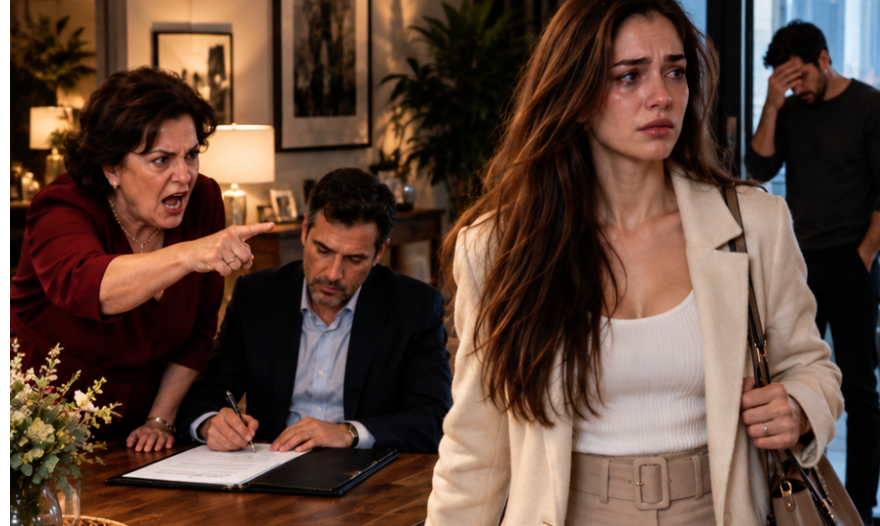
“You’ll be poor without him, you penniless nobody,” my mother-in-law sneered.
A week later, my husband stood outside my door holding wilted roses, begging me to come back.
By then, it was already too late.
My name is Olga. I’m thirty-two, and for seven years I was married to Anton.
For seven years, I convinced myself that marriage meant patience, sacrifice, and compromise.
What I didn’t understand was that I wasn’t compromising.
I was disappearing.
When Anton and I first met, he seemed perfect. He was funny, generous, affectionate, and always knew exactly what to say. He told me I was beautiful. He told me I was smart. He told me he couldn’t imagine his life without me.
Six months later, he proposed.
I believed I was lucky.
Then I met his mother.
Nina Petrovna looked me over from head to toe the first time we met and said, right in front of Anton:
“So this is her? I don’t understand what you saw in her.”
Anton laughed awkwardly.
I smiled.
Back then, I thought she was simply protective of her son.
I told myself she would eventually accept me.
She never did.
After the wedding, Anton and I moved into an apartment that his mother constantly referred to as “ours.”
She lived two buildings away.
At first, she visited occasionally.
Then she started coming every day.
She inspected my cooking, criticized the laundry, complained about the way I cleaned, and even told me how I should talk to my own husband.
Anton never defended me.
Sometimes, if she went too far, he would quietly say:
“Mom, enough.”
But his voice was so weak that she barely acknowledged him.
I worked as an accountant at a small company and earned a decent salary.
But my entire paycheck went toward household expenses.
Anton earned more than I did, yet somehow his salary remained “his money,” while mine became “family money.”
His mother thought this was perfectly normal.
“You should be grateful my son tolerates you,” she often told me. “Who else would want you?”
At night, I cried silently into my pillow.
In the morning, I got up, made breakfast, and acted as if everything was fine.
The argument that finally changed everything started over a pair of shoes.
My old work shoes had practically fallen apart.
So I bought a new pair on sale for fifteen hundred rubles.
They weren’t expensive.
They weren’t luxurious.
They were simply necessary.
Still, I hid the box in the closet because I knew what would happen if Nina Petrovna found it.
Of course, she did.
She came into the hallway holding the box as though she had discovered stolen jewelry.
“What is this?”
“Shoes,” I answered.
“You bought shoes?”
“My old ones are falling apart. My feet get wet when it rains.”
She threw the box onto the floor.
“Do you have any idea how much everything costs? Utilities, food, medicine? Anton spent money on my medication yesterday, and you’re wasting money on shoes?”
“I paid with my own salary.”
She stared at me.
“Your salary belongs to this family. You live in my son’s apartment. You eat his food. Without him, you’re nobody.”
Anton came out of the bedroom.
“What’s happening?”
His mother immediately turned to him.
“Look at your wife! She’s spending your money on unnecessary things!”
“I paid for them myself,” I said.
Anton looked at me without sympathy.
“Olga, why now? You know things are difficult. Mom needs medicine. The car needs repairs.”
“I needed shoes.”
“You could have waited another month.”
Something inside me broke.
Not loudly.
Not dramatically.
It simply broke.
“I’m tired,” I said.
His mother laughed.
“Tired? Of what? You have a home. You have food. You have a husband. What else do you need?”
“Respect.”
She laughed even harder.
“Respect has to be earned.”
I looked at Anton.
For once, I wanted him to say something.
Anything.
“I work,” I said. “I cook. I clean. I give everything I earn to this household. I haven’t spent anything on myself in years.”
Anton shrugged.
“So what? You live here. Those things are your responsibility.”
“Our responsibility,” I corrected him.
His mother smirked.
“This apartment isn’t yours anyway.”
I froze.
“What?”
“It belongs to me,” she said. “Anton only lives here.”
I turned to my husband.
“You knew?”
He avoided my eyes.
“Yes.”
“And you never told me?”
“Why would you need to know?”
That question hurt more than everything else.
His mother crossed her arms triumphantly.
“You see? Without my son, you have nothing. Divorce him and you’ll end up on the street. You’ll live in poverty.”
I looked at Anton.
“Sign the divorce papers.”
His face changed instantly.
“What?”
“If I mean nothing to you, then sign them.”
His mother jumped in immediately.
“Sign! She’s bluffing. She’ll crawl back in a week.”
Anton hesitated.
“Olga, where would you even go?”
“That’s no longer your concern.”
I wrote out a divorce application and pushed it toward him.
“Sign.”
His hand trembled.
For the first time, he seemed afraid.
But by then, I had nothing left to say.
His mother grabbed the pen impatiently.
“Give it here!”
She shoved the paper back toward me.
“Now get out.”
I packed one suitcase.
Jeans.
Shirts.
Documents.
A few personal things.
At the top, I placed an old graduation photo of myself at twenty-two, smiling as though the future belonged to me.
I looked at that young woman and barely recognized her.
Anton stood in the hallway as I left.
“Goodbye,” I said.
He said nothing.
I took a bus to my mother’s small apartment on the outskirts of the city.
The moment she opened the door, she understood.
“I left him,” I said.
She hugged me.
That was when I finally cried.
That night, lying on a folding bed, I kept hearing Nina Petrovna’s voice in my head.
“You’ll live in poverty without him.”
I stared at the ceiling.
Then I whispered:
“I’ll prove you wrong.”
The next morning, I updated my résumé.
Before marriage, I had been good at my job. Very good.
I called Lena, a former colleague.
When I told her I was looking for work, she almost shouted with excitement.
“Our accountant just left. Come tomorrow! The boss remembers you.”
The next day, I went to the interview wearing black trousers, a white blouse, and the same shoes that had caused the argument.
They suddenly felt like a symbol.
My old boss offered me a position immediately.
The salary was forty-five thousand rubles.
I nearly cried.
For the first time in years, that money would actually be mine.
The first month was exhausting.
I woke up early, traveled across the city, relearned systems, corrected reports, and worked harder than everyone expected.
Some colleagues doubted me.
But after two weeks, I completed a quarterly report that no one else had managed to fix.
My boss called me into his office.
“You’ve impressed me,” he said. “We’re opening a new branch. I need a chief accountant.”
I stared at him.
“Me?”
“You.”
I accepted.
That evening, I bought myself coffee and cake.
Such a small thing.
But sitting in that café, paying for something without asking permission, I almost cried from happiness.
Soon, I rented my own apartment.
I bought myself a coat.
I started a small social media page where I wrote about rebuilding your life after being made to feel worthless.
I never used names.
But people understood.
Women wrote to me saying my posts gave them courage.
For the first time in years, I felt visible.
Then Anton called.
“Olga, please don’t hang up.”
“What do you want?”
“I made a mistake.”
I said nothing.
“Mom pressured me. I didn’t understand what I was doing.”
“You understood perfectly,” I replied. “You watched her humiliate me for seven years.”
“I want you back.”
I agreed to meet him once.
When I arrived at the café, he looked exhausted.
There were wilted roses on the table.
“I’ve changed,” he said. “I’ll stop letting Mom interfere. We’ll move away. We’ll start again.”
I shook my head.
“It isn’t about your mother anymore.”
“Then what is it about?”
“Trust.”
He stared at me.
“You lost mine.”
He reached for my hand.
“I love you.”
I pulled away.
“I loved you too. But you taught me that love without respect means nothing.”
At that moment, Dmitry, a colleague from work, approached our table.
He smiled and kissed my cheek.
Anton’s expression hardened.
“Who is that?”
“My colleague.”
Later, Anton accused me of replacing him too quickly.
I almost laughed.
He had signed the divorce papers.
He had allowed me to be thrown out.
And somehow, he still expected me to wait for him.
I didn’t.
The divorce became official one month later.
Outside the registry office, Nina Petrovna was waiting.
She looked at my coat, my confidence, my new phone.
“You’ll regret this,” she said. “Without Anton, you’re nobody.”
I smiled.
“I’m a chief accountant now. I earn more than your son. I rent my own apartment, and I have people in my life who respect me.”
Her face went pale.
“You’re lying.”
I showed her a photo from my new office.
She stared at the screen.
I put my phone away.
“You were right about one thing,” I said. “The woman you threw out that day had almost nothing.”
She smiled faintly.
Then I continued.
“But she doesn’t exist anymore.”
Six months later, I bought my own apartment with a mortgage.
Dmitry helped me move.
Anton stopped calling.
Through mutual friends, I heard that he sold his car to pay debts and remained living with his mother.
I didn’t celebrate their problems.
I simply stopped caring.
One evening, I was walking with Dmitry when I noticed Anton across the street.
He stared at me.
I looked at him for only a second before turning away.
That night, a message came from an unfamiliar number.
“I still love you.”
I read it twice.
Then I replied:
“I don’t love you anymore. I don’t regret leaving. I hope you find happiness.”
I blocked the number.
Later that evening, I wrote one sentence on my page:
“A year ago, they called me a penniless nobody. Today, I bought my own apartment.”
Within an hour, hundreds of people responded.
I sat in my own kitchen, holding a cup of tea, reading their messages.
And for the first time, I understood something clearly.
Nina Petrovna had been wrong.
I hadn’t become poor without her son.
I had become free.