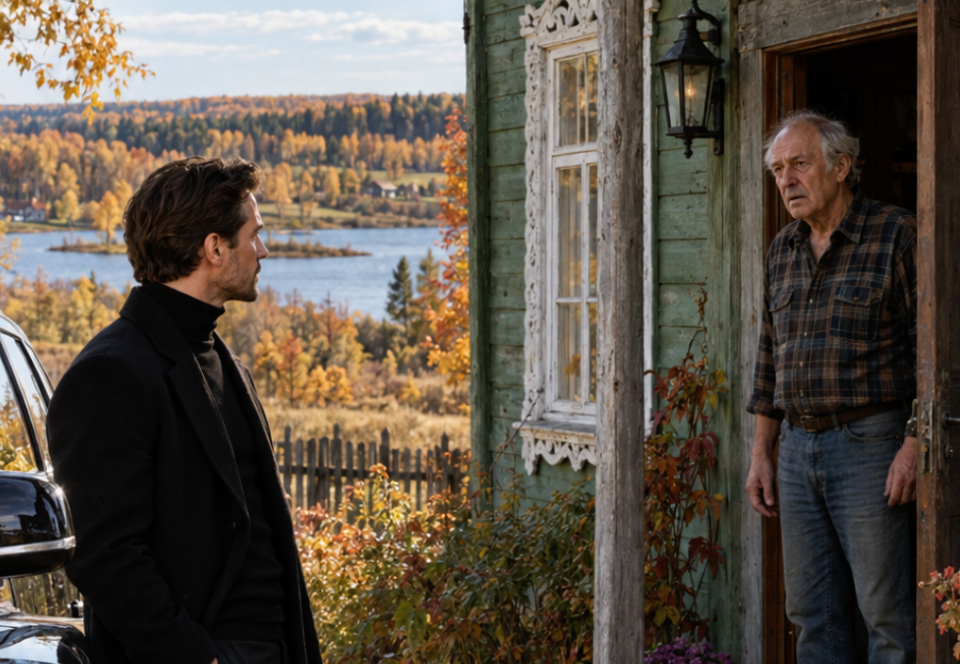
Sergey Viktorovich turned off the highway onto a narrow dirt road and almost immediately regretted it.
His new black SUV bounced over potholes while branches scraped against the doors. Dust rose behind him in thick clouds, and with every jolt his irritation grew.
“What kind of place is this?” he muttered. “Who would buy a house this far from civilization?”
The realtor had insisted the property was worth seeing. The house was solid, stood near a river, and was being sold unusually cheaply because the owner urgently needed money.
Sergey had asked why.
“Apparently he’s moving,” the realtor had replied. “Don’t worry. The paperwork is clean.”
Still annoyed, Sergey continued along the broken road until the forest suddenly opened.
He slowed down.
Ahead stretched a wide meadow flooded with June sunlight. Beyond it glittered a quiet river, and near the water, beneath tall old birch trees, stood a wooden house.
The timber had darkened with age, but the property was clearly well cared for. The porch had been repaired, the windows freshly painted, and the fence stood straight.
Sergey smiled despite himself.
“For a place like this,” he said quietly, “the road might be worth it.”
He parked near the gate and called out.
“Hello! Anyone home?”
The door opened.
A short, slightly stooped man stepped onto the porch. He wore an old plaid shirt and faded jeans. His hair was thinning, his face weathered.
Sergey automatically extended his hand, then froze.
There was something familiar about the man’s eyes.
“Hello,” the owner said. “You’re Sergey? The realtor called.”
The voice was familiar too.
Sergey studied him.
“Yes. And you are…?”
“Nikolai. Just Kolya.”
The name struck him like a blow.
Kolya Odintsov.
School.
The first desk by the window.
Thirty years earlier, Sergey had been simply Seryozha Kapustin—the confident, loud boy everyone noticed. His father held an important position, Sergey always had new clothes and pocket money, and he had quickly learned how much influence popularity could give him.
Kolya had been his opposite.
Thin, pale, quiet.
His mother worked as a cleaner at the school. He had no father. His clothes were often secondhand, and his cheap glasses were held together with blue tape.
And Kolya stuttered.
When calm, it was barely noticeable. But when embarrassed or frightened, speaking became almost impossible.
Sergey had discovered this weakness and turned it into entertainment.
At first it had been teasing.
Then it became cruelty.
He imitated Kolya’s stutter in front of the class. He hid his glasses and watched while the nearsighted boy crawled around searching for them as everyone laughed.
Sergey even invented the humiliating nickname the class began using instead of Kolya’s real name.
Worst of all, once Sergey hid several balls from the physical education teacher and blamed Kolya.
The teacher shouted at him.
Kolya tried desperately to explain, but nervousness made his stutter so severe that he could barely speak.
Everyone laughed.
Sergey laughed loudest.
After eighth grade, their lives separated completely.
Sergey’s family moved away after his father was promoted. Sergey entered a good school, later attended university, went into business, and became wealthy.
He married, divorced, married again.
Life moved forward.
During all those years, he had barely thought about Kolya.
Now Kolya stood directly in front of him.
“C-come inside,” Nikolai said.
The slight stutter was still there.
Sergey noticed it immediately.
They entered the house.
Everything was simple but warm and carefully maintained. Wooden walls, geraniums on the windowsills, family photographs, neatly stacked firewood near the stove.
Sergey looked around.
“It’s a good house. Did you build it?”
“My grandfather did. I’ve just taken care of it.”
“Why sell it?”
Kolya hesitated.
“I need money for my son.”
“What happened?”
“He’s applying to university in the capital. He wants to study programming. If he doesn’t get a state-funded place, we’ll have to pay tuition.”
Kolya smiled slightly.
“He’s smart. Not like me.”
The sentence made Sergey uncomfortable.
“And you? What do you do?”
“I work at the village administration. Paperwork. Fifteen years.”
Sergey suddenly imagined Kolya’s entire life.
A difficult childhood.
Poverty.
The stutter.
A quiet job in a village.
A wife.
A son.
And now he was prepared to sell the house his grandfather had built so his child could have opportunities he never had.
Sergey looked at him.
“Kolya… do you remember me?”
Nikolai raised his eyes.
Sergey immediately knew the answer.
“Of course,” Nikolai said quietly. “S-Seryozha Kapustin.”
Sergey swallowed.
“I wanted to say—”
“Don’t,” Kolya interrupted. “It was a long time ago.”
“You forgot?”
Kolya looked at him.
“No.”
The answer was calm.
“But it doesn’t matter anymore.”
They walked outside toward the river.
Sergey looked at the house, the birches, the fence, the water.
He had arrived believing he was the successful one.
But standing there, he suddenly wondered what success really meant.
“Kolya,” he said, “I’ll pay your full asking price. No bargaining.”
Nikolai frowned.
“Why?”
“Because I owe you.”
“You don’t.”
“I treated you terribly.”
Nikolai was silent for a moment.
“You were a child,” he finally said. “Cruel, yes. But still a child. Children can be cruel.”
“And you forgave me?”
“Yes.”
“When?”
“About ten years ago. After my son was born.”
Kolya looked toward the river.
“I looked at him and thought maybe one day someone would hurt him. Or maybe he would hurt someone else. Then I realized the most important thing isn’t what happens to you when you’re young. It’s what kind of person you become afterward.”
He turned back to Sergey.
“I decided I didn’t want to spend my life angry.”
Then he asked quietly:
“And what kind of person did you become?”
The question hit Sergey harder than any accusation could have.
Successful?
Yes.
Rich?
Certainly.
But kind?
He had never really asked himself.
“I don’t know,” Sergey admitted.
“Then think about it,” Kolya said. “It’s not too late.”
They agreed on a price, and later sat beside the river.
Kolya spoke about his family.
His grandfather had planted the birches after returning from the war. His mother was still alive but ill. His wife, Natasha, worked as a paramedic.
But his face changed completely when he talked about his seventeen-year-old son, Alyosha.
“He recently won the district mathematics competition,” Kolya said proudly. “He’s really talented.”
Sergey listened and suddenly saw the man beside him differently.
Kolya was not weak.
He had survived humiliation, poverty, and years of being underestimated.
Yet he had built a family.
Raised a talented son.
Protected his grandfather’s home.
And somehow found the strength to forgive.
Sergey felt ashamed.
By evening he returned to his SUV.
He started the engine.
Then turned it off again.
“Kolya!”
Nikolai was still standing near the gate.
Sergey walked back toward him.
“I’m not buying the house.”
Kolya stared at him.
“What?”
“You shouldn’t sell it. Your grandfather lived here. Your family belongs here.”
“But I need the money.”
“I’ll lend it to you.”
Kolya blinked.
“No interest,” Sergey continued. “Whatever your son needs. When he finishes university and starts working, you can repay it. Keep the house.”
“Seryozha…”
“I’ve owed you for thirty years.”
“You owe me nothing.”
“Yes, I do.”
Sergey lowered his voice.
“You forgave me. But I haven’t forgiven myself.”
After a long silence, he asked:
“Can I visit again sometime? Just as a friend?”
Kolya smiled.
“Come. I make excellent pickled mushrooms.”
Sergey laughed softly.
“I will.”
Three months later, he returned.
Then he came again.
And again.
Sometimes he brought groceries. Sometimes books about programming for Alyosha. Sometimes medicine for Nikolai’s mother.
Slowly, the visits became part of his life.
One day Sergey brought his wife.
While they sat beside the river drinking tea, she looked at him thoughtfully.
“You’ve changed lately.”
“How?”
“You’re calmer. Kinder. You don’t argue as much.”
Sergey smiled.
“Kolya cured me.”
“With what?”
“Forgiveness.”
Later that summer, Sergey and Nikolai sat together by the river again.
Sergey finally confessed:
“Do you remember those balls our PE teacher thought you hid?”
“Yes.”
“It was me.”
“I know.”
Sergey turned sharply.
“You knew?”
“I saw you hide them.”
“Then why didn’t you tell anyone?”
Kolya shrugged.
“Who would have believed me?”
Sergey covered his face.
After a long silence, he whispered:
“Forgive me.”
“I already did.”
“No. Say it. I need to hear it.”
Nikolai looked directly at him.
“I forgive you, Seryozha. Truly.”
The two men embraced awkwardly beside the river.
Thirty years after one boy had humiliated another, something finally released them both.
Alyosha later earned a state-funded university place, so tuition money was no longer needed. Sergey still insisted Nikolai keep the money for the family.
They continued calling each other every week.
Sometimes Nikolai visited Sergey in the city.
They rarely discussed the past.
There was no longer much reason to.
Sergey had finally understood that some debts cannot be repaid with money.
They are repaid differently.
With honesty.
With attention.
With friendship.
And with the courage to say:
I was wrong.
I hurt you.
I cannot change the past.
But I can choose who I become now.
For Sergey Viktorovich, admitting that did not make him weaker.
It required more strength than almost anything else he had ever done.