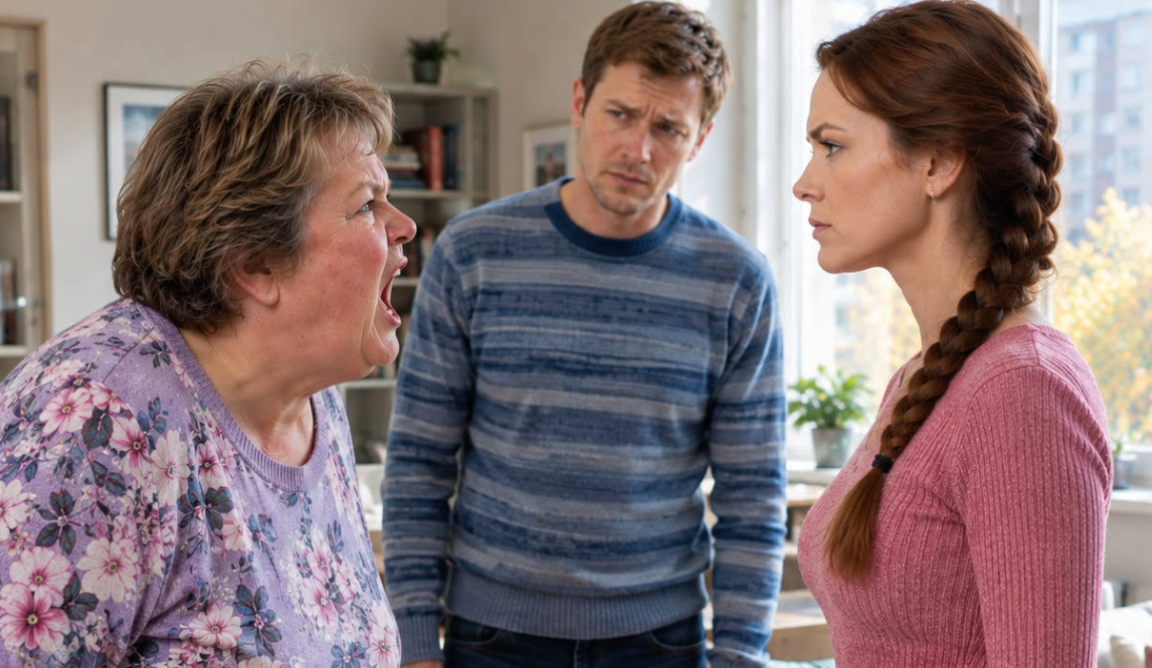
Where do you keep the ironing board?” Those were the first words Raisa Fyodorovna said as she stepped into someone else’s apartment. Not “hello,” not “thank you for having us.” Just: where is the ironing board? As though she had come not to visit, but to inspect a warehouse.
Irina stood in the hallway looking at the woman—a heavyset figure wearing a colorful housecoat over her outdoor clothes, which for some reason she had put on right there in the entryway immediately after taking off her coat. Behind Raisa Fyodorovna hovered Seryozha—Irina’s husband, the person closest to her—wearing his trademark guilty smile that always meant: you understand, Mom is Mom.
Irina understood.
She had understood everything for three years already.
“In the closet, in the storage room,” she replied evenly.
“Why isn’t it in the hallway?” Raisa Fyodorovna wasn’t really asking. She was stating what she considered someone else’s stupidity. “We always kept ours in the hallway. It’s convenient. Seryozhenka, remember—we need to move it.”
Seryozhenka nodded.
They arrived on Friday evening with all their belongings.
Two enormous suitcases, a duffel bag filled with bed linens, a box containing some kind of kitchenware, and a bag full of slippers.
Lots of slippers.
Different sizes.
As though they were planning to entertain guests.
“We’re staying permanently,” Raisa Fyodorovna announced in the hallway, surveying the apartment with the gaze of its new owner. “Seryozha said there’s enough room. You have three rooms, after all.”
Irina looked at her husband.
He studied the ceiling.
“Seryozha didn’t discuss anything with me,” she said.
“So what?” Raisa Fyodorovna looked genuinely surprised. “He’s the man of the house, isn’t he?”
The man of the house.
Irina smiled bitterly to herself.
The man of the house who couldn’t even make a doctor’s appointment without asking his mother what to do.
The man of the house who called his mother three times a day to report what he had eaten for lunch.
That night Irina lay awake listening to Raisa Fyodorovna moving furniture in the room next door.
Something scraped, dragged, and fell.
At half past midnight.
“Seryozha,” she called.
“Mm?”
“Your mother is moving furniture around in our living room.”
“She’s just getting settled,” he replied sleepily. “Don’t bother her.”
The next morning, Irina went into the kitchen and discovered that her coffee machine had been pushed into a corner.
In its place stood someone’s old Turkish coffee pot with a chipped handle.
There was a note on the table:
“Coffee machines are poison. We’ll drink proper coffee.”
Irina had bought that coffee machine herself.
She had saved money for six months.
She picked up the old coffee pot, put it in the cupboard, returned the coffee machine to its place, and silently made herself coffee.
Then she sat by the window.
Outside, it was September—gray, damp, with wet leaves covering the pavement.
The linden trees were almost bare.
Raisa Fyodorovna appeared at half past nine, still wearing her housecoat, her hair uncombed and pillow marks visible on her cheek.
“Make some eggs,” she said without looking at Irina.
“I’m leaving for work in twenty minutes.”
“So what? Twenty minutes is plenty. Seryozhenka likes them with tomatoes.”
At that moment, Seryozhenka also walked into the kitchen in his underwear and undershirt, stretching lazily and looking perfectly pleased with himself.
“Mom, you asked for sour cream. I forgot to buy it yesterday,” he said.
“That’s all right. Irisha will buy it.”
Raisa Fyodorovna was already opening the refrigerator and examining its contents like an inspector.
“What kind of cottage cheese is this? Fat-free? That isn’t food. You need proper cottage cheese. And this butter is wrong. And the bread…”
She shook her head.
“Do you two eat properly at all?”
Irina finished her coffee, placed the cup in the sink, and went to get dressed.
At work, she sat in front of her monitor trying to concentrate on numbers. She worked for a small accounting firm, and the quarterly report wasn’t going to wait.
But her thoughts kept returning home.
To the suitcases in the hallway.
To the housecoat.
To the note about the coffee machine.
Her friend Sveta called at lunchtime.
“So? How are things? Getting used to having guests?”
“They’re not guests,” Irina said. “They came to live with us.”
There was a pause.
“Wait. Permanently?”
“Permanently.”
“And Seryozha… agreed?”
“Seryozha, Sveta, always agrees with his mother. You know that.”
She did know.
Everyone knew.
It was such an obvious family arrangement that at first Irina had mistaken it for touching devotion between a son and his mother.
Later, she had called it weakness of character.
Now she had another name for it.
After lunch, a message arrived from Raisa Fyodorovna, who had somehow saved Irina’s number and mastered instant messaging.
It contained a single sentence:
“Buy chicken thighs on your way home, not breast—the breast is dry. Proper thighs. And don’t forget the sour cream.”
Irina put her phone away.
She sat there thinking about the apartment.
Her apartment.
The apartment she had inherited from her grandmother, registered in her name, renovated with her money, containing her coffee machine.
She thought about how three years earlier she had moved in there with Seryozha full of hope.
And how those hopes had gradually settled like dust—quietly, almost invisibly, until they covered everything.
That evening, walking home through the wet city, she stopped outside the property management office.
For no particular reason.
She stood by the entrance.
Then went inside.
The conversation was short and businesslike.
When she got home, the apartment smelled of fried onions.
Raisa Fyodorovna had apparently cooked something herself, though she had used Irina’s frying pan and Irina’s spices.
The kitchen looked as though civil defense exercises had taken place there.
Every lid had been moved, a kitchen towel had been thrown directly onto the stovetop, and a pile of onion peels sat on the table.
“Finally,” her mother-in-law announced. “Where’s the sour cream?”
“I didn’t buy any,” Irina replied and walked into the bedroom.
Behind her came a meaningful silence.
Then Raisa Fyodorovna’s voice, addressed, of course, to her son.
“Seryozhenka, do you see how she treats me? I say one thing to her and she turns up her nose. Is this how your wife welcomes guests?”
“Mom, come on…” Seryozha began.
“What do you mean, ‘come on’? Am I living in a stranger’s home or something?”
Yes, Irina thought.
Exactly.
She closed the bedroom door, sat on the bed, and took a piece of paper from her bag with a plumber’s phone number on it.
Beside it was the business card of an electrician from the building management company.
Raisa Fyodorovna continued talking on the other side of the wall.
Seryozha responded with short sounds of agreement.
As always.
Irina looked at the two phone numbers and thought that sometimes the quietest answer was the loudest.
She called the plumber on Sunday morning, when Raisa Fyodorovna was still asleep and Seryozha had gone to the market to buy meat according to his mother’s list.
The list covered half a page and was written in large handwriting with several items underlined.
The repairman arrived quickly.
He was a young man carrying tools who asked no unnecessary questions.
Irina showed him the utility panel and explained what she needed.
He nodded, did the job, took the money, and left.
The whole thing took about twenty minutes.
Then she called the building management company about the water.
They didn’t ask unnecessary questions either.
The property owner had the right.
Everything was legal.
Everything followed procedure.
Irina drank her coffee, got dressed, and left the apartment simply to walk around the autumn city.
Leaves rustled beneath her feet.
The air was damp and cold.
And she realized she hadn’t felt this calm in a very long time.
The explosion reached her in the form of a phone call while she was sitting in a café on the next street, flipping through a book.
“Irina!” Her mother-in-law’s voice was so loud that the coffee in the cup seemed ready to spill by itself. “What is going on?! There’s no water here! None! And the bathroom light won’t turn on!”
“Probably some kind of maintenance problem,” Irina said. “These things happen.”
“What maintenance problem?! Seryozha called the management company, and they said everything was shut off at the owner’s request! Did you do this?!”
“Raisa Fyodorovna, I’m outside right now. We’ll figure it out when I get home.”
She put the phone away and turned another page.
The tension inside the apartment when she returned was so intense it felt as though the wallpaper should have peeled itself off the walls.
Raisa Fyodorovna marched through the hallway in her housecoat, flushed, lips tightly pressed together.
Seryozha sat on the sofa looking like a man who found the whole situation exhausting but had absolutely no intention of doing anything about it.
“Explain something to me,” he said when Irina took off her shoes. “Why did you do this?”
“Do what?”
“Don’t pretend. The water. The electricity.”
“There’s scheduled maintenance in the bathroom,” she replied evenly. “The wiring is old. I’ve been meaning to deal with it for a long time.”
“On Sunday morning?!”
“The repairman was available.”
Raisa Fyodorovna stopped in front of her and crossed her arms.
“You did this deliberately. I’m not blind. Do you think I don’t understand that you’re against me?”
“Raisa Fyodorovna,” Irina said calmly, “I’m not thinking anything. I’m simply taking care of my apartment.”
“Your apartment!”
Her mother-in-law almost choked with outrage.
“Do you hear that, Seryozhenka? Her apartment! That’s how she talks! Are we one family or not?!”
Seryozha got up from the sofa and assumed his usual position—beside his mother, slightly behind her, like a loyal squire.
“Ira, you’re behaving… badly,” he said reproachfully.
He was especially good at that tone—the kind adults use when scolding a child for failing to greet an aunt properly.
Irina said nothing.
She walked into the kitchen, poured herself a glass of water from an emergency bottle, and drank it.
By evening, the tension eased somewhat—physically, at least.
Irina restored the water in the bathroom, saying the work was finished.
The electricity returned too.
Raisa Fyodorovna gave a victorious little snort, apparently deciding that she had forced Irina to give in.
Let her think that.
Irina sat in the bedroom sorting through the mail—the ordinary paper mail she hadn’t checked for a long time.
Advertisements.
Bills.
And one envelope that she immediately set aside.
Then picked up again.
The return address was unfamiliar.
Krasnodar.
She opened it.
Inside was a handwritten letter in careful elderly handwriting.
And a photograph.
Irina stared at the photograph for a long time.
It showed a woman around sixty-five years old.
A stranger.
Yet something about her face seemed strangely familiar.
Beside her stood a young man.
He looked remarkably like Seryozha.
Not Seryozha.
But similar.
Irina began reading.
“Hello. You don’t know me, but I know your family. Or rather, I used to. I’m writing because there’s no one else I can contact. My name is Antonina Vasilyevna Belykh, and I live in Krasnodar. Your husband, Sergey Pavlovich Morozov, is my nephew. Or rather, he believes I died twelve years ago. His mother made sure he believed that…”
Irina lowered the letter.
She stood up and walked to the window.
In the next room, Raisa Fyodorovna was telling her son something.
Her voice sounded sweet and musical—completely different from the voice she used when speaking to her daughter-in-law.
Seryozha laughed.
Irina returned to the letter.
“…I’m not asking for anything. I only want you to know that Seryozha has an inheritance from his father. His father, Pavel Morozov, died eight years ago and left Seryozha a share of a house. Raisa knows about it. She hid the information. The documents are still waiting at a notary’s office in Krasnodar. The deadline has not passed because the will contains special conditions. But it will expire soon. There are less than three months left.”
Irina read the letter to the end.
Folded it.
Put it back in the envelope.
She sat quietly while everything began to fit together in her mind, slowly, piece by piece, like a puzzle.
Raisa Fyodorovna, who had suddenly decided to move into their apartment.
Right now.
In September.
The woman who had controlled her son his entire life—three calls a day, lists, constant supervision.
The woman who once changed the subject so abruptly when Seryozha mentioned his father that even Irina had noticed.
So that was it.
She put the envelope into her handbag.
Then she got up, walked into the hallway, and glanced into the living room.
Her mother-in-law and husband were watching television.
Raisa Fyodorovna had already placed her knitting basket on the coffee table and was methodically untangling a ball of yarn.
“Want some tea?” Seryozha asked without looking away from the screen.
“No,” Irina replied. “Seryozha, when was the last time you were in Krasnodar?”
He turned around.
Something in her tone caught his attention.
“I’ve never been there. Why?”
“Just asking.”
She looked at Raisa Fyodorovna.
The older woman did not move.
Only her fingers froze on the yarn for a fraction of a second before continuing.
She knows, Irina realized.
She knows everything.
Irina calmly returned to the bedroom, closed the door, and picked up her phone.
She searched online for notary offices in Krasnodar.
There were several.
She started with the first one.
It took three days to find the right notary.
Not immediately.
The first two calls were to unrelated offices, where she was politely told that no one could discuss such matters without personal presence and documentation.
On the third attempt, an older woman with a tired voice answered.
She listened to Irina’s explanation and then, after a pause, said:
“The estate of Pavel Ilyich Morozov. Yes, we have that file. What is your relationship to him?”
“I’m his son’s wife.”
Another pause.
“His son needs to come personally. There is still time, but not much. Until November fifteenth.”
Irina wrote down the address, thanked her, and ended the call.
The hardest part remained.
Telling Seryozha.
She chose a moment when Raisa Fyodorovna went shopping.
The older woman left with a long list, a shopping bag, and a firm determination to buy everything the proper way—her way.
Seryozha sat in the kitchen with a newspaper, pretending to read.
Irina placed the letter in front of him.
He picked it up without much interest.
One minute later, she watched his expression change.
First confusion.
Then bewilderment.
Then something else entirely—something she rarely saw in him.
Almost fear.
“What… what is this?”
“A letter from your aunt. Antonina Vasilyevna.”
“Aunt Tonya died,” he said mechanically. “Mom told me.”
“Mom told you,” Irina repeated. “Yes.”
He finished reading.
Put the letter down.
Stared at the table for a long time.
“She’s alive,” he finally said.
It wasn’t really a question.
It sounded as though he was testing the words and couldn’t figure out what to do with them.
“She’s alive. And the notary in Krasnodar exists too. I called. You need to go there personally before November fifteenth.”
Seryozha stood up and walked to the window.
He remained there for a while.
Then he turned around, and Irina saw something in his eyes she had never noticed before.
Not confusion.
Something sharper.
“Why didn’t Mom tell me?”
“That’s something you’ll have to ask her.”
Irina hadn’t planned to listen to the conversation with her mother-in-law.
It simply happened because the apartment walls were thin and the voices kept getting louder.
Raisa Fyodorovna returned from the store, saw the letter on the table, and something in her instantly changed.
The sweetness disappeared.
So did the baby talk.
“Seryozhenka, that woman is interfering in things that don’t concern her,” she said sharply.
“Mom. Aunt Tonya is alive.”
“She has been dead to us for years. She betrayed our family. She—”
“Mom.”
Seryozha’s voice was unusually quiet.
“There’s an inheritance. From Dad. Did you know?”
Silence.
“It’s complicated,” Raisa Fyodorovna began in a different tone now—careful and conciliatory. “There were debts, there was—”
“Did you know?”
Irina stood in the hallway without moving.
“I was protecting you,” her mother-in-law finally said. “Always you. Your entire life.”
“From my own father? From his inheritance?”
“From unnecessary problems!” she raised her voice again. “Do you think it’s easy—traveling there, dealing with paperwork, fighting relatives in court? You would have gotten involved and lost more than you gained!”
“That was supposed to be my choice, Mom.”
Silence again.
Longer this time.
Irina quietly returned to the bedroom.
Four days later, she and Seryozha left for Krasnodar together.
Raisa Fyodorovna refused to speak to either of them on the morning of their departure.
She sat in the living room with her back perfectly straight, demonstratively knitting without looking up.
Seryozha was silent for almost the entire train ride.
He stared out the window at passing fields, small stations, and rain-soaked patches of forest.
Irina didn’t push him.
She read.
Or pretended to.
Sometime after midnight, he suddenly spoke.
“I barely remember my father. He left when I was nine. Mom said he abandoned us. I believed her.”
Irina closed her book.
“And now?”
“I don’t know.”
He turned toward her.
“Why did you show me that letter? You could have kept quiet.”
She thought for a second.
“Because it belongs to you. Not to me. Not to your mother. To you.”
He nodded and turned back toward the window.
Antonina Vasilyevna turned out to be a short, solidly built woman with observant eyes and remarkably straight posture.
She opened the door, saw her nephew, and simply took him by the hand, the way someone takes the hand of a lost child who has finally been found.
They sat in her kitchen for a long time.
At least three hours.
Irina mostly remained silent and listened.
The story came together in fragments—an unpleasant, ordinary, yet strangely remarkable story about how one intelligent and extremely domineering woman had spent years building a comfortable little world around her son.
A world without unnecessary people.
Without his father.
Without his aunt.
Without uncomfortable questions.
Pavel Morozov—Seryozha’s father—had not abandoned the family.
He left because staying had become impossible.
He had left his son a share in a house inherited from his own parents.
His will contained a condition: his son had to personally claim his inheritance before the age of forty.
Seryozha was thirty-eight.
The notary met with them the following day.
Everything happened quickly and almost routinely.
Documents.
Signatures.
Stamps.
The share in the Krasnodar house officially passed to Seryozha.
The house was old but solid and located in a good neighborhood.
Aunt Tonya had been living there alone for many years.
Seryozha was different on the journey home.
Not completely changed.
But something inside him had shifted.
Like something heavy finally moving after being pushed patiently for a very long time.
Raisa Fyodorovna met them in the hallway.
From her expression, Irina understood that she already knew everything.
Someone had probably called.
Maybe Seryozha himself had told her.
“Well?” she asked dryly.
“Fine, Mom,” Seryozha said.
He took off his shoes and went into the kitchen.
His mother stared at Irina with an expression that needed no words.
Irina calmly held her gaze.
“Raisa Fyodorovna,” she said quietly, “we need to talk about you moving out. Calmly. Like adults. No scandal.”
“You’re suggesting that we behave like adults?”
“Yes. I am.”
The conversation was short.
Irina spoke evenly, without anger and without pity.
She explained that the apartment belonged to her, that the three of them would not continue living together, and that other options existed.
Raisa Fyodorovna listened with a stone-like expression.
Seryozha sat at the table and remained silent.
But he didn’t leave.
And that was already something new.
“You’re on her side,” Raisa Fyodorovna finally said quietly, almost wounded, addressing her son.
“Mom,” he replied, “I’m on my own side. I just never thought about that before.”
Raisa Fyodorovna moved out in the middle of October.
Not immediately.
For another two weeks she held on, moved furniture at night, made remarks, and sighed as though she were being sent to hard labor.
But something inside Seryozha had changed permanently.
And she could feel it.
On the day she left, she stood in the hallway with her suitcases and stared at her son for a long time.
“You’ll regret this,” she said.
“Maybe,” he agreed. “But if I do, it’ll be my regret. Mine.”
Irina called a taxi.
She helped carry the duffel bag to the elevator.
She said nothing unnecessary.
When the door finally closed, Irina leaned against the wall and shut her eyes for a second.
The apartment was quiet.
Truly quiet.
Quieter than it had been in a very long time.
Seryozha came out of the kitchen and stood beside her.
“Ira.”
“Yes?”
“I…”
He paused.
“Thank you. For the letter.”
She opened her eyes and looked at him.
He stood there awkwardly, like a man who was only beginning to learn how to say what he really thought.
It was unfamiliar.
But not unpleasant.
“This is only the beginning, Seryozha,” she said simply. “We’ll see what happens next.”
Rain fell outside the window.
October was finishing its work—washing away the leaves, the remains of summer, everything unnecessary.
Irina walked to the window and watched the wet street for a long time.
The apartment belonged to her again.
And maybe, one day, it could belong to both of them.
Six months later
Seryozha decided not to sell the house in Krasnodar.
He and Aunt Tonya reached a different agreement.
She continued living there as she always had, while transferring a small amount of rent into her nephew’s bank account every month.
Quietly.
Without unnecessary explanations.
She simply transferred it.
At first, Seryozha refused to accept the money.
Eventually, he agreed.
Aunt Tonya told him:
“It isn’t money. It’s a connection. Don’t break it.”
He didn’t.
He saw his mother once a month.
He traveled to the other side of the city, brought her groceries, and stayed for an hour or an hour and a half.
Raisa Fyodorovna opened the door looking like someone who had been unfairly mistreated by the entire world.
But she still poured tea.
They talked carefully.
Like people walking across thin ice.
Sometimes something cracked.
But nothing broke.
Irina didn’t go with him on those visits.
And Seryozha didn’t insist.
That was something new too—the fact that he could understand certain things without having them explained.
The coffee machine remained in its proper place.
The ironing board stayed in the storage room.
In spring, they made a few small renovations to the apartment.
They replaced the wallpaper in the living room, something Irina had wanted to do for a long time but kept postponing.
Seryozha painted the walls himself, carefully but a little unevenly.
Irina looked at the crooked edges and, for some reason, wasn’t irritated.
Quite the opposite.
One evening, when genuine spring had already arrived outside and the linden trees were only beginning to unfold their first sticky leaves, Seryozha suddenly said:
“I made an appointment with a therapist.”
Irina looked up from her book.
“Good,” she said.
“You’re not surprised?”
“No. I’m glad.”
He nodded and returned to his cup.
They didn’t discuss it further.
But Irina knew that every Wednesday at eight in the evening he left the apartment and came back two hours later slightly different.
A little quieter.
A little more attentive.
Life didn’t become simple.
It rarely does.
Sometimes unnecessary things simply disappear from it.
And then you can finally see what had been underneath them all along.
There was something there.