“So, Tatyana, let’s have a proper talk,” Igor said, not even over the threshold yet but already surveying the veranda like he owned the place. “Svetlana and I came here for a reason. We need to sort this out.”
Tatyana stood by the washbasin, drying her hands with an old waffle towel that Pyotr had brought home from work about twenty years ago. The towel had long since faded, its edges frayed, but she never threw it away. She just didn’t. That’s all.
“Come in,” she said. “Would you like some tea?”
“No tea, thanks,” Igor waved off, squeezing through the door sideways because he had a tape measure in a yellow plastic case tucked under his arm. “We’ve got serious business to discuss.”
Svetlana followed him in. She wore white pants, a frilly blouse, and heels. To the dacha. In white pants. Tatyana noticed, but didn’t say anything. Svetlana pressed her lips together and glanced around the veranda as if she were a doctor evaluating a neglected patient.
“At least it’s set up cleanly,” Svetlana said quietly, but made sure everyone heard.
Igor placed the tape measure on the table next to Tatyana’s cup, pulled up a stool, and sat down without asking. Svetlana remained by the door frame, giving the clear impression she didn’t plan to stay long.
“We went to see the notary,” Igor began. “Petya left a will. I thought you knew about it.”
Tatyana put the kettle on the stove. Slowly, without hurrying.
“No,” she said.
“Well, there it is. So, I guess he didn’t have time to tell you, or maybe he didn’t want to—who knows. But facts are facts. According to the will, the dacha is to be divided. I get the larger half,” Igor said, unfolding a piece of paper in quarters on the table, which Tatyana didn’t even bother to look at. “See? It’s all official.”
“I see,” Tatyana replied.
She took three cups out of the cupboard. She set one down for herself, two for them. Svetlana shifted her shoulders slightly, but didn’t come to the table.
“Svetlana and I have already discussed it,” Igor continued, his tone businesslike, almost kind, the way you’d explain something that should be obvious. “You’ll get the left wing and part of the garden. We need the main living area and the right side of the lot. For a gazebo.”
Not very family-like
“I’ve been dreaming of a proper gazebo for ages,” Svetlana called out from the doorway. “With a barbecue. Everything here, Tanya, is just… so modest.”
“So it’s ‘here at your place’ now,” Tatyana thought to herself. Not ‘ours’ anymore.
“Where do you grow your raspberries?” Igor asked, standing up and moving to the window. “That bush there? And further along the fence?”
“Yes,” Tatyana answered. “Along the fence.”
“We’ll have to take those out,” he announced, not sounding particularly sorry, as if he was talking about someone else’s junk. “We’ll run the fence there. Let’s split the lot properly. I brought the tape—let’s measure it now.”
Svetlana finally stepped away from the doorway and walked to the window. She stood next to her husband and looked at the raspberry bushes with a hint of irritation on her face.
Psychologist Services
“The raspberries are old anyway,” she said. “I saw the berries—they’re tiny.”
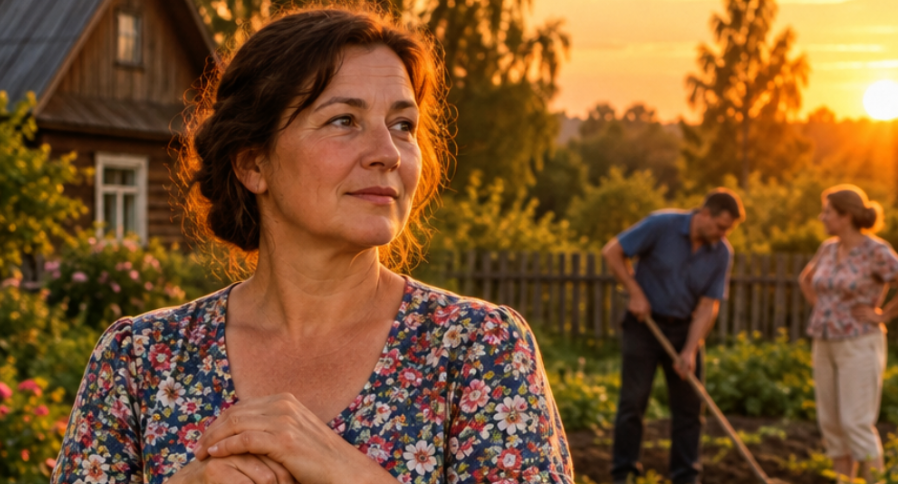
Tatyana didn’t reply. She stood by the stove, waiting for the kettle to boil. Outside, the July morning was slowly heating up, the grass still damp with dew, and the greenhouse at the end of the garden gleamed in the sun like a giant soap bubble. Pyotr had put up that greenhouse six years ago. The two of them had stretched the film together, Tatyana holding it while he nailed the planks, constantly missing with the hammer and making her laugh. She used to laugh back then.
Igor was already unrolling the tape measure, estimating the distance from the corner of the house.
“It’ll go right here,” he muttered to himself. “That’s about eight meters, plus three more in depth… Tatyana, do you have any pegs? Wooden ones, they don’t need to be new.”
“In the shed,” Tatyana replied.
“Could you bring them?”
The kettle started to hiss. Tatyana took it off the heat, poured boiling water into the teapot, covered it with the lid, and set it on the edge of the stove. Then she turned to Igor.
“Igor,” she said. “Will you have some tea or not?”
He looked a little taken aback.
“Well… I suppose I could.”
“Then have a seat.”
There was neither anger nor pleading in her voice. It was simply an invitation. Svetlana looked at her with some surprise, then walked over to the table too and carefully sat on the edge of a stool, trying not to dirty her white pants. The stool was old and a bit wobbly. Pyotr had planned to fix it. He never got around to it.
Tatyana poured the tea. She placed the sugar bowl and a plate of bagels she had bought two days ago at the village shop on the table. She then sat down herself.
For a while, all three sat in silence. Outside, a ginger cat from the neighbor’s lot slinked across the beds, bold and cheeky. Tatyana followed it with her eyes.
She thought about how Igor had arrived with a tape measure. He had brought it ahead of time. That meant he’d already mapped everything out in his mind, divided it all up. This hadn’t just come up today. It had been brewing for a while. Maybe even before Pyotr was gone. Maybe right after. She didn’t know which was worse.
A fight over the country house, a legal battle with her husband’s relatives after he died—she never saw that coming. Not because she was naive. She wasn’t naive. She just believed there was some kind of boundary people didn’t cross. Turns out, there isn’t.
“Petya loved you,” Igor suddenly said, putting down his cup. “Don’t think we’re against you. We’re just being fair. He was my brother.”
“I know he was your brother,” Tatyana replied.
“We like you too, Tanya,” Svetlana chimed in, putting on a face that was supposed to show genuine friendliness. “It’s just—life is life. Things have to be divided somehow.”
Biology courses
“They have to be,” Tatyana agreed.
“Exactly. And we’re trying to do this the right way. No courts, no scandals.”
“No courts is good,” Tatyana said and picked up a bagel.
She munched on it calmly, looking out the window. Beyond the currant bushes, the top of the greenhouse was visible. The cucumbers had sprouted well this year; she’d have to go and tie them up tomorrow. Or the day after. In two days at the latest.
Igor picked up the tape measure again and spun it thoughtfully in his hands.
“So, today we want to mark the boundaries. Just by eye for now, and then we’ll do it officially. You don’t mind, do you?”
“Tell me again exactly what you want,” Tatyana said. “I want to be sure I understand.”
Igor eagerly repeated the plan. The main room and most of the plot, the right side reserved for a gazebo. Tatiana would be left with the annex—a tiny room that used to be a storage space—and the left corner of the garden, narrow and inconvenient. The raspberries would be removed. The old fence would come down. The new one would go up in its place.
Tatiana listened quietly, never interrupting, sometimes nodding. Svetlana watched her in growing surprise, clearly expecting either tears or maybe an outburst—but there was neither.
“Kostik could stay here for the summer,” added Svetlana, referring to their son, who was thirty-two, lived in another city with his family, and had never once come to the dacha. “Kids love fresh air. And Marishka, our granddaughter. How old is she, Igor?”
“She’ll be five in September.”
“Exactly. The perfect age for a country house. Honestly, our apartment in the city is pretty small.”
Tatiana thought of Marishka, whom she’d never seen. She only knew her from a picture on Petr’s phone that he’d shown her a year ago. Marishka was holding an ice cream, furrowing her brows in a funny way. Petr had laughed showing her the photo. He loved kids. He and Tatiana had never had any of their own.
“I understand,” Igor said suddenly, pulling the tape measure toward himself, “you need some time to think it over. That’s normal. We’re not rushing you. We can give you a week.”
“No,” said Tatiana.
Igor raised his eyebrows.
“No what?”
“I don’t need any time.”
“So, you agree?”
“No,” Tatiana repeated.
Svetlana exchanged glances with her husband, her look caught between indignation and confusion.
Psychologist Services
“Tanya,” Svetlana began in a patient voice—the kind you use with someone hard of hearing—”do you understand there’s a will?”
“I understand about the will,” Tatiana said as she stood up. “Finish your tea. I’m going to the garden, there’s work to do.”
She walked out from the veranda to the yard. She put on the old rubber boots waiting by the steps, grabbed the garden hose, and headed to water the tomatoes. The sun was higher now, most of the dew had dried, and the ground felt pleasantly springy under her feet. The soil was soft and loose—she’d been working it all morning, even before they arrived.
She could hear voices behind her. Igor was mumbling something to Svetlana, who replied, clearly annoyed. Then a door creaked, followed by footsteps crunching over the gravel path.
“Tatiana,” Igor approached her, standing by the edge of the vegetable bed. He wore city shoes—light, leather—and tried not to step on the soil. “Is it that you don’t respect us?”
“Why do you think so?” Tatiana said, eyes still on the earth, carefully moving the hose, watering right at the roots.
“Well, you just listen and leave.”
“I listened to you. I heard everything.”
“And?”
“Nothing. I’m just watering.”
Igor fell silent for a moment. Then he switched tactics.
“Come on, Tanya, we’re family. Petya was the connection between us. We have to, you know… keep it within the family.”
“Within the family,” Tatiana echoed softly, as if tasting the words.
Such an interesting word—so full of family meaning. Tatiana remembered last year, when it was Peter’s birthday. Sixty years old. They were waiting for Igor and Sveta, had set the table, Tatiana baked an apple pie, Peter put on his white shirt and spent ages tying his tie in front of the mirror. They never showed. It was already half past seven when they called, after the pie had gone cold, saying that Marishka had fallen ill. Maybe she really was sick. Tatiana never knew.
Continued in the comments.
And even further back, after Igor and Peter’s mother passed away, there was that whole story with their old family dacha. There was dividing up to do, talk about things being done ‘within the family.’ Tatiana didn’t get involved back then. Peter didn’t like to talk about it.
Products for moms
“Here’s what I suggest,” said Igor. His voice grew more confident, finding the right tone. “You have your pension. You need to live somehow. We’re giving you the outhouse, the garden, everything’s fine. You stay here, enjoy your life. We’ll also come by from time to time. It’s a big lot, plenty of space for everyone.”
“It is big,” Tatiana agreed.
“Exactly.”
“Eighteen hundred square meters.”
“See what I mean.”
“Peter and I bought it together,” Tatiana said. “Do you remember when that was?”
“Well… a long time ago,” Igor hesitated a little.
“It was twenty-three years ago. From the money I got after selling Aunt Nina’s apartment. She left it to me. Aunt’s apartment.”
Exchange rates
“So what?” Igor shrugged. “It was you and Petya’s joint property. Marital assets.”
“Not exactly,” Tatiana replied.
She turned off the hose, straightened up, and looked at Igor calmly. He resembled Peter—the same high forehead, similar receding hairline. But his look was different. Peter’s gaze was soft, while Igor’s eyes always appeared a bit narrowed, as if he was calculating something in his mind.
“What do you mean ‘not exactly’?” Igor asked.
“I mean that Aunt’s apartment was my premarital property. And when we bought the dacha, we signed a prenuptial agreement. According to it, the dacha and all outbuildings are my sole property.”
Igor stared at her. He was silent for three or four seconds. Then he laughed, briefly, through his nose.
“What?”
“Prenuptial agreement,” Tatiana repeated calmly.
“What prenuptial agreement? First I’ve heard of it.”
“It’s the first you’ve heard—but it’s existed for a long time.”
Svetlana, who had been standing a little to one side all this time, eyeing the tomato plants like someone disappointed in a shop’s selection, finally turned around.
“Igor, what is she saying?”
“It’s nonsense,” he snapped.
“It’s not nonsense,” Tatiana replied. “There is a prenuptial agreement for the dacha. The dacha was bought with the money from selling Aunt Nina’s apartment. The agreement states that everything bought with that money is my personal property and not part of the jointly acquired property. So Peter didn’t have a share in it. Something he could have bequeathed.”
Silence fell—the kind of silence when someone says something, and it hasn’t quite sunk in yet, but soon will.
Igor took a step forward.
“Tatiana,” his voice changed, becoming harder. “You do realize I could contest this? I’ll get a lawyer.”
“That’s your right,” Tatiana replied.
“I’ll take you to court.”
“Go ahead.”
— That’s expensive. And time-consuming. Do you really want to deal with this at your age?
She looked at him intently. An interesting tactic. So, now he’s trying to scare her.
— Igor, she said. — You just stepped on my heels.
He instinctively glanced down. There were no heels anywhere near, just damp soil at the edge of the garden bed. He looked back up, and in his eyes flashed something she couldn’t quite name.
— I suggest we go to the notary, said Tatyana. — The one who’s holding the marriage contract. He’ll explain everything, and it’ll be quicker than talking here.
— You’re bluffing, said Svetlana, stepping closer. Her white pants grazed the garden bed, leaving a thin, brown streak on the cuff. Svetlana didn’t notice. — Tanya, come on… That’s just unreal. Pyotr would never have allowed you to do this behind his back.
— He knew, said Tatyana. — And he agreed to sign. Because it mattered more to him that the aunt’s money was protected. She left it to me, not to us together. He understood that.
Exchange Rates
— He might not have understood what he was signing, Igor said.
Tatyana didn’t answer. Some things require no reply. Pyotr absolutely understood what he was signing. He had a university degree, worked as a plant technologist for twenty years; he could read a contract. She knew it, and Igor knew it too—he just needed not to believe it right now.
— I’m saying, Tatyana calmly repeated, — let’s go to the notary. Right now, if you want. Or tomorrow. You’ll see everything for yourself.
Igor stood, tape measure dangling in his lowered hand. The yellow plastic case was a bit scratched, and she noticed a small nick on the tape. He’d brought this tool to divide someone else’s things.
— Fine, he finally said, his voice now different—dry as paper. — We’ll go tomorrow.
— Agreed, said Tatyana.
She picked up the hose again and turned to the garden bed. Behind her, she could hear Igor and Svetlana turning to leave, Svetlana whispering something angrily to him, and him whispering back, just as quietly.
Footsteps on gravel. The gate clanged shut. The car started. They were gone.
Tatyana stood watering her tomatoes, listening to the water flow and someone in a neighboring yard sawing boards—a typical summer sound. The greenhouse shimmered in the light. The raspberry bushes by the fence stood straight, dark green and juicy, the berries already beginning to ripen.
She thought that tomorrow she should wear proper shoes. Not that the notary would care what she wore—it’s just that it’s easier to think when you have the right shoes on.
The summer plot that had now sparked this inheritance dispute, she remembered as being different. She recalled how they first came to look at it, how Pyotr strode across the land with big steps, measuring the length, while she stood near where the greenhouse would be, wondering if there’d be space for cucumbers. The seller was an elderly woman named Klavdia Ivanovna; she was moving to join her daughter down south and wanted to sell quickly. They bought it right away. Then they spent three years building the house, working on weekends every summer. Pyotr laid bricks, Tatyana mixed mortar. Together.
She hadn’t really thought of herself as a widow defending the property she had earned and bought with her own hands. To her, it was just what belonged to her, and she had no intention of leaving.
That evening, she called Angela, the daughter of her friend, who worked as a lawyer. She just wanted to hear it directly from her once again, to be sure that everything was as she remembered.
“Aunt Tanya, please don’t worry,” said Angela. “If the marriage contract was registered by a notary, it has full legal force. No will can override it, because you can only bequeath what belongs to you. And if, according to the contract, Petr Alexeevich didn’t have a share, then there’s nothing for him to bequeath.”
“I understand that,” said Tatyana. “I just wanted to hear you say it one more time.”
“I’ve said it,” Angela replied. “And one more thing. If they threaten to go to court, don’t let it scare you. Challenging a marriage contract is very difficult. There have to be serious grounds. The fact that they didn’t know about it doesn’t count.”
“Thank you, Angela.”
“You’re always welcome. Stay strong.”
Tatyana set down her phone and sat by the window for a long time. It was getting dark outside. She could barely make out the outline of the greenhouse and the dark silhouettes of the raspberry bushes by the old fence. The fence was wooden, put up by the previous owners. Some of the boards were warped, others were cracked. Petr used to say it needed fixing. They kept putting it off.
She made herself some tea. The same tea that had sat on the stove all morning and, except for her, no one had drunk. She reheated it, poured it into a cup, took a bagel. It was still fresh.
It felt strange thinking about how Igor had turned up with a measuring tape. She’d known him for more than twenty years. Not closely, but still. She cooked for every holiday when they came. Once, she’d helped Svetlana when she was in the hospital—brought her home-cooked meals. All of that had happened. And now, it all seemed packed away somewhere, like things you don’t need but can’t bring yourself to throw out.
The value of human relationships after losing a loved one. She had never thought about it like that before. Now she did. Turns out, everything has a price. Even the things that once felt free.
She finished her tea. Put the cup in the sink. Went to bed.
The notary’s office was in the district center, a twenty-minute bus ride away. Tatyana got up early and dressed neatly: a gray jacket, trousers, low-heeled shoes. She put her hair up. Looking in the mirror, she thought she looked decent.
Igor and Svetlana were already waiting at the office entrance when she arrived. Igor wore a jacket, despite the serious heat. Svetlana was dressed up too, this time in dark clothes. They nodded at her without smiling. Tatyana nodded back.
The notary, Konstantin Borisovich, met them in a small office filled with folders. He was an older, calm man who spoke plainly, without unnecessary words. Tatyana stated the contract number and date. He pulled up the archive.
He found the document quickly. Konstantin Borisovich put on his glasses, looked through the papers, then raised his gaze to Igor.
“That’s correct,” he said. “The prenuptial agreement between Pyotr Alexeyevich and Tatyana Mikhailovna was made twenty-three years ago, notarized personally by me; the original is stored in the archive. According to the terms, the real estate at this address, purchased with the money from the sale of their apartment, is the sole property of Tatyana Mikhailovna and isn’t part of the couple’s shared assets.”
“And… is that legal?” Svetlana asked, her voice betraying that she already knew the answer, but hoped to be wrong.
“Absolutely,” Konstantin Borisovich replied.
“So, the will…”
“The will has no bearing on this property,” the notary said. “Pyotr Alexeyevich did not have the right to bequeath something that didn’t belong to him. I understand this may come as a shock to you. But those are the facts.”
Igor sat up straight, staring at a spot above the notary’s head. His face was expressionless.
“Can it be contested?” he asked, his voice lacking the confidence it had yesterday with the tape measure.
“Anyone can try,” Konstantin Borisovich said. “But I see no grounds. The agreement was made without violations, both parties signed willingly, Pyotr Alexeyevich was of sound mind and competent. That has all been verified.”
Tatyana sat and listened. She felt no triumph. In fact, she didn’t feel anything much right now, just a slight fatigue and something like relief—but not a joyful one, more of a quiet one. Like when you’ve been holding something heavy for a long time, and finally set it down.
Suddenly, Svetlana stood up.
“This isn’t fair,” she said, her voice trembling. “Pyotr was his brother. His own brother.”
“That’s a fact,” the notary agreed. “But even so.”
“Tatyana,” Svetlana turned to her, “do you realize what you’re doing? We’re family. Petya doesn’t have anyone else but us now.”
Tatyana looked at her—at her quivering lips, at the eyes where for the first time in two days she saw something genuine. Not sympathy, no. More like confusion. Maybe even a hint of fear.
“Svetlana,” Tatyana said. “When Petya had his birthday, you didn’t come.”
Svetlana blinked.
“Marishka had a fever…”
“Maybe,” Tatyana said. “I don’t know. All I know is, he waited. He set the table and waited. And he put on his white shirt.”
Svetlana lowered her gaze. Igor was still staring off into space.
“Family,” Tatyana said quietly. “That’s a good word.”
She didn’t add anything else.
Konstantin Borisovich handed her a notarized copy of the agreement. Tatyana carefully folded the paper in quarters, put it in her bag, stood up, said goodbye to the notary, and left the office.
It was hot outside. She stopped near the entrance, took her sunglasses out of her bag and put them on. Somewhere in the town, a cuckoo was calling—loud and insistent, as if it was getting paid for every call.
Igor and Svetlana came out about five minutes later. They walked past her to their car. Igor didn’t look at her. Svetlana glanced at her for a moment—her eyes holding something unclear, maybe hurt, maybe something else, but Tatyana didn’t dwell on it. The car drove away.
A Familiar Journey Home
Tatiana finally caught her bus. She rode home gazing out the window at the fields and groves she knew by heart, having traveled this route for twenty-three years in a row. The same pines at the turn. The same water tower. The same little store with the blue roof. Nothing had changed.
The first thing she did on the property was head to the raspberries. The berries were ripe and dark red, some nearly black with ripeness. She picked a few and ate them right there, plain. They were sweet. Svetlana remarked they were small. Clearly, Svetlana couldn’t see well.
She spent a long time just sitting on the porch, not really thinking about anything specific. She simply looked at the yard.
Eighteen ares of land that she and Pyotr bought from Klavdia Ivanovna on a hot July day twenty-three years ago. Eighteen ares that they transformed from an overgrown lot into a thriving vegetable garden. The greenhouse, the raspberries, the currant bushes, the young apple tree in the corner they planted on their fifth year at the cottage. The garden beds Tatiana dug up herself every year because in recent years Pyotr’s back wasn’t up to it. The house they built together, brick by brick.
It was hers. All of it was hers. Not just because it said so on paper—though it did—but because every square meter of this land remembered her hands.
A conflict over the inheritance of the dacha, which seemed sure to be long and drawn out, was settled in the district notary’s office in just twenty minutes. That’s what happens when the documents are all in order.
A week later, she called a company that her neighbor Galina Ivanovna had recommended. They installed fences. Two young men showed up, took a look around, and wrote up an estimate. The price was perfectly reasonable.
“Where should we install it?” asked the older one, short and practical, with a pencil behind his ear.
“Around the perimeter,” Tatiana replied. “From here to here. And please be careful—there are raspberries here. Don’t disturb them.”
“Got it,” he said, jotting down a note in his pad. “Should the fence go behind the raspberries?”
“Behind the raspberries,” Tatiana confirmed. “The raspberries stay.”
They worked for three days. The posts were set deep into the ground, and they used thick, dark green metal sheets that matched the color of the foliage. Tatiana came out every few hours to watch the progress. The workers were skilled and careful—and the raspberries were left untouched.
On the third day, when the last panel was secured and the gate with a proper lock was installed, the older worker called out to Tatiana.
“Take a look.”
She walked along the perimeter. The fence stood straight and strong. The gate opened and closed smoothly, without a squeak. Behind the green panels, the raspberries grew in the shade, invisible from outside but alive.
“Looks good,” Tatiana said.
“It’ll last about twenty years,” the worker said with some pride.
“That should be enough for us,” she replied.
That evening, after the workers’ truck had left and the property was quiet again, Tatiana grabbed the garden hose to water the cucumbers. The sun was setting slowly, lingering the way it only does in July, stretching the sunset across half the sky. The greenhouse was glowing pink. Behind the new fence, the raspberry bushes stood dark and dense, unchanged.
As she watered the garden, she thought about how it would soon be time to make jam. She had plenty of jars left over from last year, all clean and lined up neatly in the pantry. She’d need to buy sugar. She’d seen some good quality sugar at a decent price in the village shop.
She always made the jam herself. She never bought it.
The cuckoo was calling again somewhere beyond the property—persistent, but quiet. Tatyana didn’t bother counting.
The old fence was stacked behind the house, carefully taken down and set aside by the workers. She wondered if she should saw it up for firewood, throw it away, or just leave it for now and decide later.
She turned off the hose. She took off her boots by the porch and stepped onto the veranda. She put the kettle on. It was peaceful, just right for the evening.
An empty mug sat on the table—the very one she’d used for tea when Igor and Svetlana had visited. Peter’s cap hung by the door on a nail, old and faded from years of summer wear. Tatyana took it down, held it for a moment, then hung it back up.
It was getting dark outside. The new fence ran straight around the yard. The raspberries grew just beyond it.
Not So Family-Like
Don’t forget to hit the SHARE BUTTON to share this video on Facebook with your friends and family.