“Mom, we were just thinking, you’re not going anywhere this weekend anyway, so you can watch Denis and Alisa,” Andrei said, his voice completely casual, like he was just asking for the salt.
Galina Petrovna stood at the prep table in the “Homemade Bread” bakery, pressing dough with both hands until the flour dusted her fingers so much they looked like white gloves. Her phone sat at the edge of the table; she glanced at the screen, holding it between her shoulder and cheek.
“Andrei, I actually am going somewhere. I’m heading to the health resort.”
“To where?”
She even pulled her hands away from the dough.
“To ‘Pine Forest.’ I told you. Six weeks ago, I told you. And four weeks ago. And three.”
“Mom, it’s just the weekend. Saturday and Sunday. Oksana and I wanted to visit her aunt in Malinovka, it’s her anniversary — we really can’t miss it. The kids are too little; they’ll be tired on the road.”
“I bought this ticket a month and a half ago. I paid for it. I’m going.”
Exchange rates
There was a pause on the line. Then Andrei let out a sigh, so heavy that Galina Petrovna could almost picture his face — a little hurt, a little confused, just like any time things didn’t go his way.
“Come on, Mom…”
“No, Andrei. Goodbye.”
I’m not a free babysitter
She put the phone down. Looked at the dough, which waited for her calmly, a little puffed up under the film. Galina Petrovna turned back to it, the way you return to a task you know won’t let you down.
It was an ordinary Tuesday. The bakery on Gagarin Street had opened at six in the morning; by nine they’d sold half the rye loaves and every single sweet roll. Svetlana, the shift manager, had already stopped by the door twice with questions about invoices. Galina Petrovna didn’t work here because she couldn’t trust anyone else; she did it because she loved these early hours, when the smell of bread is thick and warm, and it feels like the world outside the bakery hasn’t quite woken up yet and hasn’t made its usual mischief.
Three bakeries. ‘Homemade Bread’ on Gagarin, ‘Sweet Roll’ in the market near the bus station, ‘Pretzel’ in the new neighborhood right next to the ‘Daisy’ kindergarten, which Denis and Alisa attended. It wasn’t a coincidence. When Galina Petrovna chose the location for her third bakery, she thought about her grandkids, and also knew that fresh bread sells well where there are children and young families. Turned out she was right.
Her phone buzzed again. Oksana this time.
Galina Petrovna wiped her hands on her apron and picked up the call.
“Galina Petrovna, are you serious?” Her daughter-in-law’s voice had that tense edge — the kind that means someone has almost decided to take offense, but is still holding back.
“Yes, Oksana. I’m serious.”
“But you do understand that we can’t not go. Aunt Valya is turning seventy, she’s done so much for Oksana’s family, it’s really important.”
“I’m happy for Aunt Valya. My health is important to me too, and I’ve already bought my ticket.”
“What’s so special about this ticket?” Oksana had lost her patience now. “It’s only two days! The kids love you. Denis absolutely adores you, he keeps saying he wants to be with Grandma.”
Galina Petrovna leaned against the wall, feeling a familiar ache in her heels — she’d been on her feet since six that morning. The tiredness was an old companion, as well-known as the numbers on her invoices.
“Oksana, I’m only going to say this once. I have a vacation booked for this weekend. I bought it a month and a half ago, and I told Andrey about it at that time. If he had passed that info along to you, we wouldn’t be having this conversation right now. You should have started looking for a nanny earlier.”
“So what am I supposed to do now?!”
“Find a nanny. Or don’t go to your aunt’s. Or take the kids with you. That’s your choice, not mine.”
Oksana fell silent. Galina Petrovna waited for a moment, then ended the call.
City noises filled the air outside the bakery. A titmouse perched on the ledge across the street, busily grooming its feathers. Galina Petrovna watched the bird until she felt her shoulders relax just a bit. Then she turned back to the dough.
There were three days left until Friday.
Wednesday passed without any phone calls. That made her wary. When Andrey goes quiet, it means he’s thinking. Or that Oksana is doing the thinking for him. Galina Petrovna kept busy with invoices at ‘Sdoba,’ sipped her coffee alone by the narrow window with a view of the bus station, and thought about the health resort. She’d only been there once, about eight years ago, back when her husband was alive. Nikolai Ivanovich loved the pines. He would say that you think differently under them, without all the hustle and bustle. He passed away four years ago, quietly and quickly, just as he would have wanted. Ever since, Galina Petrovna had lived alone on Stroitely Street, in a two-bedroom flat, where his ski poles were still stored in the closet.
She bought the vacation after her back started hurting in February. Not badly, but it was persistent. The doctor said she needed some treatments. She wrote it down in her planner, called ‘Sosnovy Bor’ to check for available spots, and picked one. She paid right away so she wouldn’t change her mind, because she knew herself well—she always put off anything that was just for her.
On Thursday, her in-law called.
Tamara Ivanovna lived in Vyazniki, which was two hours away by bus. She didn’t visit often, but always called regularly, and always for a reason. And that ‘reason’ usually meant, in Tamara Ivanovna’s opinion, that Galina Petrovna was doing something wrong.
“Galina, I don’t even know what to say. Oksana is in tears. Andrey is beside himself. Can’t you be a little more understanding? These are children. Your grandchildren.”
“Hello, Tamara Ivanovna.”
“Hello, hello. Are you even listening to me?”
“I am. But my answer isn’t going to change. I’m going to the resort, and the trip is paid for.”
“So what if it’s paid for? Money’s not everything. Family is more important.”
Galina Petrovna gazed out the window of her apartment on Stroitely Street. The maple tree in the yard had just begun to sprout its first leaves, pale and almost transparent. She thought, of course family is important. But she is also part of the family too. Funny how nobody remembered that when passing out the responsibilities.
“Tamara Ivanovna, I’m telling you calmly. This is my time. I have a right to rest.”
“Of course you do. Nobody’s arguing. But you could have chosen a different time.”
“Next time I will. But this time, the dates are set.”
“So the resort matters more to you than the children?”
It was a classic move. Galina Petrovna knew it by heart. Question someone’s care, and they start defending themselves, and while they’re doing that, they’re almost ready to give in.
“Tamara Ivanovna, both the resort and my grandkids are important to me. But right now, the resort matters more because that’s when my voucher is valid. If Oksana and Andrey are having trouble finding someone to watch the kids, I’m happy to help them find a nanny through my friends. That’s all I can offer.”
Tamara Ivanovna was silent for a moment.
“Well, Galina. What can I do with you.”
“There’s nothing you can do, Tamara Ivanovna. Have a good evening.”
She hung up the phone and put the kettle on. Her hands felt steady. Inside, she was calm too, but with that particular heaviness that comes when you’re preparing yourself for something unpleasant and you’ve already accepted it.
Because she sensed this wasn’t the end. Friday would bring more.
Friday began with Galina Petrovna checking her bag. Everything was packed since Thursday night: robe, a change of clothes, slippers, two books, a small thermos, the medicine prescribed by her doctor, and her notebook. She liked to travel light and over the years, had mastered packing quickly and efficiently. The voucher was in the side pocket, in the envelope where she’d placed it the day she bought it.
In the morning, she opened the bakery “Homemade Bread,” spent the first two hours making sure everything was running smoothly, and then handed over the shift to Svetlana. She told Svetlana she’d be away until Tuesday, her phone would be on, but not always available. Svetlana nodded—she’d worked at the bakery for six years and knew how to handle things without fuss.
Galina Petrovna got home at one in the afternoon. She ate, lay down for half an hour because her legs needed it, then got up, washed, brushed her ginger and grey hair, and put it in her usual bun. She looked at herself in the mirror—not criticizing, not admiring, just looking.
The bus to “Sosnovy Bor” left at 3:40 from the central station.
At half past three, the doorbell rang.
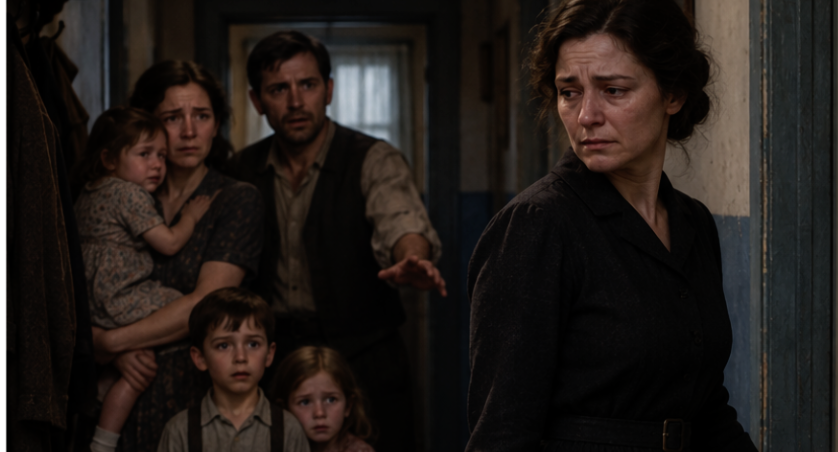
She walked over and looked through the peephole. Andrey was standing outside the door. Next to him was Oksana. At Oksana’s feet was a travel bag, and she was holding a child. Alisa, in a pink jacket, had her nose buried in her mother’s shoulder. Denis stood a little behind, holding Andrey’s hand and staring at the floor.
Galina Petrovna stood quietly by the door.
Then she opened it.
“Mom,” Andrey started, his voice soft and almost apologetic, “we thought…You just can’t leave the kids like this.”
“I’m not leaving the kids. I’m going to the resort. You’ve brought them here.”
“We brought them because we have nowhere else,” Oksana said. Her voice was shaky with tears, but she was holding it together. “Aunt Valya is waiting. We have to go. Galina Petrovna, please.”
Denis lifted his head. He looked at his grandmother. He was a sweet little boy, round-faced with his father’s eyes. Five years old. He didn’t fully understand what was happening, but he sensed the tension and stayed quiet.
“Please, come inside the apartment,” Galina Petrovna said. “The children shouldn’t have to stand out in the hallway.”
They walked in. She closed the door behind them. The hallway immediately felt crowded with the suitcase, children’s jackets, and the presence of four people all at once.
“Oksana, sit the kids on the couch in the other room. Let them not hear our conversation.”
Oksana gazed at her for a long moment, but then took the kids and went into the room. You could hear Denis asking questions, and Oksana answering him in a hushed voice.
Galina Petrovna and Andrey were left standing in the hallway.
“Mom,” he said, “you can see we’re stuck, right?”
“I see it.”
“So what are we supposed to do?”
“Andrey, I’m going to say this once, very clearly. In an hour I’m leaving for a health resort. I’ve booked my spot, paid for it, prepared everything. This is my time and my money. I’m not against the grandchildren. What I don’t like is being given just a few hours’ notice instead of weeks. If you’d told me back in January, maybe I could have changed the date. But you told me on Tuesday. That’s not my problem.”
Andrey looked at her. He resembled her in her younger days: the same broad shoulders, the same way of tilting his head a little when deep in thought. He looked tired now. Galina Petrovna saw this, and it stung her to see him like that, but not enough for her to change her mind.
“Mom, this is cruel.”
“No. These are my plans.”
Oksana came out of the room, leaving Alisa with Denis. Her face was flushed red.
“So it doesn’t matter to you?” she asked. Her voice was low, but her words cut sharper than any scream. “The grandchildren mean nothing to you? You’re just going to leave and that’s it?”
“Oksana, my grandchildren do matter to me. This conversation, however, does not.”
“You’re selfish.”
Galina Petrovna felt something tighten in her chest. It wasn’t anger. More like the tiredness of having to explain what should be obvious.
“Maybe so,” she replied. “Sometimes it’s good to be selfish.”
“Well, wonderful!” Oksana was no longer quiet. “Great, Galina Petrovna! So the resort is more important than your grandchildren! So our family just doesn’t matter to you…”
“Oksana,” Galina Petrovna said, calmly and evenly, “the kids can hear you.”
Oksana stopped. She put her hand over her mouth. From the room, Alisa’s small voice could be heard, saying something unintelligible.
“I’m taking my bag and going to the bus stop,” Galina Petrovna said. “Andrey, take the kids. Go to Aunt Valya’s, or find a nanny, or come up with something else. But I’m not taking the children.”
“Mom!”
“I’ve said what I needed to.”
She went into the hallway, picked up her travel bag. Took her jacket off the hook and put it on. Picked up her keys, then paused. She came back, opened the drawer in the hallway table, and found a keyring. The second key to the apartment on Stroiteli Street, building 8, apartment 34. She’d given it to Andrey a year ago, ‘just in case.’ She placed the key on the table.
“Just in case is no longer necessary,” she said. “If I want to, I’ll open the door myself.”
Andrey stared at the key, then at her.
“Mom…”
“Have a good trip, Andrey.”
She opened the door and stepped out.
The stairwell was quiet. Then the door behind her opened again, and Oksana came out after her. Galina Petrovna was already by the elevator, pressing the button.
“Galina Petrovna,” Oksana’s voice was hoarse, almost yelling, “You have no right! They’re your grandchildren! You’re their grandmother! Aren’t you ashamed?”
The elevator wouldn’t come. It was always slow in this building.
Their neighbor, Valentina Mikhailovna, was coming up the stairs with a shopping bag. She stopped, looked at Oksana, then at Galina Petrovna.
“Oksana,” said Galina Petrovna, her voice even and calm, “the neighbors are here. Please, go back inside.”
— I’m not going in! You’ll leave, and what about us?!
— You’ll hire a nanny.
— With what money?! That costs!
— I had money for the trip, and I spent it. Everyone spends their own money as they see fit.
The elevator finally opened. Galina Petrovna stepped in. Valentina Mikhailovna hesitated, then followed her. The doors closed.
— What was that about? Valentina Mikhailovna asked quietly.
— My daughter-in-law, Galina Petrovna said. — Don’t pay it any mind.
Downstairs, she left the building and adjusted her bag on her shoulder. Stroiteley Street was lined with poplar trees, now almost bare, just tight, dark buds left. Galina Petrovna walked towards the stop, not thinking about Oksana or Andrei. She was picturing the pool with warm water at the ‘Sosnovy Bor’ resort and the mud wraps prescribed for her back.
The bus was nearly empty. She took a seat by the window, put her bag on the luggage rack, and zipped up her jacket. Her phone buzzed. Andrei. She glanced at the screen, then looked out the window. The bus started moving.
She slipped her phone into the side pocket.
‘Sosnovy Bor’ was forty kilometers outside the city, fittingly in a pine forest. The ride took a little over an hour, unless there was traffic leaving town. Galina Petrovna gazed out the window, feeling her shoulders lower. Lower, not raise, because for weeks, her shoulders had been hunched as though expecting something heavy to be placed on them at any moment.
The forest began just past the turnoff from the Bypass. The pines were tall and straight, with reddish bark, and against the evening sky, they looked almost black. Watching them, Galina Petrovna thought that Nikolai Ivanovich was right about pines. You think differently here. Things are quieter.
At the sanatorium she was greeted by the administrator, a young woman in a blue uniform shirt, smiling and calm. She led her down a corridor and showed her the room: small, clean, walls paneled in wood, and a view of the forest. The bed was wide, the pillows soft. On the nightstand was a tiny vase with a sprig of heather.
Galina Petrovna put down her bag, took off her jacket. Sat on the bed. Stayed silent for a minute.
Then she picked up her phone. There were six missed calls. Andrei, three times. Oksana, twice. And one from an unknown number she recognized as Tamara Ivanovna’s work number.
She put the phone back on the nightstand, face down.
She opened the window. Air came into the room—resinous, a bit chilly, dense. Galina Petrovna stood by the open window and breathed.
Saturday began with treatments at eight-thirty. Last night, the nurse had given her a schedule for all four days. Mornings: physical therapy treatments. One o’clock: lunch. Afternoon: free time. In the evening, either pool time or a walk, her choice. Galina Petrovna looked over the schedule, underlined what she needed, and put it in her notebook.
Over breakfast in the cozy dining room, she met her table neighbor. Nina Georgievna, sixty-two years old from Nizhny, was visiting for the third year in a row and spoke about this sanatorium with the quiet excitement of a true expert. She shared tips on where to find the best path to the forest, where to buy good tea at the buffet, and suggested opting for dinner without the side dish—otherwise, it feels too heavy.
Galina Petrovna listened and ate. The porridge was warm, subtle in flavor. There was dried fruit compote. Bread with butter. Simple food, but she was so attentive to every bite—something she hadn’t done in ages, always snacking on the go at the bakery.
After breakfast, she finally checked her phone.
Andrey had messaged at eleven on Friday night. “Mom, did you get the message? Please write something.” Then again at one in the morning. “Mom.” Then in the morning, at eight. “We found a nanny. A student, our neighbor from across the hall. It cost a lot. Mom, please answer.”
She read all this standing by her room window, wrapped in a bathrobe, a towel draped over her shoulders. Outside, the pines glowed in the morning light, and somewhere nearby, a woodpecker tapped away, busy and rhythmic.
She replied with just one word: “Okay.”
And she put her phone away.
Mud wraps were done in a treatment room scented with mineral water and peat. The procedure lasted forty minutes. Galina Petrovna lay beneath a warm blanket, letting her mind drift into nothingness. It was a rare feeling—her thoughts usually full of lists, sums, staff names, numbers of baguettes, flour delivery dates, supplier contacts. Now, all of that faded. There was only warmth, the aroma, and the tapping of the woodpecker coming through the open window.
After lunch, she went for a walk. Nina Georgievna showed her a trail winding through the woods to a small lake. Not the decorative pond by the building, but a real forest lake, with reeds lining the shore and ducks swimming in the water. Galina Petrovna moved slowly, truly slowly, with no goal and no rush. Her feet in comfortable sneakers pressed into the soft, needle-covered path. High up in the pines, the wind rustled quietly, like someone breathing.
At the lake, she stopped. Ducks glided near the opposite bank, paying her no mind. The water was gray-blue, streaked with reflections. Galina Petrovna stood and gazed at the water. She had nothing she needed to do. It felt unusual—and wonderful.
Her phone stayed silent.
On Sunday morning, Oksana wrote a message. She didn’t call—she wrote, which was surprising, since Oksana usually felt more confident talking on the phone. “Galina Petrovna, I hope you realize you’ve put us in an awkward position. We spent a lot of money because you refused. Andrey is upset. The children miss you. I hope you understand this.”
Galina Petrovna read the message at breakfast. Nina Georgievna was telling a story about her son-in-law. The porridge arrived a bit thicker than yesterday. Today, the compote was cherry.
She didn’t reply to Oksana’s message.
After my treatments, I stopped by the little buffet next to the building and bought some thyme tea that Nina Georgievna had been raving about. It turned out to be really good. I settled into an armchair by the window, reading my book and enjoying my tea. Outside, the sanatorium yard was peaceful, with benches and a few people strolling around. An elderly man in a cap was feeding sparrows with bread crumbs.
She felt content. Simply content. Not euphoric, not excited—just content, and that was enough.
Tamara Ivanovna called on Sunday evening. Galina Petrovna glanced at her phone and waited for it to stop ringing. Then she sent a message: “Tamara Ivanovna, I’m on vacation. Let’s talk next week.” There was no reply, which suited Galina Petrovna just fine.
Monday meant hydrotherapy. Mineral baths, twenty minutes soaking in warm, bubbling water. Galina Petrovna lay there, staring at the ceiling. It was white, spotless, not a single stain. She realized she hadn’t just looked at a ceiling in a long time. No reason, no purpose—just looking.
After lunch, Nina Georgievna suggested a visit to the reading room. Inside, they found a small collection of books, board games, and two old knitting magazines that Nina Georgievna picked up like she’d found treasure. Galina Petrovna discovered a volume of Chekhov’s stories on the shelf, took it, settled into an armchair, and read until dinner. It felt like a long-forgotten pleasure, reading in quiet with nowhere to rush.
That evening, she messaged Andrey. “How are the kids?”
He replied after twenty minutes. “They’re fine. Denis asked about you this evening. Mom, when are you coming home?”
“Tuesday evening,” she wrote.
“Alright,” he replied.
There were no more messages that evening.
Tuesday. Her last morning at the sanatorium. Galina Petrovna packed her things slowly, making sure she hadn’t forgotten anything. She went down for breakfast. Nina Georgievna was leaving only on Wednesday and was a bit sad about it. They exchanged phone numbers, and Nina told her that if Galina ever came to Nizhny, she absolutely had to call. Galina promised she would.
The return bus left at noon.
On the way back, she looked out the window. The pines slipped by and became sparser, then came the highway, then the outskirts, and finally that familiar turn toward the center. The city greeted her with its familiar noise and the smell of exhaust. Galina Petrovna took a city cab to Stroiteley Street.
At home, the first thing she did was open the windows, then she brewed some coffee, and then she called Svetlana.
“How are things at ‘Khlebe’?”
“Everything’s good, Galina Petrovna. We ran out of rye flour on Saturday and had to reorder early. But by Sunday, every single braided loaf was sold.”
“Good job. I’ll be in tomorrow morning.”
“We’ll be waiting.”
She hung up the phone. She drank her coffee by the kitchen window. The maple tree outside had even more leaves now—small, sticky, nearly yellow in the light. The poplars were coming in too, and the yard looked different, less bare.
She didn’t touch her phone for an hour. Then she checked it.
Andrey had messaged twice over the past few days. Once, just a quick note that the nanny would be there until tomorrow. The second time, simply: “Hi, are you home yet?” She replied, “yes.” That was the end of the conversation.
Oksana hadn’t written since Sunday.
Tamara Ivanovna wrote on Monday: “Galina, you’re something else. Fine. We’ll talk when there’s time.” Galina Petrovna took it as a peace offering and nodded to herself. Tamara Ivanovna always gave in eventually—it just took her a while to get there on her own.
The next day, Galina Petrovna headed to “Domashny Khleb” at six in the morning, just like always. She put on her apron, washed her hands, and took her place at the table. Svetlana handed her everything on the list. They worked side by side until nine, then the morning rush hit the counter, leaving no time for anything but bread.
By lunchtime, Maxim, the flour supplier, stopped by. He was short, with reddish hair, always in a hurry. They discussed next week’s delivery, and he offered her a new kind of wheat with higher gluten content. She took a sample and said she’d try it in the dough.
That evening at home, she opened her notebook and jotted down a few lines about new menu ideas. She’d tried making croissants a year ago, but they hadn’t turned out—maybe the butter was wrong, or the technique was off. Now she was thinking of trying again. She found several recipes online and copied down by hand the steps that seemed most important.
Another week went by. And another.
May quietly slipped into early June, just as it always does when you’re busy working and not watching the calendar. Galina Petrovna opened the summer menu at “Krendel,” adding cool drinks and little pies with herbs. Sales went up. The “Sdobа” shop by the bus station needed its fridge fixed, so she had to call a repairman, wait, worry. The fridge was repaired.
Messages from Andrey were rare and short. “How are you, Mom.” “Fine, how are you.” Galina Petrovna replied just as briefly. She never called first. She was waiting, though she wasn’t sure what for. Maybe for a real conversation—a genuine one, not just small talk.
Oksana hadn’t messaged at all. It was noticeable, because before, Oksana would sometimes write about the kids—something funny Denis had drawn, a new word Alisa had learned. Now those messages were gone. Galina Petrovna felt their absence, like you notice an empty space where something used to be.
She hadn’t seen her grandchildren since that Friday evening when they stood in her hallway.
It wasn’t pain, but it was uncomfortable—a dull ache, like a splinter in a soft spot. Denis asked about her, according to Andrey’s message. Sometimes she thought about it in the evening. She’d think, and then put it aside.
One Tuesday, after making her rounds at “Krendel,” she walked past the “Romashka” kindergarten. It was half past five, parents were picking up their kids. She stopped at the gate and watched. Children walked out holding hands with grownups, little backpacks, jackets. That’s where Denis went. She realized she was searching for his face in the crowd, then forced herself to move on.
It wasn’t a rejection of her grandchildren. These were unspoken conditions—never said aloud, but already firm and definite inside her.
On Thursday, at the start of the fourth week after her stay at the sanatorium, Andrey came to “Domashny Khleb.”
Galina Petrovna spotted him right away when he walked in at four in the afternoon. The bakery was quiet—morning rush over, evening still to come. He stood at the counter, looking a bit awkward, not sure if he should stay or go. Svetlana glanced at him with a questioning look.
“That’s my son,” Galina Petrovna said from behind the counter. “Excuse me, I’m stepping out.”
She took off her apron, washed her hands, and grabbed two cups of coffee from the machine. Leaving the counter, she nodded toward a small table by the window—just big enough for two, with a view of Gagarina Street.
Andrey sat down. He looked exhausted—more than usual, genuinely worn out. There were dark circles under his eyes. His shirt was clean but wrinkled.
“Here’s your coffee,” she said, placing the cup in front of him.
“Thank you.”
They sat in silence for a moment.
“Mom,” he began, “I wanted to say… Well, basically. I was wrong.”
She waited.
“We were wrong. I should have told you about Aunt Valya sooner. Much sooner. But I kept putting it off, hoping it would resolve itself. That was my mistake.”
“Yes,” she replied.
“And what Oksana shouted on the stairs—that was wrong too. She eventually realized it herself, but… she doesn’t talk about it.”
“I see.”
“Mom, are you angry?”
Galina Petrovna looked out the window. A man was walking down the street carrying a big cardboard box, not watching where he was going, and nearly ran into a pole.
“No. I’m not angry. I just didn’t like how things turned out, and I don’t want it to happen again.”
“What exactly don’t you want to happen again?”
“I don’t want to be put on the spot at the last minute. I don’t want people showing up with kids’ things and making a scene in front of the neighbors. And I don’t want to be pressured through Tamara Ivanovna when you can’t handle things yourselves.”
Andrey wrapped both hands around his coffee cup.
“Mom, sometimes we really don’t know what to do. We have two little kids. It’s tough.”
“I know. But I’m not obligated to solve your problems at the expense of my own time.”
“But you’re a grandmother.”
“Yes. And a grandmother is also a person.”
He looked at her, and for a moment something like recognition flashed in his eyes—as if he was seeing something he’d never noticed before.
“So does that mean you’re not going to watch them at all anymore?” he asked, his voice going quiet.
“I will. But it’ll be different. I’ll see Denis and Alisa when I want to, when it’s convenient for me and when I’m asked ahead of time. I’ll invite them over or I’ll come myself. But not from a call on Friday for Saturday.”
“Oksana…” he hesitated.
“What about Oksana?”
“She’s hurt. Deeply. She says you don’t respect her.”
Galina Petrovna took her coffee and had a sip.
“Andrey, respect should go both ways. I was ready to help with the kids many times, and I did. But treating me like a free service you can call up anytime—that’s not respect. Not from anyone.”
“We didn’t mean it that way.”
“Maybe you didn’t. But that’s how it felt.”
He fell silent, staring into his coffee. Then he looked up.
“Mom, Denis keeps asking about you. Almost every day. Where’s grandma? Alisa drew something yesterday and said it was for grandma.”
Something shifted inside Galina Petrovna. Not sentimentally, no tears—just a shift, the way something finally moves after sitting out of place for too long.
“I’m glad they remember,” she said. “I think about them too.”
“Will you come?”
“Call me a week in advance. Call properly, no rush. Ask if it’s convenient for me. If it is, I’ll come.”
Andrei nodded slowly, like they were sealing a very important and serious agreement.
“And what about Oksana?”
“That’s her choice,” Galina Petrovna said. “I’m not going to apologize to her for going to the sanatorium. If she wants to talk, I’m ready. If not, we can just coexist politely.”
“She’s proud.”
“I know. I’m not weak-willed either.”
Something that almost looked like a smile flickered across Andrei’s face. Faint, and brief.
“That’s for sure.”
They finished their coffee. Outside, on Gagarina Street, people moved along in the usual evening flow. Svetlana behind the counter was putting the leftovers on discount, like she always did at the end of the day. The place smelled of bread, as it always did.
“How’s your job?” asked Galina Petrovna.
“It’s fine. I’m tired. Quarterly report.”
“When’s the last time you took a break?”
Andrei looked at her in surprise.
“Well… Last year. We went to Sochi in the summer.”
“Are you thinking about going somewhere this year?”
“We don’t know. It’s expensive. And tough with the kids.”
“Think about it. Everyone needs a break.”
He looked at her a moment longer than usual. Like he just realized she wasn’t talking about the sanatorium or criticizing, she was just speaking.
“Mom, how are you? Did you have a good rest?”
“Very good,” she answered honestly. “My back hurts less. I slept like I haven’t slept in years.”
“That’s great,” he said, and his voice held something sincere; just a son’s simple happiness for his mother.
They said goodbye at the bakery door. Andrei hugged her awkwardly, the way men hug their mothers when they want to say something important but can’t find the words. Galina Petrovna responded briefly and firmly.
“Call a week ahead,” she reminded him.
“I will,” he promised.
She watched him walk toward the bus stop. A bit hunched over, hands in his pockets. Her son, thirty-two, a manager at MegaStroy, living on Solnechnaya Street. Caught between two fires, and she could see it. But now, it was his own challenge, not hers.
Galina Petrovna went back behind the counter.
“Svetlana, how are the leftovers today?”
“Three loaves of rye and about five buns. I’ll mark them down as usual.”
“Good. I’ll stay until closing.”
“You should head home, Galina Petrovna. I’ll handle it.”
“I need to try something with the dough.”
Svetlana nodded. She had long stopped arguing with the owner when it came to dough.
Galina Petrovna went to the kitchen. She put on a clean apron. Washed her hands. Took out the butter she’d put in the fridge this morning, figuring it would reach the right consistency by now. She measured the flour. She did it from her notebook, but her hands knew half the motions already, because when you make puff pastry enough times, you start to feel when it’s right—no need for numbers anymore.
Croissants. She wanted croissants on the “Homemade Bread” menu. Not the cheap or fast kind. Real ones, with a crispy crust and soft layers that break apart with a delicate sound.
She kneaded the dough slowly and carefully. This particular dough can’t be rushed—it has a mind of its own, demanding to be chilled between steps, folded and turned just the right number of times. Galina Petrovna worked methodically, glancing at the clock, giving the dough its necessary minutes in the cold after each roll-out.
While the dough was resting, her thoughts wandered to Oksana. It wasn’t with irritation—just the way you’d ponder an unfinished problem. Oksana was genuinely upset. Galina Petrovna acknowledged that Oksana’s feelings were real, not imagined. Oksana probably saw her refusal as a mother-in-law choosing her own relaxation over the family. She didn’t see the years of phone requests, countless Saturdays spent without protests, or consider that sometimes a person needs rest without having to justify it.
But now wasn’t the time to explain all that to Oksana. Maybe there would be a time. Maybe not. Life rarely wraps up these things in a single conversation.
Galina Petrovna took out the dough, rolled it out, folded it into an envelope shape, and placed it back in the cold.
Her thoughts drifted to Tamara Ivanovna. She’d call again, of course. Tamara Ivanovna always did. It was just a part of the landscape, something to accept as it is, without trying to change it.
She thought about Denis. About the drawing Alisa made and said was for grandma. What was in that drawing? Maybe a tree. Or a little person with a round head. That’s what kids draw at age three. Alisa was three, just the right age for that.
Next time she visited, she should bring something from ‘Krendel’. Alisa seemed to love poppy seed buns. Or maybe it was raisin—it was hard to remember exactly. She’d need to ask Andrey.
The third rolling. Galina Petrovna could feel the dough changing under her hands, becoming elastic but not tearing. That was a good sign. If the dough didn’t tear at the fourth rolling, it meant the structure was right and the layers would come out beautifully.
She cut the dough into triangles. Rolled each one carefully, stretching them. Placed them on a baking sheet and brushed them with egg yolk.
The oven was already preheated.
Galina Petrovna slid the tray in and closed the oven door. She set the timer for eighteen minutes.
She left the kitchen. Svetlana was behind the counter, finishing up a book on her phone—there wasn’t a customer in sight. Through the glass, the street was already shifting into evening: a few passersby, the glow of streetlights.
Galina Petrovna walked up to the window. She grabbed her mug of cold coffee from the counter and put it in the microwave. While the coffee was heating, she gazed out at the street.
A car drove by, looking like a city taxi. Then another. Then a woman with a stroller. Then a man with a dog.
The timer dinged.
She went back to the kitchen and opened the oven.
The croissants were golden—not too dark, not too pale, but a perfect gold, just like in a good photo. She grabbed one with oven mitts, set it on a plate, waited two minutes, then broke it open.
The sound was just right—a crisp crackle, then softness, then delicate layers pulling apart, light and thin. The aroma of butter and baked dough rose toward the ceiling.
Galina Petrovna had a taste.
It was perfect—exactly what she wanted.
She took another croissant and stepped out of the kitchen.
“Svetlana, try this.”
Svetlana took a bite and closed her eyes for a moment.
“Galina Petrovna, this is really good.”
“I know.”
She went back to the kitchen and transferred the rest onto a rack. She wrote down the time, temperature, and number of folds in her notebook. This would go into the recipe card she started for new items.
Tomorrow she would need to calculate the cost. Butter for puff pastry is more expensive than regular, and it takes more time too. But treats like these sell differently—people are willing to pay for the real thing.
Galina Petrovna took off her apron and washed her hands. The water in the sink was warm.
She thought about Nina Georgievna from Nizhny, who said she would visit ‘Sosnovy Bor’ again in September. Galina Petrovna figured September was a good time anyway. Her back would need treatment again after summer. It was worth checking the available spots in advance.
Would Oksana call herself? Or would Andrey always be the go-between? It was an open question Galina Petrovna hadn’t resolved. Let it remain open; life would settle it in its own time.
She picked up a croissant from the plate, placed it on a paper napkin, and walked to the small kitchen window at the end—not facing the street, but the courtyard. There was an acacia tree and a few parking spaces, and this evening, the yard was nearly empty.
She took a bite of the croissant. Butter, crispy layers, a slightly sweet aroma—everything just right.
Somewhere in the city, on Solnechnaya street, house 45, apartment 12, Andrey was probably already home. Maybe talking with Oksana. Or maybe they sat in silence because they were both tired. Denis was likely asleep already; he always went to bed early. Sometimes Alisa woke up at night and called for her mom.
Galina Petrovna looked out into the dark courtyard and chewed her croissant.
Would Andrey call during the week? He promised he would. He usually keeps his promises more often than he breaks them. But sometimes he makes a promise, then Oksana says something, and he ends up stuck between them again—and a week stretches into two, two into three. That was possible too.
She finished her coffee.
Tomorrow morning, ‘Domashniy Khleb’ would open at six. There would be dough to make, wonderful smells, and Svetlana with her invoices. Then a stop at ‘Sdoba,’ where she’d need to talk to a supplier about a new type of flour. If she had time in the evening, she’d drop by ‘Krendel’.
On Saturday, maybe she’d call Andrey herself. Or maybe not. She’d see how things went.
The croissant was finished.
Galina Petrovna placed her plate in the sink, rinsed her hands, then took her notebook and wrote one last note for the recipe: “Increase the proofing time before baking to fifteen minutes. That way, the layers will rise a little higher.”
She closed her notebook.
She wished Svetlana good night, put on her jacket, and stepped outside onto Gagarin street. The evening was cool but not cold. Somewhere above, quiet music played from an open window.
She headed to the bus stop. She rarely took a city taxi unless necessary—walking after work helped her clear her mind.
Gagarin street led toward the center, then she’d need to turn, turn again, and finally reach Stroiteley street, building 8. A route she’d walked a thousand times.
Galina Petrovna walked along, thinking she should order butter in advance if they were adding croissants to the daily menu. She also needed to talk to Maksim about the new flour, not just for ‘Krendel’, but also for ‘Khleb’.
A taxi drove by. She didn’t even look to see who was inside.
Building 8 stood deep in the yard, behind the poplar trees. There were lights on in a few windows. Her apartment was dark—she never left lights on when she wasn’t home.
Galina Petrovna took the elevator up and opened her door with her own key. In the hallway, she found the light switch. She took off her jacket and set down her bag.
She walked into the kitchen and put the kettle on, simply because she wanted something hot in the evening.
While the kettle boiled, she stood by the window and looked at the maple tree. The leaves were big now, almost like summer. Under the maple, someone had left a bicycle—it had been there for three days already.
The kettle whistled.
Galina Petrovna brewed tea, took her mug, and went back to the window. Somewhere below, a door slammed in the entryway. Then silence.
She drank her tea without thinking of anything in particular. She simply stood in her kitchen, in her apartment, looking out her window.
Tomorrow, Andrey might call. Oksana might not. Tamara Ivanovna will definitely call at some unexpected moment—it’s just a matter of time. Denis asks where grandma is. Alisa drew something and said, ‘for grandma.’
Galina Petrovna took a sip of tea.
Outside the window, a car drove by that looked like a city taxi. It stopped by the far entrance, waited for a while, then drove on. It could have been anyone. Total strangers.
She finished her tea and put her mug in the sink.
She went into the living room and turned on the floor lamp. She picked up a book from the nightstand and opened to her bookmark. She had only finished half of this Chekhov from the sanatorium library, but she had another collection at home—she hadn’t even noticed she’d picked up this one.
She sat down in the armchair and found her page.
She started reading.
I’m not your free babysitter
Don’t forget to hit the SHARE BUTTON to share this video on Facebook with your friends and family.