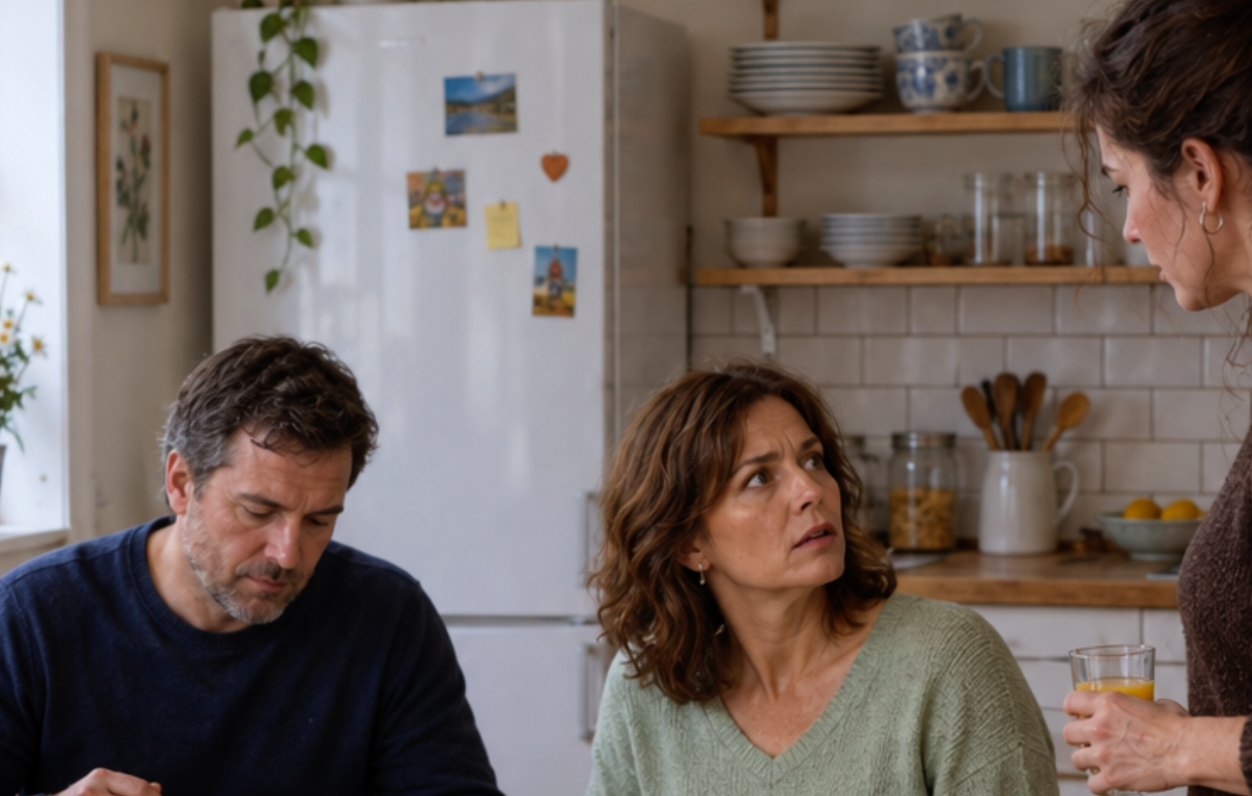
I placed the bowl of Olivier salad on the table and noticed Olesya lifting her glass of juice.
The family was already seated. My brother Andrey sat across from me, Mom was at the end closer to the stove—makes it easier for her to serve the hot food. Lyonya settled himself at the edge and immediately buried his face in his phone. Olesya stood with her glass, smiling. Her lips stretched in a grin, but her eyes checking to see if everyone was watching.
“Well then,” she said, “let’s drink to the birthday girl. Or rather, for the promotion. Kira here is now a department head at forty-four. That’s really something.”
I nodded and reached for my glass. Mom beamed, Andrey raised his too. Everything seemed normal. Just a usual family dinner. I didn’t book a restaurant—I’m not a fan of being around strangers. I wanted just my close ones. Mom baked pies, Andrey brought a cake from the supermarket, I made salads and roasted a chicken. The chicken turned out a bit dry, but nobody complained.
Olesya went on:
“We all know how much Kira works. She’s got nothing but work in her life. No husband, no kids. I guess her boss looked at her and thought: maybe I should take pity on this lonely woman and give her at least some joy.”
The table fell silent.
I held my glass. Fifteen years working at the property management company teaches you to handle anything. When residents call every day about burst pipes, cold radiators, yelling about mold in the corners and how the manager ‘steals our money,’ you learn to keep a straight face. Yelling doesn’t rattle me. But this wasn’t yelling. It was said quietly, with a smile, almost tenderly.
Mom froze. Andrey stared at his plate. Lyonya snorted, still glued to his phone—he probably wasn’t even listening.
I set my glass down.
“Olesya, are you serious?”
Olesya shrugged, still smiling:
“What’s the big deal? It’s a joke. Don’t you understand jokes?”
“No,” I said. “I don’t. Explain what’s funny.”
“Oh, come on. You’re upset already. I meant it with love.”
Mom started bustling about, sliding a plate of pickles towards me:
“Kirochka, try the pickles. I made them with garlic this time.”
I didn’t look at the pickles. I kept looking at Olesya. I had to understand: did she really think this was funny? Or was this exactly what she wanted—to make me feel like my life was worth nothing?
Olesya is Andrey’s wife. They’ve been together eleven years. Lyonya is ten.
When Andrey introduced her to us, I was thirty-three and she was twenty-four. Young, cheerful, with a short haircut and little silver hoop earrings. She worked as a shop assistant in a fabric department at the mall, but soon quit—first for maternity leave, then just never went back. Andrey supported the family alone. He’s a mechanic at a shop outside the city, six days a week, sometimes takes extra shifts on weekends. When he comes home, Olesya greets him with dinner. That’s where her interest in how he’s doing ends. She doesn’t ask how his day was. She tells him about hers.
I know this because sometimes Andrey stops by my place after work. Just to sit in silence for a bit. I pour him tea, he eats sandwiches and just stares at the wall.
One time he said, ‘Kir, it’s quiet at your place. It’s nice.’ And then I realized it was not quiet in his home.
But I never got involved. It’s his choice, his family. My role is to be the sister who listens and supports if needed—nothing more.
And now his wife is standing in front of me, holding a glass of juice, telling me that I only got promoted out of pity. Because I’m a ‘single woman’.
“Olesya,” I said. “Let’s be clear. You really think I became head of the department not because I’ve worked here for fifteen years? Not because I know the ins and outs of three hundred and sixteen buildings? Not because, last year, I got twenty-eight roofs repaired and saved the residents almost four million? But just because my boss felt sorry for me?”
“Oh, Kira, who takes a joke so seriously?” Olesya sighed. “You really have forgotten how to laugh.”
Mom quietly said:
“Olesya, maybe you shouldn’t?”
“Anna Sergeyevna, I didn’t say anything bad. I congratulated her. Everyone knows Kira is all about her job. That’s no secret.”
She said those last words with special emphasis. As if it was something shameful. As if a woman who builds a career and not a family is somehow a failure.
I looked around the table. Andrey stared into his plate, red spots growing on his neck—that’s always how he looks when he’s nervous. Lyonya chewed his salad and scrolled through his feed. Mom fiddled with the edge of the tablecloth.
And then it hit me: they were all silent.
Everyone was silent. No one would tell Olesya: ‘You’re wrong.’ Not even Mom. Not even Andrey, who knows how hard I’ve worked.
I stood up. Walked down the hallway. Took my jacket off the hook.
Mom rushed after me:
“Kirochka, where are you going? She didn’t mean anything by it. You know what Olesya’s like—her tongue’s sharp as a broom.”
“Mom, I’ve known Olesya for eleven years. In eleven years, you’d think she’d learn to watch her words. She doesn’t want to. And you don’t want to tell her to. That’s all there is to it.”
“Don’t leave. You’ll ruin the evening.”
I looked at my mom. She’s seventy-two. She’s lived alone for the last sixteen years. Spent her whole life as an accountant at the local bakery. After Dad was gone, she said: ‘Now you and Andrey are all I have left.’ And she truly tried to keep us together. Family dinners on birthdays, New Year’s. She cooked aspic, baked pies, called each of us and reminded: ‘I’m waiting on Saturday, don’t be late.’ She wanted us to stay a family.
But I couldn’t just ‘be family’ and sit there smiling at someone who just called me a lonely woman to be pitied.
“Mom, I’m sorry. I’m going. The pies were delicious.”
I put on my shoes. Unlocked the door myself—the lock is stiff, you have to pull and turn the key at the same time. I’ve done this hundreds of times.
Already at the door, I heard Olesya’s voice:
“See? She ruined the evening. I told you she’s too sensitive.”
I didn’t look back.
I bought my car four years ago. Not new, used, a dark gray sedan. Took out a loan, paid it off early in two and a half years. When I was doing the insurance paperwork, the manager asked: ‘Will your husband be listed?’
I answered: ‘No husband.’
He nodded and didn’t say another word. Totally normal.
I didn’t start the engine right away once I got in the car. I just sat there, looking out at my mom’s yard. A nine-story panel building from 1990. In the courtyard, there’s a slide, three benches, an old poplar tree that the residents always demand to be cut down every year, and every year the management company promises it’ll be in the plan. I know that poplar. I know its roots reach the foundation. I know if you cut it down, you’ll have to reinforce the foundation. There are a thousand things I understand about keeping buildings running and making sure people stay warm in winter. I’m a good specialist. I’m not just someone who dedicated their life to work—I’m a true professional.
But none of that matters to Olesya. For her, the only currency is family. Husband, kids, family photos, a beach vacation once a year, school meetings, holiday performances, buying school uniforms in August. That’s everything she has. And she uses that yardstick to judge everyone. To her, I’m a nobody. Just because I don’t have what she has.
I started the engine and drove home.
I have a two-room apartment. Bought it eight years ago with a mortgage. I spent almost ten years saving up for the down payment—ever since I started working at the management company. I began as a passport officer, stuck in a cramped office with no window, handing out family status certificates, certifying copies, registering incoming documents. Then I moved to the subscriber department. Later, I became a lead engineer. Three years ago, I was promoted to deputy head of the department. And now—I’m the boss.
My department is five people: two engineers, a technician, an estimator, and me. We handle all the technical documentation for the residential portfolio. Scheduled inspections, defect sheets, completed work reports, orders, and readiness certificates for the heating season.
Paperwork, paperwork, paperwork. But behind every piece of paper are real people. The grandmother from the third entrance whose radiator is barely warm. A young family on the ninth floor whose ceiling leaks when it rains. The entrepreneur who wants to change the ground-floor space to commercial and open a shoe repair shop. I know all of this. It’s my world.
When my supervisor, Elena Romanovna, called me and said, ‘Kira, I’m submitting your name for the department head position,’ I wasn’t surprised. I’d been waiting for this. I was ready. We’d discussed it six months ago when the previous boss retired. Elena Romanovna said, ‘You’ve basically been running the department already. Time to make it official.’
I nodded and said, ‘Let’s do it.’
No pity. No condescending looks. It’s all business. I bring results to the company—the company pays me a salary and promotes me. Everything’s fair.
At home, I warmed up yesterday’s soup. Sat at the table, opened my laptop, and checked my email. Three messages from contractors, a query from the regional administration, a complaint from a resident about elevator noise. I replied to the emails, drafted a response to the complaint, checked the inspection schedule for next week. After an hour of work, I wasn’t really thinking about Olesya anymore. Or rather, I was—but only somewhere on the periphery, like background noise.
My phone chimed. Message from Andrey: ‘Kira, I’m sorry. She’s wrong.’
I glanced at my phone screen. It was Andrey. My younger brother. He’s thirty-nine now.
When he was seven and I was twelve, I took him to school every day. He was afraid to cross the street, so I always held his hand. Dad was working at the motor depot back then; Mom worked at the bakery, so no one else could drive us. I picked him up from after-school, warmed up his lunch, checked his homework. When he got into a fight and broke his glasses, I went to the principal’s office for him. When he failed math in ninth grade, I paid for a tutor with the money I earned over summer sorting apples. I was always looking after him.
And now, he texts me: ‘She’s wrong.’ And that’s it. Just a statement. Not ‘I stood up for you,’ not ‘I said something to her in front of everyone.’ Just a private message. So I’d know he agrees with me. Secretly. Inside his own mind.
I replied, ‘Thank you, Andrey.’ And put my phone away.
Two weeks later, it was Mom’s birthday. Seventy-three years old. I called her in advance.
‘Mom, I’m coming to celebrate. But let’s do it separately. Without Olesya.’
Mom was silent for a moment.
‘Kira, how can that be? It’s a family celebration. What will I say to Andrey? “Come without your wife”?’
‘Mom, I don’t want to sit at the same table with her. Not after what she said.’
‘But she apologized!’
I almost laughed.
‘When? When did she apologize?’
‘Well, she said she was joking. She didn’t mean to hurt you.’
‘Mom, “I was joking” isn’t an apology. It’s just a way to act like I have no right to be offended.’
Mom sighed.
‘You’ve always been difficult, Kira. Everything’s wrong for you, every word is the wrong word. Olesya—she’s simple, she doesn’t think about what she says. But you weigh every word.’
‘Mom, weighing my words is my job. I write documents where a single wrong word can cost the company a lawsuit. But even if I didn’t do that, I’d understand what she said. She called me lonely in front of everyone. That’s not being difficult. That’s a direct insult.’
Mom fell silent.
I was silent too. I felt sorry for her. She meant well. She wanted everyone to get together, for things to look right, for her to be able to look at us and be happy: here’s my family. But it wasn’t working out. And it probably never would.
‘How about I come over Friday evening? I’ll bring fruit and your favorite pastries from that bakery on Pervomayskaya. We can have a small gathering, just the three of us. You, me, and Andrey.’
‘And Olesya?’
‘Without Olesya.’
‘Kira, don’t make me choose.’
‘I’m not making you choose. I’m choosing for myself. I won’t go somewhere I’m insulted. That’s my right.’
Mom didn’t answer. I heard her put the phone down on the table—she must have turned on the speaker because her voice sounded distant and hollow. Footsteps. The clatter of a pot.
‘Kira,’ she called from a distance. ‘You know I love you. And I love her, too. She’s Andrey’s wife. Lyenka’s mother. How can I just leave her out?’
‘I’m not asking you to leave her out. I just don’t want to sit at the same table with her. Let me come on Friday. Just the two or three of us.’
‘Alright,’ Mom said, her voice tired. ‘Come on Friday.’
On Friday, I bought pastries and went to Mom’s. Andrey came, too. Olesya wasn’t there.
The three of us sat together in the kitchen. Mom’s kitchen is a tight squeeze: a stove, a refrigerator, violets on the windowsill. Mom brewed tea and brought out some blackcurrant jam.
Andrey sat silently, stirring his tea with a spoon. Mom was talking about the neighbor from the fifth floor—something about a recalculation for the heating bill. I listened and nodded along.
Then Andrey spoke up:
“Olesya’s hurt. She thinks you don’t want to see her.”
I took a sip of tea.
“Andrey, you heard what she said. You were sitting at the table.”
“I heard.”
“And what do you think?”
He set his cup aside and rubbed his neck.
“I think she didn’t mean any harm. She just… well, she doesn’t realize that her words can hurt. She doesn’t really understand what it means to build a career.”
“There you go again, saying I only live for my work. Like it’s something to be ashamed of. I work hard. I’m a good professional. I bought my apartment and car myself—I earned everything. I never asked anyone for money. And I’m not complaining. Why should anyone pity me?”
“I don’t pity you. I respect you. You know that.”
“Then why didn’t you say that to Olesya? Back at the table. Why didn’t you say: ‘Olesya, stop it. Kira is not someone to be pitied. Kira built her career and helps people have a decent life. That deserves respect, not pity.’”
Andrey lowered his eyes.
“I don’t want to fight with her.”
“Why?”
“Because then at home, it’s a week of silence. Or yelling. And Lyonka hears all of it.”
I understood him. I did. But I couldn’t accept it.
Mom glanced back and forth between me and Andrey. Then she quietly said:
“Maybe we should still invite Olesya to my birthday? For my sake?”
I shook my head.
“Mom, you can invite her. It’s your day. But then I’ll come separately. Not with her.”
“Kira, you shouldn’t do that.”
“I can. I’m not asking you to stop seeing her. I just won’t share a table with her. That’s my decision, and I have the right to make it.”
Mom started to cry. Quietly, without sobbing. Tears streamed down her cheeks and she wiped them with her hand.
I hugged her.
“Mom, I’m sorry. But I can’t do otherwise.”
Andrey stood up and went out into the hallway. I could hear him pulling on his jacket.
“I’m going to head out,” he said. “It’s late already.”
He didn’t say goodbye to Mom. He just left and closed the door. I stayed there, sitting.
Two weeks later, I learned from Mom that Olesya had told their mutual friends how I ‘made a scene out of nothing.’ Supposedly, she just congratulated me, and I ‘lashed out with complaints.’ And now a few people in Mom’s circle think I have a terrible character.
I was sitting at work, staring at the monitor and thinking: how does this keep happening? Someone says something mean. I react. And suddenly, I’m the one at fault. Because I ‘ruined the evening.’ Because I ‘didn’t get the joke.’ Because I’m ‘too sensitive.’ But the fact that a grown woman publicly humiliated another woman for not having a husband or children—that’s nothing. That’s normal. That’s just ‘not thinking.’
I’m forty-four. I’m not married and I don’t have children. That’s just a fact. Up until I was about thirty-five, I still went on dates. I had relationships—twice they almost became serious. One man told me, ‘You work too much, I need a woman at home.’ Another said, ‘You earn more than I do, that makes me uncomfortable.’ And I thought: then these aren’t my people. So I stopped searching on purpose. I decided: whatever happens, happens. If I meet someone I feel good with—great. If not, I have my job, my friends, my nephew, my mom, my brother. I don’t feel empty. I’m complete on my own.
But people like Olesya don’t understand this. To them, a woman without a husband is incomplete. She deserves pity. She can be teased, called ‘lonely’, and they think it’s funny.
No. It’s not funny. And I’m not going to pretend it’s normal.
Three months passed. New Year’s came. I spent it alone. Made duck for the first time, tried a recipe I found online. The duck turned out tough, but the broth was amazing. I watched New Year’s shows, replied to messages on my phone, wrote to Andrey and my mom. I didn’t wish Olesya a happy new year. She didn’t wish me one either.
In January, my mom called and said she wanted to get everyone together in February—just a family lunch, no special reason. Olesya will be there. Andrey will be there. And they’re waiting for me too.
I said:
‘Mom, I’ll come on February 27th. In the morning. I’ll bring a gift. We’ll sit together, have some tea. And later in the evening, let everyone have the family dinner.’
Mom was upset again. But she didn’t argue. I think she’s starting to get used to it. Or maybe she’s just tired.
I hung up and walked to the window. Outside was my neighborhood. Nine-story buildings, courtyards, cars parked by the entrances. Somewhere out there, in building sixteen on Stroiteley Street, the roof was leaking, and I knew the contractor was supposed to set up scaffolding on Monday. In building seven, they were replacing the heating pipes—the residents sent a thank you. In building twenty-four, they were arguing with management about cleaning the entrance.
This was my life. Not a husband, not kids, not family dinners with forced smiles. This job. These people. These buildings.
Maybe this really is my life. Without anyone else’s judgments.
Olesya won’t change. Andrey won’t stand up for me. My mom will keep hoping ‘everything will work out’ until the end. But I won’t go to another dinner where my life is seen as a failure just because there’s no man in it.
I don’t need pity. I need respect. And if I don’t get respect—I just won’t come. That’s my choice.