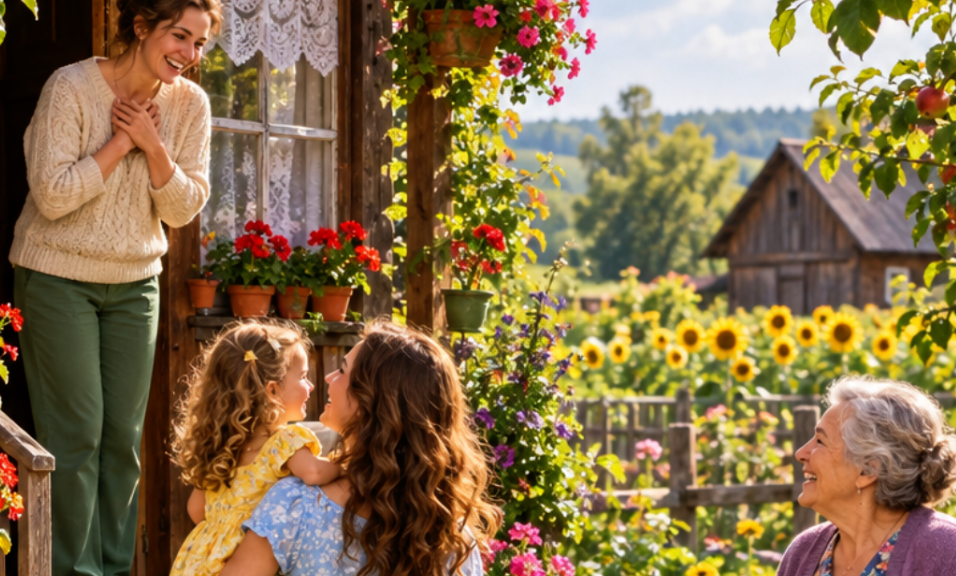
Every weekend, uninvited guests would show up at Olga’s dacha. Her mother-in-law, sister-in-law, and their kids would arrive as if it was their own place—until Olga decided she’d had enough.
On Saturday, at half past eight in the morning, Olga heard the crunch of gravel on the driveway. Her coffee in the pot hadn’t even started to boil yet.
She stood barefoot in the kitchen, wearing Gleb’s old t-shirt, and watched through the window as her mother-in-law’s silvery Largus rolled onto their property. Right behind it, almost bumper-to-bumper, came Zhanna’s white Kalina.
The coffee pot hissed. Olga took it off the stove and set it on a wooden trivet. Her fingers gripped the handle so tightly her knuckles turned white.
“Gleb,” she called quietly.
Her husband didn’t answer. He was upstairs in the attic, where he’d laid out his fishing rods and tackle box the night before. He was planning to go to the lake.
“Gleb!”
“What?”
“Your family is here.”
Silence. Then the squeak of a floorboard, footsteps on the stairs. He came down wearing only shorts, his hair squashed from the pillow, a red crease from the bedsheet on his cheek.
“Who?”
“All of them.”
He walked to the window and looked out. Zinaida Pavlovna was already popping the trunk. Zhanna was pulling two kids out of the car: six-year-old Kirill and four-year-old Polina. The kids were shrieking.
“I didn’t invite them,” said Gleb.
“I know.”
He rubbed his face with both hands, just like he always did when he wasn’t in the mood to talk. Olga had memorized this gesture down to the last detail after twelve years of marriage.
The dacha was theirs. Not a family place, not inherited, not their parents’. Olga and Gleb bought the land eight years ago, when he got a bonus at the factory and she sold her grandmother’s small apartment in Serpukhov. They poured the foundation themselves, hired the crew themselves, picked out every single board for the terrace themselves.
Back then, Zinaida Pavlovna said: why bother with all this trouble, you should’ve bought a new car instead. Zhanna twirled a finger by her head and asked if it wasn’t too far from Moscow.
It was far. One hundred and forty kilometers on the Simferopol highway, then twelve more on a dirt road. But that was exactly what Olga loved: the peace and quiet, the smell of pine resin, the morning mist over the lake that would clear by nine o’clock.
But two years ago, Zinaida Pavlovna retired. And something changed.
The first time they came was in June, with just an hour’s notice. Olga thought, it’s fine, maybe they just missed us. She set the table on the terrace, grilled chicken, chopped some salad. Zinaida Pavlovna ate two servings and said the chicken was a bit dry.
The second time, they showed up a week later. No warning at all. Olga was painting the fence that day. She was in ripped sweatpants and a headscarf, splattered with white drops. Zhanna stepped out in a sundress and heels, looked around, and asked:
“So, you still haven’t put in a pool?”
“No.”
“That’s a shame. The kids have nowhere to swim.”
Olga stayed silent. Zhanna’s kids were afraid to go to the lake—there were leeches. But a pool for the yard cost a hundred and twenty thousand, and Olga wasn’t planning to spend that sort of money for someone else’s kids who showed up without asking.
By August, the visits had become a ritual. Every Saturday, sometimes even from Friday night. Zinaida Pavlovna would arrive with jars for jam and take over the kitchen. Zhanna put the kids to bed in the attic, on Olga and Gleb’s bed, because ‘it’s cooler up there.’ Olga made up a bed for herself on the couch downstairs and lay there, listening to Kiryusha jumping on their mattress upstairs.
Gleb stayed silent.
In September, Olga tried to talk.
They were sitting in the car on the way back to Moscow, Sunday, nine in the evening. The traffic jam heading into the city stretched all the way from Podolsk. Rain was drumming on the roof.
‘Gleb.’
‘Hm?’
‘I need you to talk to your mom.’
‘About what?’
‘About the country house. About how you can’t just show up every weekend without calling first.’
He didn’t reply right away. He turned the windshield wipers to the second speed. Drops spread across the glass and gathered again.
‘She’s my mother, Olga.’
‘I’m not arguing. But the house is ours.’
‘She doesn’t understand things like that. For her, family means the doors are always open.’
‘For me, family means people ask first.’
He turned his head and looked at her. His eyes were tired, streaked red after a whole day working in the yard, fixing the porch because Kiryusha broke the railing.
‘I’ll talk to her.’
He didn’t talk to her.
In October, the country house season ended, and Olga breathed a sigh of relief. Nobody went out there in winter. The road would get buried in snow, the gas heating was efficient but frugal, and it made no sense to heat the house for just the weekends.
Olga waited for spring with a nervousness lodged deep under her ribs that wouldn’t leave, not even at night. She would wake up at four a.m. in their Moscow apartment, staring at the ceiling, running through possible things she could say to her mother-in-law. None of her ideas ever seemed right.
Because Zinaida Pavlovna was the kind of woman who didn’t hear the word ‘no.’ Not because she was mean. But because she truly didn’t understand why that word even existed.
April. The first weekend after the season opened.
Olga and Gleb arrived Friday evening. The house smelled damp and a bit of mice. She opened all the windows, cleaned the floors, unpacked their things. Gleb checked the gas boiler, turned on the water, and cleared last year’s leaves from the roof gutter.
By ten in the evening, they were sitting on the terrace. The April air still had a bite to it, but Olga wrapped herself in a blanket and didn’t want to leave. The stars above the pines were big and close—nothing like you see in Moscow.
‘It’s nice,’ she said.
‘Yeah,’ Gleb replied, wrapping his arm around her shoulders.
His hand was warm and rough from work. Olga leaned her cheek against his sweater, breathing in the scent of smoke from the fire he’d made earlier, burning cut branches.
At eight in the morning on Saturday, Gleb’s phone rang. Olga was still in bed. Sunlight slipped through a gap in the curtains in a slanting stripe, the dust swirling in it like glitter.
Gleb answered. She heard his voice from the kitchen—muffled, rushed.
‘Mom, we just got here… Yeah… No, I’m not saying… Okay. Okay, come over.’
He came back to the bedroom and sat on the edge of the bed. Olga lay with her eyes open, staring at the dust in the sunbeam.
‘They’re coming,’ he said.
‘I heard.’
‘Mom says Zhanna and the kids are coming too, it’s stuffy in their apartment.’
‘In April?’
‘Well… that’s what she said.’
Olga sat down. The blanket slipped off her shoulders. On the nightstand, there was a glass of water she had poured the night before but never drank. Overnight, tiny bubbles had formed in the water.
“You promised you’d talk.”
“I will talk. Later. Once they’ve left.”
“You’ve been saying that since last summer.”
He stayed silent. He stood up, put on his pants, and walked out. A minute later, she heard him pouring water into the kettle. The metal kettle began to hum on the stove.
Olga sat on the bed, feeling something inside her turning to stone. It wasn’t anger. It was something duller and heavier, like cement setting.
They arrived at eleven. Zinaida Pavlovna, Zhanna, Kiryusha, Polina. And Zhanna’s husband Vadim, whom Olga had only seen maybe five times in all these years. He was tall, quiet, with a patchy beard that grew like grass on an untended lawn.
“Oh, it’s so nice here!” Zinaida Pavlovna entered the yard like she owned the place: confident, appraising, fixing a flowerpot on the porch as she passed. “But this spot needs to be painted—you see, it’s peeling.”
She pointed at the corner of the house, where the paint really was coming off. Olga knew that. She had planned to paint it in May, when the weather warmed up.
“Good afternoon, Zinaida Pavlovna.”
“Hello, Olenka. Why do you look so pale? Are you sick?”
“No.”
“But you look unwell. Zhanna, look, doesn’t she look pale?”
Zhanna was carrying Polina in her arms, who was whining. Behind them walked Kiryusha, kicking rocks.
“Mom, I can’t deal with this right now. Polinka’s been fussy the whole way.”
“Give her to me. Go unload the car. Vadim, why are you just standing there? Help your wife.”
Vadim silently grabbed a bag from the trunk. A bundle of meat for the barbecue stuck out of it. The meat was in plastic, and cloudy juice was dripping down the bag.
Olga watched all this without moving. She stood on the porch, barefoot, still wearing Gleb’s t-shirt, feeling the cold boards of the terrace pressing into her feet.
Gleb came out of the house with the kettle in his hand.
“Oh, hi, Mom. Hi, Zhanna. Vadim.”
“Glebushka!” Zinaida Pavlovna hugged him, even though Polina was squealing in her arms. “You’ve lost weight. Is Olya not feeding you?”
“She’s feeding me, Mom.”
“Doesn’t look like it.”
Olga turned and went back inside the house.
She spent the whole day on autopilot. Boiled potatoes. Washed vegetables. Sliced cucumbers for a salad Zinaida Pavlovna asked her to make “like Zhanna does, with garlic.” Olga didn’t like garlic in salad, but she put it in anyway.
Kiryusha found a shovel in the yard and dug up three peony bushes that Olga had planted last autumn. She saw it from the kitchen window: holes in the ground, uprooted roots, petals smeared with dirt.
She didn’t shout. Her hands, holding a knife, froze over the cutting board. Then she just kept cutting.
Zhanna led Kiryusha out by the hand and said:
“Come on, he’s just a kid. He didn’t mean it.”
“I know.”
“You’re not upset, are you?”
“No.”
She was upset. But not at Kiryusha. He’s only six, how could she blame him when no one’s really watching him? She was mad at Zhanna, who sat on the swing scrolling through her phone while her son tore up someone else’s yard. At Vadim, who wandered off ‘for a walk in the woods’ and didn’t show up again until dinner. At Zinaida Pavlovna, who took over the kitchen, rearranged the jars in the cupboard ‘the right way,’ and told Olga three times that she was storing flour incorrectly.
But most of all, she was upset with Gleb. He just sat by the barbecue, flipping kebabs and smiling. As if nothing was wrong.
In the evening, after all the guests had gone to bed, Olga and Gleb found themselves alone on the couch in the living room. Upstairs in their bedroom, Zhanna and Vadim were asleep. Zinaida Pavlovna had taken over the guest room. The kids were on a folding bed in the attic. The folding bed had been brought by Gleb’s mother-in-law.
“They brought their own folding bed,” Olga said into the darkness.
“So what?”
“They planned to stay the night. They decided in advance they’d stay.”
“Well, it’s a long way home…”
“Gleb. They showed up with a folding bed, meat, and spare clothes for the kids. This isn’t a spontaneous visit. This is just how they live.”
He turned to her. In the darkness, she could just make out the outline of his face. The nose she once thought was perfect. The chin covered in two-day stubble.
“So what do you suggest?”
“I suggest you talk to your mother.”
“She’ll get upset.”
“Well, I’m already upset.”
“You’re different.”
Olga propped herself up on her elbow. The couch creaked.
“I’m different?”
“You’ll understand. But Mom won’t.”
“So my feelings are less important because I can control them?”
He rubbed his face with both hands again. That familiar gesture.
“That’s not what I meant.”
“So what did you mean?”
“Let’s talk in the morning.”
“Let’s talk in the morning, let’s do it later, let’s wait until they leave. Gleb, they’re not going to leave. They’ll be back every weekend until October.”
He fell silent. Olga lay back down. The pillow smelled of someone else’s perfume: Zhanna must have lain here earlier that day. It was a sweet, cloying scent.
Olga pushed the pillow aside and rested her head on the armrest of the sofa.
On Sunday, the guests left by four o’clock. What was left behind: a mountain of dirty dishes, a wine stain on the tablecloth, three dug-up peony bushes, bent porch railings (thanks to Kiryusha), and the smell of grilled meat soaked into the curtains.
Olga washed the dishes in silence. Gleb stood next to her, drying the plates. They didn’t speak.
The water from the tap was hot, almost scalding. Olga didn’t turn it down. Her arms were red up to her elbows. She scrubbed the frying pan with a steel sponge and listened as the metal scratched against metal, filling the kitchen with harsh noise.
“Ol.”
“What?”
“I’ll talk to her.”
“When?”
“This week.”
She put the pan in the drying rack. She wiped her hands on the towel. The towel was already wet—someone else had used it.
“Don’t bother.”
“What?”
“Don’t talk to her. I’ll handle it myself.”
During the week, Olga took care of a few things.
On Tuesday, she called Rita, a friend from work, and asked for the number of the handyman who built Rita’s fence at her dacha. Rita gave her the contact and asked:
“Are you putting up a fence too?”
“Something like that.”
On Wednesday, she stopped by the hardware store after work. She bought a lock for the gate—not a combination or electronic one. Just a regular, hefty padlock with a thick shackle and two keys. It felt as heavy as an iron. Holding it in her hand, she felt something close to calm.
On Thursday, she called a contractor. His name was Arkady, his voice rough with a southern accent.
“I need a gate with a lock. And the fence by the road needs to be solid, with no gaps.”
“Metal sheeting?”
“Yes. Two meters tall.”
“When?”
“This Saturday.”
“Twenty-seven thousand for materials, labor is separate.”
“Alright.”
Friday evening, Olga and Gleb arrived at their dacha. She didn’t tell him anything. She brought the lock tucked in her bag, under a bundle of groceries.
Gleb was unloading the car and didn’t notice a thing.
Arkady showed up on Saturday at seven in the morning in his Gazelle van with two helpers. The sheets of metal clanged as they unloaded them.
Gleb came out onto the porch in his underwear.
“What’s this?”
“The fence,” Olga replied. She was already dressed, hair done, and wearing work gloves.
“What fence?”
“A proper one. Replacing the old picket fence.”
“You didn’t tell me.”
“And you didn’t tell your mom.”
He opened his mouth and closed it again. Stood silently. Then went back inside.
Arkady worked fast. By lunchtime, the road-facing fence was done: two meters high, dark green metal, not a single gap. A gate with a hefty padlock.
Olga hung the lock herself. Snapped the shackle shut. Gave it a tug. It held firm. She put the key in her jeans pocket.
The second key she hid in a coffee jar on the top shelf of the kitchen cabinet. She didn’t tell Gleb.
He was moody all day. Helped Arkady in silence, handed him tools, held up the metal sheets. Olga saw how tense he was: jaw clenched, a vein throbbing at his temple.
But he didn’t argue. Because he understood.
On Sunday at nine in the morning, Gleb’s phone rang. Olga was sitting on the terrace with her coffee. The morning was warm and smelled of earth after the night rain. Drops like tiny beads glittered on the bed she’d dug yesterday.
“Hi, Mom,” said Gleb, his voice steady and careful. “No, it won’t work today. We… are busy.”
Pause.
“No, really, we’re busy. Painting. Yes. The whole house. No, we don’t need any help.”
Another pause. Longer this time.
“Mom, I’ll call you back.”
He put the phone on the table and looked at Olga. She took a sip of coffee. Didn’t smile.
“She’s upset,” he said.
“She’ll get over it.”
“Olga, you can’t do this.”
“I can.”
She set her cup down and looked him straight in the eyes. The sun hit from the side, making his face half-shadow, half-light. The lines near his eyes seemed deeper this year. Or maybe she’d just never noticed before.
“Gleb. I love your mom. And Zhanna. And the kids. But this is our home. We built it together. I painted every board on this terrace. I planted those peonies that Kiryusha dug up. I have the right to spend a Saturday without guests.”
“I understand.”
“No, you don’t. Because if you did, you’d have talked to her yourself a long time ago.”
He was silent. Fiddled with his phone. Then put it face down.
“Fine. What do you want?”
“A simple rule. If someone wants to visit, they call three days ahead. We decide together. If not, then not. And the lock on the gate stays.”
“What if Mom gets upset?”
“She’ll be upset either way. The only question is, who will she be upset with.”
Next Saturday felt like a big test.
Olga noticed herself listening intently that morning: was that the crunch of gravel? Was a car engine humming by the gate? But everything was calm. Only birdsong, the wind in the pines, and a distant woodpecker knocking.
At ten, Zinaida Pavlovna called. She wanted to speak to Gleb.
“Glebushka, we were thinking of coming over.”
“Mom, today won’t work. Olya and I want some time just for us.”
“How can it not work? I baked a pie!”
“Bring it by during the week. Or next weekend, just please call ahead.”
There was a long pause. Olga heard the silence rustle through the phone from the other room. Zinaida Pavlovna said nothing. It wasn’t like her.
“Gleb, are you trying to get rid of me?”
“No, I’m just asking you to let us know beforehand.”
“I’m your mother!”
“You are, and Olya is my wife. And this is our dacha, not a revolving door.”
He actually said ‘revolving door.’ Olga shivered. She’d never used that phrase with him. This meant he’d been thinking it, quietly, somewhere inside himself, a place he covered up by rubbing his face with his hands.
Zinaida Pavlovna hung up.
Gleb went out to the terrace and sat next to Olga. He took her hand. His fingers were cold, even though the day was warm.
“She’s upset,” he said.
“I heard.”
“She’ll call Zhanna and complain.”
“Let her.”
“Zhanna will call me.”
“Let her.”
He smirked, his mouth twisting just on one side.
“You know what’s strange? I actually feel lighter.”
Olga looked at him. Twelve years together, and she’d seen him in every mood: happy, exhausted, angry, gentle, tipsy at the New Year office party, scared in the ER when she had her appendix out. But never before had she seen him like this—lost, yet somehow free.
“Me too,” she said.
Zhanna called an hour later. This time, Olga picked up the phone herself.
“Olya, what’s going on? Mom’s hysterical. She says you two kicked her out.”
“We didn’t kick anyone out, Zhanna. We just asked her to call first.”
“Why? We’re family.”
“Exactly—because we’re family. We want everyone to feel comfortable.”
“I’m already comfortable.”
“Well, I’m not.”
Silence. Zhanna hadn’t expected that. Olga could tell by the pause: her sister-in-law was used to her agreeing, tolerating, smiling, chopping cucumbers with garlic.
“Olya, are you serious? All because of a summer house?”
“Because of my home. Yes, I’m serious.”
“Fine. Whatever you want. But don’t be surprised if we stop coming altogether.”
“Zhanna, of course you can come. Just call. Three days ahead. We’ll check our schedule and let you know.”
“Schedule? What, are you running a hotel now?”
“No. We have a home, and we want to relax here. Sometimes just the two of us.”
Zhanna snorted and hung up.
Olga set the phone down on the table. Her hands were steady. Inside, she suddenly felt empty and clean, like a room after spring cleaning.
For two weeks, nobody called. At all. Not Zinaida Pavlovna, not Zhanna. The silence was deafening.
Gleb seemed on edge. He didn’t say anything, but Olga noticed: he checked his phone more than usual, barely ate, and stood by the window for long stretches in the evenings.
“Do you regret it?” she asked one Wednesday while they were having a quick dinner of pasta and canned stew in their Moscow apartment after work.
“No,” he replied, but not right away.
“Gleb.”
“I don’t regret it. But it does feel strange. Mom always called every day.”
Olga decided not to mention that this was actually the problem. Instead, she got up, walked around the table, and hugged him from behind, pressing her cheek to the top of his head. His hair smelled of shampoo and just a hint of gasoline – he’d filled up the car after work.
“She’ll call,” Olga said.
“How do you know?”
“I just know.”
Zinaida Pavlovna called on Friday. She called Gleb.
“Son, can we come over on Sunday? Zhanna promised a pie, and I’ll make some jam.”
Gleb looked at Olga. She stood in the kitchen doorway, holding a cup of tea. She nodded.
“Come, mom. Around noon. But you’ll need to leave by seven – we have things to do Monday morning.”
“Alright, son. Alright.”
His mother’s voice was unusually quiet. No insisting, no “why by seven,” no “what things could be so urgent.” Just a simple “alright.”
They arrived on Sunday at twelve sharp. Not a minute early or late.
Zinaida Pavlovna got out of the car more slowly than usual. She looked around, noticed the new fence, but said nothing. She walked over to the gate. It was already open – Olga had made sure of it.
“Hello, Olenka.”
“Hello, Zinaida Pavlovna. Please, come in.”
Her mother-in-law walked in, and for just a second, Olga noticed something new in her eyes. Not resentment. Not anger. It was something like respect. Or maybe surprise: so Olenka does have a voice after all.
Zhanna got out of the car carrying Polina. Kiryusha walked beside them, holding Vadim’s hand. Usually, he would run ahead, kicking everything in his path.
“Kiryush, be careful,” Zhanna said. For the first time ever, as far as Olga could remember, she said it on her own, without being reminded.
“Okay, mom.”
He walked past the peonies. The new ones Olga had planted last week where the old ones had been dug up. Still small, with no buds yet. Kiryusha looked at them and walked around.
Olga set the table on the terrace. The salad had no garlic. The chicken was roasted just the way she liked – crispy skin, with lemon. Gleb brought chairs from the shed.
Zinaida Pavlovna put a jar of jam on the table and said:
“Raspberry. From last year’s batch.”
“Thank you.”
They all sat down. Vadim quietly put some meat on his plate. Zhanna cut chicken into small pieces for Polina. Kiryusha ate potatoes with his hands, but kept quiet.
Zinaida Pavlovna tried the salad.
“Turns out, it’s tasty even without garlic.”
Olga looked at her. Her mother-in-law chewed while gazing at the pine trees beyond the plot. Her face was calm. When not eating, her hands rested in her lap. Her wedding ring was still on her right hand. She hadn’t taken it off even after her husband – whom Olga had never met – passed away.
“Yes,” Olga agreed. “It’s tasty this way, too.”
By six in the evening, they started to pack up.
Zinaida Pavlovna washed her own dishes. Olga never asked her to. Zhanna gathered up the toys Kiryusha had scattered around the yard and put them in a bag. Vadim took out the trash.
At the doorway, her mother-in-law lingered for a moment. She turned to Olga.
“Ol.”
“Yes?”
“Thank you for inviting us.”
She said “inviting.” Not “letting us come,” not “not kicking us out.” Invited. Like real hosts, with the right to invite or not invite.
Olga nodded. Her throat tightened, but she didn’t let it show. She just squeezed the doorframe a little tighter.
“Come again, Zinaida Pavlovna. Give us a call.”
“I will call.”
The cars pulled out through the gates. Olga closed the small gate behind them, snapping the lock shut with a heavy, reassuring click.
Gleb came up behind her and placed his hands gently on her shoulders.
“You know, they acted differently today.”
“I noticed,” she replied.
“Kiryusha walked around the peonies.”
“I saw,” she said.
“Mom did the dishes.”
“Yes.”
He paused for a moment.
“I shouldn’t have waited for you to do everything by yourself.”
Olga turned to face him. The setting sun hung low, painting his face with warm, golden light. She saw the wrinkles by his eyes, the stubble on his chin, the nose she once thought was perfect.
“You shouldn’t have,” she agreed.
“I’m going to do better.”
“We’ll see.”
She smiled. For the first time this weekend. Maybe for the first time all month.
That evening, Olga sat alone on the terrace. Gleb had fallen asleep upstairs, in their bedroom, in their bed—the one that hadn’t had any guests for three weeks. The sheets smelled of lavender; she’d bought a new fabric softener just because she felt like it.
The night was quiet. Pine trees stood black against the sky, and the stars scattered above like coarse salt on a dark tablecloth. The forest air carried the scent of dampness and mushrooms, even though mushroom season was still far away.
A jar of raspberry jam sat on the table. Olga opened the lid and scooped some out with a spoon. The jam was thick, with whole berries and so sweet it made her teeth ache.
It was really good jam. Zinaida Pavlovna had always known how to make it perfectly.
Olga licked the spoon and closed up the jar. She placed the key to the gate on the table next to the jam. Two objects: a lock and a treat. Boundary and invitation.
She leaned back in her chair and closed her eyes.
The air smelled of resin, earth, and something elusive that only happens at the end of April, when winter is truly over and summer hasn’t arrived. An in-between space. A pause between two states.
Just like now.
Olga sat in that pause, in no hurry to leave it. For the first time in a long while, there was nowhere she had to rush to, no one she had to hide from, and nothing she needed to explain. The house stood behind her—dark, warm, hers. The fence wrapped around her yard—new, even, with a gate she could open whenever she wanted.
Whenever she wanted.
She smiled into the darkness. No one saw that smile.
But it wasn’t meant for anyone else.