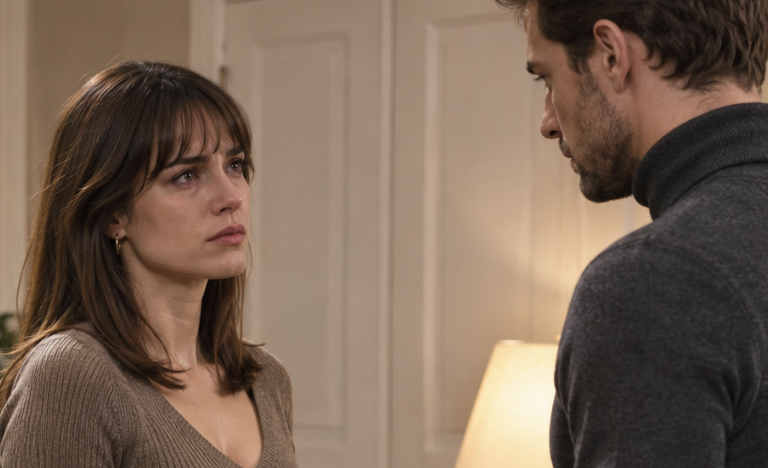
Zoya named her price on Wednesday at half past six in the evening, and she was smiling as she did so. She was certain it was the best deal of her life. Her mother-in-law didn’t even understand what she meant at first. And when she finally did, her face turned so pale that her lips began to tremble.
Six months later, Zoya would be standing behind a rosehip bush in someone else’s courtyard, afraid to look her own daughters in the eyes. But that Wednesday, she knew nothing of what lay ahead. That Wednesday, she felt like a winner.
It had all started with cookies.
Five years earlier, Arthur had brought Zoya to meet his mother for the first time. Nina Sergeyevna opened the door wearing an apron decorated with sunflowers, with a smudge of flour on her cheek. She was a short, plump woman with silver hair gathered into a soft bun. She had calm gray eyes and warm hands that smelled of cinnamon and Antonovka apples.
“Oh, I’m not ready!” she exclaimed, throwing up her hands. “Arthur said you’d be here at seven, and it’s only quarter to! He’s always like this. Promises to come at seven, then shows up while the cookies are still raw.”
“Mom, it’s not my fault Zoya walks faster than I do,” Arthur said with a smile.
“It’s true,” Zoya laughed. “I practically dragged him the whole way, like a stubborn calf on a rope.”
“There!” Nina Sergeyevna exclaimed happily. “Finally, someone’s come along who can drag him around. Come in, dear. Take off your shoes. The blue slippers are new. I bought them especially for you.”
Zoya froze in the hallway.
Never in her life had anyone called her “dear” with such easy, motherly affection, as though it were the most natural thing in the world.
Zoya’s mother, Tamara Ilyinichna, was a woman as rigid and straight as a ruler. Thin, with tightly pressed lips, she wore blouses buttoned all the way up to her throat. She kept her glasses on a chain and only took them off when she wanted to give her daughter an especially stern look.
“Getting married?” she repeated when Zoya announced the news. “To that man from the engineering bureau? He doesn’t even have a car.”
“Mom, he has an apartment. It’s small, but it’s his own.”
“A one-room apartment,” Tamara Ilyinichna clarified. “On the fifth floor, with no elevator. Congratulations. You’ll spend the rest of your life carrying a stroller up and down the stairs. Just don’t come to me asking for money. I’ve had enough.”
Zoya never did.
She had been living independently since she was nineteen. First, she rented a room and worked as a receptionist at a beauty salon. Later, she trained to become an interior designer. She had earned every ruble herself and was fiercely proud of it.
She had fought tooth and nail for her independence, and she had no intention of giving it up to anyone.
Her appearance suited her personality. She was tall and slender, with sharp cheekbones and pale, almost transparent eyes. She pulled her dark hair into a tight ponytail and always kept her nails short and neat.
Whenever Zoya grew nervous, she began tapping those nails against whatever surface was nearby, rapidly and repeatedly, like a woodpecker.
Arthur was her complete opposite.
He was tall, slightly stooped, with large, steady hands and the same gray eyes as his mother. He spoke little and quietly, but whenever he did speak, people listened.
His apartment really was tiny: a single room, a kitchen barely large enough for two people to pass each other, and a balcony overlooking a row of garages.
Zoya hung a thick linen curtain across the main room, dividing it into a bedroom and a living area.
The result was cozy and stylish, like something out of a magazine.
When Zoya became pregnant, Nina Sergeyevna didn’t rush over with unsolicited advice.
She simply called and asked:
“Do you need anything? Be honest. I won’t be offended if you don’t.”
“Nina Sergeyevna, to tell you the truth, everything makes me nauseous except pickles.”
“Pickles?” her mother-in-law laughed. “Well, I can take care of that. I’ve got three jars on the balcony, made using Grandma’s recipe, with oak leaves. Just don’t eat them all at once, or Arthur will get jealous.”
She brought the pickles that very evening.
She placed the jars on the hallway floor, kissed Zoya on the top of her head, and left without even taking off her coat.
Zoya stood by the window for a long time afterward, watching the small figure in a beige raincoat cross the courtyard, carefully stepping around puddles.
Varya was born in March, and Sonya followed a year and three months later, in June.
Two little girls, both fair-haired and curly, with their father’s gray eyes.
Zoya used to joke that the only thing they had inherited from her was her temperament.
And it was true. Both girls could scream so loudly that the neighbors would bang on the radiators.
Nina Sergeyevna helped exactly as much as she was asked.
If Zoya needed someone to watch the girls while she finished a design project, Nina Sergeyevna came.
If she wasn’t needed, she stayed away and never took offense.
She never inspected the shelves for dust or lectured Zoya about how to swaddle a baby.
“You’re their mother. You know best,” she would say whenever Zoya asked for advice. “I’ve already raised mine. Look at him. He can barely fit through the doorway.”
“Mom, I fit just fine,” Arthur would call in his deep voice from the hallway.
“You duck your head,” Nina Sergeyevna would correct him. “That doesn’t count.”
During all that time, Tamara Ilyinichna visited her granddaughters only twice.
Once when they brought the baby home from the hospital, and once for Varya’s first birthday.
She presented an envelope containing a greeting card but no money, then remarked that the cake was far too rich.
At first, Zoya noticed nothing.
Then she began noticing little things.
Whenever Varya fell and scraped her knee, she called not for her mother, but for Grandma Nina.
Sonya would only fall asleep if someone played a recording of Nina Sergeyevna reading The Buzzing Fly, a children’s story.
And when Zoya asked the girls whom they loved most in the whole world, Varya answered without hesitation.
“Grandma Nina! And Daddy. And you too, Mommy. You’re third.”
“Third?” Zoya smiled, but the smile came out crooked.
“Well, you’re always scolding us,” Varya explained very seriously. “Grandma Nina never scolds. Her house smells like apples, and she lets us draw on the wallpaper in the hallway. She has special wallpaper just for us.”
Then the girls began asking to spend weekends at their grandmother’s.
At first, only occasionally.
Then every Friday.
Nina Sergeyevna lived in a two-room apartment on the embankment, in an old brick building whose windows overlooked the river.
One Sunday evening, Zoya arrived to pick up her daughters and stopped in the doorway.
The large living room was bright and spacious. Violets bloomed on the windowsill. Outside, the gray autumn river flowed slowly past, carrying yellow maple leaves on its surface.
The girls were sitting on the carpet, building a castle out of cushions.
There was as much room for their castle as they could possibly want.
And waiting for them at home was a one-room apartment divided by a curtain.
Two little beds squeezed beside the sofa.
Zoya’s work desk stood in the kitchen, next to the stove.
The idea didn’t come to her immediately.
It developed slowly, like an abscess, throughout that winter.
At night, Zoya lay awake listening to the girls breathe in their sleep, making calculations in her head.
The apartment on the embankment.
An elderly woman living alone in two rooms.
Two little girls who couldn’t bear to be without their grandmother.
And Zoya possessed the one thing Nina Sergeyevna couldn’t bear to live without.
That Wednesday, Zoya went to see her mother-in-law alone, without her daughters or her husband.
Nina Sergeyevna was delighted. She put the kettle on and brought out a jar of cherry jam.
“Sit down, dear. Are the girls well? Has Sonya stopped coughing?”
“She has,” Zoya replied without sitting down. “Nina Sergeyevna, I’ve come to discuss something serious.”
“Something serious?” her mother-in-law repeated in surprise, setting down a cup. “Well, let’s discuss it.”
Zoya tapped her fingernails against the edge of the table.
Quickly and repeatedly.
“You understand that the girls are cramped in our apartment. That four people can’t possibly live in one room. That Varya will be starting school in a year, and she won’t even have anywhere to do her homework.”
“I understand. I offered to help Arthur with a mortgage, but he refused.”
“I don’t need your help with a mortgage,” Zoya said. “I need this apartment. You’ll transfer it into my name, and you’ll move into Arthur’s one-room apartment. That will be more than enough space for you alone.”
Nina Sergeyevna remained silent for a long time.
Then she asked quietly:
“And if I refuse?”
“Then you’ll never see Varya and Sonya again,” Zoya replied with a smile. “I’m their mother. I decide whom they can associate with. Being a grandmother, Nina Sergeyevna, isn’t a right. It’s a privilege. And privileges, as everyone knows, come at a price.”
Her mother-in-law gripped the edge of the table, as though the floor had suddenly shifted beneath her feet.
“Are you serious, Zoya?”
“Absolutely. You have a week to think about it.”
“I don’t need a week.”
Nina Sergeyevna raised her gray eyes toward her daughter-in-law.
There were no tears in them.
“Love isn’t an apartment, Zoya. You can’t transfer ownership of it to someone else. Go home. Tell the girls their grandmother loves them very much.”
As Zoya walked down the stairs, she felt as though everything inside her was singing.
She was certain she had won.
A week, perhaps two, and her mother-in-law would break.
Surely the old woman wouldn’t choose four walls over her granddaughters.
But Nina Sergeyevna didn’t call.
Not after a week.
Not after two.
She didn’t even call Arthur to complain.
She knew her daughter-in-law well and understood that if a war began, the girls would be the first to suffer.
Zoya knew how to speak convincingly. People believed her.
Nina Sergeyevna feared she might turn her granddaughters against her, so she chose silence.
She simply stopped visiting.
When her son called, she said her back was hurting or that she was busy at a friend’s country house.
Her voice remained steady, though for some reason it had become very quiet.
“Mom, are you upset about something?” Arthur asked one day.
“What would I have to be upset about, son? I’m getting old. I just want some rest.”
Arthur frowned, but he believed her.
For the time being.
A month later, Zoya realized that she had been relying on her mother-in-law the way a house relies on its foundation.
And she hadn’t even noticed.
Sonya came down with chickenpox on the very day Zoya was supposed to deliver a major project: the interior design of a restaurant she had spent six months working on.
Three days later, Varya caught chickenpox too.
Arthur was away on a business trip, overseeing a project in a neighboring region.
Zoya missed one deadline.
Then another.
The client hired a different designer.
She sat in the kitchen surrounded by bottles of antiseptic, dirty plates, and scattered papers, tapping her fingernails against the table so hard that her fingers began to ache.
Then she called her mother.
“Mom, I need help. Can you watch the girls for three days? I’m drowning in work.”
“Three days?” There was a long silence on the other end of the line. “Zoya, I have a garden. I have my own life, for heaven’s sake. You knew what you were getting into.”
“Mom, I’ve never asked you for anything!”
“Then don’t start now,” Tamara Ilyinichna snapped. “And where’s that saintly mother-in-law of yours? Got tired of you all? I’m not surprised.”
A week later, she finally agreed to come for one day.
She watched the girls from nine until five.
That evening, as she put on her raincoat, she said:
“There. I’ve sacrificed an entire day for you. Remember, that was an act of heroism, and I won’t forget it. Don’t ask me for money because I don’t have any. And you shouldn’t have had two children one after another, as if someone were chasing you.”
The door slammed.
Varya burst into tears and asked when Grandma Nina was coming.
Arthur returned from his business trip and looked at his wife, then at the girls, then at the refrigerator.
A child’s drawing was hanging on it.
Three stick figures and a message written in crooked letters:
“GRANDMA NINA, COME BACK.”
And he understood.
Not everything, of course.
But enough.
That evening, after the girls had fallen asleep behind the curtain, he sat down opposite Zoya in the kitchen.
“Zoya, what happened with Mom?”
“What happened to her? She got old. She lost interest.”
“Don’t lie to me,” he said quietly. “My mother could never lose interest in Varya and Sonya. She can barely breathe without them. Did you have a fight with her?”
“I didn’t fight with anyone!” Zoya jumped up, knocking against her chair. “Why am I always the one to blame? Your mother abandoned me when I needed her most, and you’re defending her!”
“I’m not defending her. I’m asking you a question.”
“And I don’t have to explain myself! They’re my children!”
“Our children,” Arthur corrected her. “Ours, Zoya.”
She said nothing.
She went into the bathroom and turned on the water so he wouldn’t hear her crying with rage.
The disaster happened on a Saturday, at the birthday party of a neighbor’s daughter.
A children’s café.
Balloons.
An entertainer dressed as a raccoon.
A dozen parents sitting at a long table.
Varya accidentally spilled a glass of cherry juice all over herself, staining the white dress that had been bought with the family’s last money.
“You’re impossible!” Zoya shouted. “You can’t be trusted with anything!”
“Mommy, I didn’t mean to,” Varya sobbed. “I want Grandma Nina. Grandma Nina says you can wash stains out of dresses.”
And something inside Zoya snapped.
Everything overwhelmed her at once.
The lost project.
The chickenpox.
Her mother’s so-called sacrifice.
Her mother-in-law’s silence.
The cramped apartment.
The sleepless nights.
She didn’t even realize what she was doing until her hand flew up and struck her daughter across the cheek.
The café fell so silent that the rustling of the raccoon entertainer’s tail could be heard.
Varya didn’t even cry.
She simply stared at her mother with enormous gray eyes as a red mark slowly appeared on her cheek.
Arthur rose from the table.
He didn’t shout.
He picked Varya up in his arms, took the frightened Sonya with his other hand, and headed toward the exit.
“Where are you going?” Zoya shouted after him.
“To my mother’s,” Arthur replied without turning around. “Somewhere children don’t get hit.”
The next day, Zoya filed for divorce.
She was convinced it would frighten him.
Arthur had always given in, always tried to smooth things over.
She had no doubt that within a couple of days he would come running back, begging for reconciliation.
He didn’t.
Instead, he sent a short message.
“Fine. The girls will stay with me.”
Then a woman from child protective services arrived.
Her name was Larisa Andreyevna.
She was a heavyset woman in a strict gray suit, with an unusually observant face.
She inspected the one-room apartment, looked inside the refrigerator, and spoke with Zoya for a long time.
Then she explained that she had already visited the grandmother’s apartment on the embankment and spoken with the girls.
“They’re afraid of you, Zoya Olegovna,” she said calmly. “They don’t hate you. No. They’re specifically afraid of you. And there were twelve adult witnesses at the café. For the time being, the girls will live with their father.”
“She turned them against me!” Zoya screamed. “My mother-in-law! She arranged all of this!”
“Your mother-in-law,” Larisa Andreyevna said, looking at her over the top of her folder, “told the girls in my presence that their mother loves them and is simply very tired. Not one bad word about you. I’ve worked in this field for twenty years. Believe me, I don’t hear that very often.”
Tamara Ilyinichna listened to her daughter’s story over the phone and made no attempt to soften her response.
“It’s your own fault,” she said. “You shouldn’t have lost control. And you shouldn’t have had children so young. I warned you. Don’t come moving in with me. I don’t have room.”
“Mom, you have three rooms.”
“Exactly. And all three are occupied by my life.”
Zoya hung up.
And for the first time in many years, she realized that she was completely alone.
Two little beds stood in the empty apartment.
Nobody slept in them anymore.
The drawing still hung on the refrigerator.
“GRANDMA NINA, COME BACK.”
A week later, Zoya climbed the stairs of the old brick building on the embankment.
It was late October.
A cold wind blew from the river, and the maple trees near the entrance were almost bare.
She stood outside the door for a long time, unable to bring herself to ring the bell.
Nina Sergeyevna opened it.
She had lost weight, and there were dark shadows beneath her eyes, but she stood straight.
“The girls are at kindergarten,” she said instead of greeting her. “Arthur’s at work. Come in, if that’s why you’re here.”
Zoya walked into the kitchen but remained standing.
She couldn’t bring herself to apologize.
The words stuck in her throat like a bone.
Shame burned inside her, and that only made her angrier.
“I need advice,” she finally managed to say. “What am I supposed to do? I could lose them.”
Nina Sergeyevna looked at her for a long time.
“I don’t know what to advise you, Zoya. I truly don’t. If you love the children, make peace with Arthur. That’s all I can say.”
“That’s all?” Zoya clenched her fists. “You didn’t tell him? About the apartment?”
“No.”
“Why?”
“Because the girls need a mother, not a war,” her mother-in-law answered quietly. “Go home, Zoya. Think about it.”
Zoya stormed out onto the staircase, nearly choking with rage.
She had expected anything.
Reproaches.
Bargaining.
Gloating.
But not this quiet, terrifying mercy that made her want to scream.
Rage drove her across the entire city.
She arrived at the kindergarten at exactly four o’clock, when the children were being taken outside to play.
Varya and Sonya were digging in the sandbox, wearing matching pink hats their grandmother had knitted for them.
“Girls, get ready! We’re going home!” Zoya shouted, grabbing Sonya by the hand.
“I don’t want to!” Sonya screamed, digging her feet into the sand. “I don’t want to go with you! I want Daddy!”
“Mommy, let go!” Varya grabbed hold of her sister. “We live with Daddy! You hit us!”
Both girls burst into such loud sobs that the teachers came running onto the playground.
The kindergarten director, Irina Viktorovna, followed them.
She was a thin woman with large glasses and a voice capable of silencing even the most unruly older children.
“Let go of the children immediately,” she ordered. “You are not taking them without their father’s consent. I have the documents right here. One more move, and I’m calling child protective services and the police.”
She was already dialing the number.
Arthur arrived twenty minutes later, without a jacket, wearing only his shirt.
He crouched down, and both girls threw themselves around his neck, their faces wet with tears.
Zoya stood by the fence and watched him carry them toward the car.
Sonya peered over her father’s shoulder and looked at her mother as though she were a stranger.
The courtroom was stuffy.
Outside the window, the season’s first wet snow was falling.
Zoya sat behind a wooden partition in a black sweater, her hair still pulled into the same tight ponytail.
But her cheekbones now looked even sharper.
Arthur sat opposite her and refused to look in her direction.
When the judge asked whether either party had anything to add, Zoya stood.
Her fingers tapped against the wooden partition.
Quickly and repeatedly.
“Yes,” she said hoarsely. “I want Arthur to know something. I’m the one who forbade his mother from seeing her granddaughters. Back in the spring. I told her she would only be allowed to see the girls if she transferred ownership of her apartment to me.”
Arthur slowly turned his head.
There was something in his gray eyes that made Zoya recoil.
“You bargained with my mother?” he asked quietly. “You tried to take her apartment in exchange for our daughters?”
“I wanted the girls to have somewhere decent to live!”
“The girls had everything,” Arthur said. “They had a grandmother. You didn’t just take the girls away from my mother, Zoya. You took their grandmother away from them. And she kept silent for six months so you wouldn’t be disgraced.”
The judge granted the couple time to attempt reconciliation.
But the girls remained with their father.
Zoya moved out of the one-room apartment.
She rented a room in a building where a television droned endlessly on the other side of the wall.
She found a job in a furniture showroom.
No major projects.
No ambitions.
Every evening, she returned to her cramped room and sat by the window.
There was no river outside.
No violets on the windowsill.
Only garages and a streetlamp that flickered all night.
She lived with it all.
With the slap that everyone in the building knew about.
With the knowledge that her own mother hadn’t called her even once.
And with the realization that the woman she had tried to rob had turned out to be the only person who had defended her.
In April, the first pussy willows began to bloom along the embankment.
The ice on the river had broken, and the water had grown wide and restless, carrying the last floating pieces of ice downstream.
People pushed strollers through the riverside park.
Elderly people warmed themselves in the sunshine on the benches.
The air smelled of wet earth and melting snow.
Nina Sergeyevna walked along the path in her beige raincoat, holding her granddaughters’ hands.
Varya was telling her about a hedgehog that had escaped from the kindergarten’s animal corner.
Sonya jumped over every puddle, laughing loudly.
“Grandma Nina, can a hedgehog run all the way to the sea?”
“It can, if it really wants to,” the grandmother replied seriously. “Hedgehogs are stubborn. Just like your mother.”
Zoya stood behind a rosehip bush near a bend in the path.
This was the third Sunday she had come here, and she still hadn’t dared to step forward.
She was afraid.
Afraid that the girls would scream.
Afraid that her mother-in-law would turn away.
Afraid that she would hear exactly what she deserved to hear about herself.
Sonya saw her first.
She stopped and hid behind her grandmother’s raincoat.
Varya froze too.
And Zoya saw in her daughter’s eyes the same fear that had been there in the café, when the red mark had burned on her cheek.
Nina Sergeyevna looked at her daughter-in-law.
For a long time.
Then she crouched down in front of her granddaughters.
“Girls, look who’s here. It’s Mommy. Remember what I told you? Mommy loves you very much. She was just very tired and made some mistakes. Grown-ups make mistakes too, even grandmothers. Would you like to go over to her?”
Zoya heard every word.
The wind from the river carried them toward her as though it were doing so deliberately.
She had expected anything.
Anything but this.
Something inside her cracked, like the ice breaking apart on the river.
Varya looked at her grandmother, then at her mother.
She let go of her grandmother’s hand and took one step.
Then another.
“Mommy?” she asked quietly. “You won’t hit us anymore, will you?”
“Never,” Zoya whispered. “Never again. Do you hear me?”
And then Sonya darted out from behind her grandmother’s raincoat and ran toward her through the puddles, her arms stretched wide.
“Mommy! Mommy’s here!”
Zoya fell to her knees in the wet grass, pulled both daughters into her arms, and let out a cry.
Not words.
Just a raw, aching cry that had been building inside her for six months, all winter, perhaps her entire life.
Ever since the day her own mother had told her:
“I’ve had enough.”
Nina Sergeyevna stood beside them in silence.
Then she took a handkerchief from her pocket and held it out to her daughter-in-law.
“Don’t cry in front of the children, dear,” she said gently. “Come on. Let’s go to our place and have some tea. With cherry jam. Arthur will be home from work soon.”
The first seagulls of the season were flying above the river.
And that year, spring promised to be warm