The bus dropped Ksenia off at a bend in the road, beside a weathered sign with peeling letters that read “Yagodnoye, 2 km,” then drove away, blasting her with a gust of hot air. She adjusted the shopping bags in her hands: buckwheat, chicken, two cans of sweetened condensed milk, and an assortment of pharmacy supplies. Grandpa Arkady had asked only for bread, but Grandpa Arkady was the sort of man who asked only for bread and then spent the next forty years resenting everyone for failing to guess what else he needed.
The road ran past unfamiliar fences, behind which dogs barked lazily, more out of habit than anything else. Ksenia listened with a professional ear: that one was barking from boredom, that one from stupidity, and the third one over there was actually doing its job. She had been training guide dogs for seven years and had long since stopped dividing the world into humans and animals. To her, the world consisted of those who stayed on the trail and those who merely wagged their tails.
The gate was unlocked. Grandpa stood in the middle of the yard wearing a beekeeper’s hat with the veil flipped back, glaring at a beehive as though the bees owed him money.
“Why did you walk?” he shouted instead of greeting her. “The bus goes as far as the turnoff.”
“And that’s exactly where it took me.” Ksenia set the bags on a bench. “It doesn’t go any farther, Grandpa. After that, it’s just me and my two legs.”
“Legs are a good thing.” Grandpa pulled off his hat. “City people have forgotten theirs in the elevator. What have you dragged here? I asked for bread.”
“And I brought bread and everything else. Think of the rest as wrapping around the bread.”
Grandpa snorted and began rummaging through the bags like an auditor examining someone else’s accounts. He pulled out cans, turned their labels toward the light, placed them on the table, and grunted. He approved of the buckwheat, called the chicken “waterfowl,” and pushed the medicine aside with the contempt of a man who had survived to eighty-one in defiance of the entire pharmaceutical industry.
“I’m not taking your pills.”
“You are. I count the boxes.”
“She counts the boxes,” Grandpa muttered, sitting down and stretching out his legs. “You’re not a granddaughter-in-law. You’re an auditor. Has your Artyom ever counted anything? Has your Artyom ever come to visit?”
Ksenia pretended to be occupied with the condensed milk. She had no answer—or rather, she did, but it wasn’t one she wanted to say aloud in front of the old man.
“He’s busy,” she said evenly. “It’s the season. They’re spraying the fields. He’s traveling all over the region with his drones.”
“Drones.” Grandpa repeated the word as though spitting out a cherry pit. “A high-flyer. Our family has always had high-flyers, though at least the old ones kept their feet on the ground. I’m heating the bathhouse on Saturday. Come, both of you. I tied the bath brooms back in July. Oak branches, with mint.”
“I’ll tell him.”
“Don’t just tell him. Come.”
He accompanied her to the gate, walking slowly and holding on to a post, though his back was as straight as if someone had welded it into place. Behind him stood a sturdy little house with wooden siding and a new roof, along with a shed, a bathhouse, and a greenhouse. The plot was small, about six hundred square meters, but everything had been arranged with the fierce precision of a man preparing a place where he had no intention of dying anytime soon.
“How’s your mother?” Grandpa asked at the gate.
“Her knees. She hasn’t been able to come out here for three years.”
“Knees are destiny,” he said mysteriously, and slammed the gate shut.
Her phone rang on the bus, just as it reached the bumpiest stretch of road. Ksenia looked at the screen, sighed, and answered.
“Yes, Larisa Arkadyevna.”
“Ksyusha, have you been to see my father?” Her mother-in-law always began conversations somewhere in the middle, as though she’d already conducted the first half elsewhere and been dissatisfied with the result.
“I’ve just left him. Everything’s fine. The bees are buzzing, Grandpa’s grumbling, so he must be healthy.”
“Oh, thank God. I thought about calling him yesterday, but we had such a shift at the clinic. Three implant procedures in a row. I practically crawled home…”
“He invited us to the bathhouse. Saturday.”
There was a pause on the line—short but solid, like a stopper.
“No, no,” Larisa Arkadyevna said quickly. “Bathhouses are for young people. Count me out. My blood pressure, my back, and Saturday happens to be my only day off. You two go. It’ll do you good.”
“It will,” Ksenia agreed. “It would do him good to see you, too. He asked about you.”
“Ksyushenka, there’s no need for that tone. For your information, I didn’t drive my father out there. He wanted to move to the countryside himself. I tried to talk him out of it. I said, ‘Dad, you’re eighty. What do you need land for?’”
“He fell in love.”
“What?”
“He saw the summer cottage and fell in love,” Ksenia said. “One visit, and that was it. Like a schoolboy.”
Her mother-in-law made a sound that somehow expressed both affection and irritation. She had an impressive repertoire of inarticulate noises that served in place of actual feelings.
“Well, good for him. Let him dig around. The important thing is that he left you the apartment. How are things between you two? Not fighting?”
“We’re managing.”
“’We’re managing,’” her mother-in-law mimicked. “Ksyusha, you’re too cold. A man needs warmth. Anyway, I have to run. I’ve got a patient. Give my regards to Dad.”
The call ended.
Ksenia stared at the darkened screen and thought that sending “regards to Dad” through a daughter-in-law who had spent two hundred rubles on a bus ticket was an extremely convenient form of love.
Her phone beeped again before she could even put it in her pocket.
Polina.
“Ksyukh! Well?”
“Well what?”
“Have you made up?”
Ksenia moved her bag from her lap to the seat beside her. The bus plunged into a pothole, and everything inside her seemed to plunge with it.
“We have peace,” she said. “A very thin peace. Like November ice. One step and it cracks.”
“Then don’t step on it!”
“Polina, I live on that ice. I walk across it every day, back and forth, to work and home.”
“Oh, don’t start,” Polina said. Metaphors always frightened her more than facts. “Listen, why don’t you two go somewhere together? A change of scenery helps. Everyone says so.”
“Grandpa invited us to the bathhouse on Saturday.”
“There!” her friend exclaimed, delighted, as though she’d built the bathhouse herself. “That’s perfect! Steam, birch brooms, your funny old grandpa, barbecue. Men become human after a bathhouse. Kirill comes out of the steam room practically made of silk. He’ll even admit his handwriting is worse than mine.”
“Kirill admits that without a steam room,” Ksenia chuckled.
“My Kirill is an expert. He spends all day examining other people’s signatures at work, then comes home and looks suspiciously at mine on shopping receipts. Ksyush, seriously. Go. Patch things up.”
“We’ll try to patch things up.”
“What were you actually fighting about?” Polina asked cautiously.
Ksenia was silent for a moment. The bus rolled through clouds of dust alongside the fields, and somewhere above those fields, perhaps her husband’s drone was hovering at that very moment, neatly and beautifully spraying someone else’s rapeseed.
“Little things,” she said. “Polina, it’s personal.”
“Okay, okay. I’m not prying.”
Of course she was.
They had been friends since sixth grade. They had cheated on tests together, fallen in love together, and shared secrets the way two people share one apple, each secretly resentful if her half contains the worm.
Ksenia had once been in love with Kirill. For six months. Foolishly, hopelessly, almost to the point of nausea. Then Kirill started dating Polina, Ksenia started dating Artyom, and everyone carefully pretended that this had been the plan all along.
There weren’t many little things she hadn’t told Polina about, but they were heavy ones.
Artyom had spent three consecutive paychecks entirely on himself: a new drone controller, goggles, a jacket.
“It’s equipment, Ksyush. It’s an investment.”
She had supported the household—utilities, groceries, payments on the washing machine loan, vitamins for Grandpa.
Then he’d improved.
And then, twice, he hadn’t come home at night.
Twice.
Both times, his explanation had been identical, as though copied from the same template.
“I got stuck at Ruslan’s. We were installing an elevator until late, then had some drinks.”
Ruslan was married with two children, and both times he had called her himself the following morning, speaking in that guilty voice men use when covering for one another, hoping a woman won’t recognize the difference between truth and a conspiracy of silence.
It took Ksenia four attempts to unlock the apartment door. The lock had been sticking since spring, and Artyom had promised to take it apart back in May.
A sports bag stood in the hallway. Open and stuffed full.
Artyom emerged from the bedroom holding a phone charger, with a towel draped over his shoulder. He stopped as though he’d walked into an invisible wire stretched across the corridor.
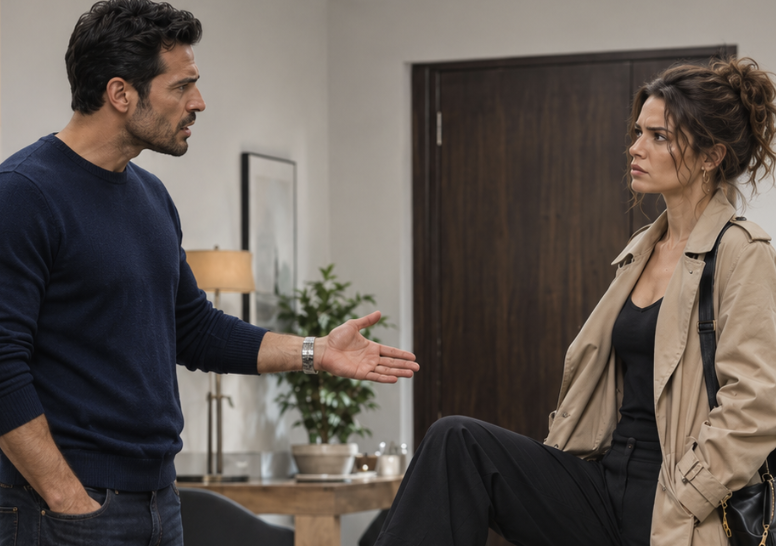
“Staying out overnight again,” Ksenia said.
It wasn’t a question. It was a statement, like marking an entry in a logbook.
“Again.” He threw the charger into the bag. “What, do I need written permission? A signature and an official stamp?”
“I was just asking.”
“You weren’t just asking.” He straightened up, his face suddenly animated and pleased, like a man who’d finally been given the excuse he’d been waiting for. “You’ve greeted me with that question for three weeks. Every single day. ‘Again?’ ‘Where?’ ‘With whom?’ I’m sick of it, Ksyusha. Do you understand? Absolutely sick of it.”
“Your job is like that,” she said. “Night work. Flying around after dark like an owl.”
“Yes, night work! They spray the fields at night when there’s no wind! I’ve explained it to you a hundred times!”
“You have,” Ksenia agreed.
She slowly lowered the bag containing the remaining groceries to the floor, careful not to drop it.
“Then why are you explaining it so loudly if it’s true?”
Artyom hurled the towel into the bag.
He stood for a moment staring at the wall, then suddenly turned around with the expression of a schoolboy who’d just remembered the answer to a test question.
“Listen. Wouldn’t it be better if we just split up?”
She heard herself as though from outside her own body. Her heart was beating steadily, like a metronome during a training session.
“What?”
“Separate,” he repeated with satisfaction. “Get divorced. If I irritate you so much and you irritate me so much, what’s the point?”
“Wait.” Ksenia took off her jacket, hung it on a hook, and turned to face him. “Let’s talk this through. Out loud. What’s wrong? Yes, we fight. I know I’m not perfect either. I nag. I count money. I don’t smile at you in the mornings.”
“Exactly.”
“But let me count on my fingers.” She raised her hand. “First. Money. You spent three consecutive salaries on yourself. Every last ruble. I paid for everything.”
“That was equipment!” he exploded.
“Second. In six months, you never once asked how I was paying for the apartment, electricity, and your loan. You just ate whatever appeared in the refrigerator without asking questions. Like a cat.”
“You’d better watch what you say.”
“Third.” She extended another finger. “You haven’t visited Grandpa once in an entire year. He’s your grandfather, not mine. I go there every week carrying bags because you’re too busy. Fourth, you stayed out all night twice, and both times you lied so lazily that I was offended less by the cheating than by the poor quality of the lies.”
“Ksyusha!”
“And fifth.” She clenched her fist. “You’ve started living off me. There’s a word for that, Artyom. A freeloader.”
The word landed in the hallway like a heavy weight dropped onto a tiled floor.
Artyom turned crimson instantly, right down to his neck.
“A freeloader?!” he roared. “A freeloader, am I?! Well, excuse me for not living up to your expectations! What a terrible disappointment, huh?! But don’t worry, that won’t happen again! I promise! That’s it, we’re splitting up! You go there”—he jabbed a finger toward the front door—“and I stay here.” His finger swung toward the bedroom.
“Very nicely divided,” Ksenia said.
“That’s how it is!”
She looked at him and remembered a dog she’d rejected from the guide-dog program the previous year. Intelligent, beautiful, but psychologically unstable, prone to attacking people without warning.
Back then, she’d struggled for a long time before signing the rejection form, constantly searching for excuses.
But eventually she’d signed it, and life had become easier for everyone, including the dog.
There was no point treating gangrene. You amputated the leg, and the person lived.
“All right,” she said. “Let’s split up.”
Artyom stopped short.
He’d expected shouting, tears, pleas to talk things through. He’d expected her to grab his sleeve.
Instead, he’d received a calm “all right.”
And he clearly didn’t like it.
“Are you serious?”
“Absolutely. You suggested it, and I agree. Want me to help you zip up your bag?”
“I can manage!”
He yanked at the zipper so hard it jammed. He pulled again, tore it, grabbed the bag, and stormed out, leaving the door wide open.
Ksenia didn’t move.
From the stairwell came the sound of his voice. He hadn’t even reached the first landing.
A phone rang, and then he spoke. His voice was muffled but perfectly audible, because the stairwell in their building worked better than any microphone.
“That’s it. I told her. Yeah, just now. Why drag it out? … I’m sick of her.”
“I told her.”
Ksenia quietly closed the door and stood with her back against it.
“I told her” sounded like a report.
And reports were made to someone who already knew the plan.
His mother? Ruslan? Or a woman he’d promised that “this week, definitely”?
Her mother had once told her while pouring homemade fruit compote into jars:
“Ksyush, a man never leaves for nowhere. He always has a backup airfield. First he trades his mother for a wife, then his wife for another woman. He doesn’t fly away. He transfers to another runway.”
Her mother had always been an expert in aviation.
Especially after divorcing Ksenia’s father.
The phone rang twenty minutes later.
“Ksyush, I can’t calm down,” Polina announced without preamble. “I’ve been thinking about you two all evening. How can this happen? You’ve been together six years…”
“Five and a half.”
“What difference does it make?”
“None,” Ksenia said. “Polina, he left. Just now. With a bag. He said we should separate.”
Polina fell so completely silent that Ksenia thought the connection had dropped.
“What do you mean, separate?” her friend finally managed. “Actually separate? Divorce?”
“Looks like it.”
“But why?! You just renovated the bathroom in May! You chose the tiles! I went shopping with you!”
“The tiles are still here,” Ksenia said. “The husband is gone. These things happen.”
“Ksyukha, stop joking around!” Polina’s voice trembled. “But why?”
“I think there’s another woman. I don’t know for certain, but all the signs point to it. He wasn’t leaving for nowhere, Polina. He was switching airfields.”
“That can’t be.”
“It can. Everything was heading this way. I just pretended not to notice because looking at it was uncomfortable.”
Polina sniffled. She had a talent for getting more upset about other people’s misfortunes than her own, a quality that made her simultaneously unbearable and indispensable.
“Listen, do you want me to come over? Right now. I’ll take a taxi and stay the night.”
“No.”
“Ksyush!”
“Polina, seriously. I need to be alone. Not because I’m going to cry. I just need silence. All day I’ve been listening to bees, then my mother-in-law, then shouting. Enough.”
“Call me if you need anything. At night. At four in the morning. Anytime.”
“I will.”
Ksenia ended the call, placed the phone on the windowsill, and went into the bedroom.
Polina lowered the phone onto her lap and looked at her husband.
Kirill sat at the table with a magnifying glass in his hand, examining a photocopy of some power of attorney. Even at home, he was constantly surrounded by other people’s signatures, the way other people carry around other people’s sins.
“Artyom and Ksyusha are getting divorced,” she said.
The magnifying glass froze.
“Why?”
“Because. He told her today they should split up. Then he walked out with a bag.”
Kirill put down the document.
He always put down his papers before allowing himself to be surprised. Order mattered more to him than emotion.
“What does she say?”
“That she thinks there’s another woman. She doesn’t know for sure. Kirill, how could he? Five years! She did everything for him. She feeds his grandfather. She was paying off his loan. I know all of it!”
“You know a lot,” Kirill said. “Only usually after the fact.”
“Oh, don’t be such a smartass!” Polina wiped her eyes with the side of her hand. “You should’ve been her husband instead of that… that goat.”
Kirill raised an eyebrow.
He paused for exactly long enough to make his next words dangerous.
“Well, it’s not too late to swap places.”
“Kirill!”
“What? You suggested it. I agreed.”
“That’s not funny!” Polina turned away and hugged a cushion. “It’s not funny at all! Her whole life is falling apart, and you’re making jokes.”
“You made the first joke. And yours had an implication. Mine didn’t.”
“Go away.”
“I’m going.” Kirill stood and took his windbreaker off the hook. “Just not in the sense you’re thinking.”
“Where are you going?”
“For a walk. I’ll call Artyom.”
“Why?”
“Because I’ve known him for eight years,” Kirill said, zipping his jacket. “And because a man who announces a divorce on a Monday evening usually made the decision last month. I’m curious what exactly he’s planned.”
He went outside, walked to the intersection, and dialed.
Artyom didn’t answer immediately.
“Yeah?”
“Hey. Where are you?”
“Walking. What’s it to you?”
“Your wife called Polina,” Kirill said calmly. “She’s upset.”
“Oh, she’s already gone complaining.” Artyom snorted. “Of course. First thing she does is run to her girlfriend. Not that I care. Yes, we’re divorcing. That’s it.”
“That was quick.”
“Not quick. Long overdue. I’ve put up with enough.”
“Who is she?” Kirill asked simply.
A pause.
“Who is who?”
“Artyom, I’ve spent eight years analyzing handwriting. People lie the same way every time. First they repeat the question, then they get offended, then they tell the truth. Let’s skip straight to step three.”
Artyom breathed heavily into the phone.
Kirill could hear gravel crunching beneath his shoes.
“Vlada,” he said at last. “So what? I’m thirty-four. I have a right to be happy.”
“Vlada…” Kirill narrowed his eyes, trying to remember. “The dog groomer?”
“Yeah.”
“The salon on Oktyabrskaya Street?”
“Listen, have you been following me?”
“I saw her once when Polina took our Diesel in for grooming,” Kirill said. “She’s divorced. Rents a place somewhere on Krylova Street.”
“So what? She rents. She’ll be living with me.”
“With you two,” Kirill corrected.
“What do you mean, ‘you two’?”
Kirill stopped beneath a streetlamp.
He had the familiar feeling he got at work when comparing two signatures and spotting a discrepancy before the client had even stopped smiling.
“Artyom, have you actually been inside her apartment?”
“Of course! That’s where I’m going right now!”
“Inside the apartment? Or have you only met outside the building?”
“Are you interrogating me?!” Artyom began getting angry. “I’ve been inside! Once. During the day. She made tea… What does that have to do with anything?”
“And you didn’t notice any children’s things?”
The silence on the line changed. It became dense.
“What things?”
“Ordinary things,” Kirill said. “Little shoes. A scooter in the hallway. Stickers on a door. Well, maybe you didn’t notice. Sometimes a man only has eyes for the woman. That’s almost romantic.”
“What are you implying?”
“Nothing. It’s your business.” Kirill shrugged, although Artyom couldn’t see him. “You’re a grown man. You’ve made your decision, so go ahead. Just be prepared. There are surprises waiting. They always come as part of the package.”
“What surprises?!”
“Different kinds. You choose a person, and you inherit their circumstances.”
“Listen, philosopher,” Artyom said through clenched teeth. “Whose friend are you anyway?”
“I’m not sure myself,” Kirill answered truthfully. “I’ve been wondering for eight years.”
Artyom hung up.
He was already outside the building he wanted: a five-story apartment block, an intercom with a broken handset, and a bench.
He spent about ten seconds thinking about the surprises, then decided Kirill was simply looking for a way to hurt him.
Something else mattered much more.
If Kirill already knew about the divorce, Polina would know by tomorrow evening, her entire family would know the day after, and then his mother would find out.
And his mother had to be presented with an accomplished fact, not an ongoing process. She had a talent for grabbing hold of a process and turning it into a theatrical production.
So the fact had to be accomplished immediately.
Artyom sat on the bench, opened the government services portal on his phone, and spent ten minutes stabbing angrily at the screen, cursing every CAPTCHA.
Application for dissolution of marriage.
Mutual consent.
No children. That part was actually pleasant. No complications.
He added his electronic signature, pressed “Submit,” and leaned back.
“Now it’s really over,” he said aloud.
Ksenia was sitting on the bedroom floor with her laptop on her knees when her phone beeped.
The notification was dry and bureaucratic, without a single unnecessary word:
An application for dissolution of marriage has been submitted by the other spouse. Confirmation required.
She read the line and smiled faintly.
An hour and a half.
Only an hour and a half since he’d walked out the door.
“Efficient,” she told the empty room.
The thought came calmly and practically, the way thoughts came during training when a dog successfully guided a person along the edge of a curb for the first time.
He had made his decision.
For six months he’d refused to listen to her, wasted money, insulted her, shouted in the hallway, pointed his finger this way and that.
In another year, he might have started pushing her around.
You could sometimes see the warning signs in advance, just as you could recognize an unstable temperament in a puppy. First the bared teeth, then the growl, then the bite.
She pressed “Confirm.”
Then she stood, pulled a large gray wheeled suitcase from beneath the bed—the one they’d bought for their trip to Abkhazia and later used to carry apricots—and opened the wardrobe.
She folded his clothes into neat piles.
T-shirts with T-shirts. Jeans with jeans. Socks in the side compartment. Chargers in a separate bag.
She didn’t throw anything or crumple anything.
It mattered to her that no one could later accuse her of having lost control.
Forty minutes later, the suitcase stood in the hallway, packed as tightly as a drum.
Vlada’s kitchen was cramped but cheerful.
She laughed as she told him about a client who had demanded that her poodle be groomed “like a lion, but dignified.”
Artyom sat with his legs stretched out and felt good.
Better than he’d felt in a very long time.
His phone chimed.
He glanced at the screen and raised his head.
“That’s it. It’s settled.”
“What’s settled?” Vlada turned around, a knife in her hand. She was slicing cheese.
“The divorce. She confirmed it. The application has been accepted.”
“That quickly?”
“Why waste time?” Artyom slapped his palms against his knees. “That’s it. I’m free. Now I just need to finish what I started.”
He got up and headed into the hallway to put on his shoes.
“Where are you going?” Vlada followed him.
“Home.”
“Artyom, it’s the middle of the night.”
“I need to do it tonight.”
“Go in the morning.” She stepped between him and the door. “Tomorrow morning. She’ll calm down, you’ll calm down, and you can talk properly.”
“I don’t need to talk properly.” He smirked. “I need her to start packing. Her mother’s nearby, and her friend has a three-bedroom apartment. She’ll find somewhere to sleep. She won’t be stranded.”
“Are you going there to throw her out?” Vlada blinked. “Artyom. At night?”
“It’s my apartment. My grandfather’s. Which means mine.” He pulled on a sneaker. “I didn’t marry her so I could provide her with housing for the rest of her life. Anyway, I’ll be quick. Two hours.”
“I don’t like this.”
“You’ll like the result.”
He left.
Vlada remained standing in the hallway, where a child’s helmet really was lying on a shelf and a little scooter stood beneath the coat rack.
Artyom hadn’t noticed them this time either.
He returned an hour later, unlocked the door with his own key, and began speaking from the threshold in a loud, cheerful, triumphant voice.
“Oh, good girl. I see you’re not dragging your feet about the apartment.”
A suitcase greeted him in the hallway.
Huge, gray, packed to capacity, and standing directly in the middle of the passage.
Ksenia came out of the bedroom and silently kicked the suitcase toward him.
Its wheels whispered across the laminate flooring before it bumped into his shin.
Artyom laughed—briefly and nastily.
“No, sweetheart, you’ve got it backward. You’re the one going out the door, not me. This is my apartment. Grandpa’s apartment, which means mine. Don’t make a scene. I’ll give you a day or two to pack your things properly.”
“You’re really giving me that long?” Ksenia asked. “A whole two days?”
“I could even give you three.” He was feeling generous. “I’m not a monster.”
“You’re simply a badly informed man,” she said. “Which is worse.”
“What the hell are you talking about?”
Ksenia leaned her shoulder against the doorframe and raised her first finger.
“First. The apartment belonged to Grandpa. Arkady Ilyich was the legal owner. That’s correct. He lived here for forty years.”
“I know, thank you.”
“Second.” She raised another finger. “Three years ago, he visited my mother’s summer cottage for the first time. Remember? We took him there in June. He sat there, looked at the greenhouse, touched the fence, and went home without saying a word. Then he started going there by himself. By bus.”
“So what? The old man got interested in cucumbers. Congratulations.”
“He fell in love,” Ksenia said. “With the property. Like a man falling in love with a woman. Meanwhile, my mother stopped going because of her knees. For three years, the cottage stood empty and overgrown. She wanted to sell it, but there were no buyers because it’s two kilometers from the bus stop.”
Artyom was beginning to understand something.
It showed in his face, which had become cautious.
“Go on.”
“Third.” Another finger. “Last autumn, Grandpa called my mother. Himself. And proposed an exchange. Not ‘let me stay there’ or ‘let me use it.’ A proper, legal exchange carried out through property transactions. She sold him the cottage, and he sold her the apartment. Two transactions, one day, legally registered. Everything’s in the official property register. The amounts were symbolic, just enough to make the paperwork official.”
“You’re lying.”
“Fourth.” Ksenia raised a fourth finger. “The legal owner of this apartment is Tamara Viktorovna. My mother. Your former mother-in-law, I should say. Since October of last year.”
Artyom stood motionless.
The suitcase was pressed against his leg, and he stared at it as though the suitcase itself were responsible for everything.
“That’s impossible,” he said. “Grandpa would have told me.”
“Did you visit him?” Ksenia asked. “Even once in the past year? He sent messages through me four times, asking you to come because he needed to talk. I passed every one of them along. You said, ‘Later. It’s the season.’”
“You… you deliberately kept quiet!”
“Fifth.” She folded down her last finger, making a fist. “I didn’t keep quiet. I told you to visit Grandpa. You heard ‘nagging woman.’ That, Artyom, is not a problem with my hearing.”
“You’re messing with my head.” He snatched out his phone. “We’ll check. Right now.”
“Go ahead. He’s awake. He has insomnia.”
Artyom dialed the number and put the call on speakerphone, either out of spite or confusion.
The phone rang for a long time.
“Hello,” Grandpa rasped.
“Grandpa, it’s Artyom.”
“Oh!” Arkady Ilyich sounded genuinely surprised. “My grandson has finally resurfaced. A whole year has passed. You’re not dead, are you?”
“Grandpa, don’t start. I have a question. Who owns the apartment on Pushkarskaya Street?”
“Tamara.”
“What Tamara?!”
“Ksyusha’s mother.” Grandpa yawned. “We swapped properties last autumn. She gave me the cottage, I gave her the apartment. All legal, all documented. We went to the notary. I told you through Ksyusha to come over so we could discuss it. If I remember correctly, you were sowing something.”
“You…” Artyom nearly choked. “You gave the apartment to some strange woman?!”
“She’s not a stranger. She’s family by marriage,” Grandpa replied calmly. “And lower your voice. I’m old. My eardrums aren’t what they used to be. I worked my entire life for that apartment, and I’ll do whatever I please with it. I’m eighty-one. I need a house with land, not a fifth-floor apartment without an elevator. Tamara needs an apartment because of her knees. It worked out perfectly.”
“What about me?! I’m your grandson!”
“And you…” Grandpa paused, and there was more contempt in that silence than in any shout. “You, my dear grandson, haven’t managed to travel thirty kilometers to see me once in a year. Ksyusha came every week, carrying groceries, walking all the way from the turnoff. So let her have a roof over her head. Simple logic. Nothing to think about.”
“You’ve left me homeless!”
“I’ve left you without a gift,” Grandpa corrected. “There’s a difference. That’s enough. I’m going to bed. And don’t come to the bathhouse on Saturday. I’ve changed my mind about steaming you.”
He hung up.
Artyom slowly lowered his phone.
The apartment was very quiet.
“Well,” Ksenia said. “Now you’re an informed man.”
He looked up at her, and there was so much anger in his eyes that she instinctively measured the distance to the door—a habit she’d developed while working with aggressive dogs.
“You knew,” he hissed. “You knew for six months and said nothing.”
“I knew for six months, and I lived with you for those six months,” Ksenia said. “Did you notice any difference? I never tried to throw you out. It never even occurred to me to use this apartment as a weapon. You’re the one who started waving it around—tonight, at eleven o’clock.”
“You set me up!”
“I made a mental note of you,” she said. “The moment you said we should split up.”
She bent down, took the suitcase by its handle, and rolled it toward the door.
She opened the lock on the fourth attempt, as always, and for some reason that amused her.
“The key,” she said, holding out her palm.
“Dream on.”
Ksenia stepped toward him, slipped her hand into his jacket pocket, pulled out his key ring, and removed two keys—one to the apartment, the other to the building entrance.
He didn’t even have time to react. The movement was swift, precise, and practiced.
“What the hell are you doing?!”
“Returning property to its rightful owner.”
She pushed the suitcase onto the landing. It tipped over the threshold, its wheels clattering against the concrete.
Then she took Artyom by the elbow and pulled him toward the door.
He was taller and heavier, but confusion weighs more than muscle. He took two steps and found himself outside.
“Ksyusha!”
“And you know what?” She stood in the doorway. “Thank you.”
“For what?!” he shouted.
“For finally acting like a man,” Ksenia said. “You proposed the divorce yourself, submitted the application yourself, and took care of all the paperwork. I would have dragged this out another year, making excuses and trying to fix everything. But you went ahead and cut it off. Well done. Not everyone can do that.”
“Open the door!”
“The landing light turns off in a minute. Better find the stairs before it does.”
The door closed.
The lock clicked.
Artyom stood on the fifth-floor landing with a suitcase, his jacket, and a phone in his hand.
The light above the door faithfully counted down its minute and went out.
He switched on his phone’s flashlight.
Anger rose inside him in layers, like limescale accumulating in a kettle.
At Grandpa—the old fool who’d reached eighty-one and suddenly decided to start digging in the dirt. He’d given away an apartment to an outsider and offered his own grandson nothing but “come over, we need to talk.” What a clever way to handle things. So proud of himself.
At his mother—what if she’d known? His mother knew everything. She was the central communications hub of the family. Maybe she’d kept quiet because it was more convenient for her if her son couldn’t lay claim to Grandpa’s apartment.
At Kirill—the know-it-all with the magnifying glass. “Surprises ahead.” He’d known and hadn’t said anything directly. Some friend. And hadn’t Kirill once been interested in Ksyusha himself? Well, let him go after her now.
But most of his anger, of course, was directed at Ksenia.
She’d kept quiet for six months.
She’d walked through this apartment, cooked, washed clothes, slept beside him—and kept quiet.
She’d watched him point toward the door and say, “You go there, I stay here,” and she’d waited.
She’d packed his suitcase in an hour, which meant she’d started the moment he left.
Not a single tear.
Not one.
The phone rang in his hand.
“Tyoma!” his mother said brightly. “Are you awake? Ksyusha called me today. Dad wants everyone at the bathhouse on Saturday. I said no, because of my back. Are you two going? Take him some sugar. He wanted some for the bees.”
“We’re not going,” Artyom said.
“Why not?”
“Because I got divorced!” he screamed into the phone, his voice echoing down the stairwell. “Divorced, do you hear me?! Today! And I’ve just been thrown out of the apartment! I’m standing on the landing with a suitcase! Happy?!”
“Tyomochka, what are you saying?” his mother stammered. “What do you mean, thrown out? It’s your apartment. It’s Grandpa’s…”
“Not Grandpa’s anymore.”
“Then whose?!”
“Ask your father!” he barked and ended the call.
His phone immediately beeped with a message.
Vlada.
“How’s it going? Everything okay? You’re taking a long time.”
Artyom stared at those three lines and didn’t know what to answer.
He could write, “I’m divorced.”
Divorced. Free. Everything as they’d agreed.
But what came after that?
The second half of the sentence would have to be:
“I’m standing on a fifth-floor landing. I have nowhere to live, and I don’t have money to rent a place because I spent it on goggles and a jacket.”
He imagined arriving at Vlada’s with that suitcase.
Her opening the door.
Him carrying the suitcase into someone else’s rented one-bedroom apartment, where—if Kirill hadn’t lied—there was a little scooter and a five-year-old child whom, for some reason, nobody had mentioned.
“You choose a person, and you inherit their circumstances.”
“Oh, hell,” Artyom muttered into the darkness.
He typed:
“Everything’s fine. On my way.”
Deleted it.
Typed again:
“Divorced. We need to talk.”
Sent.
And as he descended the stairs, dragging the suitcase from step to step—bang, bang, bang, the sound echoing throughout the building—one single thought burned in his mind, round and hot as a lump of coal.
If only he’d known the apartment no longer belonged to Grandpa.
If only he’d known that an hour after his grand gesture, he’d find himself out on the street.
Never.
Not for any amount of money.
He would have put up with everything. He would have smiled. He would have visited Grandpa every Sunday with sugar for the bees. He would have kissed Ksyusha on the top of her head and said, “Thank you, sunshine.”
Which meant it was all her fault.
She’d kept quiet.
She’d known and kept quiet.
She’d deceived him.
On the third floor, one of the suitcase wheels snapped off and bounced down the stairs.
“Well? How are you doing?” Polina answered on the first ring, as though she’d been holding the phone in her hand all evening.
“Fine,” Ksenia said. “Almost too fine.”
“What do you mean?”
“We’re getting divorced. The application has been submitted and confirmed. Everything’s in the system. The husband has abandoned his permanent base of operations and is currently on the run.”
A pause.
“Ksyukh,” Polina said cautiously. “I understood the part about the divorce. Everything after that sounded like a military report.”
“The rest was about the apartment.” Ksenia sat on the floor with her back against the door. “He came back to evict me. Said the apartment was Grandpa’s, which meant it was his. Told me to pack, gave me two days.”
“And you?!”
“And I kicked his suitcase toward him. I’d packed it while he was out.”
“You packed his suitcase?!” Polina gasped.
“Neatly. In little piles. Socks in the side pocket.”
“Ksenia!”
“And I explained that the apartment has belonged to my mother for a year. Grandpa exchanged properties with her. She gave him the summer cottage, he gave her the apartment. All properly documented, through a notary. Artyom called Grandpa right in front of me, on speakerphone. Grandpa confirmed everything and told him not to show up at the bathhouse on Saturday.”
Polina made a sound Ksenia had never heard from her in twenty years of friendship—something halfway between a gasp and an ecstatic squeal.
“So he’s been left… with nothing?”
“He’s been left with a suitcase. And the woman he was going to see. By the way, thanks to Kirill. He texted me.”
“What did he say?”
“That she apparently has a son. Five years old.”
“Oh,” Polina said. “Oh, wow. So he’s going from the landing straight to someone else’s little apartment, where there’s someone else’s child.”
“Destiny,” Ksenia said. “He’d better get used to the circumstances.”
“But… how are you, really? Aren’t you crying?”
Ksenia looked down the hallway.
There was no suitcase. No jacket hanging on the hook.
And the sticking lock was now exclusively her own problem.
“I’m angry,” she answered honestly. “It hurts, Polina, that five years are gone. It hurts that I paid off his loan. It hurts that until the very end I kept thinking it was just a difficult period, something every couple goes through. But you know what’s strange? I’m not scared. Not one bit. You know, when a dog is dropped from the training program, the trainer is angry for three days. Then they take the next dog and realize what a disaster the first one would have been.”
“You just compared your husband to a dog.”
“I wouldn’t compare a dog to my husband. That would be insulting to the dog.”
Polina burst into laughter through her tears, ugly and breathless, punctuated by hiccuping sobs.
“Ksyukh, come over tomorrow.”
“Not tomorrow. Saturday.”
“Why Saturday?”
“Because on Saturday we’re going to the bathhouse,” Ksenia said. “To Grandpa’s. He made those oak bath brooms with mint back in July. It would be a shame to waste them.”
She called Grandpa at half past midnight, knowing he would still be awake.
“Arkady Ilyich, it’s me.”
“Finally, a normal person,” Grandpa grumbled. “First my grandson was yelling at me, then my daughter. I had no idea I had such a loud family.”
“Larisa Arkadyevna called?”
“She did. Spent half an hour demanding to know why I’d ‘disposed of my property without consulting her.’ I told her, ‘Larisa, you’ve visited me four times in three years, and twice you only came to collect jars for jam.’ She got offended.”
“She’ll get over it.”
“She will,” Grandpa agreed. “She always does. So why are you calling? Don’t you dare cry. I forbid crying.”
“I’m not crying. I wanted to ask…” Ksenia rubbed her forehead with her palm. “Could I come on Saturday by myself? Or with a friend? To use the bathhouse?”
“Why, that’s even better!” Grandpa exclaimed happily. “Come! It takes two hours to heat the bathhouse, so I’ll fire it up in the morning. I’ve got the bath brooms ready. I’ll even give you a proper steaming if you want!”
“Grandpa!”
“What do you mean, ‘Grandpa’?!” He laughed, pleased with himself, his laughter rough and crowlike. “I’ll hold the doors for you and hand you towels. I’m eighty-one. I’m allowed to make jokes. Come, Ksyush. And bring your mother. I’ll steam all the foolishness right out of those knees of hers.”
“Mom won’t come. She can’t handle the bus.”
“I’ll pay for a taxi. After all, I have a summer cottage now and no apartment, so I suppose I’m rich only in land. Let her come and see how I’ve brought her currant bushes back to life.”
“All right,” Ksenia said. “I’ll convince her.”
“And one more thing.” Grandpa suddenly became serious. “Don’t think I did you some great favor. I did myself a favor. The thought of dying on the fifth floor without an elevator disgusted me. Out here, I’ve got bees. And the fact that the apartment ended up belonging to your mother? That’s arithmetic, not charity. Clear?”
“Clear.”
“Good. Saturday at ten. Bring bread. Just bread.”
“I’ll bring bread and everything else.”
“Auditor,” Grandpa muttered, and hung up.
Ksenia placed the phone on the floor beside her.
The apartment was quiet.
No television. No slamming doors. None of his pacing from one corner to another, the sound that had made her eyelid twitch for the past six months.
She stood, went into the kitchen, and opened the refrigerator.
Inside were food containers, a can of condensed milk left over from Grandpa’s groceries, and half a packet of butter.
All of it belonged to her.
Every single item had been bought with her money.
Before, that thought had made her so angry her ears rang.
Now it sounded like a profit report.
She closed the refrigerator, walked into the hallway, and locked the stubborn door on the fourth attempt.
“I’ll take you apart on Sunday,” she told the lock. “Myself. Don’t worry. I’ve worked with more complicated mechanisms than you.”
Somewhere far below, in the courtyard, someone was dragging a suitcase on three wheels.
The uneven, angry rattling faded toward the bus stop, where the last bus had departed twenty minutes earlier.
Ksenia didn’t hear it.
She was thinking about Saturday: two bedsheets, tea in a thermos, hats for the steam room, and a phone call to her mother to make sure she didn’t refuse the taxi.