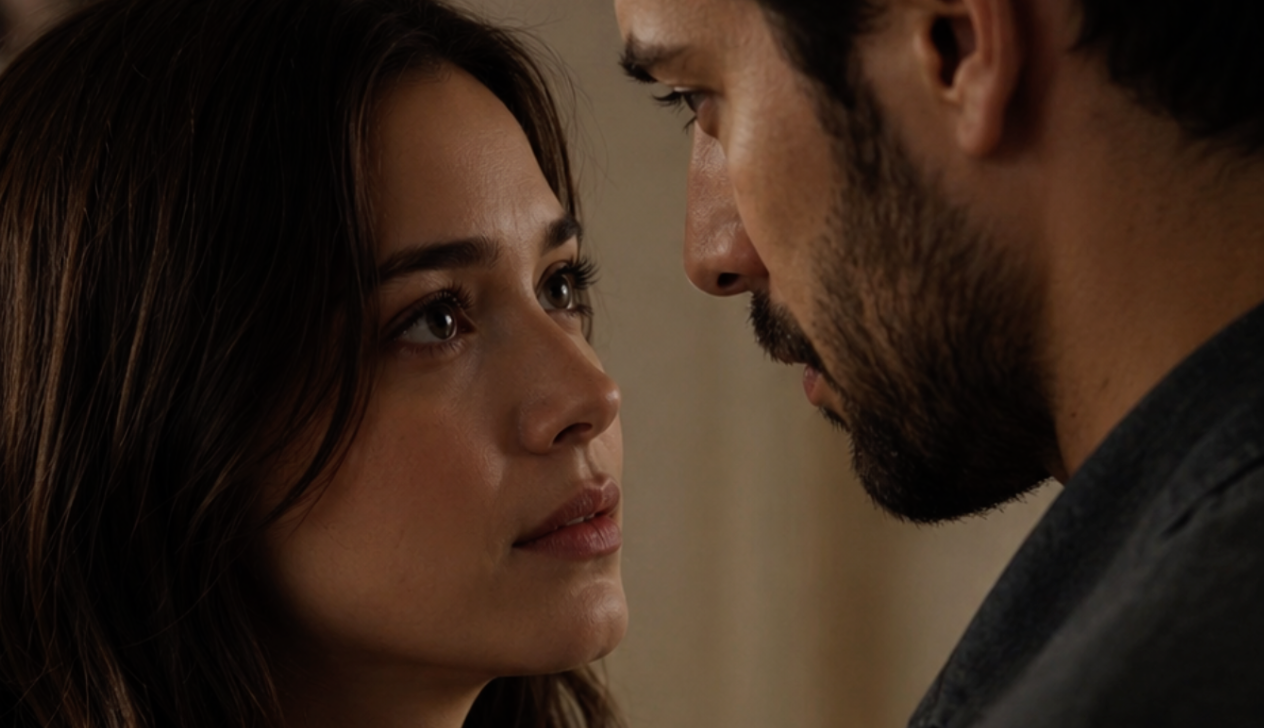
Are you serious?” Dmitry forced out, taking a step forward. “I thought… you said yourself that this was your apartment. We talked so many times about how we would remodel everything here after the wedding.”
Dmitry froze on the threshold of the living room, still holding his car keys. His face, which only moments ago had been so confident and pleased, suddenly turned pale, and his eyes darted around the room in confusion, as if searching for something to hold on to. He opened his mouth to say something, but the words got stuck somewhere inside.
Olesya stood opposite him with her arms crossed over her chest. Her laugh was clear, but there was no real joy in it—rather, relief mixed with a slight bitterness. She looked at him carefully, without looking away, and waited for his reaction. In her parents’ apartment, a spacious three-room place in the center of Moscow where they were now standing, it was quiet—only the clock on the wall ticked, and outside the window the evening rain could be heard.
“Yes, I did say that,” Olesya nodded, still smiling, though now more softly. “I said it on purpose. To see how you would react when the truth came out.”
She walked over to the sofa and sat down, gesturing for him to take the armchair opposite. Dmitry sank into it slowly, as if his legs had suddenly turned to cotton. He ran a hand through his hair—the neat hairstyle he always arranged so carefully—and looked at her with a mixture of confusion and hurt.
“Wait,” he said, trying to pull himself together. “You were testing me? As if I were some kind of… greedy type? Olesya, we’ve been together almost a year. I love you, you know that.”
Olesya sighed, leaning back against the sofa. In this living room, with its light-colored walls, large windows, and view of old Moscow courtyards, she had spent so many evenings with Dmitry. Here they had drunk tea, planned the future, laughed at silly movies. And every time the conversation turned to housing, his eyes lit up with a special gleam. She had not noticed it right away—at first she thought he was simply happy for her. But then… then the little things began to pile up.
It all began a year and a half earlier, at a corporate party at one of Moscow’s IT companies. Olesya worked as a project manager, Dmitry as a developer in a neighboring department. They met near the buffet table and started talking about work, about how Moscow pressed down on people with its endless rush. He was charming: tall, with a pleasant smile, able to listen and joke just enough. A week later, he invited her for coffee, then for a walk through Gorky Park. Everything developed naturally, without haste.
At the time, Olesya lived in a small one-room apartment on the outskirts, which she had been renting for the third year already. Her parents helped with the rent, but she tried to manage on her own—her job allowed it. Dmitry rented a room in a shared apartment with friends and often complained about how tired he was of it.
“I want my own space,” he would say. “A normal apartment where you can live peacefully, without neighbors behind the wall.”
When they began dating seriously, Olesya once invited him to meet her parents. Her mother and father lived in that very three-room apartment in an old building near Patriarch’s Ponds. Fresh renovations, comfortable furniture, a balcony overlooking a quiet courtyard. Dmitry looked around with such interest that Olesya was even surprised.
“Your parents have a great apartment,” he said later, as they were driving back. “The center, transport nearby, everything close at hand.”
“Yes, they were lucky,” she replied. “They bought it back in the nineties, when prices were different.”
He nodded, but something flashed in his eyes that she did not catch at the time.
A couple of months later, Olesya decided to test her suspicions. It was not that she immediately thought he was mercenary—her intuition simply suggested that he brought up housing too often. How hard it was for young families in Moscow, how mortgages strangled people, how important it was to have a base of your own. And every time she mentioned her parents, he somehow became especially animated.
One evening, while they were walking along Arbat Street, she casually said:
“You know, my parents want to transfer this apartment to me. They say it’s time I had something of my own. After the wedding, they’ll probably put it in my name.”
Dmitry stopped and turned to her.
“Seriously?” His voice grew warmer. “Olesya, that’s wonderful! Imagine—a three-room apartment of our own in the center. We could live there, renovate it the way we want.”
From then on, everything changed. He started talking about marriage more often—before, he had delayed, saying it was too early, that they needed to get on their feet first. Now he suggested dates, discussed where to celebrate. He called more often, brought flowers, planned a vacation together. And each time he returned to the subject of the apartment: how best to rearrange the furniture, where to make a workspace for himself, how to glaze the balcony.
Olesya watched. She said nothing, but anxiety grew inside her. She loved him—or thought she did. He was attentive, caring, knew how to surprise her with pleasant little things. But those conversations about the apartment… they left a bitter aftertaste.
To make absolutely sure, she decided to arrange a test. She invited him to “her place”—meaning her parents’ apartment, since they had just gone to the country house for a week.
“Come over to my place,” she said on the phone. “I want to show you my apartment. My parents finally decided to transfer it to me early.”
He arrived that same evening with a bottle of wine and a smile from ear to ear.
“Finally I’ll see where you really live,” he said, hugging her in the hallway.
They had dinner in the kitchen, which Olesya had prepared in advance. Dmitry walked from room to room, touching the walls, opening cabinets.
“Perfect,” he kept repeating. “Just perfect. There’s so much space here. We could make one room into a nursery later.”
Olesya smiled, but inside she grew cold. He spoke about the future so confidently, as if everything had already been decided.
Then, when they were sitting in the living room with tea, she finally made up her mind.
“Dima,” she began calmly. “What if this apartment didn’t exist? What if I had nothing of my own, only a rented one-room place on the outskirts?”
He laughed and hugged her.
“Oh, come on, silly. The main thing is that we’re together. But with an apartment like this, life would be much easier, wouldn’t it?”
And then she told him the truth.
Now he sat opposite her, pale and confused.
“Olesya, listen,” he began, leaning forward. “I’m not with you because of the apartment… I mean, of course, it’s important. It’s hard in Moscow without housing. But I love you. I truly love you.”
“And when I said I was renting, did you talk about love the same way?” she asked quietly.
Dmitry fell silent. He looked at the floor, then raised his eyes.
“I… I was thinking about the future. About how good it would be for us together. An apartment means stability, security. For us, and for children later.”
Olesya felt something tighten inside her. Not anger—rather, sadness. She had so wanted to believe he was sincere.
“Dima,” she said softly. “I was thinking about the future too. But I wanted it to be built on us, not on square meters.”
He stood up and walked to the window. The rain grew heavier, drops tapping against the glass.
“You misunderstood me,” he said without turning around. “I’m not mercenary. I’m just… realistic.”
“A realist who changed the moment he heard about an apartment in the center?” Olesya stood up too. “Dima, I saw the way you looked at these walls. The way you planned where everything would go. Before that, we had been dating for a year, and marriage was ‘too early.’ And then suddenly it all came pouring out—dates, plans, children.”
He turned around. There was hurt in his eyes.
“And you? You were lying to me all this time. Saying the apartment was yours. Why?”
“To understand,” she answered honestly. “A friend advised me. She said: test him, maybe he’s only interested because of the housing. I didn’t believe it. I thought it was paranoia. But then… the little things piled up.”
Dmitry nodded, as if agreeing with something inside himself.
“So what now?” he asked quietly. “Is it over?”
Olesya came closer and looked him in the eyes.
“I don’t know, Dima. I thought I loved you. But now… now I’m not sure I know the real you.”
He took her hand. His fingers were cold.
“Give me a chance to explain. Not now—I can see you’re tired. But tomorrow. Let’s meet and talk calmly.”
Olesya did not pull her hand away, but she did not squeeze his in return either.
“All right,” she said. “Tomorrow.”
He left soon after. Olesya stood by the door, listening as the elevator carried him down. The apartment suddenly became quiet and empty. She went to the kitchen, poured herself some tea, but did not drink it—just held the mug in her hands, staring out the window.
Her heart felt strange—a mixture of relief and loss. She had saved herself from a mistake, but she had lost the person with whom so much had connected her. Or had she not lost him? Tomorrow’s conversation could change everything.
Her phone vibrated—a message from her friend Katya, the one who had suggested the test.
“Well? Tell me everything!”
Olesya smiled sadly and began typing a reply. But she did not have time—the doorbell rang. She froze. Had Dmitry come back?
She went to the door and looked through the peephole. It was not him standing on the landing.
It was her father, with a bag of groceries and a tired smile.
“Daughter,” he said when she opened the door. “Your mother is worried. She thought you were sitting here alone and sad. I brought you your favorite pies.”
Olesya hugged him, feeling tears rise to her eyes. But these were different tears—not from pain, but from warmth.
And tomorrow… tomorrow she would find out whether Dmitry was really the person he seemed to be.
Or whether everything had truly ended today.
The next day, Olesya woke up early, although she had tossed and turned all night, replaying yesterday’s conversation in her head. Sunlight broke through the curtains in her parents’ apartment, illuminating the wallpaper with its small floral pattern, familiar from childhood. She lay there, looking at the ceiling, trying to understand her feelings. Relief that the truth had come out mixed with sadness—after all, almost a year of life with Dmitry had seemed so real. Memories of their walks together, of his smile, of how he brought her coffee in the mornings at the office—all of it now seemed colored in different shades.
Her father left early for work, leaving a note in the kitchen:
“Daughter, if anything happens, call. Your mother and I are always nearby.”
Olesya smiled as she poured herself coffee. Her parents did not interfere with advice, but she felt their support—quiet, reliable, like this old house.
Dmitry called at ten in the morning.
“Good morning,” his voice sounded cheerful, though slightly tense. “Can we meet? At that café on Patriarch’s Ponds where we often used to go?”
“All right,” Olesya answered calmly. “Would twelve work?”
“Of course. I’ll be waiting.”
She dressed simply—jeans, a light sweater, her hair tied in a ponytail. She did not want to look as if she were preparing for something special. This was not a date, but a conversation that could put an end to everything.
The café was cozy, with wooden tables and a view of the pond. Spring was just beginning, and the first green leaves were already appearing outside. Dmitry was sitting at their favorite table by the window, with a cup of espresso in front of him. When she entered, he stood up and smiled—the very smile that used to warm something inside her.
“Hi,” he said, carefully hugging her. “You look good.”
“Hi,” Olesya sat down opposite him and ordered tea. “Let’s get straight to the point, Dima. Yesterday you wanted to explain.”
He nodded, moving his cup aside. His fingers trembled slightly—she noticed.
“Olesya, I thought all night. And I understand how it looked from the outside. But believe me, I’m not with you because of the apartment. It’s just… it’s hard in Moscow without housing. I saw my friends suffer with mortgages, with rented apartments. And when you said you had your own three-room place in the center, I thought—there it is, our future. Stability. We wouldn’t have to worry about rent money, we could start planning a family right away.”
Olesya listened silently, looking at him. His words sounded logical, almost convincing. But details surfaced in her memory: how he had asked about the apartment’s value, whether there were any legal encumbrances, how he had suggested moving there right after the wedding.
“And before I told you about the apartment?” she asked quietly. “When I was renting, did you plan a family so actively then?”
Dmitry looked away, gazing at the pond outside the window. Swans floated calmly, as if nothing were happening.
“Not so actively, I admit,” he finally said. “But because I was afraid. Afraid I wouldn’t be able to provide. I’m not a millionaire, Olesya. I work as a developer, my salary is good, but in Moscow… you know.”
“I know,” she nodded. “But love is not about providing, Dima. It’s about being together despite everything.”
He turned to her and took her hand across the table.
“I love you. Truly. Let’s forget yesterday. Your parents’ apartment is fine too. We can live here if they allow it. Or rent something of our own. The main thing is us.”
Olesya did not pull her hand away immediately. His touch was familiar, warm. For a moment, she hesitated—maybe she had really gone too far with the test? Maybe he was simply pragmatic, like many people their age?
But then her phone vibrated in her bag. She looked—it was a message from Katya.
“Olesyunya, sorry for interfering, but yesterday your Dima wrote to my Sasha. He asked whether it was true that the apartment wasn’t yours. And also… well, in short, read the screenshot.”
Olesya’s heart clenched. She opened the message. Katya had sent a screenshot of Dmitry’s correspondence with her husband Sasha—they knew each other through mutual friends.
Dmitry: “Listen, bro, Olesya said yesterday that the apartment isn’t hers, it belongs to her parents. Is that true? I thought she was the owner.”
Sasha: “Yes, it’s true. It belongs to her parents, they live there.”
Dmitry: “Damn… And she said they would transfer it to her. Now everything changes. I don’t know if it’s worth continuing.”
Sasha: “What do you mean? Are you with her because of the apartment?”
Dmitry: “Not only, but it was important. Without your own housing in Moscow, marriage is nothing but problems. All right, I’ll think about it.”
Olesya froze, rereading the words.
“Worth continuing.”
“It was important.”
Everything inside her went cold. She raised her eyes to Dmitry—he was still holding her hand, smiling expectantly.
“Olesya?” he asked. “What is it?”
She slowly freed her hand and placed the phone on the table, screen facing him.
“Read it,” she said quietly.
Dmitry frowned and picked up the phone. His face changed as he read: first surprise, then paleness, then an attempt to pull himself together.
“This… this isn’t what you think,” he began quickly. “I was in shock yesterday. I wrote to Sasha to clarify. I just… just asked.”
“‘I don’t know if it’s worth continuing,’” Olesya quoted. Her voice was steady, though a storm raged inside her. “‘Without your own housing, marriage is a problem.’ Dima, that isn’t shock. That’s calculation.”
He put the phone down and rubbed his temples.
“Olesya, listen. I’m not perfect. Yes, the apartment played a role. In our world, it matters—stability, the future. But it wasn’t only because of that. We were good together.”
“Yes,” she agreed. “But under what conditions? On the condition that I had a three-room apartment in the center?”
Dmitry was silent. The waitress brought the tea, but Olesya did not even touch the cup. The café was noisy—people talking, spoons clinking—but to her everything sounded muffled, as if through cotton.
“I’m not some kind of swindler,” he finally said. “I was just thinking practically. Many people do that. They take out mortgages, ask their parents for help.”
“But you weren’t asking for help,” Olesya looked him in the eyes. “You thought I already had everything. And when you found out the truth—you doubted whether it was worth continuing.”
He lowered his head.
“Maybe I did doubt it. For a moment. But now… now I’m here. I want to be with you.”
Olesya felt tears rising. Not from resentment—from disappointment. She had so wanted to hear something different. Real apologies, an admission that he had been wrong not only about the facts, but about his priorities.
“Dima,” she said softly but firmly. “I’m glad everything became clear now. Before the wedding, before rings, before shared plans. Because a marriage based on calculation is not what I want.”
He raised his eyes—there was a mixture of despair and anger in them.
“So that’s it? Because of one correspondence?”
“Not because of one,” she replied. “Because of everything. Because of how you changed when you thought I had an apartment. Because of how you planned our life around it. Because even now you are trying to justify calculation with love.”
Dmitry leaned back in his chair. His face hardened.
“And you? You lied to me for months. You told me an untruth about the apartment. Which of us is worse?”
Olesya nodded—he was right about that.
“I lied to test you. And now I know the truth. Thank you for that.”
She stood up and placed money for the tea on the table.
“Goodbye, Dima.”
He did not stop her. He only watched as she left the café. Outside, it was warm and smelled of blooming trees. Olesya walked along Patriarch’s Ponds, feeling something tearing inside her. The tears finally flowed—quietly, without sobs. She did not look back.
At home, she collapsed onto the sofa, hugging a pillow. Her phone rang—Dmitry, then Katya. She did not answer. She only wanted to lie there and survive this pain.
In the evening, her mother came home from work with a bag of fruit.
“Daughter,” she said, hugging Olesya. “Dad told me. How are you?”
“I’m all right,” Olesya tried to smile. “Better than it could have been.”
They had dinner together and talked about nonsense—work, the country house. Her mother did not pry with questions; she was simply there.
That night, Olesya again could not sleep. She thought about how close she had come to a mistake. How she could have married a man for whom she was not the main thing, but an attachment to square meters.
But there was also something cleansing in the pain. She felt herself becoming stronger. In the morning, she would write to Katya and thank her for the screenshot. She would go to work, meet friends. Life went on.
And Dmitry… he was probably already thinking about how to find someone with an apartment. Or perhaps not? Maybe this lesson would be useful to him too.
But Olesya knew one thing for certain: next time, she would be more careful. And she would look for someone who would love her herself—without bonuses in the form of real estate.
Her phone vibrated again—a message from an unknown number.
“Olesya, this is Dmitry’s mother. He told me everything. Can we talk?”
Olesya froze. What would his mother say? Would she defend her son? Or… something else?
She did not answer right away. Let her wait until tomorrow. And tomorrow… tomorrow would be a new day.
Olesya stared at the phone screen for a long time, as if the message might disappear on its own.
“Dmitry’s mother.”
She did not even know her full name and patronymic—she had always called her simply “Aunt Lena” during the few times they had met over the past year. What did she want to say? Defend her son? Accuse Olesya of lying? Or perhaps apologize?
Finally, Olesya typed a reply:
“Good evening. Of course, we can. When would be convenient for you?”
The answer came almost immediately:
“If it isn’t difficult, tomorrow morning? I can come to you, or we can meet in some café. I don’t want to talk on the phone.”
Olesya agreed to a café—the same one on Patriarch’s Ponds, neutral territory. In the morning, again, she lay awake for a long time, going over possible scenarios in her head. Her mother came to see her off at the door and hugged her tightly.
“Daughter, whatever that woman says, remember: you did nothing wrong. You simply protected yourself.”
“I know, Mom,” Olesya smiled. “I just want to put an end to it.”
The café was almost empty on a weekday morning. Elena Ivanovna was already sitting at a table—an elegant, well-groomed woman of about fifty-five, with short hair and sad eyes. When Olesya approached, she stood up and held out her hand, but then hugged her after all—awkwardly, but warmly.
“Olesenka, hello. Thank you for agreeing.”
“Hello, Elena Ivanovna. Please, sit down.”
They ordered coffee. Olesya waited for the woman to begin. Elena Ivanovna stirred sugar with a spoon, not raising her eyes.
“Dima told me everything yesterday evening,” she finally began quietly. “How you quarreled, about the apartment… about you testing him.”
Olesya nodded without interrupting.
“I won’t defend him,” Elena Ivanovna raised her eyes. There was weariness in them. “Although, of course, as a mother, I want to. But I know my son. He… he has always been practical. Since childhood. When his father and I were divorcing, he was fifteen, and the first thing he asked was: ‘How will the apartment be divided?’ He wasn’t worried about me and his father first, but about housing. We lived in a two-room apartment then, it was cramped.”
She fell silent for a moment, sipping her coffee.
“I’m not saying he’s bad, Olesya. He’s kind, hardworking. But yes, housing is the main thing for him. In Moscow, he believes, there’s no other way. When he told me about you, he always mentioned: ‘Olesya has an apartment in the center, Mom. We’ll immediately start living normally.’ I thought it was just happiness for the two of you. And then… yesterday he came home angry, upset. He said: ‘Everything fell apart because of the apartment.’ Not because of you—because of the apartment.”
Olesya felt everything inside her tighten. His mother’s words confirmed the worst.
“He loves you, in his own way,” Elena Ivanovna continued. “But his love… it always comes with calculation. I tried telling him: ‘Dima, people don’t live together for square meters.’ And he said: ‘Mom, you don’t understand, times are different now.’ Maybe times really are different. But I came not to defend him, but… to apologize to you.”
“To apologize?” Olesya was surprised.
“Yes. For raising him that way. And for the fact that he hurt you. You are a good girl, Olesya. Smart, beautiful, kind. You deserve a person who will love you simply as you are. Without ‘bonuses,’ as Dima says.”
Olesya was silent. Tears rose, but she held them back.
“I’m glad everything became clear now,” she finally said. “Before the wedding. Thank you for coming and telling me the truth.”
Elena Ivanovna nodded and took a small package from her bag.
“Here, take this. These are Dima’s things that were left at your place. And the engagement ring—he asked for it back, said it was expensive. But I thought… perhaps you should decide yourself.”
Olesya took the package, but immediately returned the ring.
“Give it back to him. I don’t want anything to remind me.”
They sat a little longer, talking about the weather, about work. The conversation was strange—two women connected by one man, and now both understood that this connection was over. When Elena Ivanovna left, Olesya stayed behind to finish her coffee alone. Inside, there was emptiness, but no longer pain. Rather, relief. The full stop had been placed.
A month passed. Olesya returned to her rented apartment on the outskirts—her parents had offered for her to stay, but she wanted her own life. Work distracted her: new projects, business trips, meetings with colleagues. Her friends supported her—Katya especially, organizing girls’ nights and dragging her to the movies.
One evening, at the end of May, Olesya was walking home from the metro. Spring had truly bloomed: lilacs scented the entire neighborhood, people sat on benches. She entered the small park near her building—to sit for a while, to breathe.
On the bench opposite sat a young man with a book. She had seen him before—he seemed to be a neighbor from her building. He always greeted her and smiled. Today he raised his head and noticed her.
“Good evening,” he said. “Enjoying the lilacs again?”
Olesya smiled—yes, she often sat here.
“Yes, the scent is amazing.”
“I’m Alexey,” he held out his hand. “Third entrance, fifth floor.”
“Olesya,” she shook his hand. “Second entrance.”
They began talking. It turned out he was a designer, worked freelance, loved books and walks. No questions about housing, no questions about family plans—just a conversation about spring, about how Moscow was coming alive. He treated her to ice cream from the nearest kiosk and walked her to the entrance of her building.
“May I have your phone number?” he asked by the door. “Only if you don’t mind, of course.”
Olesya gave it to him. Without hesitation.
They began seeing each other—slowly, without rushing. Coffee, walks, movies. Alexey was different: attentive, but not intrusive. He talked about himself, asked about her. One day, while they were walking through Neskuchny Garden, she decided to tell him about Dmitry.
“I was afraid all men were like that,” she admitted. “Calculating.”
Alexey stopped and looked at her seriously.
“Not all of them. I, for example, have been renting an apartment for seven years already. I’m only thinking about getting a mortgage. But what matters to me is having someone beside me with whom it feels good even to be silent. Not square meters.”
Olesya laughed—sincerely, for the first time in a long while.
Another six months passed. Olesya stood on the balcony of her parents’ apartment—her parents had gone to the country house again, and she had come to water the flowers. The city hummed below, but her soul was calm. She remembered Dmitry sometimes—without anger, rather with gratitude. That lesson had made her stronger. It had taught her to value sincerity.
Her phone rang—Alexey.
“Hi, my love. Shall we meet tonight? I have a surprise.”
“Of course,” she smiled.
She did not know what would come next—a wedding, children, an apartment of her own someday. But she knew one thing: now she chose with her heart.
And that feeling was real.
Somewhere in another district of Moscow, Dmitry was probably still searching for his “stability.”
But that was no longer her story.
Olesya closed the balcony, turned off the light.
Life went on—bright, real, and without deception.