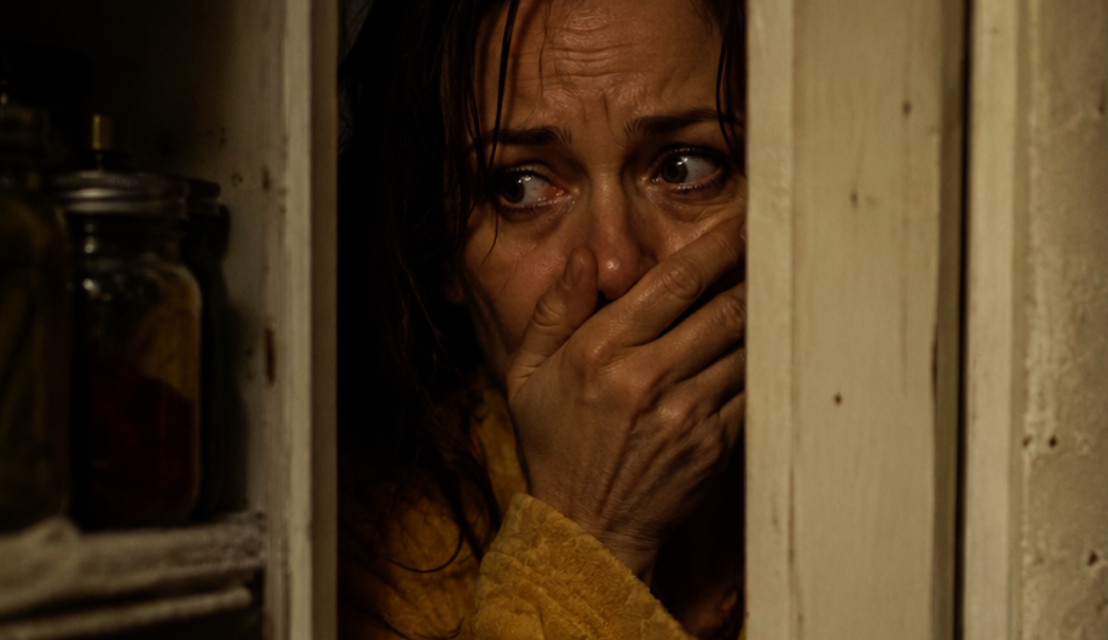
Vera managed to slip behind the pantry door one second before the key turned in the lock.
She pressed her back against the shelf lined with jars, found the door handle from the inside, and pulled it toward herself just enough to leave a gap no wider than a finger.
She was breathing quickly, with a slight rasp, and covered her mouth with her palm, because the hallway was completely silent and any sound would have carried through the apartment.
The front door swung open.
Vadik coughed and stepped into the entryway. Through the narrow strip of the crack, Vera could see his hands: two white grocery bags, packed tight, their rope handles digging into his fingers.
“Mom!” he called. “Are you home?”
Vera pressed her hand tighter over her mouth.
Before all this happened, Vera had been living alone for five years already. Kolya had died suddenly, as often happens with people who keep quiet about their pain: his heart simply gave out, and that was that.
The first year without him was the hardest. It was not the grief itself that broke her — she knew how to hold herself together — but the silence in the apartment pushed her to the edge. Kolya used to laugh at the television so loudly that every word could be heard from the kitchen.
In the bathroom, he sang terribly, getting both the words and the melody wrong, and he was not the least bit ashamed of it. Now, from behind the closed bathroom door, there was nothing but the hum of the pipes, and to Vera that hum seemed deafening.
Her daughter Sveta rushed in from Yekaterinburg during the very first days. She stayed for two weeks: cleaned, cooked, sat on her mother’s bed at night, and simply stayed nearby without demanding conversation.
That was precious.
Her son, however, did not show up then or later. Vadik had been gone for eleven years, and Vera had long stopped explaining out loud why, though inside she replayed it again and again like a worn-out record.
The story of his departure was painful and tangled, as things often are when the truth has been hidden under the rug for too long. Vadik had been difficult since childhood: sharp, hot-tempered, throwing tantrums over anything.
He barely scraped by at school, repeated sixth grade, and then somehow stumbled through with mediocre marks. His sister Sveta was the complete opposite: calm, well-behaved, bringing home nothing but top grades.
Vadik was angry at his sister, snapped back at every remark, and Kolya sometimes lost his temper, though he tried with all his strength to restrain himself.
When Vadik turned nineteen, Kolya sent him for the summer to his mother, old Klavdia, in a village near Ryazan. He thought: let him work with his hands, smell the earth, clear his head from city idleness.
Klavdia was a woman of brutal directness. She did not know how to hold her tongue, and did not consider it necessary. When Vadik messed something up in the vegetable garden, she snapped at him in anger:
“Well, what else can one expect from you, foster boy?”
Vadik returned to Moscow that very same day. He put his bag down in the hallway, walked into the kitchen, sat down, and asked quietly, almost without intonation:
“Is it true?”
Vera looked at Kolya. Kolya looked at her.
They had long been planning to tell him themselves when the right moment came, but they had kept putting it off, convincing each other that it was still too early, that he needed to grow up a little more.
“It’s true,” Vera said. “We took you from the baby home when you were eight months old. You were screaming so terribly, you had the whole ward turned upside down, and when you saw us, you went quiet and just stared at me.
I told Kolya then: he’s ours, no doubt about it.”
Vadik stood up and went to his room. Vera and Kolya sat in the kitchen until midnight, talking about anything except that, because they did not know how to talk about it.
A few days later, Vadik disappeared. He took with him the money that she and Kolya had been saving for him, money meant for a room in a dormitory. They had wanted to surprise him by autumn.
He arranged his own surprise first.
Kolya almost never spoke about him aloud. In the evenings, he would sit for a long time by the window and look out at the street.
Vera saw how much he was suffering, but she did not dare press him with questions. Kolya had his own way of dealing with pain — through silence — and she respected that. A few years later, his heart stopped.
Vadik appeared at the very beginning of April. He knocked carefully, not ringing the bell, but knocking, as if he were not sure anyone would open the door for him.
Vera opened the door and simply stood there for several seconds, looking at him: a thirty-year-old man with noticeable stubble, slightly hunched, holding a bag of mandarins.
“Mom,” he said. “Forgive me. I acted stupidly back then.”
Almost like a boy.
She stood there, not knowing what to do with herself.
“I want to make up for lost time,” he added. “If you’ll give me a chance.”
She hugged him right there on the threshold. He hugged her back awkwardly, hesitantly, the way people hug when they have lived too long without embraces and have forgotten how it is done.
Over dinner, he told her about himself: he had worked as a cook all over the country, from Krasnodar to Novosibirsk, starting in cheap roadside cafés and eventually making his way up to restaurants. And he really did cook well.
Vera watched how skillfully he cut up a chicken and thought that life was arranged in a strange way: a person disappears for eleven years, then comes back and fries cutlets for you.
He stayed to live with her. He took his old room, arranged his things on the shelves, and in the mornings cooked porridge or eggs.
Vera called Sveta every evening.
“He came back, you say,” Sveta was silent on the other end. “And how does he seem?”
“Good. Polite.
He cooks wonderfully.”
“Mom, are you sure everything is all right? Eleven years have passed, after all.”
“Sveta, he’s my son. Why are you acting like a stranger?”
She called relatives all over the country and told everyone: Vadik had returned, Vadik was home. Her cousin from Samara sighed into the phone and kept saying that there was no smoke without fire, and people did not come back out of nowhere for no reason.
Vera replied that there was no need to croak like a crow, everything was fine.
About two weeks later, Vera noticed that she had begun to get much more tired than before. By evening, her head felt as though it had been stuffed with cotton wool, and in the mornings she felt nauseous.
She decided it was just spring taking its toll: vitamin deficiency, pressure changes, age. At sixty, health was an unreliable thing by itself, and there was nothing specific to complain about.
The main thing was that her son was nearby.
Sveta asked in the evenings how her health was. Vera replied that it was normal, that she was a little tired, but it would pass.
“Maybe you should see a doctor?”
“Oh, come on. Am I supposed to run to the clinic over every bit of tiredness? You have to wait two weeks just to get an appointment. It’ll pass on its own.”
It did not pass. The nausea grew stronger, and by midday her head became heavy.
Vera took vitamins, brewed rosehip tea, and tried not to dwell on it.
That night she woke up very early, before six. Outside the window stretched a gray April sky; there was no one on the street.
Her mouth was so dry that she swallowed with difficulty. She got up, put on her slippers, and went to the kitchen for water. She did not turn on the light in the hallway: she knew the apartment by heart, every turn.
Before she reached the kitchen, she stopped.
Vadik was standing by the stove. One burner was lit beneath a small pot of porridge.
He was holding a small cellophane packet with some kind of powder in his hand and carefully poured it into the pot. Then he took a spoon and stirred it thoroughly.
Vera backed away down the hallway. She reached the bedroom, lay down on the bed, and pulled the blanket over herself.
She lay there staring at the ceiling with open eyes. A few minutes later, the bedroom door creaked.
She squeezed her eyes shut and breathed evenly, pretending to be asleep. She could feel Vadik looking at her from the doorway.
He stood there. Then he closed the door.
The front door slammed.
Vera opened her eyes.
Dawn was breaking outside the window. She lay there and went over the dates in her mind: when exactly she had begun feeling unwell, when the nausea had appeared, when that leaden exhaustion had come over her.
She counted backward. It turned out to be exactly from the days when Vadik had moved in and taken over the cooking.
She got up, dressed, and decided to go to her neighbor Tamara on the third floor. Tamara was a sensible woman, not one to wag her tongue for nothing, and she knew how to sort out a situation without unnecessary tears. Vera was already putting on her coat in the hallway when the key turned in the lock.
She did not even have time to realize what she was doing before she found herself in the pantry.
Through the crack, Vera watched Vadik take out his phone and press it to his ear.
“Hello. Yes, I’m already home.” A pause. “No, the old woman wandered off somewhere. She’s not here.” He walked along the hallway. “Don’t get nervous, I’m telling you.
She doesn’t have much time left anyway. She probably thinks it’s vitamin deficiency or blood pressure.” He snorted. “Once it’s all over, we’ll sell the apartment quickly. That’s easy enough. And I’ll come to you right away.
We’ll live properly!”
Vera stood without moving, her hand at her mouth, staring through the crack at her son.
“Damn it, I forgot to go to the pharmacy again,” he said irritably. “Now I’ll have to drag myself out again.” He swore. “All right, I’ll be there soon. Wait for me.”
The door slammed. His footsteps faded on the stairs.
Vera came out of the pantry and stood in the middle of the hallway. For a long time she stood like that, looking at his jacket on the hanger, his boots by the threshold, and the keys to the upper lock on the little shelf.
The lower lock could only be opened with her key. She had never made a spare for anyone.
She packed a bag in twenty minutes. Documents, her pension certificate, a small framed photograph of Kolya.
She called Sveta.
“Mom, why are you calling so early?” Sveta yawned into the phone.
“Well, I’ve been thinking, Sveta. I’ll just come visit you.
I miss you.”
“Come, of course. When?”
“Today.”
“Today?!” Sveta woke up completely. “And what about Vadik? Let him come too. I finally want to see my brother.”
“Vadik went away for work, to earn some money. He’s not here right now.
I’ll come alone.”
“Well, send me the train number. I’ll meet you.”
Vera put away the phone. She gathered Vadik’s things that had accumulated over the month — several T-shirts, a razor, a worn book — folded them neatly into his bag, and zipped it shut.
She placed the bag on the landing by the entrance.
She took a sheet of paper and a pen from her pocket. Slowly and clearly, she wrote:
“Vadik. I love you, I always have, and apparently I always will, even though you don’t deserve it.
That is why I won’t go to the police. But I no longer wish to see you.
Never. Mom.”
She folded the sheet and placed it on top of the bag.
Then she left. She locked the door with the lower lock using her own key.
She put the key into her coat pocket.
She reached Vykhino metro station by bus. She went down into the subway, stood in the train car, and looked not at the advertisements above the doors, but at her reflection in the dark glass.
The train jerked and began to move.
The ride to Kazansky railway station was not long, with a transfer at Taganskaya. The platform was empty and echoing.
She bought a ticket to Yekaterinburg for the daytime train, found a bench in the waiting hall, and sat down. Beside her, some man was feeding pigeons crumbs from a roll.
The pigeons jostled and shifted from foot to foot.
Vera sat and thought that she would still have to tell Sveta everything. Not today, not right from the doorway, but she would tell her.
Sveta was smart. She would understand and would not wail needlessly.
Vera tried not to think about Vadik at all. She did not succeed very well.
Sveta met her on the platform in Yekaterinburg, almost running toward her, and hugged her immediately, tightly, before any words were spoken. Vera buried her face in her daughter’s shoulder and closed her eyes.
“Mom,” Sveta said quietly. “What happened?”
“I’ll tell you later,” Vera answered. “Let’s go home first.”
They walked along the platform together, Sveta carrying her bag. A soft morning sun was shining.
Vera walked and thought that back in Moscow, in the pantry on the top shelf, there was a jar of cherry jam, sealed the previous August. She had been saving it for winter and had never opened it.
Well, let it stay there. Happiness does not live in jam.