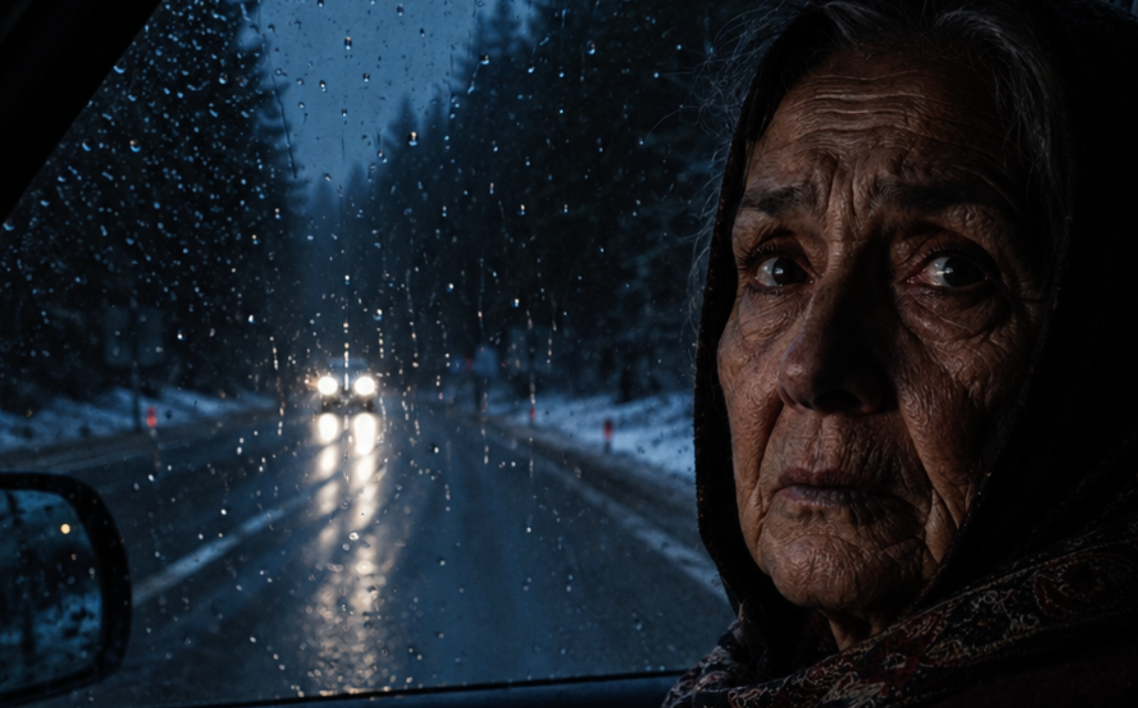
I had been driving for the third hour already, and the road was empty and slushy. In our region, it gets dark early in November, and I was hurrying to make it before nightfall. The radio was playing inside the car, the heater was barely warming the cabin, and in my mind I was already home, where my husband, my daughter, and, of course, my mother-in-law with her eternal dissatisfaction were waiting for me.
I was so lost in thought that I didn’t even notice when someone appeared in the back seat.
“Well then, mother, have you given me a ride?”
I flinched so hard I almost turned the steering wheel into the ditch. My heart dropped somewhere deep inside me, and I hit the brakes, staring into the rearview mirror.
There, leaning back on the seat, sat an old woman. Her face was cut with deep wrinkles, her head was covered with a dark scarf, and her eyes — unnaturally bright, almost black — looked at me calmly and attentively.
“Where… where did you come from?” My voice sank from fear.
I remembered exactly that I had gotten into the car alone. The apartment keys were lying on the front seat beside my bag, and I had not picked anyone up.
“From the road,” the old woman answered, adjusting her scarf. “I’ll freeze to death out there. Are you going to drive me or what?”
I wanted to say that I didn’t take passengers, that it was dangerous, that they were waiting for me at home, but the words stuck in my throat. The old woman looked at me as if she knew everything about me. As if she were reading me like an open book.
“I’m going to Nikolskoye,” I said quietly, hoping she would get out.
“And Nikolskoye is exactly where I need to go,” she smirked. “Don’t be afraid, daughter. I’m not going to kill you. I’m too old for that. But helping you — maybe I can do that. I can see your soul is black with sorrow. Your husband running around? Your mother-in-law eating you alive?”
I stayed silent.
We had been living with my mother-in-law for six years already, and for the last two years my life had turned into one continuous torment. But to talk about that with the first stranger I met?
The old woman seemed to read my thoughts.
“All right, stay quiet,” she said, stretching out her hand and poking her wrinkled finger in my direction. “I can see it anyway. You’re kind. Too kind. And the kind ones, daughter, are the first to be eaten in this world. Let’s go already, before it gets dark.”
I started the engine and pulled back onto the highway. Only one thought spun in my head: why am I doing this?
But my foot obediently pressed the gas.
We drove in silence for about half an hour. The old woman looked out the window, sometimes muttering something under her breath. When the sparse lights of Nikolskoye appeared ahead, she suddenly commanded sharply:
“Stop here.”
I stopped near a half-ruined wooden hut. The old woman opened the door, and before getting out, she turned around.
“Thank you, darling. Listen here. In a month, I’ll knock on your door. Don’t be afraid. Just know this: when everything falls apart, I’ll come.”
“What?” I couldn’t even find an answer.
“That’s what,” the old woman said, climbing out of the car and, leaning on her cane, walking toward the house without looking back. “Remember: one month. Exactly.”
I drove away, gripping the steering wheel with trembling hands. All the way home, I convinced myself that it had been a dream, a hallucination from exhaustion.
I almost threw that story out of my head.
For exactly one month.
And one month later, we were preparing for a family celebration — our tenth wedding anniversary. Or, as my mother-in-law Valentina Petrovna put it, “ten years of suffering for my poor son.”
She was sitting in the kitchen, sorting through groats and, of course, grumbling.
“Your Seryozha is like a skeleton. You don’t know how to feed him. You dried out the meat again. And who sets a table like this? We’re having guests, not homeless people.”
I silently arranged salad onto plates.
My husband, Sergey, was sitting in the living room, drinking beer and watching television. There was no point expecting help from him. I worked one and a half jobs, carried the mortgage on my shoulders — we had bought the apartment together with his mother, and she had a share in it — along with the household and raising our daughter.
Masha had just turned ten, and she often looked at me with eyes as if she could feel my exhaustion.
The doorbell rang.
I went to open it, wiping my hands on my apron. On the threshold stood my sister-in-law Svetlana with her husband and two teenage boys. They barged into the apartment without even taking off their shoes.
“Oh, why isn’t the table set yet?” Svetlana asked, kicking off her dirty boots right in the hallway. “Seryoga! Come greet your relatives!”
“Come in,” I said quietly, though inside everything was boiling.
And then more came.
Second cousins, some “family friends” I was seeing for the first time. Valentina Petrovna felt like a queen. She commanded:
“Lenka, bring this. Lenka, serve that. Clean this up. Seryozha, sit down, you’re tired.”
The number of guests exceeded all imaginable limits. I ran around with plates like a waitress, while Svetlana commented loudly:
“Oh, Mom, what did she cook here? Olivier salad with chicken? It should have been made properly, with sausage. And the dressed herring is oversalted.”
“Maybe you should have cooked it yourself, since you’re such an important guest?” I finally snapped, placing another dish on the table.
“Me?” Svetlana rounded her eyes. “I’m a guest, and guests are served. You don’t even work anywhere properly, so you might as well try.”
“I work,” I hissed through my teeth.
“Well, you work,” Valentina Petrovna waved her hand. “That salary is nothing but mouse tears. If not for my Seryozha, you and your daughter would be living under a bridge. By the way, send Masha to her room. She’s in the way here.”
I looked at my daughter. She was sitting in the corner, hugging her knees, looking at me with frightened eyes. She had not been invited to the table. In fact, no one noticed her at all except me.
“Masha, go to your room,” I said, feeling my teeth clench.
At that moment, the doorbell rang again.
I went to open it, expecting to see yet another late guest.
On the threshold stood her.
The same old woman. In the same scarf, with the same cane, but her eyes burned brighter than last time.
“Hello, darling. I told you — one month. I’ve come.”
“Who is this now?” Valentina Petrovna’s voice sounded like a gunshot.
The old woman ignored her and stepped over the threshold. She calmly took off her old galoshes, patched with electrical tape, and walked into the living room, where the guests froze.
“Good evening, kind people,” she nodded. “I’m Evdokia. Simply Dunya. I’ve come to see Lenka. To stay for a little while.”
“What?!” Sergey jumped up from the couch, red from the beer he had drunk. “Lenka, have you lost your mind? Who is this?”
“I…” I stared at the old woman in confusion, not knowing what to say.
I was in shock myself.
“Lenka, are you even sane?” Svetlana joined in, looking the guest over with disgust. “Who are you dragging into the house? We have a proper gathering here, and you’ve brought some homeless old hag!”
“How dare you?” I felt anger boiling inside me, mixed with humiliation. “This is my apartment too!”
“Our apartment!” my mother-in-law barked. “And I will not allow all kinds of trash to settle here!”
Meanwhile, Dunya had already settled herself on the only free chair — the one I had brought for myself. She looked over the table, the dirty plates, the displeased faces, and sighed loudly.
“Trash, you say?” she asked calmly. “I’m the trash? Then what are you? You came here to gorge yourselves in someone else’s apartment, treat the hostess like a servant, and crush her own little girl… Trash, you say?”
“Lena! Remove this scarecrow immediately!” Valentina Petrovna screamed.
“She’s staying,” I heard my own voice say.
I said it so firmly that I surprised myself.
“What?!” Svetlana and Sergey asked in unison.
“You heard me,” I said, standing between the old woman and the relatives. “Evdokia is my guest. If you don’t like her, the door is over there. You already behave as if I’m a servant here.”
The silence rang.
Svetlana grabbed her husband by the arm.
“Well, then stay with your granny! Let’s get out of here! I’m not taking part in this circus!”
The guests began to leave, loudly indignant, throwing angry looks at me. My mother-in-law remained sitting in the kitchen, drilling into me with her eyes, while Sergey demonstratively turned the television up loud.
When the door slammed behind the last guest, Dunya came up to me.
“Well done,” she said softly. “You’ve taken the first step. It will get worse from here, but hold on. Now show me where I’ll sleep.”
I took her to the small room we called the nook. There was an old sofa there. Dunya lay down, groaning, and, closing her eyes, muttered:
“That’s it, Lenka. The most interesting part begins. Tomorrow your dear ‘relatives’ will show themselves in all their glory.”
In the morning, I woke up to shouting.
Running into the kitchen, I saw Sergey and my mother-in-law. They were standing over Dunya, who was calmly drinking tea from my favorite mug.
“She stole my earrings!” Valentina Petrovna screamed, shaking with rage. “Gold ones! Seryozha, call the police!”
“What earrings?” I looked from my husband to the old woman.
“As if you don’t know!” Sergey barked, his eyes flashing. “You set this all up to drive Mom out! You brought a beggar into the house, and now she’s stealing!”
“I didn’t take your earrings,” Dunya said calmly, sipping her tea. “I have enough of my own, even if I’m dressed poorly. Happiness isn’t in money, daughter.”
“Get out of here!” my mother-in-law screamed. “Out immediately!”
I looked into my mother-in-law’s eyes. She didn’t look upset. She looked triumphant.
It dawned on me: this was a setup.
“Where did you look for them?” I asked.
“In her room,” Svetlana said, stepping out from behind her mother.
Apparently, she had dragged herself over early in the morning.
“I saw with my own eyes how she hid them in the pocket of her robe.”
“You’re lying,” I said calmly.
“Who are you calling a liar?” Svetlana moved toward me. “I’ll—”
“Hands off!” Dunya suddenly stood up, and her voice became as hard as steel. “You girls think an old woman is stupid? You think I wouldn’t understand that you planted the earrings in the pocket of my robe while I was sleeping? I heard everything.”
Valentina Petrovna turned pale.
“What did you hear, you old hag?”
“How you were whispering with your daughter. ‘Seryozha will believe her, we’ll throw her out, and Lenka will run after her granny.’ It won’t work.”
“Seryozha!” my mother-in-law shrieked. “Are you going to listen to this?!”
Sergey stood there red-faced, fists clenched.
“Lena,” he said through his teeth, “either this old woman leaves, or I leave. Choose.”
I looked at my husband.
Ten years of marriage. Ten years of humiliation, his silence, his eternal “Mom said so.” I looked at my daughter, who was standing in the doorway, staring at her father in horror.
“Choose,” he repeated.
“Leave,” I said.
“What?”
“I said leave. Go to your mother, to Svetlana, wherever you want. But from this apartment, which, by the way, is registered in my name and Masha’s, you are the one leaving.”
The legal threat worked.
Sergey was stunned. He was used to me being silent, enduring everything. But now something inside me had broken.
Or, on the contrary, finally fallen into place.
“You’ll regret this,” my mother-in-law hissed, grabbing her son by the arm. “Let’s go, Seryozhenka. We’ll see how she manages here with her old woman and without a man.”
They left, slamming the door loudly.
I sank onto a chair, feeling my knees trembling.
“So that’s it,” I breathed out.
“No, darling,” Dunya said, coming up to me and stroking my head. “This is only the beginning. They won’t give up so easily. The apartment is yours, yes. But they also have a share. Now they’ll go to court. Demand alimony from you if he quits his job. Take your car. Are you ready?”
I lifted my head.
I was not ready.
But I had no choice left.
Sergey returned three days later.
Not with an apology, but with a court summons.
Valentina Petrovna had filed a lawsuit to evict me and Dunya, demanding that the apartment be sold and the money divided. The lawsuit stated that I was “creating unbearable living conditions,” had “brought an unrelated person into the apartment,” and had “psychologically pressured my husband, forcing him to leave.”
I sat in the kitchen, holding the paper in my hands, unable to believe it. My mother-in-law, who had lived at my expense and eaten my bread, was now trying to deprive me of a roof over my head.
“Don’t be afraid, darling,” Dunya said, bustling at the stove and brewing some herbs. “Court is a certain kind of thing. Whoever is right is stronger.”
“But they have a share,” I whispered. “And a lawyer. They hired a lawyer.”
“And you think we’re defenseless?” Dunya smirked. “The main thing is to gather your documents. All the receipts showing that you paid the mortgage while your Seryoga lay on the couch. And utility bills. Electricity, water. Everything you paid for.”
“What’s the point?” I looked at her in despair. “It’s her word against ours.”
“Not hers,” Dunya said, going to the window and pulling the curtain closed. “Today after work, go to child protective services. Get a statement that you provide the proper conditions for the child, and the father does not. That he left, pays no child support, and does not participate in his daughter’s life. That’s reinforced concrete.”
I was surprised by her knowledge.
“How do you know all this?”
“I’ve lived a long life, daughter,” Dunya sighed. “I’ve seen all kinds of things. Been in courts too. Not as a defendant, but as a witness. My tongue is sharp; I like telling the truth. Judges appreciate that.”
That same evening, I went to the guardianship authorities. The woman who received me was wary at first, but when I showed her my salary certificates, Masha’s school references, and explained that the child’s father had left without leaving a single kopeck, she nodded.
“Yes, this is a typical situation. We’ll prepare a conclusion. The child must be protected. By the way, has your husband tried to take things or threaten you?”
“Not yet.”
“Write a statement,” she said strictly. “Just in case. Let it be on record.”
I returned home late.
Sergey was standing by the entrance, smoking. When he saw me, he threw away the cigarette and blocked my path.
“Lenka, come to your senses before it’s too late,” he said, trying to sound peaceful, though there was malice in his eyes. “Throw out that old woman, and we’ll forget everything. Mom won’t insist on selling.”
“So you admit the lawsuit is blackmail?” I asked, looking him in the eyes.
He faltered.
“I admit that you went too far. Mom is old, she’s nervous.”
“Your mother wants to put me and your daughter out on the street,” I said, feeling cold fury rising inside me. “And you support that. Go home, Seryozha. To your mother.”
I walked around him and entered the building. He shouted something after me, but I didn’t hear it.
I knew there was no way back now.
The court hearing was scheduled for two weeks later. I prepared as if for an exam. Dunya taught me what to say, how to carry myself. On the day of court, I put on a strict suit and dressed Masha in her school uniform.
We entered the courtroom.
Valentina Petrovna sat in the first row with the look of a martyr. Beside her were Svetlana and some man in a leather jacket — their lawyer. Sergey stood by the window, trying not to look at me.
The judge — a woman of about forty with a tired face — opened the hearing.
“The plaintiff claims that the defendant creates impossible conditions for cohabitation, brought an unrelated person into the apartment who behaves aggressively, and” — she read from the claim — “exerts moral pressure on the minor child.”
“That is a lie,” I said when I was asked whether I admitted the claim.
“Your Honor,” my mother-in-law’s lawyer stood up, spreading his hands, “we have witness testimony. Svetlana Igorevna, the plaintiff’s own daughter, is prepared to confirm that the defendant systematically insulted an elderly woman and once used physical force.”
“That’s not true!” I shouted.
“Silence in the courtroom,” the judge raised her head. “The witness may speak.”
Svetlana went to the stand. She told them how I had “attacked Mom,” “thrown plates,” and “driven my brother to a nervous breakdown.” I listened and felt the ground slipping from under my feet. She lied so convincingly, with so many details, that for a second even I doubted whether it might have happened.
“Your Honor,” I jumped up, “permission to present the conclusion of the guardianship and trusteeship authorities!”
The judge nodded.
I handed over the document. In black and white it stated:
“The child’s living conditions are satisfactory. The mother has created all necessary conditions. The father does not participate in upbringing and does not pay child support. A change of the child’s residence is inadvisable.”
My mother-in-law’s lawyer grimaced.
Then Dunya asked to speak.
She stood up, leaning on her cane, and looked at the judge.
“Your Honor,” she said quietly but clearly. “I am an old person. I have no reason to lie. This woman here” — she pointed at Valentina Petrovna — “not only tried to drive her daughter-in-law out, but also planted her own earrings on me to slander me. And her son Sergey — he doesn’t deal with the child at all. I saw Lenka working nights to pay the loan while that one” — she nodded toward Sergey — “drank away money.”
“Slander!” my mother-in-law shrieked.
“Then let’s check,” Dunya said calmly. “Let Sergey provide an income certificate for the past year. Where did he work? How much did he earn? Or was he simply sitting on his wife’s neck?”
Sergey turned pale.
The judge looked at him.
“Do you have such documents, citizen Petrov?”
“I… I worked unofficially…”
“I see,” the judge said, making a note in her notebook.
The hearing lasted three hours.
In the end, the judge stood.
“The claims of Valentina Petrovna Petrova are denied in full. The child remains with the mother. The place of residence is the apartment belonging to the defendant and her minor daughter. The parties are advised to conclude an amicable agreement regarding the use of shares. The hearing is closed.”
Valentina Petrovna jumped up, pale as a sheet.
“We will appeal!”
“That is your right,” the judge shrugged and left.
I exhaled.
In the corridor, Sergey caught up with us.
“Are you happy now?” he hissed. “You destroyed the family!”
“What family, Sergey?” I looked at him. “Where were you when your mother humiliated me? Where were you when I cried at night? Go. And don’t come near Masha again. I’ll file for child support and restricted contact if you don’t come to your senses.”
He spat and left.
When I returned home, I collapsed onto the sofa and burst into tears. It was a hysteria of relief. Dunya sat beside me, silently stroking my head.
When I calmed down, I asked the question that had tormented me from the very beginning.
“Who are you really, Evdokia?”
Dunya sighed, was silent for a long time, and then said:
“Haven’t you guessed? I’m your grandmother. Your blood.”
I stared at her.
“My mother had an older sister who disappeared during the war,” I said quietly. “Grandma said she died.”
“She didn’t die,” Dunya shook her head. “She survived. Only she didn’t return home. She was ashamed. Got involved with a bad man, gave birth, and then he abandoned us. I put my daughter in an orphanage, thinking I’d take her back later. But I couldn’t. So I lived out in the backwoods, alone. Your mother is my granddaughter, then. And you are my great-granddaughter.”
“But why didn’t you come earlier?”
“Why?” Dunya smiled bitterly. “So you could call me a ‘beggar granny’ too? I waited. Watched you from afar. Saw how your mother-in-law oppressed you, how your husband didn’t value you. I waited until you were ready yourself. And I didn’t end up on that road by chance. I stood there on purpose. I wanted to see what kind of person you were. Kind,” she repeated. “Just like me.”
“And the house in Nikolskoye?”
“Mine. The house is mine, the land is mine,” she said firmly. “And I’m not poor, Lenka. I saved my pension for thirty years, and there in the wilderness, they used to wash for gold in the old days. I know the places. I don’t need housing in the city. But I will leave it to you and Masha.”
She handed me a worn envelope.
“Here are the documents for the house and the land. And a deed of gift to you, drawn up a year ago, as soon as I learned you were in trouble. I have my own notary. Everything is legal.”
“You… you were watching me all this time?” I stared at her, unable to believe it.
“I was. How else? You are my blood. I have no one closer. And those people” — she waved her hand toward the place where the relatives had gone — “they are not people. They were just taking up space.”
I began to cry again, but this time they were tears of gratitude.
That night we sat in the kitchen for a long time. Dunya told me about her life, about how she had survived in the forests, how she had found gold, how she had saved money. She turned out to be completely different from the strange old woman I had imagined.
She was strong.
A month later, Sergey and Valentina Petrovna no longer appeared. Rumor had it they had tried to challenge the court decision, but lost in the second instance as well. Svetlana, they said, had quarreled with her mother over the money she had spent on the lawyer.
Their close-knit family was cracking at the seams without a scapegoat — without me.
Dunya and I renovated the house in Nikolskoye. I decided to keep the apartment in the city and rent it out to pay the mortgage, which I was now carrying alone, while I moved into the house myself.
It was quiet there. It smelled of pine and dry grass. Masha started at the local school, where no one bullied her, and for the first time in a long while I saw her smiling.
One evening, we were sitting on the veranda. Dunya, as usual, was drinking herbal tea and looking at the stars.
“Well, darling,” she said, “did I fulfill my duty?”
“What duty?” I flinched.
“You were my last concern,” she said, stroking my hand. “I got you back on your feet, cleared the snakes away from you, gave you a home. Now I can rest.”
“Where are you going?” I asked, frightened.
“Don’t be afraid. I’m still here, with you,” she smiled. “But my soul is calm now. You did well. You endured. And this story” — she nodded toward the highway — “let it be a lesson to you. Kindness is kindness, but life is a hard thing. You must know not only how to love, but how to show your teeth too. Otherwise they’ll eat you alive.”
I hugged her.
Then I went into the house and turned on my laptop. I decided to write this story.
Let people know: miracles happen. But most often they don’t come in the form of a magic wand. They come as an old, wise woman who one day gets into your car on a deserted highway.
I looked at the clock.
It was exactly twelve midnight.
A month to the month, day to the day.
I smiled.
Life was only beginning.