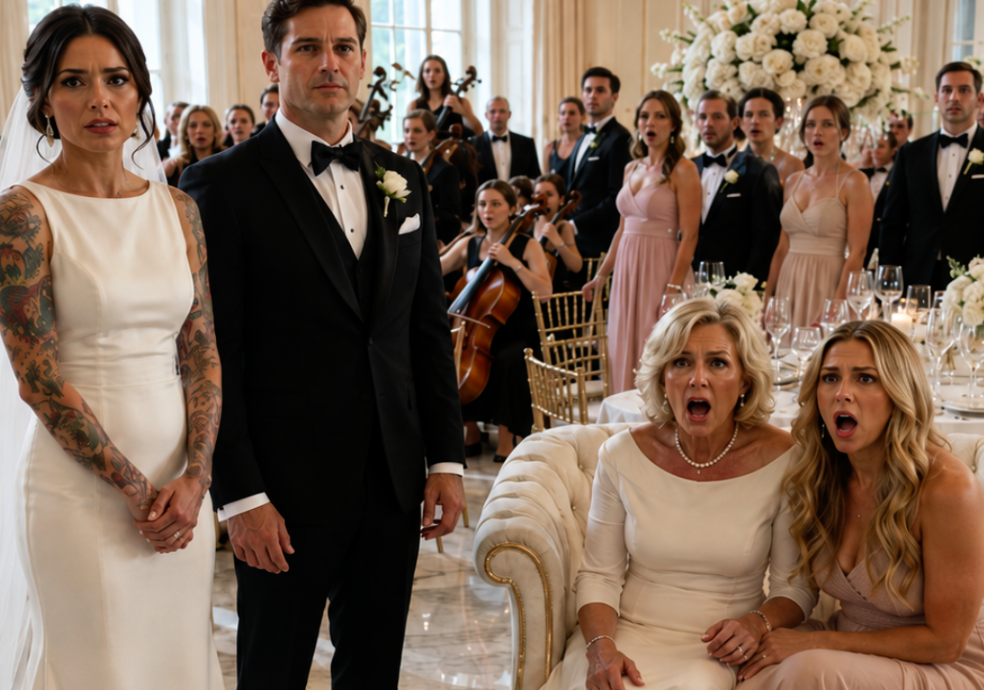
If the Harrison family operated as a corporate entity, my mother, Brenda, was its ruthless, image-obsessed Chief Executive Officer. My father, Richard, served as the compliant, perpetually nodding board of directors who never dared challenge her absolute authority. My younger sister, Courtney, was the flagship product—a meticulously crafted, flawless offering designed strictly for elite public consumption.
And then there was me. My name is Valerie. At twenty-six years old, I functioned as the unpaid intern banished to the subterranean basement: completely out of sight, and almost entirely out of mind.
I was the undeniable black sheep of the family, though not for the traditional reasons. I had not dropped out of school, committed a crime, or brought any tangible scandal to the Harrison name. My singular, unforgivable transgression was daring to be unapologetically average in a household that worshipped high social status, physical perfection, and the shallow validation of country club socialites.
While Courtney was a former pageant queen who glided through a decorative art history degree just to have something to discuss with investment bankers, I was a size-twelve software developer. I resided in a chaotic, exposed-brick industrial loft in downtown Chicago, my arms adorned with vibrant, intricate half-sleeves of floral tattoos. I earned mid-six figures engineering complex inventory management systems, but to Brenda, writing computer code was tantamount to blue-collar warehouse labor. Because she could not boast about my career over afternoon tea, my professional existence was entirely invalidated.
The alienation between Courtney and me was not born of a sudden explosion; it was a slow-dripping poison Brenda administered over decades. It was evident in the way dinner conversations revolved exclusively around Courtney’s caloric intake and social calendar. It was obvious when my straight-A report cards were casually tossed aside, while Courtney’s spot on the junior varsity cheerleading squad triggered a celebratory dinner at a five-star steakhouse.
Brenda systematically conditioned me to view my natural state as an embarrassment. My loud laugh, my curves, my ink, and my career were painted as fundamental flaws. To survive, I made myself small. I became the invisible older sister, foolishly believing that if I simply accommodated their endless, suffocating rules, I would be permitted to occupy a quiet corner of my own family.
I could not have been more wrong.
The true psychological warfare—the catalyst that ultimately detonated our family structure—commenced the moment Courtney became engaged to Preston Kensington.
To understand the Kensingtons is to picture the absolute zenith of old-money Boston: generational wealth, trust funds, and summer estates that masqueraded as minor European castles. When Preston proposed with a flawless three-carat diamond, my mother practically went into cardiac arrest from sheer social euphoria. Within hours, Brenda abandoned her role as a mother and morphed into a frantic, full-time wedding publicist. Her sole purpose in life became appeasing Preston’s mother, Margaret Kensington.
Despite a lifetime of marginalization, I was genuinely thrilled for my sister. I immediately sent a $300 bottle of vintage champagne to her apartment and began researching high-end, heavily conservative, long-sleeved gowns. I was fully prepared to swallow my pride, drain my savings for a lavish bachelorette trip, and wrap myself in whatever matronly beige fabric they deemed necessary to cover my tattoos and keep the peace.
Instead, I was met with deafening silence.
Weeks bled into months. I watched through the digital window of Instagram as my mother and sister curated a cinematic wedding experience—luxury bridal boutiques in Manhattan, elaborate floral tastings, and venue walkthroughs. Whenever I called Brenda to ask for a timeline or a budget, I was brushed off with a practiced, dismissive sigh.
“Oh, Valerie, please don’t nag me right now. You have no idea the level of detail this requires. Just keep your autumn schedule flexible. I will let you know when we need you.”
I trusted her. I was so desperate to finally be included in the inner circle that I willfully ignored the glaring red flags.
The shattering reality check arrived on a rainy Tuesday in May. Taking a break from a grueling coding sprint, I mindlessly scrolled through social media. A post from Courtney’s former roommate, Khloe, materialized on my screen. It featured five beautiful women holding custom-engraved wooden boxes filled with champagne, silk robes, and macarons.
The caption was a death blow: “So incredibly honored to stand beside my absolute bestie in Tuscany. We are officially bridesmaids.”
My sister was flying across the world to marry in an Italian villa. She had selected her bridal party, commissioned bespoke gifts, and completely excluded me. My stomach plummeted. I frantically called Courtney, who screened the call. I immediately dialed my mother.
Brenda answered with heavy, breathless annoyance. When I confronted her about Khloe’s post, my voice trembling with the raw, abandoned grief of a wounded child, a heavy silence fell over the line. When Brenda finally spoke, she utilized her icy, corporate human resources cadence.
“To be completely honest with you, Valerie, you stick out. Your prominent tattoos, your weight, your whole alternative vibe. It is just not a fit for the formal photographs. Margaret is very particular about the visual presentation of her family. We thought it would be significantly less stressful for you if you just stayed home.”
I was being uninvited from my only sister’s wedding because I did not fit an aesthetic. When I yelled, finally vocalizing my heartbreak, Brenda snapped at me not to be dramatic and hung up.
Days later, my father called. He did not call to apologize or advocate for me. He called to offer me a $2,000 wire transfer to “make up for the disappointment,” begging me in hushed tones not to cause a public scene on social media. They were literally paying the ugly troll to stay hidden under the bridge so the royals could enjoy their feast.
I told him to keep his filthy money. I hung up, packed every photograph of my family into a cardboard box, taped it shut, and shoved it into the darkest corner of my closet. I then methodically blocked Brenda, Richard, and Courtney on every digital platform.
In September, morbid curiosity forced me to view Khloe’s public stories of the wedding. It was a sickeningly perfect display at a 16th-century Tuscan villa. But the ultimate betrayal was the crowd. Over two hundred people were in attendance—random sorority sisters, irritating business associates, distant cousins. The narrative of an “intimate, exclusive affair” was a calculated lie.
Seeing that visual confirmation did not break me. It did the exact opposite. It flipped a heavy metallic switch in my chest, incinerating my lifelong need for their approval and leaving behind a razor-sharp resolve.
I threw myself entirely into my software development firm with a manic, obsessive intensity. I built an impenetrable digital fortress—a complex world my mother could neither judge nor take credit for. Without the exhausting emotional drain of my family’s passive-aggressive warfare, my confidence skyrocketed. I stopped hiding my arms. I stopped apologizing for my space.
My specialized inventory management software began securing multi-million-dollar corporate contracts. I was rapidly hiring staff and watching my bank account swell to numbers that would have intimidated even the Kensingtons.
Months later, wearing a custom-tailored emerald suit that proudly displayed my ink, I flew to London for a prestigious global tech summit. I stood on a brightly lit stage and delivered the pitch of my life. When I stepped down, fueled by adrenaline, I met Alistair Montgomery.
Alistair was British, fiercely intelligent, with sharp aristocratic features and a devastatingly dry wit. A high-level venture capitalist, he walked straight up to me and immediately challenged the architecture of my software.
“Your data processing architecture has a fatal bottleneck in the third tier,” he stated, his accent crisp and authoritative.
“You’re completely wrong,” I fired back, stepping into his space. “The data is pre-indexed on the edge servers locally. It doesn’t lag.”
We spent the next hour aggressively debating cloud computing limits, ignoring the hundreds of tech professionals swarming around us. That debate turned into a three-course dinner, which seamlessly dissolved into talking until three in the morning in a dimly lit hotel bar. Alistair looked at me not as a broken project, but as an intellectual equal. He traced the dark rose tattooed on my forearm, calling it a masterpiece. He loved the exact things my mother had tried to violently suppress.
Eight months of a grueling transatlantic relationship later, my company required a European headquarters. I packed up my Chicago loft and moved into Alistair’s historic townhouse in Kensington, London.
I soon learned the intimidating truth about Alistair’s background: the Montgomery family was deeply embedded in the British aristocracy. His grandfather was an Earl; his mother, Lady Vivien, sat on the boards of international museums.
When Alistair took me to his family’s sprawling country estate, I reverted to my traumatized sixteen-year-old self, wearing a suffocating, high-necked sweater to hide my tattoos. But Lady Vivien shattered my expectations. She bypassed my formal handshake, poured me an expensive Scottish whiskey, and commanded me to remove my cardigan.
“Anyone who can get my stubborn son to stop checking his emails during Sunday roast is a saint,” she declared warmly. “Now take off that dreadful sweater. I want to see those beautiful tattoos he has been raving about.”
For two years, I lived in untethered bliss. I possessed a thriving global business, an extraordinary partner, and a family that accepted me without condition. The silence from Boston remained golden.
Then, during an anniversary trip to Kyoto, Alistair proposed in the Arashiyama Bamboo Grove with a vintage sapphire ring. Intoxicated by happiness, I posted a photo to my heavily locked-down private Facebook page.
Three days later, sitting in the first-class lounge at Haneda Airport, my phone lit up with a Connecticut area code. Brenda had seen a screenshot forwarded by my Aunt Vivien.
“Valerie, Aunt Vivien just sent me the picture of your hand. A sapphire. Really? Very Princess Diana of you. We need to talk about the engagement party timeline immediately. Call your mother.”
Two years of absolute silence. Not a single holiday card. But the second Brenda deduced that my fiancé was wealthy, she snapped her fingers, expecting her deflated employee to return to the corporate fold.
I looked at the text, and a dangerous smile spread across my face. I was not the terrified scapegoat anymore. I was a tech CEO and the future daughter-in-law of a British Earl. I held every single card in the deck.
I replied with a vague acknowledgement. Let her think she was back in.
Over the next eight months, Brenda’s emails grew frantic, demanding timelines and begging to leverage her country club connections for venues and florists. I strung her along before finally deploying the decoy.
I emailed her, feigning budget constraints. I claimed Alistair and I were planning a “micro-wedding” in a public London park, complete with paper plates and a potluck lunch.
Brenda’s resulting voicemail was a masterpiece of aristocratic horror. She shrieked about the humiliation of potato salad, terrified of what the Kensingtons would think. Courtney texted shortly after, dripping with condescension, offering to pay for a restaurant dinner so I wouldn’t “embarrass myself.”
While my mother and sister hyperventilated over my fictitious poverty, Alistair and I were quietly orchestrating an event that would rewrite the definition of high society. We were not getting married in a park. We were getting married at Syon House, the spectacularly grand historic London residence of the Duke of Northumberland.
Lady Vivien personally introduced me to the Alexander McQueen atelier. Unlike American bridal boutiques, the lead designer looked at my floral sleeves and smiled. “We are framing these. We are absolutely not hiding them.” They engineered a custom gown of heavy silk crepe and Chantilly lace, mathematically placed to seamlessly intertwine with my ink.
Two weeks before the ceremony, I sent the final email of my trap. I told my family the park permit fell through, so we were doing a ten-minute legal ceremony in our living room. I provided them with a Zoom link so they could watch from their suburban couch at 9:00 a.m. Eastern Standard Time.
Brenda’s reply was palpable with relief. A private living room meant no guests, no photographs, and nothing to publicly embarrass her.
The morning of the wedding, London was draped in perfect silver mist. In the bridal suite, surrounded by my closest friends and my fiercely loyal Aunt Vivien, my phone buzzed with a patronizing text from Courtney, who was getting her coffee and logging into the Zoom link.
I handed my phone to Aunt Vivien. She powered it down entirely, tossing it into her designer clutch. “Let them stare at the blank holding screen all day,” she said.
When the heavy carved oak doors of Syon House opened, I walked down the marble aisle alone. I did not need Richard to give me away; he had sold me for $2,000 two years prior. The great hall was overflowing with cascading white orchids, English ivy, and a sixty-piece live orchestra.
Seated before me were five hundred of the most influential people on earth: global tech billionaires, Silicon Valley venture capitalists, Members of Parliament, and European nobility. It was a networking goldmine—the exact room Margaret Kensington would have sold her soul to stand inside.
The reception in the glass conservatory was a cinematic dream of Michelin-starred cuisine and vintage champagne. Moving discreetly among the elite guests were professional photographers. Tatler magazine had requested exclusive rights to cover the wedding.
Alistair and I agreed on one non-negotiable condition: the massive digital article and high-resolution photo gallery had to go live globally at exactly 10:00 a.m. Eastern Standard Time.
Right around the time my family realized the Zoom meeting was never going to start.
On Monday afternoon, sitting in the ultra-exclusive Concorde Room at Heathrow Airport waiting for our flight to the Maldives, I finally powered my phone back on.
The digital dam broke. My phone violently convulsed, freezing under the weight of thousands of notifications.
47 missed calls from Brenda.
22 missed calls from Richard.
15 missed calls from Courtney.
My private Instagram had exploded to forty thousand followers. Alistair pulled up the Tatler spread on his iPad. The headline roared: Silicon Valley Meets British Nobility: Tech CEO Valerie Harrison’s Breathtaking Exclusive Nuptials to Alistair Montgomery.
The lead image was a full-page shot of me in the McQueen gown, looking edgy, regal, and fiercely unapologetic. The article detailed the exclusive guest list and even featured a candid photo of Aunt Vivien clinking champagne with the editor-in-chief of Vogue UK. My mother had been entirely, publicly, and humiliatingly locked out.
I placed the phone on the mahogany table and played Brenda’s voicemails on speaker. The progression from annoyance, to confusion, to utter unhinged hysteria was a symphony. Her final message was a shrieking breakdown—Margaret Kensington had seen the article and was threatening to pull financial backing for Courtney’s house because the family missed a royal networking connection.
I tapped Brenda’s name and hit dial. She answered on the first half-ring, gasping, demanding I call Margaret to claim their invitations were lost in the mail.
I let her rant until she ran out of breath.
“Hello, Mom,” I said, utilizing my coldest CEO cadence. “There was absolutely no mix-up. You simply weren’t invited.”
She screamed that excluding family was unnatural and cruel.
“Two years ago, you had a very different philosophy,” I countered, my voice dropping to a lethal whisper. “My wedding was a highly exclusive affair. And to be completely honest with you, you, Dad, and Courtney just didn’t fit the aesthetic. You’re a bit too suburban middle-class. I thought it would be significantly less stressful for you if you just stayed home.”
Hearing her own cruel words weaponized and echoed back broke her completely. Courtney ripped the phone away, sobbing, begging for an introduction to Alistair’s family, terrified of her mother-in-law’s wrath.
“I offered to buy you a nice dinner when you got back from Tuscany, remember?” I replied, completely devoid of pity. “You will never meet my husband. You will never step foot in my home. Goodbye, Courtney.”
I disconnected the call. I blocked Brenda. I blocked Richard. I blocked Courtney.
A massive, invisible weight evaporated into the quiet air of the lounge. They had tried to bury me in Tuscany, assuming I was a weed that would ruin their manicured garden. They failed to realize I was a seed. When I finally broke through the dirt, I bloomed so brightly it cast a permanent shadow over their entire world.
Taking my husband’s arm, I walked onto the plane and into my beautiful life, never looking back.