“Keys on the table, duplicates destroyed,” I ordered. And my sister’s husband suddenly realized that the resort at my garden house was closed.
“Niina, are you home? We’re already on the ring road. Forty minutes and we’ll be there.”
For a moment, Nina could not even understand what offended her more: the word “we’ll be there” or the calmness with which her brother said it. Not “may we come?” Not “how are you?” Not “are you busy?” Just a traffic report, as if he were talking about gas prices and a jam near a police checkpoint.
“Good morning, Kostya. Same to you. Or is asking first already old-fashioned?”
“Oh, here we go. Why are you starting right away? We’re family. Zhanna promised the kids some fresh air, I bought meat, we’ll sit together properly. It’ll be more fun for you too.”
“So you’ve already decided what will be fun for me?”
“Nina, don’t get worked up first thing in the morning. Since your divorce, you’ve been living inside a shell. Sitting out there in your garden settlement like a guard. We’re pulling you back into life.”
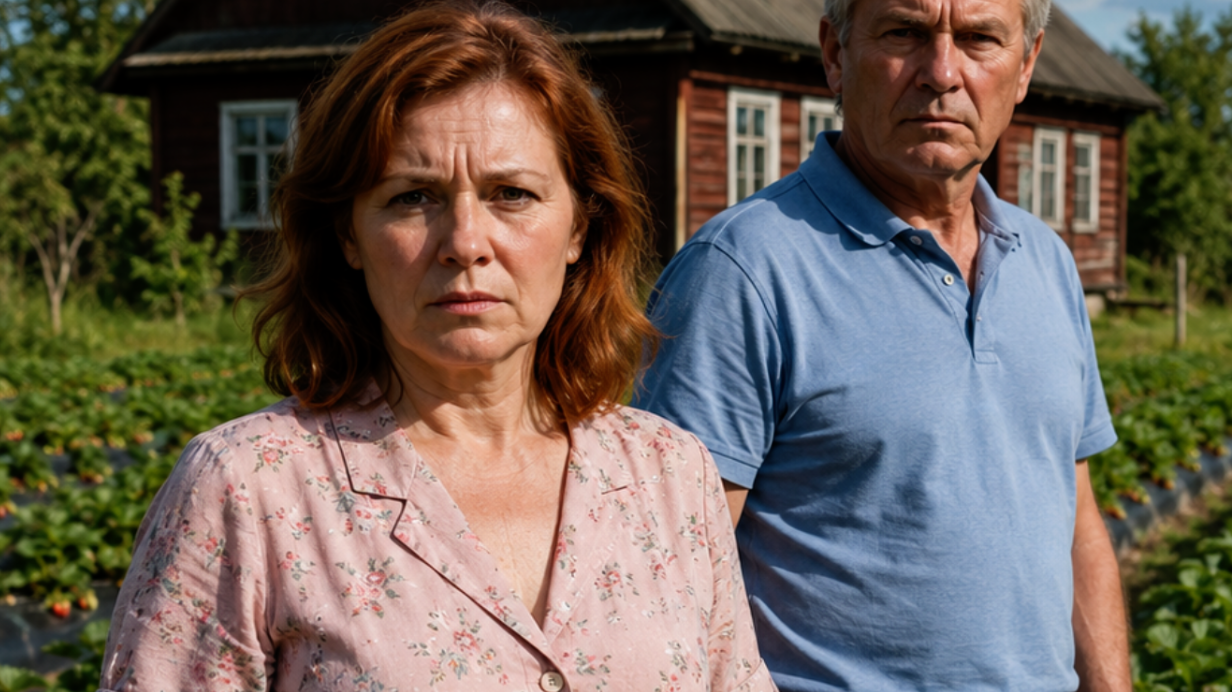
She looked out the window. Outside was her small plot in the Rechnik garden community: two strawberry beds, a greenhouse, an old table under the apple tree, mint by the porch, and a hose still wet after watering. She had put all of it together over three years, piece by piece, the way people put themselves back together after a solid, well-executed betrayal. Her husband had not simply left her for another woman. He had left cheerfully, with the confident swagger of a man who believed he was also a victim of circumstances. The apartment had been sold, the money divided, the children had moved out. Nina bought a little house near Ryazan and learned to live without other people’s slippers in the hallway and without other people’s decisions in her life.
For some reason, her relatives considered this a temporary mental condition.
“All right,” she said. “Come.”
“That’s my girl. You put the kettle on, we’ll bring the good mood.”
“Your good mood is free anyway.”
“Fine, wait for us.”
She ended the call and placed the phone face down, as if it were to blame. The kitchen smelled of dill, damp soil, and yesterday’s jam, which she had been pouring into jars. Silence still held on, like the last trace of dignity after family holidays, but Nina already knew that in about forty minutes her yard would look like a railway station square.
And that was exactly what happened.
“Aunt Ninaaa!” Yegor flew in first, without closing the gate. “Does your Wi-Fi work?”
“Hello to you too, children,” Nina said. “And yes, I missed you too. So much that I dreamed of hearing about Wi-Fi first thing.”
“Mom, I told you Auntie’s signal is better than ours at home!” Yegor shouted, already from the veranda.
“Nin, don’t grumble,” Zhanna said, climbing out of the back seat and adjusting her sunglasses on her head. “Look, we brought you peaches. They were on sale, but they’re decent.”
“Thank you, of course. Was closing the gate behind you not included in the sale?”
“My God, you’re prickly today,” Zhanna said, looking around the yard. “Oh, look at those peonies. I’ll cut a couple of branches to take home, okay? My vase is empty.”
“Not okay. I planted them for myself.”
“For yourself and for us. We’re not strangers.”
Kostya pulled a bag of marinated meat and a bag of beer out of the trunk, put both on the porch, and immediately squared his shoulders like a man who had made a decisive contribution to civilization.
“Where’s the grill? I’ll do everything.”
Nina looked at him with that particular calm behind which anger was already starting to boil.
“Like last time? When you ‘did everything,’ and I was raking coals out of the flower bed the next morning?”
“Come on, that happened once.”
“Twice.”
“Fine, twice. No need to keep minutes.”
“Someone has to. Otherwise you’ll decide that’s how it was supposed to be.”
Alina, the younger one, was already dragging a plate of cherries out of the kitchen.
“Aunt Nina, can I take your tablet? You have cool games on it.”
“No.”
“Why?”
“Because it’s my tablet.”
“What, are you stingy?”
Zhanna laughed.
“You hear that? The child sees straight to the point.”
Nina silently took the cherries, put them higher up on the refrigerator, and turned to her brother.
“Kostya, are you staying until evening this time, or again ‘we’ll see how it goes’?”
“Well, we’ll see,” he answered too quickly. “If the kids get tired, we’ll stay. The city is stuffy, you know that.”
“No, I don’t. I don’t live in the city. Though you explain to everyone that I never leave this place at all.”
“Nina, are you starting again? We came to relax, and you’re conducting an interrogation.”
“I’m not conducting an interrogation. I simply like to understand what is happening in my own house.”
“What’s happening in your house is family,” Kostya snapped. “Not an audit.”
Within half an hour, “family” was already acting as if they paid the mortgage on every nail in the place. Yegor stomped around the house in his outdoor sneakers, Alina dragged a blanket onto the grass, and Zhanna unloaded jars from the refrigerator as if checking inventory.
“Nin, what kind of cheese is this? Expensive?”
“Lida brought it from Moscow for me.”
“Then we’ll open it. Otherwise it’ll go bad. You can’t keep things like that locked away.”
“Zhanna, don’t touch it.”
“Oh, stop acting like a museum guard. Everything with you is ‘don’t touch,’ ‘don’t take,’ ‘don’t go there.’ Honestly, you should live a little simpler.”
“I do live simply. Without your visits, it’s wonderful.”
Kostya pretended not to hear. He was already fussing by the grill and shouting from there:
“Nin, where’s your charcoal? And lighter fluid. And a proper knife, this one’s blunt. And coarse salt. And a couple more skewers.”
“From what I can see, I don’t have a house. I have a distribution point.”
“Well, what are relatives for?” he called back cheerfully. “To help each other.”
“A very convenient formula,” Nina said. “For some reason, your help always flows in one direction.”
Zhanna settled into a lounge chair the way people sit when they are completely unburdened by either conscience or tasks for the day.
“Nin, you really are fixated on this. It’s hard for you alone, we understand that. That’s why we come. So you don’t turn wild.”
“Wild?” Nina put a bowl of cucumbers on the table. “So in your view, a person either tolerates relatives sitting on her head, or she turns wild?”
“Don’t twist my words. I mean something else. Since the divorce, you take everything as hostility. You used to be softer.”
“I used to be more convenient. Those are different things.”
They sat down at the table noisily, talking about prices, traffic jams, other people’s children who had gone to study psychology “for some unclear reason,” and Kostya’s neighbor who had “done her lips again, like a carp.” Nina sat off to the side and watched her homemade bread disappear, watched Kostya open without asking a jar of lecho she had planned to take to her daughter, watched Zhanna pour compote for the children into those very thin-glass tumblers that had belonged to their mother.
“Kostya, be careful with those glasses.”
“What’s going to happen to them? It’s not crystal.”
“That’s the point. It’s thin glass. If you break one, there won’t be another like it.”
“Nina, are you talking about the glasses now or your life?” Zhanna smirked.
“And are you joking now or being rude?”
“Whichever makes it easier for you to be offended.”
Kostya opened a beer, took a sip, and suddenly, without looking at his sister, said:
“Listen, since we’re sitting here. I’m forty thousand short until payday. Just for a week. Could you transfer it to me? I’ll pay you back in ten days.”
Nina even gave a small laugh.
“Of course. How did I not immediately guess that ‘you put the kettle on, we’ll bring the good mood’ was only the introduction?”
“What’s the big deal? You have money. You sold the apartment, bought the house, and still had some left. I’m not asking forever.”
“Doesn’t your tongue dry up from counting my money every time? You didn’t sell my apartment. And you didn’t pay for my divorce.”
“Nin, don’t start. I’m asking you as your brother.”
“You’re asking me as an ATM. A sister is someone you at least ask how she is first.”
Zhanna leaned back and looked at Nina over her glass.
“There you go again. Everything is about you. He asked normally. If the answer is no, say no. Without the performance.”
“Fine. No.”
The table became a little quieter. Even the children looked up from their phones for a second.
“Seriously?” Kostya put down the bottle. “You’re going to make a circus out of forty thousand?”
“No. Out of the fact that everything with you has long been automatic. The dacha is yours. The cellar is yours. The jars are yours. The wine is yours. Apparently, I’m for your use too.”
“No one is using you,” Kostya said sharply. “You made that up yourself.”
“Really? Then remind me who borrowed my screwdriver and returned it with the button torn off?”
“It broke by accident.”
“Who took two boxes of jars ‘temporarily’ and never returned them?”
“Oh, for God’s sake, they’re just jars.”
“Who dragged a box of seedlings out of my greenhouse ‘for Mom’s garden’ without even warning me?”
Zhanna pressed her lips together.
“Oh, here comes the accounting report.”
“Because accounting is the only language you understand. When something isn’t counted, you think nothing happened.”
Kostya stood up, poured himself more beer, and spoke in a different voice now, dry and slightly dangerous.
“Listen carefully. We don’t come to you for handouts. We don’t abandon you. While your ex is building a new life, we are here. And instead of gratitude, we get this.”
Nina looked at her brother and, for the first time that day, felt not hurt, but a tired clarity. There it was. The family’s main weapon: calling intrusion care. Slipping a rough hand under your arm and presenting it as a shoulder of support.
“You’re not here beside me, Kostya. You’re above me. There’s a difference.”
“Oh, enough. Zhann, pour some wine. Where does she keep the good bottles?”
Nina jerked.
“Don’t go into the cellar.”
“Oh, come on. You have a red one down there, I saw it. With a blue label. Let’s open it properly.”
“I said no.”
“What are you saving everything for, some special occasion?” Kostya was already heading for the door. “Life is happening. Drink now.”
“It’s a gift from Lida. I’m not keeping it unopened because I’m greedy. I want to decide for myself when to open it.”
“Nin, sometimes you talk as if the whole world is only dreaming of taking something from you.”
She answered quietly:
“Because some people are doing exactly that.”
By evening, the house breathed heat, meat, children’s shouts, and irritation. Zhanna cut three peonies anyway, put them in a cucumber jar, and declared that “flowers should work.” Yegor spilled lemonade on the sofa. Alina dropped one of their mother’s glasses. It cracked almost soundlessly, like patience.
“It’s nothing terrible,” Zhanna hurried to say. “It’s just a thing.”
“For you, yes,” Nina answered. “For you, everything in my house is ‘just’ something.”
“My God, where does so much poison come from?” Zhanna flared up. “You invite us yourself and then make faces.”
“I don’t invite you. You present me with a fact.”
“We’re family! Normal people are happy when relatives come to visit.”
“Normal people ask first.”
They stayed overnight anyway. Of course. “The children are worn out,” “it’s late to drive back,” “why drag ourselves around.” Nina handed out bed linen, unfolded the sofa, and brought pillows in from the veranda. Kostya was already snoring in the room, while Zhanna washed her face with Nina’s expensive gel, which had “just happened to be there.” Nina went to the kitchen to drink tea standing up, like in a bad communal apartment, except the communal apartment was her own.
Voices came through the thin wall.
“I’m telling you, we’ll press her,” Kostya whispered, but he whispered loudly enough that every word could be heard. “She’ll yell and then calm down. It’s hard for her alone anyway.”
“I don’t like her mood,” Zhanna answered. “Last time was easier. Now she’s clinging to every jar.”
“That’s boredom. She has nothing besides her garden. I already told Sanya he could come here with a group in August for the weekend.”
“Are you crazy? Without asking?”
“She won’t refuse. Where will she go? She’ll show off a little and let them in. She just wants to feel important.”
“Just be careful not to blurt out about money again. First we need to be gentle. And also… if she agreed to temporary registration, things would be easier for Alina’s school.”
Nina put her cup down so sharply that tea splashed across the table. So that was where the roots of this obsessive “we’re family” had been growing. Not just barbecue. Not just fresh air for the children. They needed the house—as a resource, as an address, as free space, as a backdrop for a convenient life.
She did not sleep until three in the morning. She stared at the ceiling and felt the last habit of justifying relatives slowly freezing inside her.
In the morning, she was awakened by the knocking of plastic containers.
By the beds near the fence stood Zhanna and Kostya. Zhanna, squatting down, was deftly picking large strawberries and placing them into two food containers. Kostya held a third and instructed the children:
“Don’t take the small ones, only the red ones. These are for home, and the soft ones you can eat now.”
Nina walked out barefoot onto the wet grass.
“What are you doing?”
Zhanna did not even flinch.
“Picking them. Before the sun gets too hot.”
“I can see you’re picking them. My question was different: by what right?”
Kostya straightened up, squinting at her as if she had ruined the picnic with her untimely awareness.
“Nin, don’t start in the morning.”
“In the morning? You’ve already managed to strip my beds and decided this morning can still be considered peaceful?”
“We didn’t strip them, we picked them. The berries are ripe. They’ll go bad.”
“They won’t. I pick them myself. For myself. For my daughter. Sometimes for jam.”
Zhanna sighed like a teacher in a remedial classroom.
“Nina, honestly, this is already indecent. Making a scene with adults over strawberries.”
“Over strawberries?” Nina stepped closer. “No, Zhanna. Not over strawberries. Over the fact that you’ve been living here for a long time as if I can be ignored. As if I’m an attachment to the land. As if the house has no owner, only service staff.”
“There go the pretty phrases again,” Kostya grimaced. “Say it plainly: you’re sorry to give berries to your nephews and nieces.”
“I’m not sorry for the berries. I’m disgusted by your attitude.”
“What attitude?” Zhanna raised her voice. “We come, we spend time together, the children get fresh air. Or do you want us to sit in city boxes and never poke our noses out?”
“I want you to behave like people, not like a raid.”
“A raid?” Kostya stepped toward her. “You’ve completely lost your mind. We’re not strangers.”
“That is exactly the word you hide behind all the time. ‘Not strangers.’ Very convenient. You can show up without asking. You can eat from my cellar. You can take money. You can break things. You can manage my house. And I’m supposed to keep quiet because you’re ‘not strangers.’”
“What have we taken from you?” Kostya flared up. “Jars? Skewers? Berries? That’s ridiculous.”
“And my time. And my strength. And my silence. And my right not to expect a landing party to descend into my yard on Saturday.”
Zhanna straightened up, holding the container in her hands.
“Listen to me carefully. You’re simply bitter. Your husband left you, your children moved away, you’re alone, you’re hurting—that’s understandable. But don’t pour everything sour inside you onto us.”
That phrase hit precisely and cruelly. Nina felt something inside her stop trembling. There are moments like that: someone strikes you so accurately that you stop being afraid of a scandal. Because it cannot get worse.
“Put the containers on the ground,” she said very calmly.
“What?”
“Put them down. On the ground. Now.”
Kostya snorted.
“Or what?”
“Or both of you will pack your things and leave right now. Without breakfast, without ‘let’s talk this over,’ without your family lectures about gratitude.”
“You’re throwing us out?” he asked in disbelief.
“No. I’m ending this circus. There is a difference.”
“Nina, you’ll regret this,” Zhanna narrowed her eyes. “This isn’t how family acts.”
“Family doesn’t turn a sister into a free holiday base. Family doesn’t discuss behind a wall how to ‘press’ a person for registration and bring strangers here. Do you think I didn’t hear?”
For a moment, that expression flashed across Kostya’s face, the one people get when they’ve been caught—not shame, but irritation that they were not allowed to continue in peace.
“You were eavesdropping?”
“I was living in my own house. And you were whispering as if I were already furniture.”
“You misunderstood everything,” Zhanna quickly cut in.
“No. For the first time, I understood everything correctly. And now you will do exactly two things: put the berries back, then load your bags into the car.”
“Go to hell,” Kostya said quietly.
“Better. At least that’s honest.”
“You’re seriously going to destroy family relations over such nonsense?” he raised his voice. “Later you’ll cry because you’re left alone.”
“I’m already alone. And as it turns out, it’s calmer than being in your company.”
“Children, into the car!” Zhanna barked, turning pale. “Don’t touch anything.”
“And put the key to the gate on the hallway table,” Nina said. “The spare one. The one Kostya made ‘just in case’ without my knowledge.”
Kostya twitched.
“I didn’t make anything.”
“Don’t lie at least now. I saw the duplicate on your keyring a month ago.”
“So I made one. And what? For convenience. You should have thanked me.”
“For breaking in under the guise of care? I’ll pass.”
They packed noisily, angrily, with theatrical rustling of bags and slamming of doors. Yegor tried to ask something, but Zhanna snapped at him as if he were responsible for the architecture of this scandal. Alina cried because she was not allowed to finish her cake. Kostya deliberately left empty bottles and greasy napkins on the table—the last petty masculine revenge available to those whose big words had run out.
At the gate, he turned around.
“Remember this, Nina. People don’t live like this. Push everyone away, and later you’ll be talking to your garden beds.”
“Better to garden beds than to you. At least they don’t demand anything.”
“You’ll crawl back to make peace.”
“Don’t fantasize.”
The car drove away, raising dust by the gate. Silence fell so sharply that her ears rang. Nina stood on the path and looked at the crushed grass, at the overturned child’s scooter near the shed, at the half-picked strawberries. She was shaking, but not from tears—from the aftershock. Like after emergency braking.
She went into the house, took a trash bag from the cupboard, and silently began collecting the traces of “family warmth”: plastic forks, sticky glasses, peach pits, someone’s wet T-shirt on a chair, Zhanna’s hair clip under a pillow. At some point, her phone chimed. Her neighbor Tamara Sergeyevna had written: “Nin, come out for a minute. There’s something interesting.”
“What happened?” Nina asked, opening the gate.
“Nothing good,” the neighbor said, thrusting her phone under Nina’s nose. “Isn’t this your veranda?”
On the screen was a post in the local chat: “Cozy dacha for rent for family recreation. Grill, garden, river nearby, quiet place. Available for weekends. Message privately.” Below were four photos. Her table under the apple tree. Her veranda with the checkered blanket. Her greenhouse. And the account signature: Zhanna K.
Nina said nothing.
“I saw it yesterday,” the neighbor continued. “I thought maybe I was mistaken. And today I looked again—the photos match exactly. Do you know about this?”
“Now I do.”
“She also wrote in the comments to one woman: ‘The house belongs to our family; the owner is rarely there.’ That’s why I ran over. I thought this was no longer just guests.”
For some reason, Nina was not surprised. Or rather, what surprised her was not the fact itself, but how much it simplified everything. As long as it had been “well, the relatives have gotten a little too brazen,” the habit of looking for excuses had still stirred inside her. But now everything had become clean, like after a thunderstorm: they had not confused boundaries. They had consciously erased them.
“Thank you, Tamara Sergeyevna.”
“Just don’t mumble with them,” the neighbor said. “Across the street, a son took over his mother’s house ‘temporarily’ like that, and then they called the district police officer for a year.”
“I won’t mumble.”
Nina returned to the house, sat down at the table, and at first automatically reached for a sheet of paper. An old-school habit: write down everything important by hand so you don’t break into shouting. She even wrote: “Kostya.” Then she looked at the name and slowly put the pen aside.
No. Letters are written to people with whom there is still a misunderstanding. This was not a misunderstanding. This was a scheme.
She opened the family chat. Her fingers were dry and calm.
“From this day on, no one comes to my place without my invitation. If anyone has duplicate keys, destroy them today. Remove the ad renting out my house immediately. I have screenshots. If I see my photos again or learn of any attempt to let people in here, I will file a police report. And one last thing: don’t call this care. It was exploitation. That’s all.”
The message went through. Almost immediately, “Kostya is typing…” appeared, then disappeared. Then appeared again.
“You’ve completely lost your mind.”
Nina smiled faintly. That was their whole vocabulary once their usual access to someone else’s property stopped working.
She dialed the locksmith whose number Lida had once recommended.
“Good afternoon. Can you come today to the Rechnik garden community? I need both locks changed and a stronger inside latch installed.”
“I’ll be there after three.”
“Come.”
Then she called her daughter.
“Mom? Is everything all right?”
“Now it is.”
“Okay. That sounds suspicious. What happened?”
“I kicked Kostya and his family out.”
The pause lasted one second, then her daughter said in a tone that unexpectedly warmed something inside Nina:
“Finally.”
“You’re not surprised?”
“Mom, Dima and I have been waiting for ages for you to stop pretending that ‘that’s just how they are.’ They came to you like it was a boarding house. I told you.”
“You did. I didn’t hear you.”
“But now you heard. And that’s already good.”
“Did you know Zhanna tried to rent out my house?”
“What? Seriously?”
“With photos and a caption saying the owner is rarely there.”
“Mom, that’s not just nerve. That’s clinical.”
“I know.”
“Do you want me to come?”
Nina looked out the window. The watered soil gleamed in the beds. Under the apple tree lay someone’s forgotten child’s cap. The house was quiet, and that silence no longer frightened her. It was not emptiness, but a form of order.
“No. No need. I’ll manage.”
“All right. But you’re not alone, understood? Just don’t you dare write to them in two days saying, ‘let’s not quarrel.’”
“I won’t.”
“Promise?”
“I promise.”
After the call, Nina went out onto the veranda, picked up the trash bag, lifted the child’s cap, turned it in her hand for a second, and tossed it on top of the empty bottles. Then she went to the strawberries and began calmly, row by row, collecting the berries into her own bowl. Not saving the leftovers after someone else’s raid, but simply doing her own work. The red ones into the bowl. The bruised ones straight into her mouth. Warm from the sun, smelling of summer and her own labor.
The phone vibrated a few more times—Kostya called, Zhanna recorded a voice message, then Kostya again. Nina turned off the sound and continued picking. At some point, she even caught herself thinking something she would once have felt ashamed of: had she really needed to finally become inconvenient for someone in order to feel alive?
Apparently, yes.
At three, the locksmith arrived, changed the locks, installed the new bolt, and as he was leaving said:
“You have a good place here. Take care of it.”
“Now I will,” Nina answered.
That evening, she brewed strong tea, sliced the expensive cheese, and opened the very bottle of wine she had been saving. For no occasion. Or rather, the occasion was exactly this: the first evening in a house where no one decided for her what was “good for her,” what she “shouldn’t be sorry to share,” and exactly how she was supposed to be grateful.
She sat on the veranda, listened to a dog barking somewhere far beyond the plots, to the distant hum of a commuter train near the station, and thought about a strange thing: all her life she had been taught that kindness meant enduring. Staying silent. Not escalating. Understanding the situation of those who, for some reason, never understood hers. And only now, at fifty-six, with an empty yard, new locks, and a bowl of strawberries on the table, did she see the truth without lace around it: sometimes decency is simply a door closed in time.
That thought did not make her festive or bring her to tears with relief. It made her sober. And sobriety, as it turned out, could also be happiness.
The end.