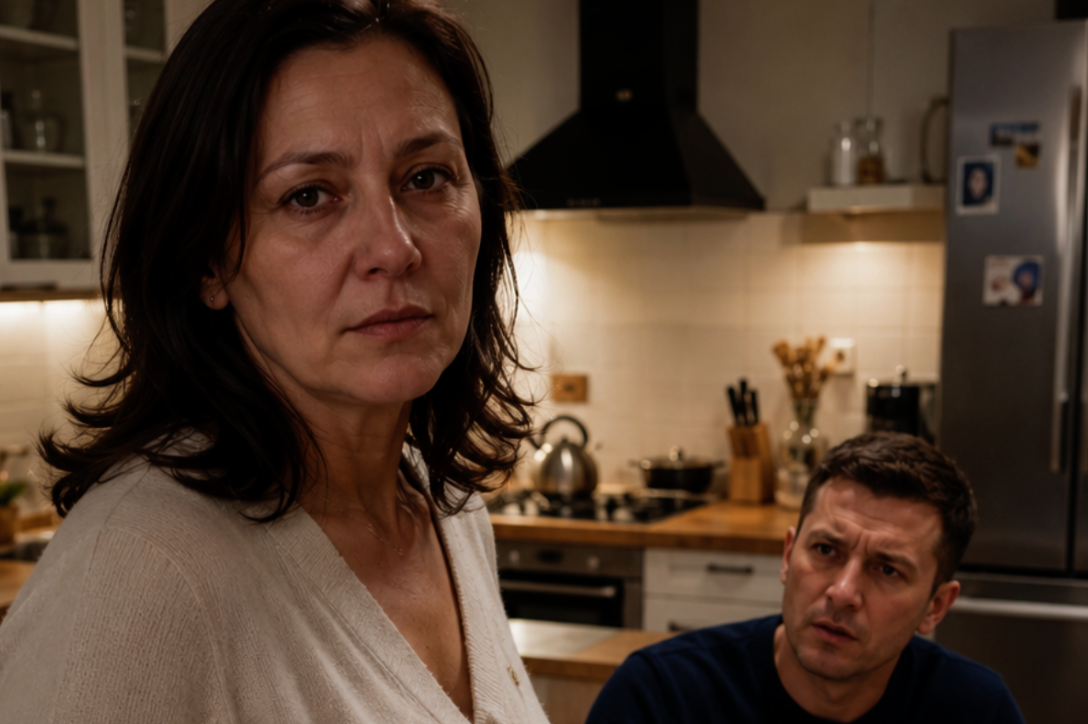
“Learn to cook like my mother,” my husband repeated for 15 years. On our anniversary, I served him Mom’s signature dish
“Again, not right.”
Oleg pushed the plate away. Cutlets with mashed potatoes. I spent two hours cooking after work. I had ground the meat myself, not bought ready-made mince.
“Mom makes it differently. How many times do I have to tell you?”
I had been hearing that phrase for fifteen years. Fifteen. We got married in 2011, and already on the second day, when I served him an omelet, he said, “Learn to cook like my mother.”
Back then, I smiled. I thought it would pass. He was young, attached to his mother, nothing serious.
It did not pass.
Silently, I took his plate and went to the kitchen. The cutlets went into the refrigerator—I would take them to work for myself tomorrow. The mashed potatoes went there too. Oleg was already rustling around in the hallway—I knew that sound. He had brought containers again.
“Mom sent some,” he said, entering the kitchen. “Stuffed cabbage rolls. And borscht. Heat it up for me.”
Four containers. Every week—four containers. I had even stopped counting when it started. Five years ago? Seven? At first it was one, then more and more. As if I were not a wife in this house, but a dishwasher for his mother’s dishes.
“Oleg, I made dinner.”
“I told you—it’s not right.”
He sat down at the table. Took out his phone. Waited while I heated up his mother’s stuffed cabbage rolls.
I looked at the back of his head. At the gray hair that had not been there fifteen years ago. At the confident back of a man who knew his wife would now heat everything up.
And I did heat it up.
I put the plate in front of him. Stuffed cabbage rolls. They looked ordinary, like everyone else’s. Oleg picked one up with his fork, took a bite—and closed his eyes.
“There. That is food. Learn.”
Learn. The word he had been repeating to me for fifteen years.
I went into the room. Angela, our daughter, was lying on the sofa with her laptop. Twenty-two years old, already grown up, finishing university this year.
“Mom,” she said without looking up. “How much longer?”
“How much longer what?”
“How much longer are you going to put up with this? Mom, have you looked at yourself in the mirror lately? You’re forty-seven. You have dark circles under your eyes. You come home from work and go straight to the stove. And for what? So he can wrinkle his nose?”
I did not answer. I sat down next to her. My daughter put her laptop aside and looked at me. She has my eyes. Gray, with a dark rim.
“I would have told him to go to hell a long time ago,” Angela said. “Honestly.”
“Anya, you’re twenty-two. You don’t understand yet.”
“No, you’re the one who doesn’t understand. I’ve lived in this house my whole life. I’ve heard his ‘learn like Mom’ since kindergarten. I thought it was normal until I went to visit Katya—her parents thank each other for dinner. They just say, ‘Thank you, it was delicious.’ That’s it. No comparisons with anyone’s mother. That was the first time I realized something was wrong in our house.”
I was silent. Something tightened in my chest. Like a spring. Small and tense. I felt it and became frightened.
“Mom,” Angela said very quietly. “If you don’t leave, you’ll be cooking for him your whole life. In ten years, in twenty. And it will still be ‘not like Mom’s.’ Do you understand?”
I understood. But at forty-seven, leaving is frightening. Where to? To whom? I had a job, I had my own apartment. But it was still frightening. Habit grows onto a person like skin.
I stroked Angela’s head and got up. I went to the kitchen to wash the dishes. Oleg had already finished his mother’s stuffed cabbage rolls and was sitting in the living room, scrolling through his phone. Of course, he had not cleared his plate. He never did—that was not a man’s job, as he liked to say.
A week later, my mother-in-law came herself.
Luiza Petrovna. Seventy-three years old, straight as a stick, gray hair in a chignon, always wearing red lipstick. She entered the apartment as if it were hers.
“Well, show me,” she said. “What are you cooking for my son here?”
I opened the refrigerator. There was a pot of soup inside. I had made it that morning—chicken soup with homemade noodles. I had rolled out the noodles myself after getting up at six in the morning.
My mother-in-law scooped some up with a ladle. Smelled it. Grimaced.
“And this is what you feed him?”
“Luiza Petrovna, it’s chicken soup. Ordinary soup.”
“Ordinary,” she repeated. “Exactly. Ordinary. And Oleg is used to something special.”
She poured my soup down the sink. Three liters. The noodles I had spent an hour rolling out disappeared into the drain in five seconds.
I stood and watched. Silently.
“I’ll teach you now,” Luiza Petrovna said. “Get the meat. We’ll make minced meat. Cutlets according to my recipe. You know, this recipe is sixty years old. From my mother.”
Sixty years. She said that every time.
I took out the mince. Luiza Petrovna gave orders: the onion this way, the bread that way, one egg, not two. I obeyed. I had been obeying for fifteen years. I knew it all by heart. And every time it turned out “wrong.”
“You have the wrong hands,” my mother-in-law said, taking the bowl from me. “Let me.”
She kneaded the mince with her dry old woman’s hands. With the look of someone performing a sacred ritual.
And then I noticed something.
On her left hand, on her wrist, there was a receipt. A small paper receipt stuck to her skin. It must have fallen out of her handbag when she took out her apron and stuck to her wet hand. Luiza Petrovna did not notice it.
I leaned closer, as if to help.
“You have something here.”
I carefully removed the receipt from her hand. Put it on the table. My mother-in-law did not even glance at it—she was busy with the mince.
But I did look.
The receipt was from a deli called “Tamara’s.” It was three bus stops from her house. I knew that shop—my friend and I sometimes stopped there for baked goods.
The receipt said: “Homemade stuffed cabbage rolls — 1 kg,” “Ukrainian borscht — 1 liter,” “Homestyle cutlets — 800 g.”
The date was yesterday.
Yesterday. The very same stuffed cabbage rolls Oleg had brought me “from Mom” the previous evening. The very same ones that had made him close his eyes. Learn.
I folded the receipt in half. Quietly. Put it into the pocket of my robe.
My heart was not pounding. It became steady and cold. As if some lever had clicked inside me.
“Luiza Petrovna,” I said calmly. “You know what? Let me do it myself. Please leave my kitchen.”
She froze with the minced meat in her hands.
“What?”
“Leave. I’ll cook myself.”
“You’re speaking to me like that?”
“Yes. I am speaking to you like that.”
She stared for a long time. Then she snorted, threw the mince into the bowl, wiped her hands on my towel, and went to the door.
“I’ll tell Oleg everything,” she threw over her shoulder.
“Tell him.”
The door slammed. I was left alone in the kitchen. With the mince. With the receipt in my pocket.
I sat down on a stool. And started laughing. Quietly, without sound, only my shoulders shaking. Angela came in, saw me, and became frightened.
“Mom, what’s wrong?”
I took out the receipt. Held it out to her. My daughter read it. Then read it again. She looked up at me—and also started laughing.
“Mom. Mom. Do you understand what this means?”
I understood.
Fifteen years of “learn to cook like my mother.” And his mother does not cook anything. His mother buys food from “Tamara’s” deli and pours it into her own pots.
That evening, Oleg came home from work gloomy. His mother had already called him.
“You kicked Mom out of the kitchen?”
“Yes.”
“Are you out of your mind?”
“No.”
He waited for something else. Explanations, excuses. But I was silent. I sat across from him and simply looked at him.
“Our anniversary is in two weeks,” Oleg said. “Fifteen years. I’m inviting Mom. And people from work. About ten people. And you will prepare the table. Understood? And EVERYTHING must be like Mom’s. Understood?”
“Understood,” I said.
And I smiled. For the first time that evening.
For two weeks, I prepared for the anniversary.
Just not the way Oleg thought.
The next day, I went to “Tamara’s” deli. It was an ordinary shop—small, clean, with a display case covering the whole wall. A woman about my age stood behind the counter in a white cap.
“Hello,” I said. “I need your stuffed cabbage rolls, borscht, and cutlets. And one more question. Does a certain Luiza Petrovna come here? Gray-haired, very straight posture, red lipstick?”
The woman smiled.
“Luiza Petrovna? Of course she comes. For about ten years now, I think. Every Wednesday and Friday. She always takes the same things—stuffed cabbage rolls, borscht, cutlets. Sometimes she orders jellied meat for holidays. A very regular customer.”
Ten years.
I stood at the counter. Breathed.
“Could you,” I said, “give me the recipes for those exact dishes she buys?”
“Our recipes are secret,” the woman smiled. “But I can sell them to you, if you want. Already prepared. For what date?”
I gave her the anniversary date. I ordered everything. Stuffed cabbage rolls, borscht, cutlets, jellied meat. Paid in advance. Eight thousand rubles. And I asked for one more thing: that they attach a receipt to every package with the date and the shop name.
“It’s for a gift,” I explained. “A surprise.”
The woman looked at me carefully. Then nodded. It seemed to me she understood something. But she did not ask questions.
And then the anniversary arrived.
All day, I pretended to cook. I rattled pots, rustled bags. Oleg looked into the kitchen once, sniffed the air—it smelled of fried onions. I had fried some on purpose, for the smell.
“Well, finally you’re trying,” he said. “Good girl.”
Good girl. After fifteen years—“good girl.”
The guests arrived at seven. Luiza Petrovna was first. In a blue dress, wearing a brooch, her lipstick fresh. She entered with the look of someone who had forgiven me. I smiled at her. Very sweetly.
“Luiza Petrovna, come in. I tried very hard today.”
“We’ll see, we’ll see.”
The guests sat down. Ten people—Oleg’s colleagues, his friend and his wife, my brother and his wife, and Angela. My daughter sat beside me. She knew everything. I had told her a week earlier. She only asked, “Have you really decided?” I answered, “I have.”
I began bringing out the dishes.
First, the jellied meat. Oleg tried it—and closed his eyes.
“Like Mom’s.”
Then the borscht. Oleg ate and shook his head.
“I can’t believe it. Rimma, you learned. Mom, she learned.”
Luiza Petrovna ate the borscht in silence. Something twitched in her face. She recognized the taste. Her own familiar taste from “Tamara’s” deli, known to her for years.
Then came the stuffed cabbage rolls. And the cutlets. Everything was the same—the taste of Luiza Petrovna. The guests praised the food. Oleg glowed. Luiza Petrovna grew paler and paler.
When the plates were empty, I stood up.
“My dear ones,” I said. “Today is Oleg’s and my anniversary. Fifteen years together. And I want to give a speech.”
Everyone became quiet. Oleg leaned back in his chair good-naturedly.
“For fifteen years,” I continued, “my husband has been saying one phrase to me. Every day. Every dinner. Do you know what it is? ‘Learn to cook like my mother.’”
The guests smiled. Someone chuckled kindly. Luiza Petrovna tensed.
“For fifteen years,” I said. “I counted. That is approximately sixteen thousand dinners. And not one of them was ‘like Mom’s.’ I tried. I took cooking courses. I bought books. I got up at six in the morning and rolled out noodles. Still wrong.”
Oleg frowned. He did not understand where I was going with this.
“And for the last three years,” I said, “Oleg has been bringing me ‘Mom’s’ food. Stuffed cabbage rolls, borscht, cutlets. So I could learn the taste. Four containers a week. For two years—that’s four hundred containers. For three—that’s six hundred.”
I picked up a small paper stack from the table. Held it up to the light.
“These,” I said, “are receipts. Receipts from ‘Tamara’s’ deli on Ozernaya Street. Today’s receipts. All the dishes you just ate, I brought from there. I did not cook them.”
The room became quiet. Very quiet.
“And this one,” I pulled one receipt from the stack, “is not from today. I found it on Luiza Petrovna’s wrist two weeks ago. She had come to teach me how to cook. To teach me.”
I placed the receipt on the table in front of my mother-in-law.
“Luiza Petrovna has been going to that deli for ten years. Every Wednesday and Friday. She buys stuffed cabbage rolls, borscht, and cutlets. Transfers them into her own pots. And gives them to her son with the phrase, ‘Mom makes it differently.’”
The guests stopped chewing. Oleg’s friend’s wife quietly put down her fork.
Oleg turned white. Opened his mouth. Closed it.
“Mom,” he finally said. “Is this true?”
Luiza Petrovna was silent. Her face had turned gray beneath the layer of powder. Her lipstick was the only thing still bright.
“Mom.”
“I…” she began. “I get tired.”
“For ten years?”
“Oleg, I get tired of cooking. I’m old.”
“For ten years you said you cooked it yourself. For ten years you taught Rimma. TEN YEARS.”
One of his colleagues coughed. Oleg’s friend stared at his plate. Angela, beside me, did not move.
I did not sit down. I stood at the head of the table.
“Oleg,” I said. “I want to say one more thing. For fifteen years, I asked you for one thing. Don’t criticize my food. Just don’t criticize it. You didn’t hear me once. Not once. Do you know how many times you told me ‘learn like Mom’? I didn’t count. But if it was three times a week, that’s two thousand three hundred times. Two thousand three hundred.”
I placed my napkin on the table.
“So this,” I swept my hand over the table, “is my anniversary gift to you. Fifteen years of ‘learn like Mom’—and now, finally, it is ‘like Mom’s.’ Exactly the same. The same shop, the same cook. Eat, darling. Learn.”
I turned and left the room.
Angela followed me.
In the bedroom, I sat on the edge of the bed. My hands were not shaking. I was surprised by that myself.
Angela closed the door. Leaned against it.
“Mom,” she said. “You were like a queen just now.”
I smiled. Voices came from the living room. At first quiet, then louder. I heard someone get up. Heard footsteps in the hallway. The front door slammed once, then again. The guests were leaving.
I sat and listened. Inside, it was empty and calm. As if after a long illness, the fever had finally broken.
“You know,” I said to Angela, “I thought I would be scared. But I’m not scared.”
“Then what are you feeling?”
I thought.
“Lightness.”
My daughter came over, sat beside me, and put her head on my shoulder. We probably had not sat like that for ten years. Since she started school—and became grown-up and independent.
“Mom, what if he kicks you out?”
“He won’t. This is my apartment. From Grandma. Didn’t I tell you?”
Angela turned her head.
“You didn’t.”
“Grandma transferred it to me before she died. I never told anyone. Not even Oleg. He thinks the apartment somehow came to both of us from our parents. He never clarified.”
“Mom.”
“What?”
“You’re freaking amazing.”
I laughed. Quietly. From the living room came the sound of a plate breaking. Someone had stayed behind. Oleg or his mother—I did not know.
There was a knock on the bedroom door. I did not open it.
“Rimma!” Oleg’s voice. “Open up! We need to talk!”
“Tomorrow,” I said through the door. “Today I’m tired. Fifteen years tired.”
He stood there. Tugged the handle. Left.
I undressed and lay down. Angela went to her room. I lay on my back and looked at the ceiling. Oleg was moving around somewhere in the apartment. Then I heard him make up the sofa in the living room for himself.
Good. Very good.
Two months have passed.
Oleg is still sleeping on the sofa. I have not kicked him out of the apartment—why should I? Let him decide what to do. We barely speak. In the morning, “Good morning.” In the evening, “Good night.” Sometimes he asks something about household matters. I answer briefly.
I do not cook for him. At all. For myself and Angela—yes. For him—no. Let him learn from his mother. Or from Tamara on Ozernaya Street—I gave him the phone number.
My mother-in-law does not call. Not once in two months. Oleg visits her alone on Saturdays. He comes back gloomy. I know she tells him what a bitch I am, how ungrateful I am, how I disgraced her in front of everyone.
Let her talk.
That woman from the deli, by the way, sent me a message a week after the anniversary. She simply wrote: “Luiza Petrovna doesn’t come anymore.” And a smiley face. I answered, “Thank you.” And also added a smiley face. A month later, I stopped by myself and bought a pie. We talked for about ten minutes. It turns out her name really is Tamara, and she has had that shop for twenty years. She says she has about five customers like Luiza Petrovna. They buy food and pass it off as their own. For some reason, that made me laugh.
Angela moved out. She rented a room from a friend. She said, “Mom, I’m with you, but I can’t breathe in this house.” I understand her. We call each other every day.
My friends are divided. Half say, “Rimma, well done, you should have done it long ago.” The other half say, “Why in front of guests? You could have done it privately, like a human being, without humiliating an old woman. You disgraced her in her old age, and that’s a sin.”
Maybe it is a sin.
I do not know. I know one thing: I sleep peacefully. For the first time in fifteen years. And when I eat my own chicken soup with homemade noodles, no one tells me that Mom makes it differently.
Yesterday, Oleg tried to talk. He came up to me in the kitchen and said:
“Rimma. Maybe you’ll forgive me?”
I looked at him.
“Oleg, I’m not angry. I just stopped.”
“Stopped what?”
“Trying.”
He stood there. Nodded. Left.
And I poured myself some tea and sat by the window. And I thought about this.
Did I go too far at the anniversary? It could have been done privately, quietly, without guests. I could have shown him the receipt and said, “This is how it is.” Without shame, without scandal. My mother-in-law would have apologized, Oleg would have understood, and we would have somehow gone on living.
Or maybe they would not have understood. Maybe they would have swallowed it and then again: “Learn like Mom.” Another fifteen years.
I do not know.
Girls, tell me honestly—did I go too far, or did I do the right thing? It could have been done quietly. But I did it in front of everyone. In front of his colleagues, my brother, the guests. I disgraced a seventy-three-year-old woman. Maybe now she is ashamed to even go out to the shop.
Or is fifteen years of patience also shameful? Only mine. The shame I stayed silent about.
What would you have done in my place?