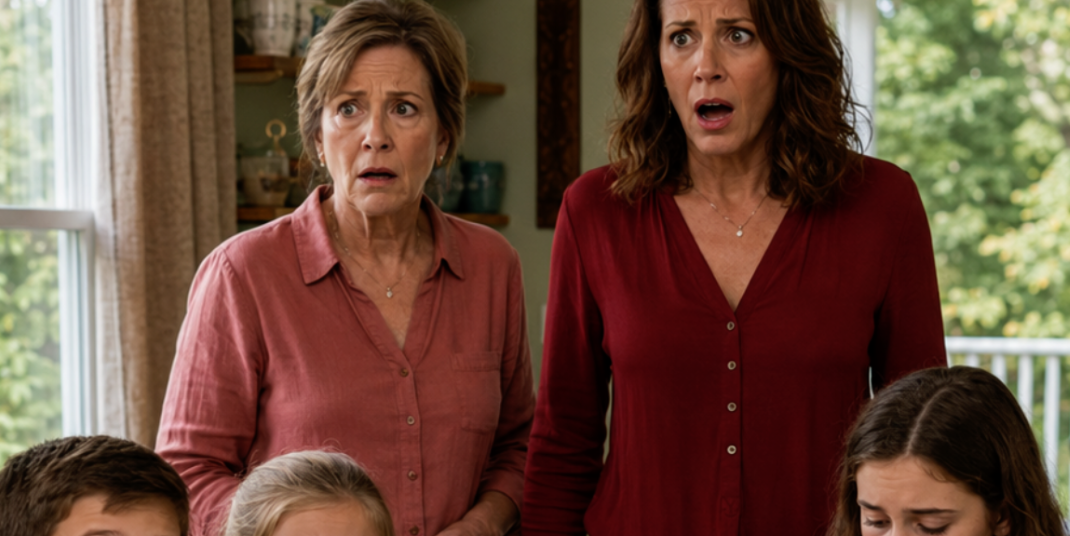
— I walk into the country house without warning, and they’re having lunch: pastries and grapes for the twins, and for my Alisa — oatmeal made with water, separately, on a little stool.
— Why don’t you pour it into a separate bowl for her too, Tamara Petrovna? Better yet, hang up a sign: “Not for outsiders,” I said from the doorway, clutching a children’s book so tightly that the corners of the cover dug into my palm.
The dining room became so quiet that I could hear some shelf rattling in the old refrigerator out on the veranda. The twins froze with their spoons in hand. Alisa was sitting on a low stool by the sideboard, not at the table, but as if she were on probation in someone else’s home. In front of her was a plate of oatmeal made with water. On the shared table were chicken, pastries, cucumber-and-dill salad, grapes in a vase, compote in a jug. A perfect oil painting: “Blood relatives eat, everyone else watches.”
“Marina,” Tamara Petrovna said dryly, not turning around right away, as if I were not the mistress of the situation but a late water delivery, “decent people warn others before arriving.”
“And indecent people divide children into categories?” I asked, walking into the room. “I’m just wondering which one of us has distinguished herself more today.”
“Marina,” my mother-in-law said with a strained smile, adjusting the napkin beside little Tyoma’s plate, “as always, you enter dramatically and completely out of place. We’re having lunch. Alisa has a special diet.”
“Special?” I repeated, walking up to my daughter. “So that’s what it’s called now? I’ll make a note. Chicken is for the family, oatmeal with water is for the attachment to the family.”
“Mom, I’m not hungry,” Alisa said quickly, without raising her eyes.
That “I’m not hungry” hurt more than anything else. The child is eight years old, and she has already learned to cover up someone else’s cruelty so as not to make anyone angry. She sits there, breaking up the lumps with her spoon like a grown woman at a family council where she has already been assigned the role of the guilty one.
“Alisa, please stand up,” I said quietly, holding out my hand.
“Sit down,” Tamara Petrovna snapped, and that was said not to me, but to the girl. “You haven’t finished your oatmeal.”
I slowly turned toward her.
“Did you just give my child an order?”
“I am trying to maintain order in this house,” my mother-in-law replied, pursing her lips. “And you, it seems, have decided to put on a circus. At least not in front of the children.”
“In front of the children?” I gave a bitter laugh. “No, Tamara Petrovna, the circus started without me. With a clown who sorts children by grade. One at the table, another in the corner. Very educational. Clearly, the school still hasn’t let you go.”
“Marina,” she said coldly, folding her arms across her chest, “there is no need for hysterics. I told the girl that sweets and baked goods are bad for her. She’s prone to gaining weight. And these two need a proper diet.”
“These two?” I nodded toward the twins. “So, if I translate from your ceremonial language into plain Russian, ‘these two’ are yours. And Alisa is just an add-on to the marriage?”
“Don’t twist my words,” Tamara Petrovna said quietly, and there was so much arrogance in that quiet tone that I wanted to open the window wider. “You understand perfectly well. There are things that cannot be canceled by a stamp in a passport or pretty speeches about love. Blood is blood.”
“Right,” I nodded. “And conscience, apparently, also depends on blood type.”
“Mom,” Sofiyka squeaked in fear, “why is Grandma angry?”
“Because Grandma thinks you can be smart and heartless at the same time,” I answered, not taking my eyes off my mother-in-law.
“Don’t you dare turn the children against me,” Tamara Petrovna raised her voice, and a silver spoon clinked against a plate. “I have done more for this family than you have in all these years. Who helped you with the down payment on the apartment? Who bought the furniture? Who sat with the twins while you were getting your hair and nails done?”
“My nails?” I even laughed. “Wonderful. Especially considering that at that time I was racing around the city, showing apartments to clients and covering the mortgage payment while your son was finding himself somewhere between a football chat and corporate parties.”
“Don’t you dare speak about Artyom like that,” she hissed.
“And don’t you dare speak to my daughter like that,” I cut her off.
I bent down to Alisa and put her jacket on over her house sweater. The girl’s fingers were trembling.
“Mom, can I take my book?” she whispered.
“You can take everything that belongs to you,” I said.
“You are not taking anything now,” Tamara Petrovna said sharply, stepping toward the door. “The twins are staying. They have a routine, fresh air, the country house. As if it weren’t enough, now you want to ruin the children’s weekend because of your hurt feelings.”
“Move away from the door,” I said calmly.
“No.”
“Tamara Petrovna,” I looked at her in a way I had never looked at her before, without wanting to be liked, without the polite mask, “move away. While I am still only asking.”
“Or what?” she narrowed her eyes. “Will you drag me aside with your hands? Go ahead, show the children what kind of mother you are.”
“You have already shown what kind of grandmother you are,” I said, and opened the door wider.
The twins exchanged glances. Little Tyoma, as always, was the first to sense what mattered.
“Mom, are we going home?” he asked, climbing down from his chair.
“Home,” I nodded.
“But I haven’t finished my pastry,” he said, confused.
“Will you wrap it for him?” I asked my mother-in-law with acid politeness. “Or are pastries also distributed strictly by pedigree?”
“You’re rude,” Tamara Petrovna breathed.
“And you’re a specialist in humiliating children. Everyone has their own talent.”
I packed the things quickly. On autopilot. Alisa’s backpack, Sonya’s sweater, Tyoma’s toy car, the tablet charger that, as luck would have it, is always found at the last possible moment. Inside, I was no longer shaking. On the contrary, everything had become cold and clear. That’s how it happens: while you doubt, you are afraid; once you understand who you are dealing with, they become the ones who should be afraid.
The children were silent in the car for about ten minutes. Then Sofiyka asked cautiously:
“Mom, does Grandma not love us anymore?”
“To love and to command are not the same thing,” I said, keeping my eyes on the road. “Some people confuse the two.”
“Why did they seat Alisa separately?” Tyoma spoke up.
I felt everything tighten in my chest.
“Because adults sometimes do nasty things and think children don’t understand anything,” I answered. “But you understood. And that is the main thing.”
“I wanted to give her my pastry,” Sonya said quietly. “But Grandma looked at me with those eyes… like a teacher when you’re chewing gum.”
“A very accurate comparison,” I said. “With that kind of tone, you could rent out a basement without saying a word.”
When we got home, Artyom was sitting in the kitchen in socks, scrolling through the news on his phone and eating my syrniki from yesterday without even warming them up. Men are sometimes amazingly calm at moments when their entire family structure is about to collapse. There he sits, dipping a syrnik into sour cream, while fate is already taking off its shoes at the door.
“Oh, you’re early,” he said. “Why didn’t you warn me you were going?”
“So I could make it in time for the beginning of the performance,” I replied, taking off the children’s jackets. “And I did. Front row, live sound.”
“What happened?” he frowned.
“I’ll tell you now. Children, go to your room. Alisa, take your book. Tyoma, don’t argue. Sonya, please, no cartoons for ten minutes.”
The children left. Artyom looked at me more attentively now.
“Marin, don’t stay silent like that. What happened?”
“Your mother fed my children lunch,” I said. “Two of them got chicken, pastries, and fruit. Alisa got oatmeal made with water. Separately. On a stool. And she didn’t just feed her — she explained to the child that delicacies are for those who have their blood in them.”
Artyom blinked. Then he put down his fork.
“Wait. What do you mean, separately?”
“I mean exactly that. Like in a cheap soap opera, only without the music. She also added that Alisa had no real rights there and shouldn’t dare complain to me, otherwise you would throw us out.”
“That can’t be true,” he said automatically.
That “that can’t be true” is a favorite male religion. Until he sees it himself, his wife must be retelling a horror movie. Even though his wife, by the way, is an observant person. Especially when it concerns her child.
“I used to think it couldn’t be true either,” I said. “Then I walked in and heard it. So now it’s your turn to be surprised not with words, but with action.”
“Marin,” he rubbed the bridge of his nose, “Mom, of course, can blurt out something inappropriate. She’s… she’s sharp. But for it to be exactly like that…”
“Not ‘for it to be like that,’ Artyom. Exactly like that. With the words, the tone, and complete confidence in her own righteousness. What are you going to do?”
“I’ll talk to her.”
“No,” I said. “You won’t talk. You’ll choose.”
He raised his head.
“What do you mean?”
“Simple. Either you admit right now that it was vile, and we stop any trips to her with the children. All the children. Or you start singing the usual song about ‘she’s an elderly person,’ ‘there’s no need for scandals,’ ‘we need to keep the peace,’ and then I understand that I have no one to count on.”
“Don’t exaggerate,” he said sharply. “She’s my mother.”
“And this is my daughter,” I replied. “And your children saw everything too. They were also taught who at the table is one of their own and who is just a spare.”
“There couldn’t have been that kind of intent,” he said stubbornly. “Maybe Alisa really shouldn’t have eaten that? Maybe Mom—”
“Shut up,” I said so quietly that he stopped. “Just shut up for one second and listen to how awful you sound right now. You are not asking how she feels. You are not asking if she cried. You are not asking why your wife is standing in front of you as white as a wall. You are looking for an excuse for your mother. Right away. Automatically. As if you had been practicing for a long time.”
He stood up.
“Don’t make me into a monster. I just don’t want to act rashly.”
“Rashly?” I smirked. “That is something all of you are very good at. First you spend years pretending everything is normal, and then you say, ‘Why so abruptly?’ A very convenient philosophy. For those who have never sat on a stool by the sideboard.”
“I raised her for five years!” Artyom said irritably. “I’m not a stranger to her!”
“Exactly. For five years you were her father. And today you had a chance to remain one. Right now. Use it before it expires.”
He turned away to the window and tapped his fingers on the windowsill.
“I won’t renounce my mother.”
“I wasn’t asking you to renounce her. I was asking you to protect a child. If those are the same thing to you, the problem is deeper than I thought.”
“So what do you want?” he turned sharply. “For me to stop speaking to her? Ban her from seeing the twins? Start a war? Do you know who wins from that? No one.”
“You’re wrong,” I said. “Alisa wins. For the first time, she gets a chance to live without fear.”
“You’re being dramatic.”
“And you’re being a coward.”
He turned red.
“Don’t you dare.”
“Courage is when a man stands between his child and injustice. Even if that injustice carries his surname. Everything else is domestic acrobatics.”
“Enough!” he roared. “Don’t lecture me. I’m tired, I have work, my head is spinning, and you barge in and demand that I immediately burn bridges!”
“No, Artyom,” I said. “I’m not burning them. Your mother set them on fire with oatmeal made with water.”
We were silent for about ten seconds. Then he said the thing after which something inside me finally sank to the bottom:
“You will not cut the twins off from her. They are her blood grandchildren.”
I looked at him and did not recognize him. Or rather, it was the opposite — I finally recognized him fully. Without holidays, repairs, trips to Lenta, without his habit of buying balloons for the children on Sundays. Only the naked meaning remained. Blood grandchildren. And the rest are what?
“That’s it,” I said. “You don’t have to continue.”
“What do you mean, that’s it?”
“That’s it. The marriage. The conversation. The illusion. Choose any word, the meaning is the same.”
He even smirked, not believing me.
“Are you going into drama again, packing a bag and waiting for me to run after you with flowers?”
“No,” I said. “I’m packing three bags. And I won’t be waiting for anything.”
“Marina, don’t put on a show.”
“Too late. The theater is closing. The audience is tired.”
I went into the bedroom and took out a suitcase. He followed me in.
“Are you serious?”
“More than.”
“And where will you go with three children?”
“Somewhere people don’t conduct a genetic examination for a pastry at the table.”
“Stop being sarcastic!” he grabbed the suitcase handle. “You have no right to take the twins away just because you quarreled with my mother!”
I pulled the handle back.
“I have the right to take my children away from an environment where they are taught to despise their sister. And I also have the right not to live with a man who excuses it.”
“I’m not excusing anything!”
“Then say one simple sentence. One. ‘My mother acted vilely, and I will not allow her near the children until she admits it.’ Go ahead. It’s no harder than ordering winter tires.”
He was silent.
“I see,” I nodded. “So it really is harder.”
An hour later I was sitting in a taxi with three children, two suitcases, a bag of toys, and the feeling that I was both nauseous and being released at the same time. Truth has a strange quality: first it breaks your breathing, and then suddenly it becomes easier. Not better — easier. As if you had been dragging a wardrobe alone, and now you had simply put it down on the floor.
I rented an apartment on the outskirts, in a new building near the station. Nothing fancy. A small kitchen, a slow elevator, and neighbors who, judging by the hammer drill, were in a constant creative search. But it had the main thing — silence without humiliation.
On the second evening, Alisa asked while sitting in the kitchen in cat socks:
“Mom, am I really extra?”
I nearly dropped my mug.
“Who told you such nonsense?”
“No one… It’s just, if I was separate, then…”
“Then some adults have a dusty wardrobe instead of a heart,” I said, crouching in front of her and taking her hands. “You are not extra. You are first. You are mine. You are Tyoma and Sonya’s sister. And if someone doesn’t understand that, it is their problem, not yours.”
She nodded, then quietly asked:
“And Artyom… who is he to us now?”
That was the hardest part. Because I didn’t want to lie, but I also didn’t want to chop the child’s past apart with an axe.
“He is an adult who should have been braver,” I said. “So far, he hasn’t managed it. We’ll see what happens next.”
A week later, Artyom came. With bags, as usual. A toy, fruit, marmalade. Men sometimes think marmalade is diplomacy.
“Can I come in?” he asked.
“Depends why,” I replied.
“To talk.”
“All right. But no props. Put the bags on the floor.”
He came in, looked around, grimaced at the cramped hallway, but said nothing. Progress already.
“I went to Mom’s,” he began. “She says you understood everything too… emotionally.”
“Fantastic,” I nodded. “A woman humiliates a child, and I’m the emotional one. Continue, this is very interesting.”
“Don’t start,” he said tiredly. “I came to make peace. Children should live with their father.”
“Then the father should grow up first.”
“Marina, enough. You understand that divorce is no joke. The apartment, child support, visitation arrangements… Are you ready to get into all that?”
“And are you?” I asked. “Or are you hoping I’ll get scared by the word ‘lawyer’ and come running back just so I don’t touch your family icon?”
“Don’t talk about Mom like that.”
“Why not? She was allowed to say far worse about my child.”
He sat down on a stool and, for the first time all this time, looked me straight in the eye.
“Fine. Yes. Mom went too far. Are you happy?”
“No,” I answered. “Because ‘went too far’ is when someone puts too much salt in the soup. When a child is told she is second-rate, it is called something else.”
“And what is it called?”
“Vileness. Cowardice. Psychological abuse. Choose whichever you like.”
He laughed nervously.
“Have you become a lawyer?”
“No. I finally stopped pretending to be a convenient fool.”
“All right,” he exhaled. “What do you want?”
“Separate living. Proper child support. Visitation with the twins according to a schedule. Without your mother. And you never raise your voice at Alisa again. Ever.”
“You’re setting conditions.”
“No, Artyom. I’m stating the new rules after the old ones were used by all of you as toilet paper.”
He jumped up.
“Who are you to dictate how I see my children?”
“A mother,” I said. “That is enough.”
He stepped closer and grabbed my elbow.
“You’re destroying everything yourself!”
I pulled my arm free.
“Touch me again and this conversation ends with the police. A very modern family story, don’t you think?”
He recoiled and looked at me as if he had noticed for the first time that I was no longer going to smooth over the sharp corners.
“You’ve changed,” he said.
“No,” I answered. “I simply stopped nodding along to all of you.”
The divorce was dirty, like shoes in March. No crime, no fantasy — just our kind of domestic dirt. First, endless messages: “Let’s do this amicably.” Then the phrase, “You’re turning the children against me.” Then threats that he would demand that the twins live with him because things were “more stable” with him. Then Tamara Petrovna suddenly joined in, deciding that since I was “ungrateful,” I needed to be disciplined officially.
But life has a sense of humor. While they were thinking up ways to put me in my place, Alisa one day said during a meeting with the psychologist, where we had been sent as part of the standard procedure:
“I don’t want to go to Grandma’s anymore. There, everything tasty is only for the real ones.”
After that, the psychologist looked at Artyom for a long time. Very calmly. With that kind of look after which adults start fidgeting more than children.
And the twins, those little traitors to someone else’s lie, when asked by the specialist whether they loved Grandma, honestly said:
“When she doesn’t make a face like she ate a lemon, then she’s okay.”
At that point, to be honest, my mother-in-law’s grand strategy sagged a little.
The court hearing passed without fireworks, but with a clear result. The children stayed with me. The visitation schedule with their father was established. The apartment bought during the marriage with a mortgage was divided according to all the boring but correct rules: shares, compensation, calculations. No romance, but legal. By the way, at that moment I understood one simple thing: when a woman stops hoping for “maybe it will work out” and starts reading documents, many people in the family become uncomfortable.
Six months later, we were already living differently. Not richly, but peacefully. In the evenings, I fried syrniki, Alisa did her homework at the table, and the twins argued about who would wash the apples. Sometimes it was hard, of course. Sometimes I sat in the kitchen at night and thought: why did I need all this in my forties, why couldn’t we just live and bake our pies? And then, in the morning, Sonya would say:
“Mom, the air in our home is kind.”
And I understood — that was why.
One day Artyom came for the twins earlier than scheduled. He stood in the entrance hall looking awkward, without bags, without marmalade. Almost human already.
“Can I come in for a minute?” he asked.
“For a minute, yes,” I said.
He came in and watched Alisa cutting salad, Tyoma spinning around near the stove, and Sonya learning a poem.
“You’re… doing all right,” he said.
“Unexpected, isn’t it?” I replied.
He was silent for a moment.
“I hardly speak to Mom anymore.”
“That’s your business.”
“She doesn’t understand why the children themselves don’t want to visit her.”
“And do you understand?”
He lowered his eyes.
“Now I do.”
I said nothing. Late insight is useful, but it is not magic. It does not rewind the stool by the sideboard, or the child’s “I’m not hungry,” or my night with the suitcases.
He shifted from foot to foot and suddenly said:
“Alisa… if she wants… I would like to talk to her someday.”
Without turning away from the cutting board, Alisa answered for herself:
“When people don’t believe you right away, it’s too late to talk afterward.”
The silence after that sentence was so complete that even the kettle decided not to whistle unnecessarily.
Artyom nodded. Without offense. He simply nodded.
“Fair,” he said.
And that, perhaps, was the most unexpected turn in the whole story. Not that he finally understood. Not that Tamara Petrovna was left alone with her flawless table and meaningless grandeur. But that my quiet, always cautious Alisa had suddenly grown into a person who could call things by their proper names. Without shouting. Without hysteria. Calmly. Like a verdict.
That evening, when the children were already getting ready for bed, she came up to me in the kitchen.
“Mom, I really didn’t call you back then. I was scared.”
“I know,” I said.
“But you came anyway.”
“Of course.”
“Why?”
I smiled and slid the plate with the last syrnik toward her.
“Because I’m a mother. Mothers, you know, have strange characters. We can tolerate nonsense, repairs, mortgages, and relatives with opinions for years. But if someone touches our child, our politeness suddenly runs out.”
Alisa laughed.
“Yours ran out beautifully.”
“No,” I said, pouring tea. “Beautifully is in the movies. Mine ran out in a country house, beside a plate of oatmeal. Just in time.”
Outside the window, March snow was falling again — the kind that melts during the day and by evening pretends it is in charge again. I looked at my children, at the ordinary kitchen, at the drying rack with laundry, at the mismatched cups, and suddenly I found the simple thought funny: how much strength I used to spend trying to look like a family, and how little it actually took to finally become one.
We no longer had a big house, a country place, a pretty picture, or a mother-in-law with royal posture. But we had a table where everyone sat together. And as it turned out, that is a greater luxury than any renovation.