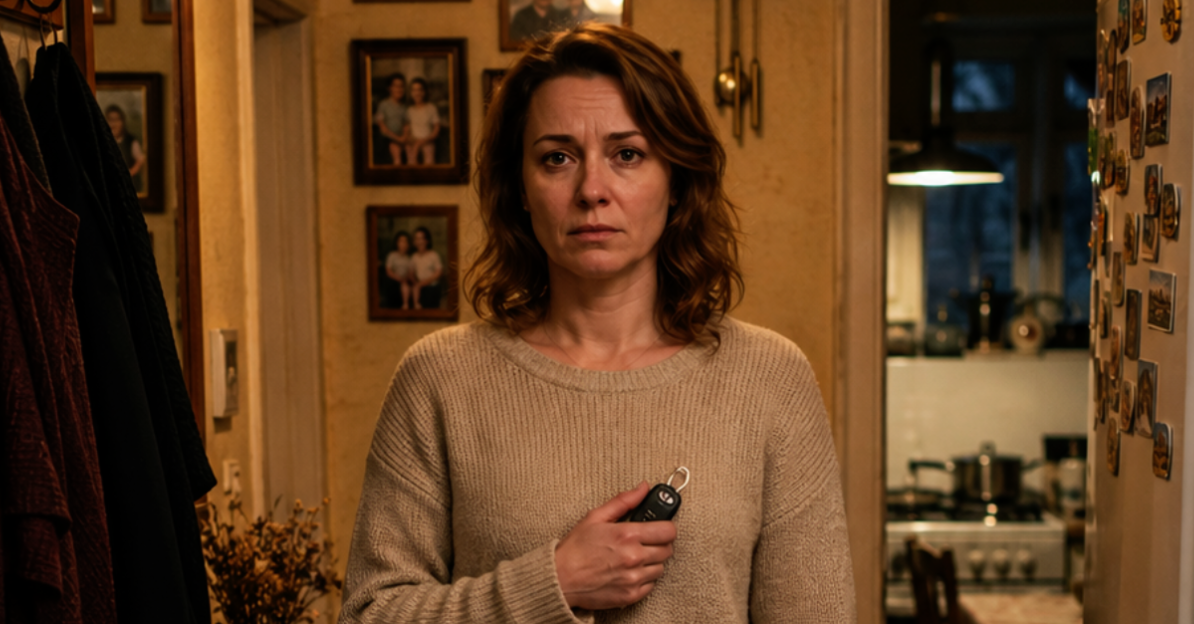
“Either you register my sister in your apartment, or pack your bags—Mom said there’s no place for you here,” my husband declared.
“Svet. Don’t you understand? Mom said either you register Ritka in your apartment, or you pack your things and move out. Mom would never give bad advice.”
My husband Anton was standing in the kitchen doorway. In his underwear and undershirt. With a cup of tea in his hand. And he was telling me, in all seriousness—me, the owner of the apartment—that I had to move out. Of my own apartment. If I did not register his sister there.
I slowly put down the knife. Turned off the tap. Wiped my hands on a towel. I turned to my husband.
“Anton. Repeat that, please. I want to make sure I heard you correctly.”
“Svet, you heard me. Mom called and said so. Ritka needs registration in Moscow. They’re offering her a good job, but they won’t hire her without Moscow registration. You have a two-room apartment. What, are you sorry? It’s just a piece of paper.”
“Anton. This is my apartment. Bought before our marriage. With the money my parents gave me for my wedding with my first husband—the wedding that never happened.”
“So what? You’re my wife.”
“So what? I’m a wife, not a public registration office for your relatives.”
“Svet, don’t show off. Just register her. Mom said it’s a family matter.”
“Anton. Listen to me very carefully. I will not register your sister. Never. That is final.”
Anton put the cup on the table. Sharply. Tea spilled onto the tablecloth. He did not notice.
“Then, Sveta, Mom said you should move out. Since you don’t respect our family, it means you have no place beside me.”
I looked at him. At the tea stain on my favorite tablecloth. At his stupid, stubborn, mommy-controlled face.
And I said calmly:
“Fine, Anton. I’ll move out.”
He was surprised. He thought I would start crying, begging, making peace. But I simply went to the bedroom. Took a suitcase out of the wardrobe.
My name is Sveta. I am thirty-two years old. I work as a marketer in an IT company, and I earn decent money—eighty-five thousand after taxes. I bought my apartment—a two-room place in a residential district of Moscow—five years ago. I was twenty-seven then and was preparing to marry a young man. We had been saving for an apartment together. My parents gave me four million for the wedding: “Start your new life properly.”
The wedding never happened. A month before the ceremony, the young man confessed that he had met “his destiny”—a yoga instructor named Snezhana. Back then, I almost ended it all, figuratively speaking. My parents said, “Don’t give the money back. Buy yourself an apartment. If you have your own place, you’ll have confidence.”
So I bought one. A one-room apartment in the Moscow region, plus my own savings—and it turned into a two-room apartment in Moscow. Small, on the eighth floor, but mine. Completely mine, registered in my name, before my marriage to Anton.
I met Anton two years after that failed wedding. He worked at our company too, in the department next door—as a programmer. Quiet, modest, good-looking. We dated for a year and a half, then got married. I told him right away, “Anton, the apartment is mine, bought before marriage. It is not joint property. I love you, but the apartment is my safety net. Do you understand?” Anton said, “Of course I understand, Svetik. I’m not claiming anything.”
He did not claim anything.
For one year.
And then his mother became active in his life.
My mother-in-law is Tamara Nikolaevna. She lives in Voronezh. Sixty-two years old, a former accountant, retired. Bossy, loud, convinced she knows everything better than everyone else.
At first, she was polite. She congratulated me on holidays and asked about my health. Then she started “interfering kindly”:
“Svetochka, when are you planning to have children? Antosha is already thirty-five; he’s not getting any younger.”
“Svetochka, why don’t you cook borscht for Antosha every day? He’s a man; he needs borscht.”
“Svetochka, is it true that you didn’t transfer the apartment to Anton? That’s strange for a family.”
I answered politely. To the last question, I said no, I had not transferred it and was not planning to. Tamara Nikolaevna fell silent. For a long time.
And then came the phone call. My mother-in-law called Anton. Anton came to me:
“Svet. Mom needs us to register Ritka in Moscow.”
Ritka—Anton’s younger sister—was twenty-four. She studied part-time in Voronezh, some kind of management degree. She worked as a sales assistant in a shopping center. Not married, no children. And then suddenly, she had “found a job in Moscow.” A good one. With Moscow registration.
What kind of job? No one could explain properly. “Some kind of manager,” “some kind of administrator.” No one knew the company name.
I sensed something was wrong. And I told Anton:
“Anton. I won’t register her. If she needs a job, let her get one. Hundreds of thousands of people work in Moscow with temporary registration. Temporary—not permanent registration in someone’s apartment. It’s completely legal.”
“Svet, well, you understand, the employer is like that…”
“Anton. I’ll tell you directly. I won’t register your sister because registration is not just a piece of paper. A registered person has the right to live in the apartment. They have the right to bring in their children, their husband. They have the right to refuse to deregister for years, and then I could only deregister her through court—a year at least, nerves, lawyers. And if she gets pregnant while registered, I would never be able to remove her and the child until the child comes of age. This is my apartment. I am the owner here. By the way, I didn’t even register you here permanently. We’ve lived together for five years, and you are temporarily registered with me, and everything is fine—you work normally. So no. Final answer—no.”
Anton went to call his mother.
And then the next morning, that conversation happened. The one about “move out, Mom said so.”
I packed my suitcase. Calmly. Without tears. Anton walked around me, puffing and grumbling:
“Svet, come on, are you serious?”
“Serious.”
“Svet, where are you going?”
“I’m going to my mother’s. I’ll stay with her.”
“Svet, think about it! Mom isn’t kicking you out; she just wants you to understand…”
“Anton. Wait. I don’t understand something. This is my apartment. I bought it. With my own money, before marriage. And I’m the one who has to move out? From my own apartment? On the orders of your mother from Voronezh?”
“Svet, well…”
“Anton. Did I understand you correctly? You’re suggesting that I move out, and you stay here?”
“Well, temporarily. Until you think things over.”
“I see.”
I silently took my suitcase. My jacket. My bag with my laptop and documents. I went to the door. And I said:
“Anton. I’m moving out. Of this apartment. Only I’m not the one moving out. You are.”
“What?!”
“That’s right. This is my apartment. You have temporary registration here, which ends in two months, and I will not extend it. I have spare keys, and I’m taking them with me now. And you—get out. Today. By eight in the evening. Otherwise, I’ll call the police.”
“You have no right!”
“I do. Every right. This is my property. You live here by my kind permission. And I am withdrawing that permission now. That’s it. Go to Voronezh, to your mother. She’s waiting for you. She’ll tell you how to ‘live properly.’”
Anton turned pale.
“Svet. You can’t.”
“I can. Test me if you want.”
I went to my own mother’s place. Alone. With a suitcase. Mom was surprised:
“Svetochka, what happened?”
“Mom. I’m here for a week. Just give me a week. I’m evicting Anton from the apartment. I want to live separately while he moves out, so I don’t ruin my nerves.”
Mom did not interrogate me. She poured tea. Said, “Stay as long as you need.”
I opened my laptop. And I started acting.
Here is what I did over the next three days:
I called my management company and confirmed that Anton was indeed temporarily registered at my place until the end of next month. They confirmed it—yes. Two months left.
I wrote Anton an official text message: “Anton, I inform you that the temporary registration at [my address] will not be extended. I ask you to vacate the apartment within 7 (seven) days. If you do not leave the premises within the specified period, I will be forced to contact the police to evict an unwanted resident, and also file a lawsuit to recognize that you have lost the right to use the residence. Svetlana.” I saved a screenshot.
I went to the local police officer. I filed a notification statement saying that there was a former temporarily registered resident in my apartment whom I was asking to leave my property. The officer—a normal guy—looked at the documents and nodded: “Everything is clean. If he doesn’t leave, call us; we’ll remove him. The law is one hundred percent on your side.”
I changed the lock. Or rather, I arranged with a locksmith to come in seven days and change it. If Anton moved out before then—great. If not, the three of us would come: me, the locksmith, and the local police officer.
I spoke with my parents. Dad said, “Svetik, you’re doing the right thing. Kick that infantile idiot out. And his mother too—let her sit in Voronezh with her daughter.” My dad is a man of few words, but precise.
On the fourth day, Anton called.
“Svet. Svet, let’s talk.”
“I’m listening.”
“Svet, are you really serious about the local officer?”
“Absolutely.”
“Svet, Mom didn’t mean…”
“Anton. I don’t care what your mother meant. I gave you a deadline—seven days. Four have already passed. Three remain. If you don’t move out in these three days, the officer and locksmith will come. You will be evicted officially. With a scandal. Possibly with a police report. Do you need that?”
“Svet, I’m your husband!”
“Anton. You are my husband by stamp. In reality, you are a weakling who follows his mother’s commands. Four days ago, with your own mouth, you told me to move out of my own apartment. Remember? ‘Mom said so.’ Well, Mom said so, and I decided differently. I am not moving out. You are. Your mother will approve—you’ll go to her now, and she’ll cook you borscht.”
“Svet, I don’t want to go to Voronezh!”
“I don’t care what you want, Anton. You made your choice. You chose your mother’s ultimatum. Now receive the result.”
“Svet, let me think!”
“You have three days left to think. Think.”
I hung up.
On the sixth day, Anton called again. This time he was crying.
“Svet, forgive me. I was an idiot. Mom wound me up. Forgive me, I love you, let’s go back to how things were.”
“Anton. Have you moved out?”
“Svet, give me one more week!”
“The seven days end tomorrow. If you’re still there tomorrow evening, the locksmith and the officer will come. This is not my decision; these are the consequences of your decision. Goodbye.”
On the seventh day, my mother-in-law called. Tamara Nikolaevna. I had almost forgotten what her voice sounded like.
“Svetlana! I don’t understand what you think you’re doing! This is family! Antosha is my son! You have no right to kick him out!”
“Hello, Tamara Nikolaevna.”
“Don’t you ‘hello’ me! Explain yourself!”
“Tamara Nikolaevna. This is my apartment. I am the owner. Anton lived there with my permission. I withdrew that permission. By law, I have every right. If you have any objections, go to court. But I warn you in advance—the court will side with me. It is property acquired before marriage. Under Article 36 of the Family Code, it is my personal property, not divisible by even a kopeck.”
“Svetlana! You… you…”
“Tamara Nikolaevna. And while we’re at it, I will not register Ritka, your daughter, either. Never. If you need Moscow registration for Rita, buy Rita an apartment in Moscow. Mine is not available.”
“How dare you!”
“I dare. Goodbye.”
I hung up. Put my phone on silent mode.
Anton moved out on the seventh day. In the evening. When I arrived with the officer and the locksmith, the apartment was empty. Anton had left the keys on the nightstand. And a note: “Forgive me. I was wrong.”
I took the note. Read it. Put it in the cupboard. As a keepsake. I changed the lock anyway. Just in case.
Six months passed.
I filed for divorce. Anton did not resist. We divorced without court—no children, no shared property, and the apartment was not mine—meaning, formally, not ours, only mine. Anton went to Voronezh. He lives with his mother. He works remotely—he’s a programmer, so it doesn’t matter where he works from.
Ritka’s Moscow job fell through. What kind of “job” it was, I do not know and do not want to know. I suspect it was just an excuse. My mother-in-law wanted to anchor her daughter in my apartment—and then slowly push me out. And get herself some Moscow square meters. For free.
It did not work.
I live alone. In my own two-room apartment. I live well—for the first time in five years, I can do whatever I want in my own home. I don’t have to report what I cooked, who called, what time I came home. No one calls and says, “Mom said so.”
Sometimes I meet friends, sometimes men too, though I’m looking carefully and not rushing. I started doing sports—I go to yoga now. That’s how fate joked with me: the very yoga that once started my “failed wedding.” At work, I got promoted—I became a senior marketer, plus fifteen thousand. I bought myself a trip to Turkey—the first time in many years I rested alone, for myself.
And you know, I understood one simple thing.
If you are the owner. If you have something of your own. Your own apartment, your own job, your own money—even if not much, but your own—no one, no one has the right to tell you, “Move out.” No one. Not a husband, not a mother-in-law, not parents.
What is yours is freedom.
What is yours is dignity.
What is yours means, “No, thank you, I’ll think about it,” instead of, “Yes, of course, whatever you say.”
And if you have something of your own, protect it. Never, never transfer it to your husband. To your mother-in-law. To “the family.” Never register strangers “just on paper.”
Because paper is never “just paper.”
Paper is always a door through which they will later enter.
And stay.
And who needs extra people in their own home when they never invited them?
Exactly.
No one.