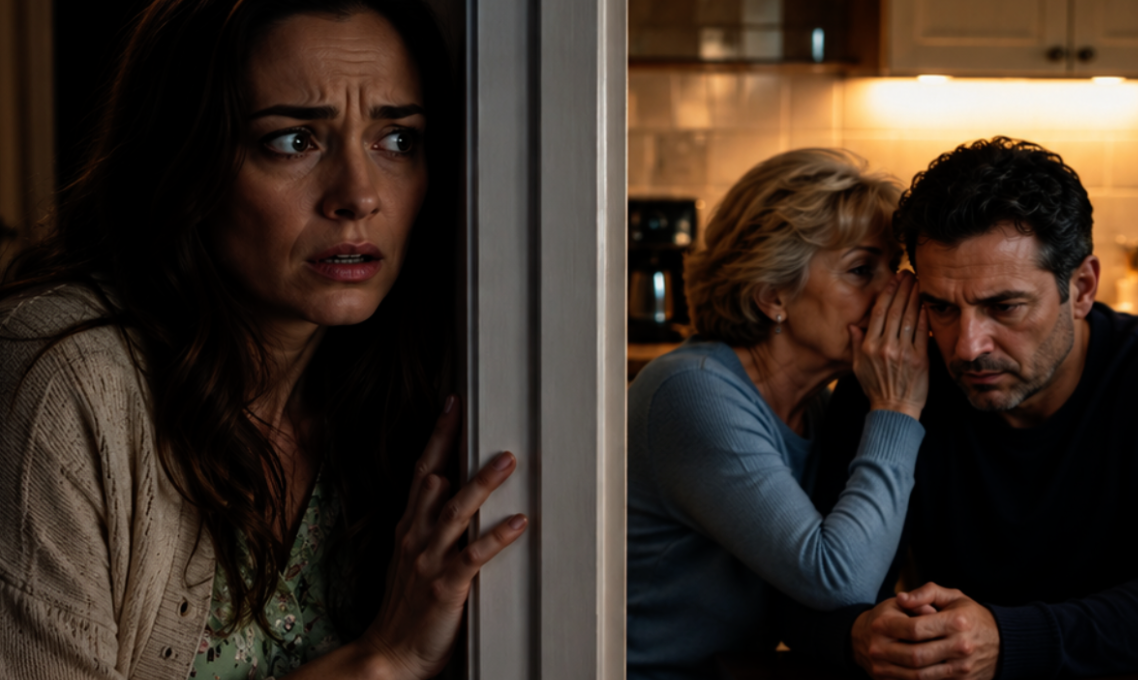
I got up at night to drink some water and froze in the hallway when I heard my mother-in-law whispering with my husband about my will.
“Don’t wake her,” my mother-in-law whispered. “If she hears about the will, everything will fall apart.”
I stood barefoot in the hallway, holding an empty glass. At night, the only sounds in the apartment were usually the refrigerator and the clicking of the old radiators, but now a thin strip of light stretched out from the kitchen, along with two voices.
“Mom, keep your voice down,” my husband said. “She’s asleep.”
“Exactly,” Tamara Pavlovna replied. “While she’s asleep, you have to decide. In the morning you’ll take her to the notary and tell her it’s just a routine paper, for order’s sake.”
The glass almost slipped from my fingers. I was fifty-four, and I had long stopped believing in fairy tales about sudden concern, but hearing something like that at night in my own apartment still felt cold.
“She’ll ask why,” Oleg said. “You know Lena.”
“You’ll tell her I’ve become worried about the family property,” my mother-in-law said almost gently. “She’s soft. Pressure her with conscience, with age, with the fact that you’re her husband.”
“And if she doesn’t want to?” Oleg asked.
“She will,” Tamara Pavlovna said. “You simply must not ask. You have to present her with a fact.”
I slowly placed the glass on the small cabinet so it would not clink. So it was not about my tiredness or concern for me. The dacha, bought with my money and registered in my name, had suddenly become their family property.
I returned to the bedroom as quietly as I could. I lay down on the edge of the bed and stared into the darkness. Oleg’s pillow beside me was empty. For the first time in many years, I did not start making excuses for him.
In the morning, he came into the room with a cup of tea, careful and far too attentive.
“Len, how are you feeling?” he asked. “Did you sleep all right?”
“All right,” I said and sat up. “Why?”
“Just asking. Yesterday you said you were tired.”
I had not said that. Yesterday, until evening, I had been sorting out payments for the dacha: the tax, electricity, the road contribution, and the receipt for a new pump. Oleg had passed by the table then, seen the folder, and immediately grown irritated.
“We need to go somewhere today,” he continued. “It won’t take long.”
“Where?” I asked.
“To the notary’s office,” he said, placing the cup on the bedside table. “Just to talk.”
I looked at the tea. Too sweet, the way he only made it when he wanted to soften me up.
“Talk about what?” I asked.
Oleg sat down beside me.
“Mom thinks it’s time we put the documents in order. So there won’t be any arguments over papers later.”
“What documents?” I looked straight into his face. “Say it directly.”
“Ordinary ones,” he said. “A will. A formality.”
“In whose name?” I asked.
He jerked his shoulder.
“In mine, of course. I’m your husband.”
“And why are you speaking as if this has already been decided?”
“Because it’s reasonable, Len. You and I have been together for eighteen years. What else do I have to prove to you?”
“And what does the dacha have to do with it?” I asked.
He turned his gaze toward the window.
“It has to do with the fact that it’s in your name, but we all use it.”
“Use it?” I repeated. “You were there a couple of times last summer.”
“Don’t start counting,” Oleg grimaced. “Not everything is measured by trips.”
Tamara Pavlovna appeared in the doorway. She was in a robe, her hair neatly styled, as if she had not been whispering in the kitchen at night, but had just come to congratulate us on something pleasant.
“Lenochka,” she said. “Don’t be offended, but in a family, the papers should be clear. Oleg is the man. He is the one responsible.”
“Responsible for what?” I asked.
“For the house, for the dacha, for the property,” she entered without being invited and adjusted the edge of the bedspread. “You are a kind woman, trusting. You’ll sign today, and everyone will feel calmer.”
“Everyone — who is that?” I shifted my gaze from her to Oleg. “The two of you?”
My mother-in-law smiled.
“Don’t nitpick. We’re not strangers.”
Oleg sighed, as if my single question had already exhausted him.
“Len, they’re expecting us at eleven,” he said. “I made the appointment in advance.”
“When did you make it?”
“Yesterday,” Oleg answered. “I wanted to spare you unnecessary fuss.”
“And the decision too?” I asked.
Tamara Pavlovna slapped her palm against the doorframe.
“You see, Oleg? I told you. She’ll dig her heels in now, and then we’ll be the ones blamed for not thinking about the future.”
“Tamara Pavlovna,” I said calmly, “I am thinking about the future. That is why I am not going anywhere today.”
Oleg stood up sharply.
“Lena, don’t make a scene.”
“I haven’t even started yet.”
He walked to the window, then came back.
“We have the contribution for the dacha road coming up soon, twenty-four thousand rubles,” he said. “You’ll say again that you’re paying alone, and then you’ll keep bringing it up.”
“Because I do pay alone.”
“There!” my mother-in-law raised a finger. “Do you hear that? She’s already dividing things. A family should not divide.”
“A family should not discuss my papers in whispers at night,” I said.
Both of them fell silent. Oleg was the first to find his voice.
“You misunderstood.”
“I was standing in the hallway with an empty glass,” I replied. “I understood enough.”
Tamara Pavlovna pressed her lips together.
“It isn’t nice to eavesdrop.”
“It isn’t nice to force someone to sign either,” I said.
“No one is forcing you,” Oleg spoke more softly. “We just wanted everything to be done properly.”
“Then show me exactly what has been prepared.”
“It’s just a standard form,” he said.
“Show me.”
He began to get angry. With him, it was always noticeable in his fingers: he would start rubbing his wedding ring with his thumb.
“The document is with Mom,” he finally said.
I turned to my mother-in-law.
“Show me.”
“First get dressed. We’ll go, and you can read everything there,” she said. “There’s no need to arrange an interrogation at home.”
“So I’m supposed to go and read it there, where you’ve already decided everything?”
“You should trust your husband,” Tamara Pavlovna replied. “Otherwise, why do you live with him?”
I stood up, threw on my robe, and went into the kitchen. Her bag was on the table, not fully closed. The corner of a folded sheet of paper was sticking out of the side pocket.
I did not touch someone else’s bag. I simply walked to the window and saw a business card from the notary’s office on the windowsill.
“Oleg,” I said, “you are going to call now and cancel the appointment.”
“I won’t.”
“Then I’ll call myself.”
He stepped toward me.
“Don’t do anything stupid.”
“The stupid thing has already been done. You made an appointment for me about a will without my consent.”
Tamara Pavlovna quickly took the business card from the windowsill and hid it in the pocket of her robe.
“Don’t make things up. It was an appointment for a consultation.”
“Then what are you afraid of?”
“Your character,” she said. “You’ve been quiet your whole life, but as soon as it comes to money, you turn to stone.”
I looked at her and, for the first time, saw not a strict elderly woman, but a person who had long ago decided that my boundaries could be pushed aside with an elbow. First it had been, “let me stay for a week,” then “give me the keys to the dacha,” then “transfer the shed to Oleg, it’ll be more convenient,” and now a will.
I took my phone and dialed my friend, who worked as a secretary at a legal consultation office. Not for advice, but to find out where I could quickly get an extract for the dacha and copies of payments.
“Nina, good morning,” I said. “Today I need to confirm that the dacha is registered in my name and that I am the one paying for it.”
Oleg grabbed the edge of the chair.
“Who are you calling?”
“Someone who knows how to read documents before signing them.”
“Lena, hang up.”
“I won’t.”
Nina was silent on the other end for a moment, then said:
“Come to me with the folder. And don’t sign anything until you’ve read it yourself.”
I ended the call. Tamara Pavlovna was now looking at me without a smile.
“Fine,” she said. “If you want to play at being independent, then play. Just don’t complain later when Oleg stops investing in your dacha.”
“He doesn’t invest in it now.”
“But my son worked there with his own hands.”
“He painted the fence for a short while,” I said. “And I bought the paint.”
Oleg flared up.
“There it is! You remember everything, every single can!”
“Because every single can was paid for with my card.”
I went to the bedroom to get dressed. Oleg followed me.
“Len, stop,” he said more quietly now. “Mom went too far, yes. But the idea is right. The dacha should remain in the family.”
“It is already in the family as long as I decide for myself whom to let in and which papers to sign.”
“You’re talking as if I’m a stranger.”
“And you’re behaving as if I should be the last to find out about my own will.”
He sat on the edge of the bed.
“I have a debt,” he said.
I buttoned my sweater and turned around.
“What debt?”
“Not a big one.”
“The amount.”
He was silent for a moment.
“Three hundred and sixty thousand rubles.”
So there it was, the real reason. Not concern for the future, not family order, not my mother-in-law’s anxiety. Oleg’s debt, which for some reason was supposed to cast its shadow over my dacha.
“Who do you owe?” I asked.
“An acquaintance. From work. I wanted to cover it, then it didn’t work out.”
“And how is a will supposed to help?”
“Mom’s acquaintance said that if the dacha is willed to me, it would be possible to arrange a loan with a written acknowledgment, because it would be clear that the property remains in the family.”
I froze with my sweater in my hands.
“You wanted to take on a new debt against my will?”
“Not against the will,” he jumped up. “Just to show that I have a prospect.”
“A prospect of getting my property?”
“You’re twisting everything.”
“No. I’m finally hearing it clearly.”
He rubbed his face.
“I got tangled up, Len,” he said. “I need to return at least part of it by the end of the month. Mom said she would help find someone.”
“Tamara Pavlovna knew?”
“Yes.”
“And I was supposed to sign without knowing anything?”
“We would have explained later.”
I laughed once, shortly, without joy.
“After the signature?”
He was silent.
I took my bag and the blue folder with the dacha papers. Inside were the purchase agreement for the plot, receipts for repairing the roof of the little house, electricity payments, and a receipt for forty-eight thousand rubles for the well, which Oleg called our joint improvement.
In the hallway, Tamara Pavlovna blocked my way.
“Where do you think you’re going?”
“To check the documents.”
“You want to drag family matters to strangers?”
“No. I want to take them back from strangers’ hands into my own.”
She lowered her voice.
“Lena, don’t be ungrateful,” she said. “Oleg has been beside you for so many years. A man should feel that his wife trusts him.”
“Trust is not signed in the morning after nighttime whispers.”
“You are destroying the family right now.”
“No,” I said. “I am stopping what you started without me.”
At the legal consultation office, Nina met me in the hallway, led me into a small office, and silently placed a glass of water in front of me. I told her everything plainly: the nighttime conversation, the appointment with the notary, Oleg’s debt, and the idea of a loan based on a future document.
“A will in itself does not transfer property now,” Nina said. “But if they are planning to show it to a third party as a future guarantee, that is already a bad sign.”
“What should I do?”
“First, cancel the appointment, if it’s in your name. Then request who made it and on what basis. And don’t give the originals to anyone.”
“The text seems to be with my mother-in-law.”
Nina looked at me carefully.
“Then don’t argue at home without witnesses,” she said. “First, document that you gave no instructions.”
She helped me draft a short statement for the notary’s office. We went there together, because I suddenly understood: if I went alone, Oleg and Tamara Pavlovna would again start pressuring me with words about family.
At the office, the administrator found the appointment and frowned.
“There is indeed a consultation in your name today,” she said. “A man made the appointment and introduced himself as your husband.”
“Did he have the right to make an appointment for me without my consent?”
“He could make an appointment for a consultation, but any actions can only be done with your personal consent.”
“Did he mention a will?”
The administrator lowered her eyes to the register.
“The topic is listed as: preparation of a will for a plot and house.”
I felt the cold inside me again, but now that cold kept me steady.
“I refuse the consultation,” I said. “And I ask you to note that I gave no instructions to prepare any text.”
Nina pushed a pen toward me. I wrote the statement. The administrator stamped a mark on the copy, and that was the first real paper in my favor.
But when we stepped outside, my phone rang almost immediately. Oleg spoke sharply, without even saying hello.
“Why did you go to the notary without me?”
“Because the appointment was in my name.”
“Mom is crying,” he said. “You humiliated her.”
“She was preparing my will behind my back.”
“She wanted to help me!”
“You just said everything yourself.”
He breathed heavily.
“Listen carefully,” Oleg said. “If you start running around to people now, I’ll say the dacha was bought with joint money.”
“You don’t have any documents proving that.”
“But I have witnesses who saw that I worked there and invested in it.”
“Painting a fence and rare visits do not make you an owner.”
“You’ll regret this conversation.”
I ended the call and looked at Nina.
“Here comes the second round,” she said. “They haven’t stopped.”
I did not go home right away. First, I went to the bank and requested a statement for payments related to the plot and the house. Then, at a copy center, I made copies of all the receipts in the folder. Some had faded, but the amounts could still be read.
By evening, I returned home with a thick folder. The apartment smelled of fried onions, but the kitchen felt not cozy, but cramped with someone else’s tension. Tamara Pavlovna was sitting at the table, and in front of her lay that same folded sheet.
“Well, did you get enough running around done?” she asked. “Can we talk now like adult women?”
“We can,” I said and sat down opposite her. “Show me the sheet.”
She pressed her palm against the paper.
“It’s not a sheet. It’s a draft.”
“All the more reason to show me.”
Oleg was standing by the window.
“Len, don’t turn this into a trial,” he said.
“I am not turning it into a trial. I am reading what you wanted me to sign.”
My mother-in-law slowly unfolded the paper and turned it toward me. The text was neatly typed. It said that I was leaving the dacha plot and house to Oleg in my will.
Not a single word that this was my personal decision. Not the slightest trace of doubt. Only a ready-made will that had already been invented for me.
“Who wrote this?” I asked.
“An acquaintance suggested the form,” Tamara Pavlovna lifted her chin. “There is nothing criminal about it.”
“Does this acquaintance know that I never asked for it?”
“She doesn’t need to know that.”
“And do I need to know about Oleg’s debt?”
Oleg turned sharply.
“Don’t drag Mom into this.”
“She is already in it,” I said. “She brought the draft.”
Tamara Pavlovna stood up.
“I brought a way out,” she said. “You could have helped your husband, but instead you’re dragging papers through strangers’ offices.”
I took out the bank statement, copies of the receipts, and the statement with the stamp from the notary’s office. I placed everything on the table next to the draft.
“Here are my papers,” I said. “The plot was bought from my account. The well was paid for by me. Contributions and taxes were paid by me. The appointment was canceled by me. I gave no instructions for a will.”
Oleg looked at the folder as if it had appeared by itself and was now making it difficult for him to breathe.
“You prepared everything in advance,” he said.
“No. I prepared it after you prepared me in advance.”
Tamara Pavlovna took the draft from the table, but I covered it with my palm.
“Leave it.”
“It’s mine.”
“It is a text about my property, prepared without my consent. It stays with me.”
“Don’t you dare,” she said. “You don’t understand what kind of people are waiting for an answer.”
“What people?”
Oleg closed his eyes. My mother-in-law realized she had said too much.
“No one is waiting,” she said quickly. “I was speaking figuratively.”
“No,” I replied. “Now speak plainly.”
Oleg sat down on a chair.
“Mom’s acquaintance was ready to give me money if he saw that the dacha would later be registered to me,” he said. “He said he wouldn’t take the risk without certainty.”
“And you decided to make that certainty out of my will.”
“I was going to pay back the debt,” Oleg slapped his palm on the table, then immediately withdrew his hand. “I wasn’t going to take the dacha from you.”
“Then why did I find out about it at night in the hallway?”
He did not answer.
That was when everything fell into place. It did not become completely easier, nor finally calm, but it became clear. The draft, the notary appointment, the debt, the man waiting for confirmation, and my dacha as future bait for someone else’s loan.
“Tomorrow you will tell that acquaintance that there will be no documents,” I said. “In front of me.”
“Lena, don’t pressure me.”
“You tried to pressure me with a will. Now I demand clarity.”
Tamara Pavlovna smirked.
“She demands,” my mother-in-law said. “Oleg, don’t listen. She’s your wife, not your boss.”
“No,” I said. “Today I am the owner of my documents.”
My mother-in-law was the first to fall silent. Oleg sat with his shoulders lowered. Suddenly, in the kitchen, the sound of the dripping faucet became audible.
“If you don’t call him in front of me tomorrow,” I continued, “I will personally hand over a copy of the statement and the draft to people who will explain why someone else’s property cannot be used in conversations about a loan.”
“You would turn me in?” Oleg asked.
“I will protect myself.”
He looked at his mother, but she no longer looked confident. All her strength had rested on the idea that I was supposed to be quiet, convenient, and grateful. Without that, she did not know what voice to use.
In the morning, Oleg came into the kitchen with his phone by himself. Tamara Pavlovna came out of the room after him, but I stopped her at the door.
“You will be present silently,” I said. “Yesterday you already said enough.”
She wanted to answer, but Oleg raised his hand.
“Mom, enough.”
It was the first word he had said not against me.
He dialed the number and turned on the speakerphone. A man’s voice answered quickly.
“Well? Will there be a document?”
Oleg swallowed.
“No,” he said. “There will be no will. I have no right to promise my wife’s dacha.”
“Did you understand that before?”
“I understand it now.”
“Then find the money yourself.”
“I will,” Oleg said. “But without her property.”
I did not interfere. It was important for me to hear exactly that: without her property.
When the call ended, Tamara Pavlovna heavily lowered herself onto a chair.
“Are you satisfied?” she asked. “Now my son will be left with his debt.”
“Your son will be left with his own debt,” I said. “Those are different things.”
“You are his wife.”
“I am not collateral.”
Oleg raised his head. His face showed shame, anger, and emptiness all at once.
“Lena, I ruined everything.”
“Yes.”
“Can I fix it?”
“You’ll start by packing your mother’s things,” I said. “She is going home today.”
Tamara Pavlovna straightened.
“You’re throwing me out?”
“I am returning my kitchen, my table, and my documents to myself.”
“Oleg!” she turned to her son. “You’ll allow this?”
He was silent for a long time. Then he said:
“Mom, go home.”
My mother-in-law looked at him as if, for the first time, she had seen an adult man instead of an obedient son. Then she stood up and went to the room to pack her bag.
While she folded her robe, scarf, and comb, I took a small metal box from the cupboard. It used to hold threads, buttons, and old keys to the dacha shed.
I took everything out onto the table and placed inside the draft of the will, the copy of the refusal of the notary appointment, the bank statement, and the receipts. Oleg watched silently.
“I will not justify myself to your mother,” I said. “And I won’t justify myself to you every day either. If you want to stay, you will deal with your debt yourself, without my papers, without my dacha, and without nighttime advice.”
“And what if I can’t manage?” he asked.
“Then at least don’t drag me down with you.”
My mother-in-law came out into the hallway with her bag. At the threshold, she stopped.
“You will remember my words one day, Lena.”
“I will,” I said. “Especially the ones I heard at night.”
The door closed behind her. Not loudly, without a scene, but the apartment suddenly felt more spacious.
I took my phone and called the chairwoman of the dacha association.
“Maria Stepanovna, this is Elena Krylova, the plot near the birch alley. From today on, please do not issue any documents related to my plot to anyone, and do not let anyone into the house without my personal call. Even if it is my husband.”
“Understood, Elena,” she replied. “I’ll make a note of it.”
Then I opened the kitchen table drawer, took out the spare dacha key, and removed Oleg’s keychain from it. The thought was brief: a will should not begin with someone else’s whispering.
I placed the key in the metal box on top of the draft and closed the lid. After that, I sat down at the table where, during the night, they had tried to decide my will without me, and for the first time in twenty-four hours, I calmly drank water from that same glass.
Now this family knew: my signature appears only where my voice is heard.
Would you forgive your husband if he discussed your will behind your back?