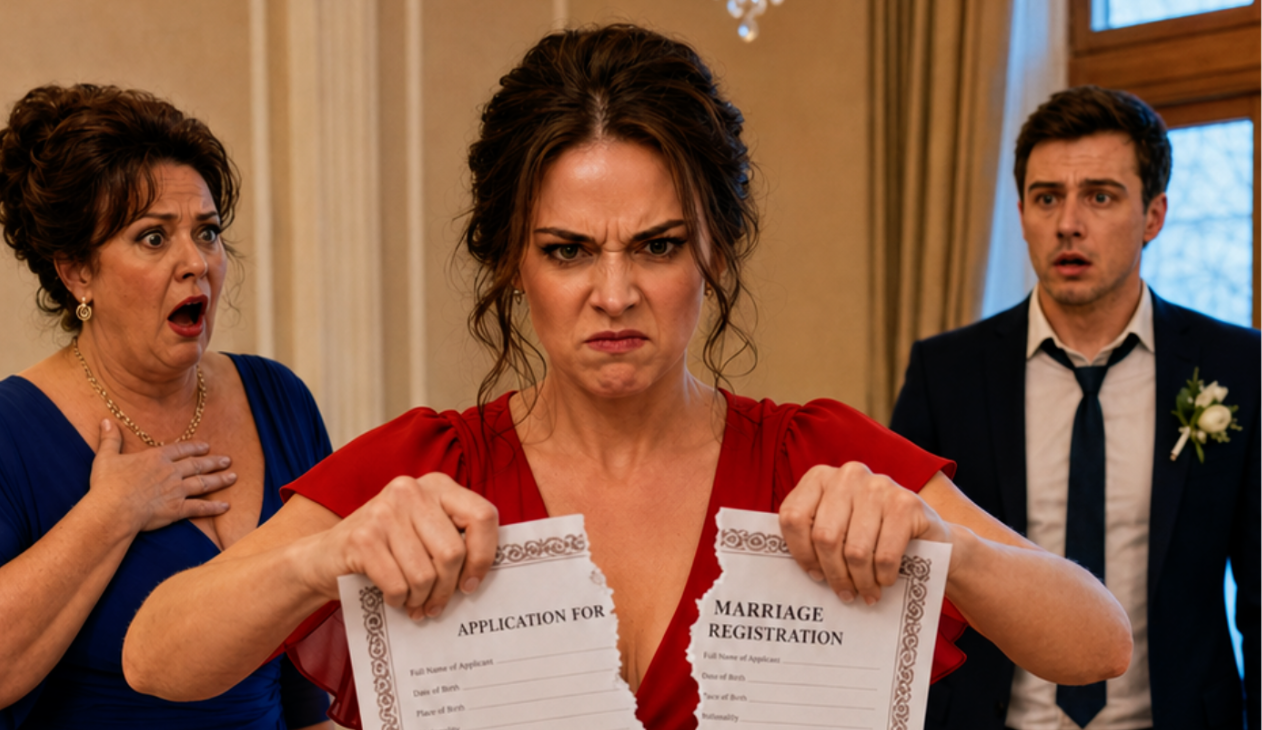
I Tore Up the Marriage Registration Application Right in Front of Her. After What I Said, My Fiance Turned Pale
Outside the window, the wind drove dry, brittle leaves across the yard, scraping them over the paving stones as though someone invisible were trying to get into the house. Elena stood at the kitchen window, watching the autumn dance and feeling a dull, persistent irritation growing inside her.
It was unlike her. Normally, after fifteen years of working as a pharmacist, she was known for her enviable calm and her ability to put everything neatly in order—like medicines in a pharmacy cabinet. But over the past two months, her previously measured and understandable life had descended into chaos.
The cause of the chaos was not the weather or even the approaching wedding.
The cause was Nadezhda Viktorovna.
Goulash—Anton’s favorite dish—was quietly simmering on the stove. Elena had deliberately left work early so she would have enough time to prepare dinner before her fiancé and his mother arrived.
Another “family meeting” was scheduled for that evening.
The sound of an engine near the gate made Elena flinch. She adjusted her apron, took a deep breath, forced a polite smile onto her face, and went to open the door.
“Lenochka, hello, my dear!” Nadezhda Viktorovna swept into the hallway, carrying an enormous cake in a plastic container before her like a banner. “Antosha and I decided not to be late. The traffic was dreadful today, but I told my son, ‘You mustn’t keep the bride waiting!’”
Anton, a tall, slightly stooped thirty-two-year-old man, followed her inside with an apologetic smile. He always smiled like that in his mother’s presence, as though he were apologizing for the very fact of his existence.
“Hi, Lena.” He kissed her on the cheek. His lips were cold. “Something smells delicious.”
“It’s goulash,” Elena said as she took the cake from her future mother-in-law. The container was sticky.
“Meat again?” Nadezhda Viktorovna threw her hands up theatrically without taking off her coat. “Lenochka, I’ve already told you that Anton shouldn’t eat such heavy food at night. He needs vegetables and steamed cutlets. He had gastritis in the fifth grade!”
“Anton’s stomach is perfectly fine, Nadezhda Viktorovna. Come in and wash your hands.”
Dinner began in tense silence, broken only by the clinking of forks.
Elena loved this kitchen. She had inherited the house from her grandfather, a geology professor. It was a sturdy brick building with high ceilings and oak parquet flooring, which Elena carefully maintained and polished with wax twice a year. Every object here had its own place and its own history.
But whenever Nadezhda Viktorovna appeared, the space seemed to shrink. The woman filled everything with her presence: her loud voice, the scent of her sweet, heavy perfume, and her endless advice occupied every cubic inch of air.
“I’ve been thinking,” Nadezhda Viktorovna began, pushing away her plate of half-eaten goulash. “The wedding is in three weeks, and the question of where the guests will stay still hasn’t been resolved.”
“But we already agreed,” Elena gently objected. “My relatives will stay at a hotel in the city center. I’ve already booked their rooms. Yours will stay at your apartment.”
“At my apartment?” Her future mother-in-law’s eyebrows shot upward. “In my tiny two-room Khrushchev-era flat? Lena, are you joking? Aunt Klava will barely have room to turn around, and she has bad legs. No, that won’t work. We’ll have to accommodate them here.”
Elena gripped her fork so tightly that her fingers turned white, but she immediately relaxed her hand.
She must not show emotion.
“Nadezhda Viktorovna, we only have one guest bedroom here. The sofa in my grandfather’s study doesn’t fold out. Where are we supposed to put five people? On the floor?”
“Why would we put them on the floor?” The woman gave her that particular smile that always sent a chill down Elena’s spine. “We can clear out the study. All those old cabinets, stones, and books—they’re nothing but dust collectors! We’ll move them into the garage and put folding beds in there. At the same time, we’ll free up space for a nursery in the future.”
“The study will remain a study,” Elena said more harshly than she had intended. “That is a mineral collection my grandfather spent forty years assembling. I’m not moving it into a damp garage for the sake of two nights.”
Anton, who had been silently chewing bread until then, raised his head.
“Lena, Mom is right, honestly. Those shelves take up a lot of space. We’re going to be a family now. We need to make compromises.”
Elena looked at her fiancé. She saw no support in his eyes—only a desire to please his mother and end the unpleasant conversation as quickly as possible.
“The hotel is the compromise, Anton. I’m paying for it myself. It’s convenient for everyone.”
Nadezhda Viktorovna pursed her lips, and for a moment her face resembled a mask of wounded virtue.
“So that’s how it is. I come to you with all my heart, bring you a cake, think about my future grandchildren, and you show me the door. You’re very proud, Lena. Be careful—pride is a sin. It’s true that my apartment is small and stuffy. My heart has been acting up recently. Sometimes I can hardly breathe…”
She took a handkerchief out of her handbag and dabbed her completely dry eyes.
“Mom, don’t start,” Anton said weakly.
“Fine, the subject is closed,” his mother said sharply, instantly changing her tone from plaintive to businesslike. “There’s something more serious we need to discuss. Anton, take out the documents.”
Elena tensed.
“What documents?”
Anton began fumbling around. He reached into the briefcase sitting on the chair and pulled out a thin folder.
“Here’s the thing, Lena…” He avoided her eyes as he played with the folder’s clasp. “Mom found a good lawyer. We thought… well, times are unstable right now. Basically, this is a draft prenuptial agreement. And there are a few other things concerning the house.”
Elena took the folder. The first few pages were standard, but what came afterward made her eyebrows rise.
“‘The wife gives her consent to the permanent residence registration of Nadezhda Viktorovna Karelina at the address…’” Elena read aloud before looking up. “Nadezhda Viktorovna, you want to register your permanent residence here? In my house?”
Her future mother-in-law smiled broadly and openly into her face.
“Sweetheart, it’s just a formality!” she chirped. “I’m selling my apartment so I can invest in your family business. Anton wanted to open his own IT company, remember? I need to be officially registered somewhere while the sale is going through and I’m looking for another place to live. I can’t become homeless, after all! I’ll simply be registered here, and I’ll stay with you temporarily in that guest room. I’ll even help around the house.”
Elena turned her gaze toward Anton.
“What apartment? What business? You never told me anything about this. You work as a systems administrator at a bank.”
“Well… I thought it would be a surprise.” Anton blushed and began speaking faster, with an unusual excitement in his voice. “Mom came up with a brilliant idea! A start-up. I already have a team, and an investor is showing interest. But we need initial capital to rent an office and buy equipment. We’ll sell Mom’s apartment and use the money as capital! While I’m getting the business off the ground, she’ll stay with us. It makes perfect sense. And the residence registration… you can hardly even open a bank account without one these days because of all the checks. It’s for the business.”
Elena placed the folder on the table and covered it with her palm.
“No.”
A ringing silence settled over the kitchen. Even the refrigerator seemed to stop humming.
“What do you mean, ‘no’?” Nadezhda Viktorovna’s voice turned icy.
“I mean exactly that. There will be no residence registration in my house. And there will be no business financed by selling your mother’s only home. Anton, this is madness. You’ll go bankrupt, and your mother will be left on the street. Unless…”
She stopped, struck by a sudden realization.
“Unless she isn’t planning to look for another home. You’re planning for her to stay here. Permanently.”
“How dare you speak to your elders that way?” her future mother-in-law exploded. “I’m doing this for my son! And you resent giving up a few square meters? Are you afraid we’ll take a corner of your precious house away from you? I don’t need your old house! It’s full of drafts!”
She stood and angrily tugged her jacket into place.
“Come on, Anton. We’re not welcome here. Let your fiancée think about her behavior. There’s still time before the wedding. Perhaps she’ll come to her senses.”
Anton looked helplessly at Elena and then at his mother. As if he were attached to an invisible string, he followed her toward the door.
“Lena, why are you being so harsh?” he whispered when they reached the doorway. “This is an opportunity! I can escape that miserable company and become my own boss! Mom believes in me.”
“Helping someone lose her home isn’t belief. It’s recklessness. Go, Anton. I need to be alone.”
When the door closed behind them, Elena did not cry. She poured herself a glass of cold water and drank it in one gulp. Her hands were trembling, but her mind was clear.
The intuition that had repeatedly saved her while working with complicated prescriptions was now screaming like a siren:
“Danger! Don’t trust them!”
The next three days passed in a vacuum.
Anton sent her messages:
“Mom is offended.”
“You need to apologize.”
“You don’t understand the possibilities.”
Elena replied with only a few words. She needed time.
On Thursday, she was supposed to travel to a pharmacists’ conference in a neighboring city. That morning, however, she learned that the scheduled speaker had fallen ill and the event had been moved online.
Elena stayed home and decided to devote the day to a thorough cleaning—the best remedy for disturbing thoughts.
She washed the first-floor windows and laundered all the curtains. By lunchtime, tired but satisfied, she went up to the attic to find the old winter covers for the garden furniture.
The attic window was slightly open.
From outside came the sound of an approaching car. Elena cautiously looked out. Anton’s familiar gray sedan stopped by the gate.
But he was supposed to be at work.
Nadezhda Viktorovna climbed out of the car, followed by an unfamiliar man carrying a tape measure and a tablet.
Elena froze. Her heart struck heavily against her ribs.
Why were they here?
Anton had his own keys, but why would he bring a stranger into the house without warning her?
She heard the front door open. The voices downstairs were muffled, but the old ventilation shaft ran through the entire house. From the attic, the sound carried perfectly if she stood near the chimney.
Elena quietly approached the brickwork around the pipe.
“…we’ll demolish this partition here,” Nadezhda Viktorovna said with the confident, authoritative voice of a homeowner. “We’ll combine the kitchen with the living room. I can’t stand these little boxes.”
“You can’t touch the load-bearing wall, but the opening can be widened,” the unfamiliar man replied.
“Excellent. And this study will become my bedroom. The windows face the garden, so it’s quiet.”
“Mom, I’m not sure we should be doing this now,” Anton said nervously. “Lena could come back, or the neighbors might see us.”
“Oh, stop it! She’s away at a conference in another city. We’ll tell the neighbors we’re preparing a surprise. More importantly, did you arrange everything with the lawyer? Are we going there after the registry office?”
“Yes, it’s arranged. But Mom, she’ll read whatever she signs…”
“She’ll read it, but will she understand all of it?” Nadezhda Viktorovna gave a condescending chuckle. “The important thing is to get her to sign the consent for my residence registration. It will be one sheet among dozens of others—name-change forms, insurance documents, questionnaires, or whatever else they give her. We’ll arrange a temporary registration first, and then, before she knows it, make it permanent. Once I’m registered here, I’ll no longer be merely a guest. Later, if necessary, we can go to court and demand both a share of the property and the right to use it. Courts feel sorry for elderly mothers. Or we’ll simply make her life unbearable until she agrees to buy out our share. And once that happens, her share will eventually become yours, son. It will be our family home.”
“Well… I suppose it makes sense,” Anton said uncertainly after a pause. “But what if she refuses to sign at the registry office?”
“She’ll sign. She’ll be wearing a beautiful dress, drinking champagne, and feeling euphoric. She won’t want to cause a scandal on a day like that. Once she signs, the process will already be underway. We’ll deal with the business as well. We’ll sell my apartment and invest the money in your company, and we’ll live here. There’s plenty of room. As for her… if she loves you, she’ll accept it. If she doesn’t, she’ll leave on her own. She won’t be able to live with us anyway. You know how stubborn she is.”
Elena pressed a hand over her mouth.
This was not merely greed. It was a cold, carefully calculated plan.
Residence registration as a legal hook. Pressure. A campaign to force her out.
Her fear was replaced by icy clarity.
They were not a family.
They were invaders.
Their arrogance saved her. Had they acted more subtly and gradually, she might eventually have surrendered. But hearing them discuss their cynical scheme so openly inside her own house while believing she was “out of town” sobered her instantly.
Elena straightened her back and adjusted her T-shirt.
Then she began walking downstairs.
The steps creaked, but the voices below were too absorbed in their conversation to notice.
She entered the living room.
The three of them were standing in the center of the room. The man with the measuring tape was measuring the width of the doorway. Nadezhda Viktorovna was drawing something on the tablet. Anton had his back to Elena.
“Five forty,” the man said.
“The breakfast bar will go here,” his mother nodded.
“There will be no breakfast bar here,” Elena said loudly and clearly.
Everyone jumped.
Anton spun around, and red blotches spread over his face. Nadezhda Viktorovna almost dropped the tablet.
“Lena?! But you’re supposed to be… at the conference!” Anton stammered.
“It was moved online. Convenient, isn’t it? I can stay home and learn so many interesting things. For example, I’ve learned that my guest room has already become someone else’s future bedroom. And that you need my signature on our wedding day to launch a legal plan to seize my house.”
“You were eavesdropping!” Nadezhda Viktorovna shrieked, instantly going on the offensive. “How despicable! A grown woman, listening in like some common…”
“Like some common what? The owner of her own house?” Elena interrupted as she approached the table where Anton’s folder was lying. “You are here in my house without my permission, accompanied by a contractor, planning to demolish walls and file lawsuits against me. Who is behaving despicably?”
“We wanted what was best!” her future mother-in-law shouted. “We were building a future together! You’re living alone in this enormous barn while Anton has potential! You’re selfish!”
“Anton.” Elena looked at her fiancé.
He could not meet her eyes.
“Did you know that your mother’s ‘temporary registration’ was only the first step toward demanding a share of my property through the courts? Were you planning to do this to me?”
He remained silent, staring at the parquet floor.
That was her answer.
Elena opened the folder and removed the marriage registration application—a beautiful form decorated with gold embossing.
“You know, I’m actually grateful to you,” she said, looking directly into Nadezhda Viktorovna’s eyes. “You’ve saved me from wasting my life.”
I tore the application apart in front of everyone. Methodically and slowly.
The sound of ripping paper was loud and final.
“Get out,” she said calmly. “All of you. You”—she nodded toward the confused surveyor—“are free to leave. And you two”—her gaze shifted to Anton and his mother—“will collect all of Anton’s belongings. Right now. You have ten minutes. Anything left behind will be thrown away.”
“You have no right!” Nadezhda Viktorovna hissed, but the former force had disappeared from her voice.
She could see that everything had collapsed.
“This is my house. Get out.”
Anton rushed into the bedroom. The sound of belongings being thrown into bags came from down the hall.
Nadezhda Viktorovna remained where she was, breathing heavily.
She understood that the game was over.
“You’ll regret this. You’ll rot here alone with your rocks.”
“Better with the rocks than with you. The clock is ticking.”
Seven minutes later, Anton dragged two bags and his laptop into the hallway.
“Lena, let’s talk later… You’ve misunderstood everything…”
“The keys.” Elena held out her hand.
He obediently placed the key ring in her palm. The metal was damp. She wiped it against the edge of her T-shirt with disgust.
“Goodbye, Anton.”
They left.
Trying to preserve what remained of her dignity, Nadezhda Viktorovna stumbled on the front steps.
Elena closed the door.
The first lock clicked.
Then the second.
Then the bolt.
She leaned back against the door and waited for the pain and emptiness to come.
But inside, everything felt clean and quiet, like the aftermath of a difficult but successful operation.
The tumor had been removed.
She walked into the living room. The torn pieces of the application were lying on the floor. She did not pick them up.
She approached the window.
The gray sedan jerked forward and sped through the gates, sending a whirlwind of leaves into the air.
Her gaze fell upon her grandmother’s writing desk.
History.
Memory.
Not dust collectors.
She ran her hand over the polished surface.
“No renovations,” she said aloud into the silence of the house.
She went into the kitchen and took out a jar of expensive coffee she had been saving for a special occasion.
Today was exactly such an occasion.
A light rain began to fall outside, washing away the marks left by the strangers’ tires, but the house was warm.
Elena switched on the radio.
Jazz began to play.
She took a sip of hot, bitter coffee and smiled sincerely—genuinely—for the first time in a long while.
She was home.
And this house belonged only to her.
That was what mattered most.