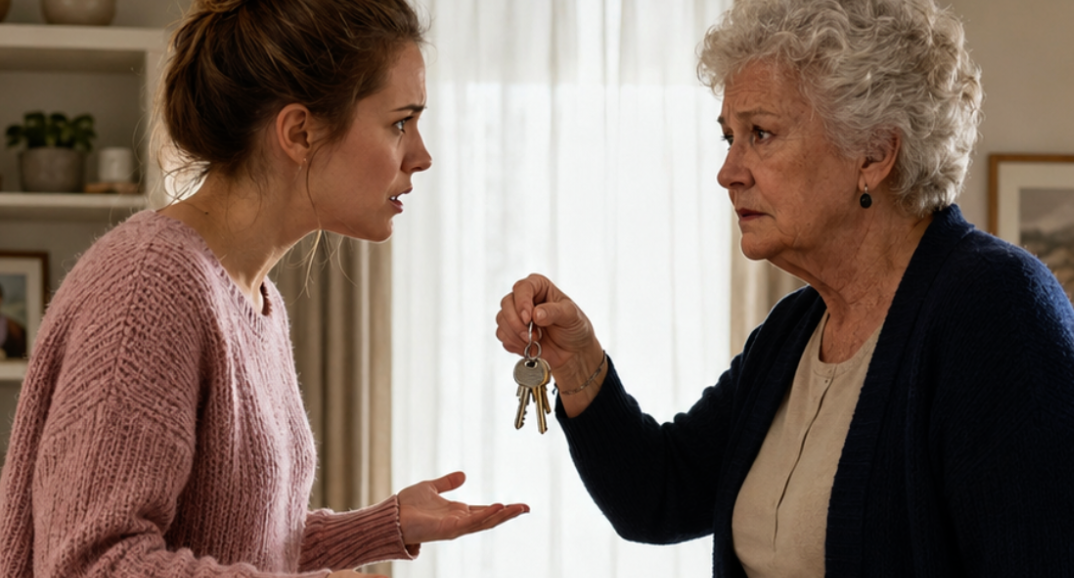
— Share your apartment with your sister. I need to feel secure about her future, — my mother wanted me to transfer half of my home to my sister
Marina woke to the sound of the doorbell. Still half asleep, she looked at the clock—it was eight on a Saturday morning. Who could possibly arrive without warning? Pulling on her robe, she opened the door and froze.
“Mom? What are you doing here?”
Valentina Petrovna stood on the doorstep with a large bag and her usual domineering expression.
“What do you mean, what am I doing here? Am I not allowed to visit my own daughter? Let me in—I’m freezing.”
Marina silently stepped aside. Her mother entered the apartment, casting an appraising eye over the renovation, furniture, and appliances. Over the years, Marina had grown accustomed to these inspections, but something about her mother’s expression made her uneasy this time.
“Would you like some coffee?” Marina asked as she walked into the kitchen.
“Yes. And we need to have a serious talk.”
There it was. In their family, “having a serious talk” always meant that someone was about to demand something from her.
Without saying anything, Marina placed the cezve on the stove. An autumn drizzle fell outside the window, and the city was waking slowly and reluctantly. She had planned to spend the day at her shop, sorting through a new shipment from Turkey. Bags, shoes, and accessories were all waiting for her at the warehouse.
“You have a nice apartment,” her mother began as she settled at the table. “Two rooms, about fifty square meters, right?”
“Fifty-two,” Marina replied automatically. “That’s a lot of space for one person. Why do you need such a large apartment when you’re not even planning to get married?”
“Mom, what does that have to do with anything?” Marina placed a cup of coffee in front of her mother. “You didn’t travel a thousand kilometers just to discuss my personal life, did you?”
Valentina Petrovna stirred sugar into her coffee without looking at her daughter.
“I came because of Yulia. She’s already twenty-five, and she still lives with us. Her job is nothing special, and she’ll never save enough for an apartment. Your father and I are nearly sixty. We have to start thinking about her future somehow.”
“And what are you suggesting?”
“Share your apartment with your sister. I need to feel secure about her future,” Valentina Petrovna said as though she were making the most ordinary request in the world. “Register her at this address, or better yet, transfer half of the ownership to her immediately. Let her live here and settle in. You have far too much space for one person anyway.”
Marina slowly lowered her cup onto the table. Her ears began to ring.
“Are you serious right now?”
“Absolutely. You know what Yulia is like. She’ll never accomplish anything on her own. She needs help. And you’re already established. You have a business…”
“A business that took me seven years to build!” Marina’s voice rose to a shout. “Do you remember when I left home at eighteen? When I rented a room and worked two jobs? When I spent an entire year saving for my first trip to Istanbul?” “Well, that was your choice,” her mother said with a shrug. “Nobody forced you to leave home.”
“Nobody forced me? Seriously?” Marina stood and paced across the kitchen. “‘Marina, you have to understand that supporting you is difficult. We still have two younger children.’ ‘Marina, be sensible and apply to a university in another city. They’ll give you a place in a dormitory there.’ I understood everything perfectly, Mom. I saw how you could barely make ends meet.”
“Exactly!” Valentina Petrovna said, suddenly growing animated. “You understood. You were sensible. So be sensible now and help your sister.”
Marina returned to the table and sat across from her mother. Her heart was pounding, but she forced herself to speak calmly.
“Mom, I left so I wouldn’t be a burden. I studied, worked, and never asked you for money. Do you remember how I couldn’t come home for New Year’s during my first three years because I couldn’t afford the ticket? And when I started bringing merchandise from Turkey, everyone laughed at me. ‘Junk seller,’ ‘shuttle trader’—do you remember Dad saying those things?” “I don’t remember anything like that,” her mother lied.
“You do. You remember perfectly well. I came home and showed you the new phone I’d bought with the first money I had earned. Dad said, ‘Look at her—she’s become a trader, profiting from other people’s needs.’ And you joined in: ‘I bet you’re ashamed to look respectable people in the eye.’”
Valentina Petrovna pursed her lips.
“We were worried about you. We thought you had lost your mind—abandoning a respectable education to sell things at a market.”
“I didn’t abandon my education. I earned a degree in economics and realized that I didn’t want to sit in an office earning pennies. Mom, I worked twelve hours a day. At night, I arranged the merchandise, photographed it, and wrote advertisements. Then I learned how to build and promote websites. I opened my first little shop in a shopping center. It was six square meters, and there wasn’t even anywhere to sit down. Do you know how long I saved for the down payment on my mortgage?”
“But still…”
“Five years, Mom! For five years, I saved money from every trip and every sale. I denied myself everything. And now you come here and tell me to simply hand over half of my apartment?”
“Not hand it over—share it!” her mother said, raising her voice. “With your own sister! Don’t you feel sorry for her? You’ve become so greedy, Marina. Money has corrupted you.”
“Greedy?” Marina laughed. “I’m greedy? Mom, I visit you every year and bring presents. When Yulia needed a laptop for her studies, who bought it? When Dima needed money for driving lessons and his license, who gave it to him?”
“But those were small things! This is an apartment—a home! You have to understand that Yulia won’t manage on her own. She isn’t as driven as you are. She needs support.”
Marina stood and walked over to the window. Gray streams of rain ran down the glass and merged with the puddles on the asphalt. Somewhere out there in the city was her life: three fashionable clothing stores, a warehouse, regular suppliers, and customers. There was also this apartment, whose mortgage she would be paying for another ten years. It was the life she had built herself, brick by brick.
“What about your apartment?” she asked without turning around.
“What about it?” her mother asked, failing to understand.
“Your three-room apartment in the city center. Who will get it?”
Silence fell. Marina turned around. Valentina Petrovna was staring into her cup.
“Dima, of course,” she finally said. “He’s a man. He’ll need to start a family. He’ll have to bring his wife somewhere, and then they’ll have children.”
“I understand.” Marina nodded. “Dima gets your apartment, Yulia gets mine. And what do I get?”
“You already have everything!” her mother snapped. “Your own business and all those shops of yours! You’re already taken care of.”
“I took care of myself, Mom. Me! Not you, not our relatives, and not the government. I worked myself to the bone to have what I have now. And now I’m supposed to divide it because Yulia ‘isn’t as driven’ as I am?”
“She’s your sister!”
“She’s a twenty-five-year-old adult woman!” Marina sat down again and leaned toward her mother. “Do you know what she was doing while I was building my business? She lived with you, ate, slept, and went to some part-time job. In the evenings, she watched television series. On weekends, she went to cafés with her friends. Has she ever tried to change anything? Has she looked for a proper job? Has she tried to learn anything?”
“Not everyone has your entrepreneurial streak,” her mother muttered.
“I’m not asking her to become an entrepreneur! There are plenty of ordinary jobs that pay a decent salary. Has she even tried? Or has she always been waiting for someone else to solve her problems?” “You’ve become cruel, Marina. Completely coldhearted. We didn’t raise you to be like this.”
“You hardly raised me at all,” Marina said quietly. “I raised myself. And do you know something? I’m tired of constantly having to prove myself to everyone. I’m tired of feeling guilty because I succeeded—because I didn’t surrender, didn’t give up, and didn’t sit around waiting for someone to come and save me.”
Valentina Petrovna abruptly stood and grabbed her bag.
“So you’re refusing? You’re refusing to help your own sister?”
“I’m not refusing to help her. But I’m not prepared to give away half of something for which I paid such a high price. Mom, you want Yulia to have a good life? Wonderful. Help her find a proper job. Let her rent a room and learn to take care of herself. I can pay her first month’s rent if necessary. I can hire her and teach her about the business. But simply giving her part of my apartment…”
“Not giving it away—dividing it!” her mother was practically shouting now. “Half and half! Is that really so much? You have a two-room apartment!”
“This is my apartment, and I’ll be paying for it for another ten years! You have to understand—I only just bought it! I’m thirty-one years old, and this is the first home I’ve ever owned! Why should I immediately divide it with someone else?”
“Because you’re the oldest! Because you have something and she doesn’t! Because that’s what you’re supposed to do!”
“No, Mom.” Marina shook her head. “It isn’t. It’s unfair. It’s simply convenient for you. You want to transfer responsibility for Yulia onto me.”
Valentina Petrovna snatched up her jacket.
“Fine. So that’s how it is. Then don’t expect us to consider you our daughter anymore. You’ve betrayed us. You’ve betrayed your family.”
“Mom…”
“No!” She raised her hand. “Everything has been said. Just wait until your father finds out—he won’t want to speak to you at all. Neither will Dima or Yulia. None of us wants anything to do with you now. Live alone with your money!”
The door slammed shut. Marina remained standing in the middle of the entryway, staring at the closed door. Her hands were trembling. She walked into the living room and collapsed onto the sofa.
Messages began appearing on her phone. The first was from Dima:
“Mom said you refused to give Yulia a place to live. Have you lost your mind? Your sister is going to be left without a roof over her head, and you’re too selfish to help.”
Then came a message from Yulia:
“Thanks, dear sister. Now I know what kind of person you really are. Greedy. All you care about is making sure you’re comfortable.”
Then her father wrote:
“Marina, I never expected this from you. I’m ashamed of you.”
Marina read the messages and felt herself growing cold inside. She imagined the three of them sitting in the kitchen where she had grown up. Her mother would sob as she described the ungrateful daughter they had raised. Her father would sit in gloomy silence before finally saying, “Money corrupts people.” Dima would protest, “I would’ve agreed immediately if someone had asked me.” Yulia would wipe away her tears and say, “And I thought she loved me.”
But love was not about sacrificing everything you had. Love meant helping someone become stronger, not assuming responsibility for their entire life.
She remembered the day she had collected the keys to the apartment. She had stood in the empty room, looked out the window, and thought, “Mine. This is mine. I did this.”
For the first time in her life, she had a home. Not a rented room, not a dormitory, and not her parents’ apartment, where she was always treated as less important than everyone else. Her own home.
And now they were demanding that she share it. Not because Yulia was in trouble or had nowhere to live, but simply because “that’s how it should be,” “that’s the right thing to do,” and “she’s your sister.”
Marina opened the family group chat and began typing. She spent a long time choosing her words, deleting them, and starting again.
“Mom, Dad, Dima, Yulia. I’ve thought everything over. I love all of you, but I will not divide my apartment. This is not greed or coldheartedness. It is my right to the life I built myself.
“Yulia, I’m prepared to help you find a job, and I can give you money to rent a place for the first few months. I can teach you everything I know. But I will not solve your problems for you.
“Mom and Dad, you raised three children. That was a great deal of work, and I appreciate it. But my life is not compensation for the fact that I succeeded. I am not obligated to pay for my success by supporting you, Yulia, and Dima.
“If you decide that this means we are no longer a family, that is your choice. It will hurt me, but I can no longer live while constantly feeling guilty for being who I am.
“I’m open to talking when you’re ready. The door is not closed on my side, but the conversation will take place on my terms—with mutual respect.
“I love you.
“Marina.”
She pressed “send” and muted her phone.
The apartment was silent. The rain continued to fall outside. Marina stood and walked through the rooms. Here in the living room was the sofa she had spent two months choosing. In the kitchen were the appliances on which she had spent nearly all her money at the time. In the bedroom was the bed where she woke every morning with the thought, “I’m home.”
Yes, perhaps her family would reject her. Perhaps they would continue to consider her selfish and greedy for a long time. Perhaps she would end up alone.
But it would be her choice. Her life. Her home.
And nobody would take that away from her.
Six months passed.
Marina stood inside her new shop, her fourth one. The interior had turned out exactly as she wanted: light-colored walls, stylish clothing racks, and large mirrors. A new collection from Milan was displayed in the window. She had traveled there herself the previous month and selected every item personally.
“Marina, where should I put these dresses?” Lena, one of the sales assistants, asked.
“On the right, on the new-arrivals rack,” Marina replied.
Her phone remained silent. Her family had not written to her once during those six months. She had heard from acquaintances that Yulia was still living with their parents and that Dima had gotten married. Her mother told everyone about her “ungrateful oldest daughter.”
Sometimes, late at night, Marina was overcome by a wave of sadness. She imagined how things might have been: family celebrations, nieces and nephews she could spoil with presents, and warm telephone conversations on weekends. An ordinary family.
But then she looked around at her apartment, her business, and her life, and she understood that the price would have been too high. First, an apartment for Yulia. Then money for Dima’s wedding. Then help with renovations. Then help with the grandchildren.
Every request would have contained the same message:
“You can afford it. You have the money.”
Being able to do something does not mean you are obligated to do it.
“Marina, would you like me to bring you some coffee?” Lena asked, peeking into the back room.
“Yes, please.” Marina smiled.
No, she did not regret it. She did not regret it at all.
That evening, after returning home, she sat beside the window with a cup of tea. The city glowed with lights, and somewhere in the distance, cars hummed along the streets.
Her city.
Her life.
Her choice.
She was free.
And it had been worth it.