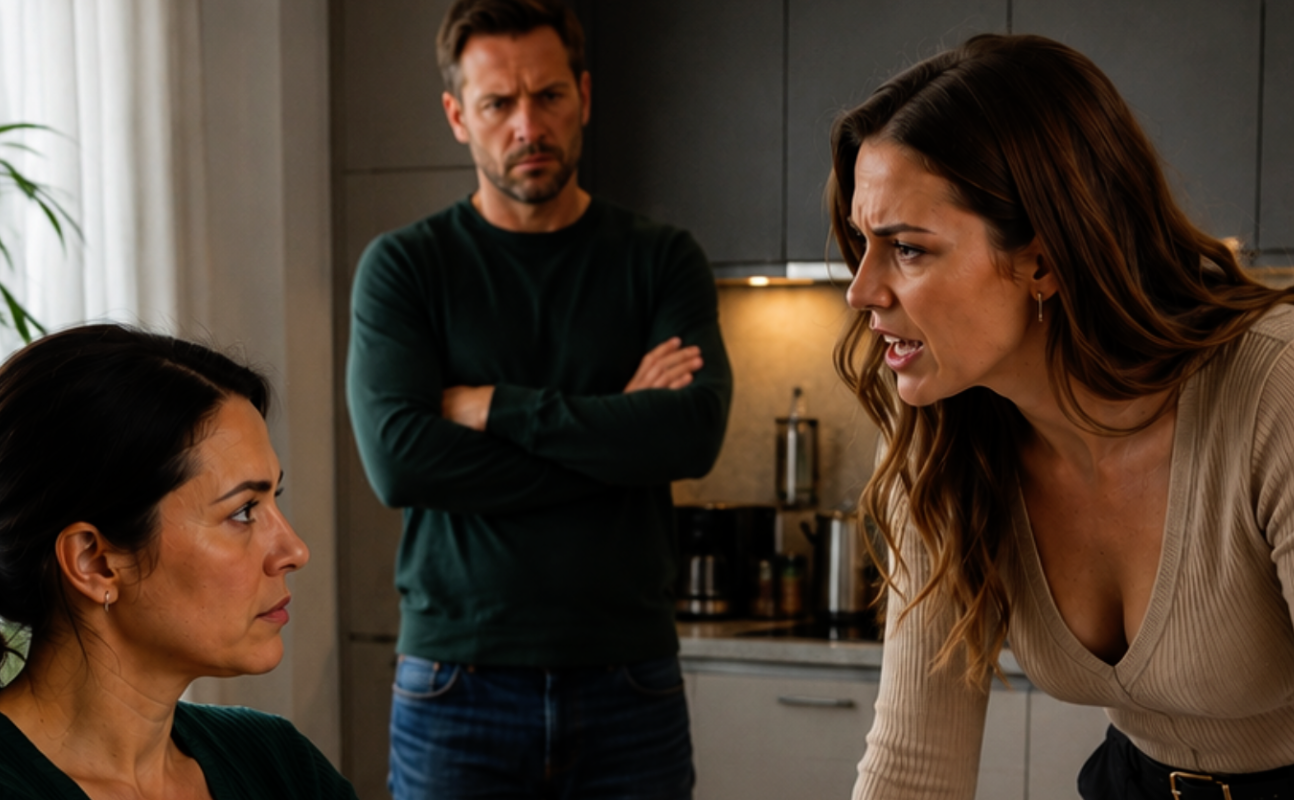
“We were counting on your help when we took out the mortgage!” my sister-in-law declared, spreading the bills across my kitchen table.
“Are you serious? I mean, are you actually seriously telling me this right now?”
Vera didn’t even turn around. She stood at the stove, stirring sauce in a small pot and watching the wind chase last year’s leaves around the courtyard outside the window. Her husband’s question hung in the air, heavy and sticky like steam from boiling coffee.
“Vera!”
“I heard you, Zhenya. And yes, I meant what I said. You don’t have to repeat yourself every thirty seconds.”
Evgeny stood in the middle of the kitchen with his feet planted apart, as though preparing to defend his position. His faded house T-shirt stretched across his shoulders. He looked confused, even frightened, and a year earlier that expression—lost, almost childlike—would have made Vera soften, walk over, put a hand on his chest, and say, “All right, let’s talk about it.”
But not now.
Now that face stirred nothing in her except a dull, settled exhaustion. “You’re selling the car,” Zhenya said slowly, syllable by syllable, as though explaining an obvious truth to a clueless child. “Our car. Without discussing it with me. You’re just presenting me with a fait accompli. You think that’s normal?”
Vera finally turned around. She placed the spoon on its rest, wiped her hands on a kitchen towel, and looked her husband directly in the eyes.
“Zhenya, I’m not selling ‘our’ car. I’m selling the car I bought three years ago with my own money. I paid off the loan last month. It’s registered in my name. I’m informing you because we live together. I’m not asking your permission.”
“What difference does it make whose name it’s in?” He threw up his hands. “We’re a family! Everything belongs to both of us! Or have you forgotten that too?”
Vera smirked. It was a humorless, crooked sort of smile.
“Everything belongs to both of us, you say? When you got a bonus at work last year and bought yourself a new laptop, did you ask me? Or when you borrowed money from your mother to renovate the garage? Did we discuss that ‘as a family’? I don’t seem to remember.”
Zhenya stopped short. The muscles in his jaw tightened. He was clearly searching for a decent answer, but all he could find was resentment—the pure, almost childish resentment of a man whose wife had suddenly stopped being convenient.
This conversation had not begun today.
Not even yesterday.
It had been festering for years, like an abscess that occasionally subsided only to become inflamed again, never disappearing completely.
That morning, over breakfast, Vera had casually mentioned that she had found a buyer for her Volkswagen, and Zhenya had nearly choked on his sandwich.
The event that triggered everything was almost laughably ordinary. There was no affair, no crime.
Vera, an accountant at a construction company, had decided to renovate their apartment. Not a cosmetic renovation, not merely “fresh wallpaper,” but a major overhaul.
She had been saving for it for two years.
That was exactly why she was selling the car—to free up money without touching her main savings account.
For the past five years Vera had worked two jobs. In the evenings and on weekends, she handled private bookkeeping, taking small companies on as outsourced clients. Every penny in their home had been earned through her hard work.
Zhenya worked as a sales manager at a car dealership. His income was steady but modest. His salary covered utilities, groceries, and his personal wants: a new phone every year, winter tires for the very car Vera was now planning to sell, and regular nights out drinking with his friends.
He had no savings.
When Vera first mentioned the renovation, he had been delighted.
“Finally! The bathroom tiles are already falling off.”
But when he discovered that the renovation meant selling the car, he froze.
Not because he desperately needed the car.
What bothered him was the principle of it: she was making decisions about property without asking him.
And underneath that irritation, something deeper was stirring.
His mother and sister viewed Vera as someone who was obligated to share.
If she was selling a car to pay for renovations, then obviously she had plenty of money.
And if she had plenty of money, where was it all going?
Why wasn’t she helping her husband’s relatives?
Zhenya hadn’t said that part aloud yet.
But Vera knew that in the evening he would call his mother.
And tomorrow, it would begin. To understand how Vera had ended up in this situation at all, you had to go back ten years.
They met when she was twenty-six and he was twenty-eight.
Vera had only recently become the legal owner of the apartment—a two-room flat in a nine-story building on the outskirts of the city that the state had provided to her as an orphan.
Her parents had died in an accident when she was twelve.
The apartment had originally been municipal property. Then privatization began, followed by years of court proceedings, and by the age of twenty-five Vera finally became the owner of those forty-six square meters.
She renovated it with her own hands.
She hung wallpaper at night after work, primed the walls, and carried bags of plaster up to the fifth floor in a building without an elevator.
No one helped her.
An aunt on her father’s side, somewhere in Novosibirsk—the only relative she had left—called once, congratulated her, and then disappeared from her life.
So when Vera met Zhenya—an ordinary, cheerful man with dimples in his cheeks who was always willing to put up a shelf—she believed she had finally found it.
A family.
A real one.
One in which she would no longer be alone.
Zhenya moved in with her six months later.
A year after that, they married.
Then he introduced her to his family.
Alina Sergeyevna, her future mother-in-law, lived in a nearby district in a three-room apartment she had inherited from her late husband. Her daughter Svetlana lived there with her.
Sveta was five years older than Zhenya, twice divorced, with two children from different marriages and an unshakable conviction that the world owed her something.
During their first visit, Vera behaved modestly, trying to make a good impression. She brought a cake she had baked the day before.
Alina Sergeyevna tasted it and complimented her.
Then, when Vera went to the bathroom, she said something to Zhenya that Vera accidentally overheard through the thin door.
“She’s a sharp one, that girl of yours. Has her own apartment, a car, works a lot. You make sure she doesn’t start pushing you around. People like her, going from rags to riches—they start looking down their noses at everyone.”
Vera pretended she hadn’t heard.
She remained silent.
And she continued remaining silent for the next ten years.
She stayed silent when her mother-in-law gave her instructional books about marital happiness and feminine wisdom for every holiday.
She stayed silent when Svetlana showed up unannounced and rummaged through her cupboards and closets, exclaiming:
“Oh, Vera, where did you get this blouse? Probably from that boutique that never has sales, right?”
She stayed silent when Alina Sergeyevna organized family dinners and deliberately seated Vera at the very end of the table while placing Zhenya at the head beside herself.
Vera tolerated it.
She told herself every family had its quirks.
They would get used to her.
They would eventually appreciate her.
She even helped them regularly.
Not because she was obligated to, but because she sincerely believed that if they were her husband’s family, then they were her family too.
She paid for massage therapy courses when Sveta decided to learn a new profession.
Fifty thousand rubles.
Vera handed over the money without hesitation.
Sveta quit the course after a month.
“Boring. Not my thing.”
She never returned the money and never even mentioned it.
When Alina Sergeyevna’s washing machine broke, Vera bought her a new one—not expensive, but reliable, costing a little over twenty thousand.
Her mother-in-law accepted the gift as though Vera had somehow disappointed her.
“Well, you could have bought a more expensive one, but thanks anyway.”
Every New Year, Vera brought bags full of groceries—caviar, red fish, good sausage, chocolates.
Alina Sergeyevna would arrange everything on the table and comment:
“You bought the caviar at the supermarket? It isn’t real there. Next time buy it at the market from people you can trust.”
Not once—not a single time in ten years—did Vera hear a simple, sincere “thank you.”
Instead of gratitude, she always received another serving of advice and mild contempt.
About three years earlier, Vera had registered herself as a sole proprietor and started handling accounting for several small companies.
It was grueling work.
Office during the day, private clients in the evening, reports at night.
She lost weight. Her face became drawn. One of her eyes began twitching from chronic lack of sleep.
But the business took off.
Real money began coming in.
Vera bought the car so she could travel to meet clients.
She furnished the apartment properly—not with IKEA furniture, but good custom-made oak pieces.
And from that moment onward, the family’s attitude toward her changed completely.
Before, it had been condescension.
Now it became something thick, sticky, and dark.
Envy. One day Svetlana came to visit with her children and saw the new kitchen—light wood cabinets, a stone countertop, a matching extractor hood—and whistled.
“Wow. Vera, did you rob a bank or something? Or does Zhenya actually earn that much?”
“Zhenya had nothing to do with it,” Vera replied calmly. “I work for myself, Sveta.”
“Sure, sure…” Svetlana walked around the kitchen and ran a finger across the countertop. “That’s what happens when you don’t have children of your own. You can spend everything on yourself.”
Vera said nothing.
She clenched her teeth, smiled, and offered her tea.
That night she lay awake staring at the ceiling and replaying those words.
“You don’t have children of your own.”
It was the most painful blow Svetlana could possibly have delivered.
Because Vera really couldn’t get pregnant.
The doctors had no answers. There were no obvious medical problems. It simply wasn’t happening.
Five years of trying.
Hormone treatments that Vera had saved for separately.
Tears soaking her pillow while Zhenya slept.
And Zhenya…
Zhenya had never supported her.
Not once.
“Well, if it hasn’t happened, then it hasn’t happened,” he would say while flipping through television channels. “Maybe it isn’t meant to be. Relax. Stop obsessing over it.”
He didn’t care.
She did.
And Sveta knew.
She knew exactly where to strike, and she struck deliberately.
Her husband’s family came to visit two days after the conversation about selling the car.
Vera hadn’t expected them, but she wasn’t surprised either.
She had already noticed the pattern.
Whenever Vera was about to make some important decision, Alina Sergeyevna and Svetlana appeared on the doorstep as though they could sense it.
Zhenya had probably called them to complain.
And they came—not to support him, but to “sort things out.”
In other words, to apply gentle, feminine, family pressure.
The three of them sat in the living room.
Alina Sergeyevna sat in an armchair like a queen on a throne.
Svetlana sat on the sofa with her legs tucked beneath her.
Zhenya hovered near the window, pretending none of it concerned him.
Vera came in, poured tea, and placed a bowl of sweets on the table.
The conversation began neutrally.
The weather.
Health.
Sveta’s children.
As usual, they were “getting bad grades in math, the teachers are idiots, we need to hire a tutor.”
Then Alina Sergeyevna, stirring her tea, smoothly moved to the real subject.
“Verochka, Zhenya told us you’re selling the car. Aren’t you practical! How much are you asking?”
“Market price,” Vera replied, feeling something tighten inside her. “It should bring in around eight hundred thousand.”
“Eight hundred!” Svetlana threw up her hands. “Wow! Listen, maybe you could… well, put some of that money toward the family? You see, we’re in a difficult situation right now. Kiryusha has a problem with his knee and needs surgery. Sports injury. Insurance won’t cover it, so it has to be paid privately. Two hundred thousand. I’ve tried everything… Zhenya said you have some spare money. Wouldn’t you like to help?”
Vera slowly turned her gaze toward her husband.
He was staring at the floor, studying the pattern of the carpet as though it concealed the secrets of the universe.
“Zhenya,” she said quietly. “Did you tell Sveta that we have spare money? What spare money exactly?”
“Well…” He hesitated and scratched the back of his head. “I only told her that you were selling the car for eight hundred. And that the renovation could be done more cheaply. And whatever’s left… why not? We’re family.”
Vera laughed.
The sound was dry, like sandpaper scraping.
“Zhenya, the renovation we planned costs six hundred thousand. I calculated everything. The pipes need replacing, the electrical wiring needs replacing, and the bathroom needs to be completely redone. That leaves two hundred thousand. I want to put that into an emergency fund because we don’t have one. Because you don’t save anything. What ‘spare money’ are you talking about? Do you even understand what you’ve done? You promised my money to your sister behind my back.”
“Why is it suddenly ‘your’ money?” Svetlana exploded. “You’re married! It’s shared money! Zhenya has a right to a say!”
“Zhenya.” Vera turned her entire body toward her husband, ignoring Svetlana. “Do you really think your nephew’s operation is more important than repairing our home? The home where the bathroom pipe leaks so badly that we’re flooding the neighbors downstairs?”
Zhenya raised his eyes.
There was anguish in them, but not remorse.
He was suffering because he had been forced to choose and give an answer.
“Ler, he’s a child. Do you understand? Kiryusha is suffering. The renovation can wait. The pipes haven’t burst yet. You’re a kind woman. You’ve always helped. What happened to you?”
That was when something inside Vera snapped.
“What happened to me?”
She stood up.
The chair scraped loudly backward across the floor.
“You want to know what happened to me? Ten years happened, Zhenya. For ten years I’ve listened to your mother telling me how to live. For ten years your sister has come into my home and counted my possessions. For ten years I’ve paid for courses, washing machines, birthdays—and what do I hear in return? ‘You could have bought a more expensive one.’ For ten years all of you have been sitting on my neck, in my apartment, acting as though that’s exactly how things are supposed to be!”
Svetlana jumped up from the sofa.
“Oh, so that’s how you’re talking now! Sitting on your neck! So we’re freeloaders and you’re the queen, is that it?! You’re some rootless orphan who got an apartment for free and now you think you’re somebody! You think we don’t know how you bully Zhenya? You think he doesn’t tell us? You’re always dissatisfied, everything’s always wrong, and according to you we’re always the ones who owe you something!”
“Shut up, Sveta!”
Vera stepped forward.
Her eyes burned with dry, unshed anger.
“Don’t you lecture me about my apartment. Your mother got her three-room apartment from her husband and now supports you and your two children. You haven’t held a steady job for a single day in ten years. You live on child support and your mother’s pension. What right do you have to judge me? What right?”
Alina Sergeyevna slowly rose from the armchair.
Her voice trembled—not from weakness, but from rage.
“I knew it. I knew it from the first day. You were never one of us. A common little nobody. You can feed a wolf all you like, and sooner or later it’ll still turn on you. I told Zhenya not to marry you. I told him you were calculating, that you’d devour him. And here we are. She has money, apparently! And who are you to have money? You crawled out of the gutter, while we’re a respectable family! My late husband, Zhenya’s father, was an engineer. We were respected people. And you… you’re a complete nobody. The only reason you got anywhere was because your aunt threw you a bone out of pity. Otherwise you’d have spent your whole life scrubbing floors!”
This was no longer merely an insult.
It was a direct spit into her soul.
Vera froze.
Everything that had accumulated over ten years—loneliness, the pain of childlessness, the feeling that she would always be an outsider to them, the knowledge that her hard work meant nothing to them, the realization that they were simply using her—exploded inside her in a blinding white flash.
But she didn’t scream.
Instead, her voice dropped to a whisper.
Quiet.
Terrifying.
“You are going to leave my home now. All of you. You, Alina Sergeyevna. You, Svetlana. And you, Zhenya. You too. Because now I’m going to see exactly what your ‘respectable family’ taught you.”
“What?!” Alina Sergeyevna gasped.
“Leave. Immediately. Or I’ll call the police. This is my apartment. I’m the only person registered here. None of you has any right to be here. Not even you, Zhenya. You simply lived here. Like a guest. Except guests contribute something, and you didn’t even do that.”
Zhenya turned pale.
He stared at his wife as though he no longer recognized her.
She had always been gentle.
Always willing to wait, compromise, keep quiet.
Now she stood in front of him straight as a taut string, and in her eyes he saw something he had never seen before.
Complete, absolute indifference.
“Lera, you’re going too far… That’s my mother, my sister…” he stammered.
“Out,” Vera repeated.
She walked toward the hallway and opened the front door.
Alina Sergeyevna swept past grandly without even looking at her.
Svetlana grabbed her bag and hissed into Vera’s face:
“You’ll regret this. He’ll leave you, and you’ll be all alone with your precious apartment. You’ll die in here and there won’t be anyone to give you a glass of water.”
Zhenya lingered in the hallway, hoping his wife would suddenly come to her senses.
Vera silently pointed toward the door.
So he left.
The moment the door closed behind him, her mother-in-law immediately began wailing loudly and theatrically in the corridor.
“Oh, my heart… Call an ambulance… That witch has done this to me!”
Vera closed the door and locked it.
The silence inside the apartment rang in her ears.
Vera pressed her forehead against the cold wooden door and, for the first time in many years, began to cry.
Silently.
Large tears streamed down her cheeks, leaving wet tracks behind them.
She wasn’t mourning the argument.
She was mourning ten wasted years.
The next several days passed in a muffled, cotton-like silence.
Zhenya didn’t call.
Vera suspected his mother had forbidden him.
Something like: Let her come running after you. Let her realize what she’s losing.
But Vera had no intention of running after anyone.
On the third day, she called the contractor and told him they were starting the renovation on Monday, just as planned.
On the fourth day, she sold the car.
The buyer was decent and paid immediately.
On the fifth day, Zhenya finally called.
His voice sounded tired and somehow extinguished.
“Ler, what are you doing? Mom says you need to apologize to her and Sveta. They’re really offended. Sveta says she’ll never set foot in your house again until you apologize.”
“And what exactly am I supposed to apologize for?” Vera asked, holding the phone between her shoulder and ear while mixing plaster in a bucket.
“Well… you threw them out. You said some really harsh things. Mom’s blood pressure is up now, and Sveta’s crying. Why did you have to do that? We’re family. Just apologize and everything will go back to normal. I’ll come home. We’ll live the way we used to.”
Vera stopped stirring.
She looked out the window.
Two elderly women sat on a bench in the courtyard, and nearby a young mother pushed a stroller.
An ordinary life.
An ordinary day.
But Vera’s life was no longer ordinary.
Something had shifted.
Something had broken.
“Zhenya, I’m not going to apologize. Your mother called me a nobody. Sveta told me she hoped I’d die alone. And you stood there and said nothing. You always say nothing, Zhenya. You never defend me. You choose them because it’s easier. You let them hurt me as long as they leave you alone.”
“Ler, stop being so dramatic! Mom just lost her temper. She’s an elderly woman. She’s getting old. And Sveta—well, she’s an idiot, you know that. What did you expect? Apologize. Be the bigger person. You’re the strong one in our family. You can handle anything.”
“I’m tired of being strong,” Vera said quietly. “You know, I’ve been thinking… If all I am to you is a strong woman who carries everything and forgives everything, then why do you need a wife? You could’ve hired an accountant and a housekeeper. It would’ve been cheaper and more peaceful. I’ll text you the address of a lawyer. We need to file the papers.”
“Vera, what are you saying?!” he shouted into the phone. “You want to destroy our family because of one stupid argument?”
“Our family?” Vera repeated. “What family? The one where I owe everyone everything and nobody owes me anything? The one where my husband offers me to his sister like a discount coupon? No, Zhenya. I don’t want that kind of family. I’d rather be alone.”
She hung up.
Her hands weren’t shaking.
Her heartbeat was steady.
The divorce proceeded quietly.
There was nothing to divide.
The apartment belonged to Vera and had been hers before the marriage.
The car had already been sold.
They had no joint bank accounts.
Zhenya tried to insist that certain things were “marital property,” but Vera’s lawyer quickly cooled his enthusiasm.
The only property they had actually acquired together was some household appliances, and Vera generously let her husband keep them.
“Take the television and the washing machine I bought for your mother,” she told him during their final meeting in court.
He did.
Then he moved back in with his mother.
Vera continued with the renovation.
It became her therapy.
As she tore the old wallpaper from the walls, it felt as though she were stripping away her old life.
As she filled cracks and holes in the walls, she imagined herself repairing the holes inside her own soul.
When the workers left for the day, she would sit on the windowsill in the still-empty room smelling of fresh paint and watch the sun set behind the concrete apartment towers.
She was sad.
But it was a clean sadness.
There was no humiliation in it.
About six months passed.
One evening, Vera was finishing washing the floors after the final cleanup.
The renovation was complete.
The apartment gleamed and smelled of fresh wood and a new life.
The doorbell rang.
She wiped her hands, looked through the peephole, and saw Svetlana’s tear-streaked, exhausted face.
Vera didn’t want to open the door.
But Sveta had already noticed the light through the peephole and began speaking rapidly from the other side.
“Vera, please open the door! I’m alone… I really need to talk to you. I won’t stay long.”
Vera sighed and opened the door.
Svetlana entered, removed her shoes in the hallway, and froze as she looked around the transformed apartment.
“Wow… It’s beautiful…” she breathed. “Vera, listen… I came here… Just don’t throw me out immediately, okay? I came to tell you that you were right.”
Vera leaned against the wall and crossed her arms.
She said nothing.
“I’ve thought about so much over these past few months,” Svetlana began quickly, swallowing her words. “When you threw Zhenya out, Mom was happy. She thought now he’d be living with us again and everything would be the way it used to be. But he sat down on the sofa and that’s where he stayed. He hasn’t worked for six months. Mom nags him from morning until night. Her pension isn’t enough, and he isn’t even looking for a job.
“Now Mom tells me, ‘This is your fault. You should’ve been gentler with Vera.’ And I tell her, ‘You’re the one who called her a nobody!’ And for the first time in our lives, we had a real fight. Can you imagine?
“Then Kiryukha asked, ‘Where’s Aunt Vera? Isn’t she going to come see me?’
“And I realized…
“God, Vera, I finally realized that we lost you because of our own stupidity.
“You were the only normal person in our entire family.
“You carried all of us, and we…
“We hated you because you were better than us.
“It was envy.
“Ordinary, ugly female envy.
“Pure jealousy.
“And now I look at that idiot—my brother—and without you, he’s nobody. Mom’s going to destroy him. He’ll drink himself to death or lose his mind.
“You’re strong. You survived.
“He didn’t.
“He’s weak.
“You left, and everything collapsed.”
Vera remained silent.
She listened to these belated confessions echoing through the new quiet of her apartment.
She didn’t feel sorry for Svetlana.
She wasn’t happy to have been proven right either.
She simply listened like a person who had crossed a raging river and reached the opposite bank, now watching those who had remained behind.
They were struggling in the water.
Shouting.
But she was already standing on dry land.
And the bridge had burned.
“I’m not going back to him, Sveta,” she finally said. “And I’m not going to help you anymore. I have a different life now.”
“I know.” Svetlana wiped her nose with her sleeve. “I’m not asking you to. I just wanted you to know that you weren’t to blame. For any of it. And what I said about the children… Forgive me, Vera. That was the cruelest thing I’ve ever said in my life.”
Vera nodded.
She walked Svetlana to the door and locked it behind her.
Then she returned to the living room and sat down on her new sofa—cream-colored, with textured upholstery—and tucked her legs underneath herself.
Outside, the streetlights came on, filling the room with a soft orange glow.
An open planner lay on the coffee table.
Tomorrow she was starting a new project.
Three large companies.
A business trip to St. Petersburg in a week.
Life was moving, bubbling, calling her forward.
And then Vera understood.
The divorce hadn’t really been caused by the sale of the car.
Nor by the argument with her husband’s relatives.
The real reason was the emptiness she had spent years trying to fill with other people’s noise.
With money. With patience. With forgiveness.
But the emptiness had never been filled.
It had only grown larger.
The divorce hadn’t destroyed a family.
It had simply exposed the truth about something that had never truly existed.
And now, inside her apartment, inside her new, clean, bright life, Vera didn’t feel lonely.
She felt free.
Having a roof of your own isn’t really about walls.
It’s about finally being home.
Home within yourself.
A place from which no one can throw you out.
A place where no one can deceive you anymore.