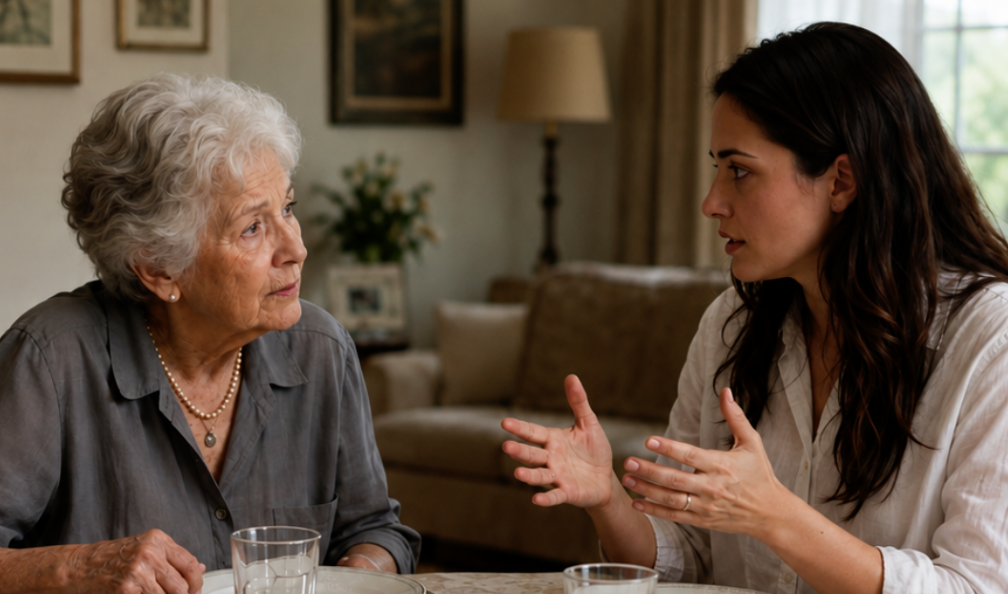
“There Will Be No More Money. Get Used to Relying Only on Yourselves,” Lyuba Told Her Mother-in-Law
Galina Petrovna, her mother-in-law, froze.
The cup stopped halfway to her mouth, the tea inside trembling slightly.
Silence.
Only the refrigerator hummed loudly across the kitchen.
Sergey sat beside his mother, staring down at his plate. He always stared at his plate whenever the conversation turned to money.
Lyuba said it without raising her voice:
“There will be no more money. Get used to relying only on yourselves.”
Thirteen Years
They had married in 2009.
Lyuba was twenty-six, Sergey thirty. They had a one-bedroom apartment on the outskirts of town and a fifteen-year mortgage. Lyuba worked as an accountant for a construction company, while Sergey was a foreman at a factory.
Together, they managed.
They managed quite well.
Then the requests started.
Galina Petrovna was the first.
The pipes in her bathroom had started leaking, her pension wasn’t enough, and, as she put it, “You’re not going to abandon your own mother, are you?”
Lyuba gave her twenty thousand rubles.
Back then, that was a significant amount for their household budget—almost a third of a monthly salary.
Sergey said:
“Mom, this is the last time.”
Galina Petrovna nodded.
Her eyes were dry and calm.
But there was never a last time.
Then Sergey’s younger brother, Alyosha, asked for money for driving school.
After that, he needed money to repair his car.
Then for the security deposit on a rented apartment.
And every time Sergey said the same thing:
“They’re family, Lyub. They’re not strangers.”
Lyuba would nod.
Transfer the money.
And write it down.
She had a notebook.
An ordinary green-covered squared notebook that had cost nine rubles at a stationery store.
Lyuba recorded every amount, every date, and every reason for the payment.
Not because she wanted ammunition for an argument.
She did it for herself.
So she wouldn’t lose her mind when, someday, they inevitably started saying, “Come on, we barely took anything from you.”
By the autumn of 2022, the notebook contained twenty-three entries.
Total amount: 840,000 rubles.
Amount repaid: zero.
“We Can’t Afford Everything”
In October, Lyuba’s mother, Vera Nikolaevna, received a diagnosis.
Her knee joint had deteriorated badly.
She could no longer walk without pain. Every step made her groan, and crossing the courtyard to the grocery store took her nearly twenty minutes.
She could have surgery through the state healthcare system, but the waiting list was a year and a half.
Private surgery would cost around three hundred thousand rubles.
Lyuba began calculating.
Savings.
Extra work.
Maybe a consumer loan.
Every evening, she went over the numbers while Sergey watched football.
And that very same week, Galina Petrovna called.
Her voice sounded cheerful, almost excited.
She wanted a new kitchen.
The old cabinets, she said, were completely falling apart. The doors wouldn’t close properly anymore. She was embarrassed to invite people over.
“Seryozhenka, maybe you and Lyubochka could chip in. At least a hundred thousand. I’ve already picked out a kitchen set.”
Lyuba heard every word.
She stood in the doorway listening as Sergey hesitated on the phone.
When he hung up, he rubbed the bridge of his nose.
That was his habit.
Whenever he didn’t know what to say, he rubbed the bridge of his nose as though thinking too hard had suddenly given him a migraine.
“Mom’s asking for money for a new kitchen,” he said.
“I heard. And my mother needs surgery. Three hundred thousand.”
Sergey rubbed his nose harder.
“We can’t afford everything, Lyub,” he said quietly. “Maybe your mother could get herself on the waiting list for now…”
He didn’t finish the sentence.
But Lyuba had already heard everything she needed to hear.
“We can’t afford everything” meant they couldn’t support his mother and hers at the same time.
And he had already made his choice.
Without even thinking.
A kitchen set with soft-close cabinet doors had somehow become more important than a living person’s ability to walk.
Lyuba went into the bedroom and closed the door.
She didn’t slam it.
She simply closed it.
Then she spent two hours sitting with the squared notebook in her hands, rereading thirteen years of entries.
Afterward, she closed the notebook.
Put it into her bag.
Zipped the bag shut.
And that night, she made her decision.
Sunday Lunch
A week later, Galina Petrovna invited them over for Sunday lunch.
Cabbage soup, meat patties, apple pie.
Tradition.
Alyosha came too, without his wife but with a healthy appetite.
He ate enough for two people, praised the pie, and kept refilling his glass with fruit compote.
After tea, Galina Petrovna got down to business.
She always got down to business after tea, when everyone was full, relaxed, and in a good mood.
“Well, kids, have you decided about the kitchen? I already went to the store and picked one out. White, with soft-close hinges. It costs one hundred and twenty thousand, but if you give me a hundred, I’ll scrape together the other twenty myself.”
Alyosha chewed his pie in silence.
Sergey stared into his cup.
That was when Lyuba took out the notebook.
She placed it on the table between the saucer of jam and the sugar bowl.
Then she opened it to the first page.
“Galina Petrovna,” she said, her voice steady and completely controlled. “This contains everything we have given your family over the past thirteen years. Every amount, every date, every reason. The total is eight hundred and forty thousand rubles. Not a single kopek has ever been returned.”
Galina Petrovna went pale.
Alyosha stopped chewing, a piece of pie still stuffed into his cheek.
“My mother can barely walk. She needs surgery. I’m going to pay for it.”
Lyuba looked at all three of them.
At Sergey, rubbing the bridge of his nose.
At Alyosha, who had finally swallowed his pie.
At Galina Petrovna, whose lower lip had started trembling.
“And that is why I’m only going to say this once. There will be no more money. Get used to relying only on yourselves.”
Her voice didn’t shake.
Lyuba had practiced the sentence all week.
In front of the bathroom mirror.
Silently, moving only her lips.
Because she knew that if her voice trembled, they would think she could still be persuaded.
The Fallout
Galina Petrovna burst into tears.
Not from sadness.
From anger.
Tears had always been one of her weapons.
Lyuba had seen the routine dozens of times: first the tears, then the accusations, then pressure through Sergey.
“Seryozha!” her mother-in-law shouted. “Do you hear what your wife is saying? She’s waving some notebook in your mother’s face! Are you a man or what?”
Sergey raised his eyes.
He looked at his mother.
Then at Lyuba.
Then back at his mother.
By then, he had rubbed the bridge of his nose until it was red.
“Mom, she does have a point…”
“A point?!” Galina Petrovna jumped to her feet so abruptly that her chair slid backward toward the wall. “A point?! That your mother is supposed to spend her old age without a decent kitchen? That she’s too stingy to spare a kopek for family? I raised you! I gave everything I had for you, and now she’s sitting here doing bookkeeping on me!”
“Mom,” Alyosha suddenly interrupted.
Lyuba was surprised.
He never interfered.
“Mom, sit down. She really did write everything down.”
He picked up the notebook.
He turned the pages silently.
His expression changed with every page.
First disbelief.
Then recognition.
Then something resembling shame.
Lyuba thought that perhaps this was the first time he had ever seen the whole picture.
It was one thing to ask for thirty-five thousand rubles and forget about it.
It was another to see yourself as one link in a chain totaling eight hundred and forty thousand.
Galina Petrovna kept shouting.
About ingratitude.
About how “some outsider’s mother matters more than your own.”
About how Lyuba’s mother had only herself to blame for neglecting her joints until they became so bad.
Lyuba heard every word.
She remembered every word.
And she answered none of them.
She put the notebook back into her bag.
Zipped it shut.
Stood up.
“Seryozha, I’ll be in the car.”
Then she walked out.
Calmly.
Without looking back.
In the hallway, she pulled on her boots and zipped up her coat.
Three Months of Silence
Galina Petrovna stopped calling.
Completely.
Before that, she had called every other day.
To chat.
To complain about her blood pressure.
To tell them that her neighbor was making noise again.
And, somewhere in the middle of the conversation, to ask for something.
Now there was silence.
Lyuba caught herself checking her phone.
Not because she was waiting for a call.
Simply because she wasn’t used to the silence.
Sergey spent the first week looking gloomy.
He didn’t argue.
He didn’t accuse her of anything.
But he barely spoke.
Coffee in the morning.
Television in the evening.
And between them, silence—thick as cotton.
On the ninth day, Lyuba placed his dinner in front of him and said:
“If you think I was wrong, say it. Out loud. Just say the words.”
Sergey stared at the buckwheat on his plate for a long time.
Then he said:
“You were right. I just feel like hell.”
He didn’t explain exactly why he felt that way.
But Lyuba understood.
It was one thing to know that your mother was taking advantage of you.
It was another to see the evidence arranged in columns of numbers, written in someone else’s handwriting.
The Call
During the second week, Alyosha called.
Not Sergey.
Lyuba.
His voice was unusually quiet.
“Lyub, I’ve been thinking. That last ninety-five thousand I borrowed… I can pay you back twenty thousand a month. Is that okay?”
Lyuba nearly dropped her phone.
In thirteen years, this was the first time.
The first time anyone in Sergey’s family had used the words “pay you back.”
“That’s fine, Alyosh.”
He repaid all of it within five months.
Every payment arrived exactly on the twentieth day of the month, down to the last kopek.
On the final payment, instead of twenty thousand, he transferred twenty-five.
Five thousand extra.
No explanation.
Maybe it was interest on a guilty conscience.
And Lyuba realized that the notebook had accomplished something thirteen years of requests, arguments, and silence never had.
It had shown the truth.
Not with words.
With numbers.
Numbers don’t shout.
Numbers don’t get offended.
They simply stand there in neat columns and say everything that needs to be said.
The Surgery
By January, Lyuba had gathered enough money for the operation.
Savings.
Three months of weekend work.
Alyosha’s repayments.
Altogether, she had three hundred and ten thousand rubles.
Vera Nikolaevna was admitted to the clinic in February.
The operation went well.
By March, Lyuba’s mother was already walking through the hospital corridor, holding onto the wall with one hand and her daughter with the other.
Her steps were short and careful.
But there was no pain.
For the first time in two years, there was no pain.
“Lyubka, look—I’m walking,” she said, her voice ringing like a young girl’s.
“You are, Mom. You’re walking.”
Lyuba walked beside her, supporting her by the elbow, thinking that those three hundred thousand rubles had been worth every last ruble.
No kitchen set with soft-close doors could ever be worth hearing that joyful, ringing:
“Look—I’m walking.”
The Kitchen
In April, Sergey came home from work, sat down at the table, and stayed silent for a long time.
He turned his mug in his hands, studying the pattern on the plastic tablecloth.
“Mom bought the kitchen herself,” he finally said. “On credit. Alyosha helped with the down payment.”
Lyuba nodded.
Silently.
“And she asked me to tell you…”
He paused.
His hand started moving toward the bridge of his nose again, but he stopped himself halfway.
“Tell me what?”
“That she understands.”
“Understands what?”
Sergey finally looked her directly in the eyes.
“That for thirteen years, you weren’t supporting one family. You were supporting two. And that it has to stop.”
Lyuba felt her throat tighten.
She wanted to cry.
She didn’t.
Instead, she stood up, opened the refrigerator, and started making dinner.
The Notebook
The green squared notebook is still lying in the bottom drawer of the dresser beneath a stack of documents.
Sometimes Lyuba comes across it while looking for an insurance policy or a certificate.
She picks it up.
Feels the familiar cover beneath her fingers.
She doesn’t open it.
But she doesn’t throw it away either.