I was running across the marble floor of the district courthouse, clutching a plastic folder of documents in my sweaty hand. My pumps—the very same ones I had worn to my wedding six years earlier—kept treacherously slipping beneath me. Damn that traffic jam on the Garden Ring, and damn my boss, who had decided at the very last minute that without my signature, the sales report would “simply die.”
Die?
I had nearly died of embarrassment myself.
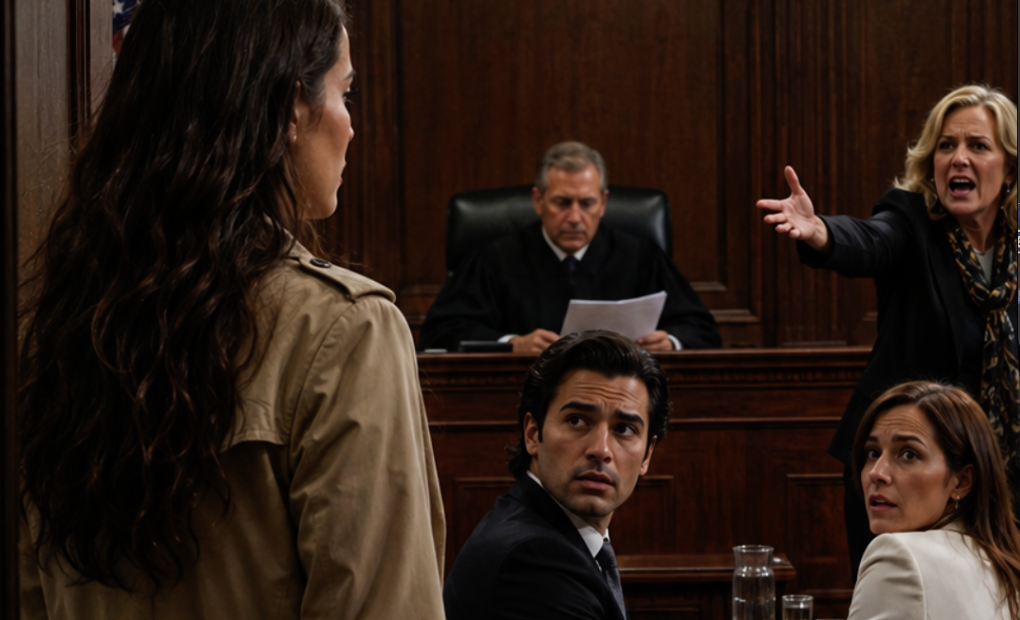
When I burst into Courtroom No. 14, the clock above the heavy oak door showed 11:15.
Fifteen minutes late.
Judge Petrenko—a dry, pedantic man whose face reminded me of a grumpy owl—looked at me disapprovingly over the top of his glasses. He had already opened his mouth to utter the dreaded phrase:
“Due to the plaintiff’s failure to appear…”
“I’m sorry, Your Honor! Traffic,” I gasped, dropping heavily onto my rightful bench.
And then I saw them.
On the defendant’s bench, sitting so close together that not even a rose petal could have fit between them, were two people.
My husband—my former husband?—Andrei.
And her.
I knew her face.
I had seen it on Andrei’s phone two months before he silently packed a suitcase and placed the divorce papers on the kitchen table.
“Difference in personalities,” he had written as the reason.
A lie.
The real reason was sitting beside him now, adjusting her platinum-blonde curls and shooting me a victorious look.
Ksenia.
Five years younger than me. Fresher. More flexible. She had full lips and an expensive handbag—the same model Andrei had promised to buy me for New Year’s after I had once admired it in a magazine.
Something inside me snapped.
All week, while gathering documents for the division of our property, I had entertained myself with one stupid hope.
Maybe he would come to his senses.
Maybe this was just a crisis we could somehow outgrow.
But seeing them together, in court, on the very day the fate of our shared apartment and our shared life was being decided, felt like a slap across the face.
Andrei would not look at me.
He stared down at his phone, nervously dragging one finger over the screen. Only the collar of his white shirt—the same collar I had ironed every morning for five years—was unbuttoned.
I knew what that meant.
He was nervous.
“Very well, let us continue,” Judge Petrenko said, his voice sounding almost like a sentence being passed. “The matter before the court concerns the dissolution of marriage and division of jointly acquired property between citizen Anna Igorevna Reshetova and citizen Andrei Pavlovich Reshetov. Plaintiff, you were late. Please be punctual in the future.”
“Yes, Your Honor,” I squeaked.
The judge sighed and began reading the prepared summary.
The apartment in Sokolniki.
The car.
Two futuristic sculptures from an exhibition that had cost as much as half a year of my salary. Andrei called them “investments in art.”
I called them “idiocy.”
The lawyer I had hired with the last of my savings, a capable man in a gray suit, was rapidly making notes in his notebook.
“Considering that the marriage has effectively broken down, responsibility for the destruction of the family lies…” Petrenko removed his glasses and tiredly rubbed the bridge of his nose. “…in this case, with both parties. However, the defendant has been recognized as the initiator of the divorce.”
I looked at Andrei.
The initiator.
Of course.
The initiator who had left me for his new “investment sculpture.”
“As for the division of property, the court is inclined toward the arrangement proposed by the plaintiff’s attorney, namely…”
He read out the figures.
Seventy percent to thirty in my favor, taking into account that Andrei had violated our financial agreement. Technically, we had never signed a formal prenuptial agreement, but there was a written acknowledgment that I had paid for the kitchen renovation with my own money.
I saw Ksenia’s knuckles turn white.
She grabbed Andrei by the elbow and whispered something venomous into his ear.
Andrei stood.
“Your Honor, this is unfair. The apartment was purchased with my money—”
“Your arguments have already been entered into the record,” the judge said, lifting one hand to stop him. “The decision will be announced in five minutes. Both parties may make a final statement.”
My heart was pounding somewhere in my throat.
I stared at my husband.
God, he was still handsome, even now, with his face twisted in anger.
Five minutes.
Five more minutes, and I would receive my share.
I could buy a tiny studio apartment somewhere on the outskirts of the city and begin a new life without constantly feeling that I was somehow “interfering” with his artistic impulses.
My lawyer touched my shoulder.
“Everything is fine. Don’t worry.”
And then the door opened.
At first, I thought it was a court employee who had forgotten a folder or some papers.
But no.
Standing in the doorway, blocking the light from the corridor, was a small, stooped woman in a beige coat. Her gray hair was combed smoothly back, and she carried an enormous string shopping bag with a loaf of bread sticking out of it.
Valentina Pavlovna.
My mother-in-law.
“Mom?” Andrei and I breathed at exactly the same time.
She was his mother, but for the past three years, Andrei had forgotten even to wish her a happy birthday.
I was the one who took her to the doctor.
I bought her blood-pressure medication.
I listened to her endless stories about how “everything used to be better.”
Somewhere along the way, a strange, quiet friendship had formed between us.
“Your Honor,” Valentina Pavlovna said.
She did not ask permission to enter.
She simply walked inside, looked around the courtroom as if she owned the place, and stopped directly in front of the judge’s desk.
“I’m late. The bus broke down. But I want to testify.”
“Madam, this is a closed hearing,” the judge said with a frown. “Who are you?”
“I’m a witness,” she said firmly.
“A key witness.”
Ksenia rolled her eyes and sighed theatrically.
Andrei hissed:
“Mom, get out of here. This has nothing to do with you.”
His lawyer—a smug-looking man with a signet ring on his little finger—was already rising, apparently preparing to call the bailiff.
But Judge Petrenko, to my surprise, hesitated.
Perhaps he, too, sensed something in this small woman carrying a shopping bag.
Something dangerous.
“Your passport, please. And what exactly do you wish to testify about? The hearing is practically over. The decision is about to be announced.”
“Then don’t announce it yet.”
Valentina Pavlovna placed her shopping bag on the floor and pulled a piece of paper from her coat pocket. It had been folded into quarters.
The paper was old, yellowed around the edges.
“This is the will of Pavel Reshetov, my husband and Andrei’s father. It was written two years before his death. Notarized.”
“Dad died ten years ago,” Andrei said blankly. “What is this nonsense?”
The courtroom fell silent.
Behind me, I heard the door creak.
The bailiff had frozen in the doorway.
“The apartment you are dividing,” my mother-in-law continued, turning toward me, “was purchased with money Pasha received for an invention. Not with your money, Andrei. And not hers.”
She nodded toward Ksenia.
“You, son, contributed exactly zero kopecks. You took out a mortgage to make it look official, but the down payment came from your father’s inheritance. And according to the law, if that inheritance was not properly registered…”
“The inheritance was properly registered,” Andrei’s lawyer interrupted in a hoarse voice. “The apartment is legally considered jointly acquired property because—”
“Because my son forged a signature on the purchase agreement and transferred his deceased father’s share to himself.”
Valentina Pavlovna paused.
In the silence, I could hear the ticking of the wall clock.
“And I keep the original will at home in a small box. In that will, Pavel leaves all of his property not to me and not to his son, but to Anna—because she cared for him in hospice during the final three months of his life.”
She looked at Andrei.
“My husband was afraid you would sell everything and drink the money away. And it seems he was right.”
Ksenia jumped to her feet.
Her perfect hairstyle was beginning to come apart.
“That’s a lie! Andrei, tell them!”
But Andrei said nothing.
His face had turned the color of wet asphalt.
He looked at his mother.
Then at me.
Then at the old sheet of paper.
And in his eyes, I saw not anger, but fear.
Fear of being exposed.
So it was true?
Had he really forged the documents?
Judge Petrenko slowly held out his hand for the paper.
Valentina Pavlovna walked over and placed it into his fingers.
“I’m not a witness to their divorce,” she said, turning toward me.
“I’m a witness to love.”
Her voice remained calm.
“Anna took care of my dying husband while her own husband—my son—was traveling to resorts with that…”
She gave Ksenia an icy glance.
“…woman.”
“She gave Pasha three months of her life. To a man who wasn’t even her blood relative. And all of you are sitting here arguing over who gets the refrigerator.”
A tear rolled down my cheek.
I did not wipe it away.
“Your Honor,” my lawyer whispered as he stood, “this changes everything. Potentially even the legal status of the property itself, not to mention possible criminal prosecution for forgery.”
“The hearing is adjourned pending verification of this information,” the judge said.
For the first time that morning, his voice trembled slightly.
He removed his glasses and looked at Valentina Pavlovna with something that resembled respect.
“Citizen… mother of the defendant. Why did you not come forward earlier?”
My mother-in-law smirked.
She picked up her shopping bag, reached inside, pulled out a red apple, and handed it to me.
“Because I wanted to see the faces of those bastards,” she said, nodding toward Ksenia and Andrei, “at the exact moment their world collapsed.”
She smiled faintly.
“And I saw it.”
Then she turned back to the judge.
“Now, Your Honor, may I sit beside my daughter-in-law? Today is an important day for her. And she needs family.”
The judge silently nodded.
Andrei was no longer looking at me.
He stared at the blank sheet of paper lying in front of him, realizing that he had lost not only the apartment but also his final chance to be treated like a decent human being.
Ksenia clutched her handbag and began whispering rapidly and bitterly:
“I didn’t know anything. I had nothing to do with this. I’m practically here by accident.”
But no one was listening to her anymore.
Valentina Pavlovna sat beside me.
She smelled of bread and the autumn wind.
She reached out with her dry, wrinkled hand and covered mine, which was still clutching the apple.
“It’s all right, my girl,” she said quietly enough that only the two of us could hear.
“God sees everything.”
She glanced toward the judge.
“And sometimes judges do too.”
A peculiar silence settled over Courtroom No. 14—the kind of silence that comes only before a storm.
Or before the most long-awaited, most righteous storm of your life.
I closed my eyes and breathed in.
For the first time in many months, I could finally take a full breath.