The City Bride Demanded Oysters at a Village Wedding, but Her Father-in-Law Found an Alternative…
Andrey brought Karina to the village around the middle of June. Bright summer nights hung over the river, the bird cherry trees were in full bloom, and the air seemed thick and sweet, with the faint bitterness of young nettles.
Karina got out of the car, looked around carefully, and asked suspiciously:
“Oh my God, what a backwater. There isn’t even a decent supermarket here?”
Andrey only smirked.
He knew perfectly well what he had signed up for.
He and Karina had met two years earlier in a big city, where Andrey had gone to take advanced training courses for mechanics. She worked as a manager at a beauty salon—tall, striking, with bright fuchsia nails and the latest smartphone.
Andrey was an ordinary village guy, a specialist in diesel engine repair.
Karina constantly used words like “okay” and “super,” while Andrey, out of old habit, might simply say “all right” or “fine.” She loved ordering salmon rolls, while Andrey sometimes desperately missed his mother’s homemade shangi pastries.
They seemed completely different—almost like a noisy city and a quiet village.
But perhaps it was precisely those differences that had brought them together.
Karina added color to Andrey’s measured life, while he gave her something she had always lacked—a sense of peace and reliability.
After a year and eight months together, Andrey proposed to her.
Karina cried with happiness, said yes, and almost immediately started making a guest list, which soon grew to one hundred and twenty people.
However, Andrey calmly but firmly informed her that the wedding would take place in his native village.
His home was there.
His parents and numerous relatives lived there.
The graves of his ancestors were there.
Karina visibly grimaced, but in the end she chose not to argue.
And now she stood in the middle of a village street in expensive designer sneakers, staring at the log houses as if Andrey had brought her not to meet his parents, but had dropped her off somewhere on the Moon.
“It’s not so bad,” he said, taking his fiancée by the hand. “You’ll get used to it little by little. The people here are good.”
“Maybe the people are good,” Karina sighed heavily. “But I still want a proper wedding. I don’t want it to look like something from the nineties—strong alcohol, karaoke, and then inevitably some kind of fight. Everything has to be respectable. A beautiful buffet, good appetizers, champagne. And oysters. Definitely oysters.”
Andrey nearly choked.
“What oysters? Karina, where are we supposed to get oysters here? The nearest large settlement is thirty-five kilometers away, and part of the road isn’t even paved. Where am I supposed to find oysters for you?”
Karina pursed her lips in offense.
“So on the most important day of my life, I’m supposed to give up what I want? I’ve always dreamed of a beautiful wedding. Oysters are a classic. On ice, with lemon. Your father is a fisherman, isn’t he? Let him get some.”
Andrey opened his mouth to object, but then changed his mind.
Arguing with Karina at moments like this was completely pointless.
Especially now that she had fully entered “bride mode.”
Sergey Petrovich, Andrey’s father, met his future daughter-in-law right on the porch.
He was fifty-eight, though he looked noticeably younger. Thin, wiry, with strong hands whose skin was constantly covered with tiny cracks from hard work and water.
Sergey Petrovich had spent thirty-five years on the river.
He fished, hunted, and traveled by boat.
He knew every shallow, every bend, and every rapid for many kilometers in both directions.
His face was calm, deep wrinkles lined the corners of his eyes, and his gaze remained attentive and sharp—the kind often found in people who, over many years, have learned to understand nature from its smallest signs.
“Hello, Sergey Petrovich,” Karina said, trying to smile as warmly as possible. “I’m very happy to finally meet you.”
“Hello, daughter,” the man replied.
He nodded and shook her hand firmly but carefully.
“Come inside. Mother baked pies.”
At the table, the conversation quickly turned to the upcoming wedding.
Andrey’s mother, Galina Ivanovna, a gentle, round-faced woman of fifty-five, had already planned the festive menu.
She intended to serve meat jelly, salted milk mushrooms, homemade fish and cabbage pies, pike-perch soup, roast elk, soaked lingonberries, and cranberry drink.
Almost everything was their own.
Homemade.
Cooked in the oven.
Karina listened to her future mother-in-law, set down her fork, and added:
“And I also want oysters. And good champagne—French, of course. The presentation has to be beautiful too. I’ve already booked a photographer. He’s coming from the city.”
Silence fell over the table.
Galina Ivanovna looked uncertainly at her husband.
Andrey lowered his eyes to his plate as though he had suddenly discovered something incredibly interesting there.
Sergey Petrovich remained silent for a while.
Then he slowly set aside his cup of tea.
“So, oysters?” he clarified.
“Yes. They’re seafood,” Karina began explaining, assuming her future father-in-law had simply never encountered them. “They’re eaten raw, usually with lemon. They come in shells. They’re very tasty. And they look elegant.”
Sergey Petrovich studied the girl carefully.
For a moment, a strange expression appeared in his eyes.
Not irritation.
Not offense.
More like an old, deeply hidden excitement.
It was roughly the same expression he usually had when looking at the river before setting out to place a fishing net.
“I see,” he finally said, rising from the table. “You’ll have your oysters. Just don’t be offended—they’ll be ours. Local ones.”
Karina blinked in surprise, but she didn’t ask any questions.
Sergey Petrovich left the house.
A minute later, the characteristic clatter of equipment came from the shed—the man had started taking out his fishing gear.
Karina leaned toward Andrey.
“Where is he going?” she whispered.
“Probably to the river,” Andrey replied just as quietly. “Don’t worry. If Dad promises something, he always does it.”
The next morning, Sergey Petrovich left before dawn.
He took a spinning rod, a box of lures, an old canvas backpack, and a thermos of hot tea.
He headed upstream, toward the place where the river became rocky, the rapids began, and grayling could be caught especially well.
Sergey Petrovich knew this fish perfectly.
Grayling was considered a noble fish.
It needed clean, cold, fast-running water.
Its meat was tender, slightly pink, with few bones, and fresh grayling had a faint cucumber-like aroma—the smell of purity and of the river itself.
Fresh grayling could be sliced thin, lightly salted, and served at the table.
In Sergey Petrovich’s opinion, such a treat was every bit as good as foreign oysters.
Maybe even better.
Because it was theirs.
Because it came from their own river.
Because it had been caught with his own hands.
As he walked along the riverbank, Sergey Petrovich thought about his future daughter-in-law.
To be honest, he liked Karina.
Of course, she was completely different—a city girl, bright and fashionable, with her fuchsia nails, expensive phones, and unfamiliar desires.
But he could sense immediately that she had character.
And Sergey Petrovich had always respected people with character.
The only thing was that village life did not suit everyone.
It was not easy here for someone weak.
Karina simply did not understand that yet.
That was all right.
She would understand with time.
If Andrey had chosen her, then he must have seen something real in her.
Something much deeper than bright nail polish and city habits.
For now, that real part of her was simply hidden beneath the outer shine and the layers of city life.
And Sergey Petrovich decided to help bring it out a little.
Much like the spring sun helps a seed hidden underground finally begin to sprout.
At the third rocky rapid, Sergey Petrovich finally found the right spot. The grayling were hiding in the cool shadow behind a large boulder, sheltered from the strong current. The man did not rush. He chose his position, carefully cast the lure, and landed it exactly in the right stream of water.
The bite came almost immediately.
The fish struck sharply and fiercely—the way only grayling could. Sergey Petrovich smiled with satisfaction and carefully began bringing his catch toward the shore.
By noon, fourteen excellent fish were splashing in his keepnet. Their large silver scales gleamed in the sun, and their dorsal fins shimmered with rainbow colors.
When he finished fishing, Sergey Petrovich sat down on the riverbank. He poured himself some tea from the thermos and spent a long time looking at the river.
The sun was already high. The water sparkled beneath its rays, the current calmly flowed around the stones, and Sergey Petrovich’s thoughts moved just as slowly and evenly.
He did not return home until evening.
When Galina Ivanovna saw the catch, she threw up her hands.
“Seryozha, why did you catch so many? You could feed an entire army with this!”
“For the wedding,” Sergey Petrovich explained briefly. “Tomorrow I’ll show you how we’re going to prepare it.”
He spent almost the entire next day in the kitchen.
Sergey Petrovich cleaned and filleted the fish himself—carefully, almost with a jeweler’s precision. With a sharp knife, he removed the fillets gently so as not to damage the tender flesh or ruin its texture.
He sprinkled the prepared pieces with coarse salt, added just a little sugar, black pepper, and fresh dill. Then he put everything in the cool cellar.
The grayling needed time to cure evenly, absorb the aromas, and reach exactly the condition Sergey Petrovich considered perfect.
When the fish was finally ready, he sliced it into extremely thin, almost transparent strips and arranged them neatly in rows on a large wooden platter.
On top, he added very thin rings of onion that had first been soaked in vinegar.
He placed lemon wedges around the edges.
Separately, he set out a small clay bowl of sauce made from sour cream, grated horseradish, and a little mustard.
When he was finished, Sergey Petrovich covered the platter with a clean towel and put it somewhere cold until the next day.
Galina Ivanovna watched her husband the entire time and could only shake her head in amazement.
“Seryozha, you’re working as if you’re preparing something for the tsar’s table.”
“For my own son’s wedding, I can make the effort,” he replied calmly. “The girl wanted oysters, so she’ll get oysters. Just our way.”
The wedding day turned out sunny and warm like a true summer day.
They decided to set up the tables right in the yard beneath an old spreading bird cherry tree. They covered them with snow-white starched tablecloths, and Galina Ivanovna brought out the finest dishes kept in the house.
Around forty people came to the celebration.
Relatives, neighbors, and Andrey’s friends.
Three of Karina’s city friends arrived from her side. They had come the day before and had spent almost the entire night marveling at village conditions, complaining about mosquitoes and the absence of their usual hot water.
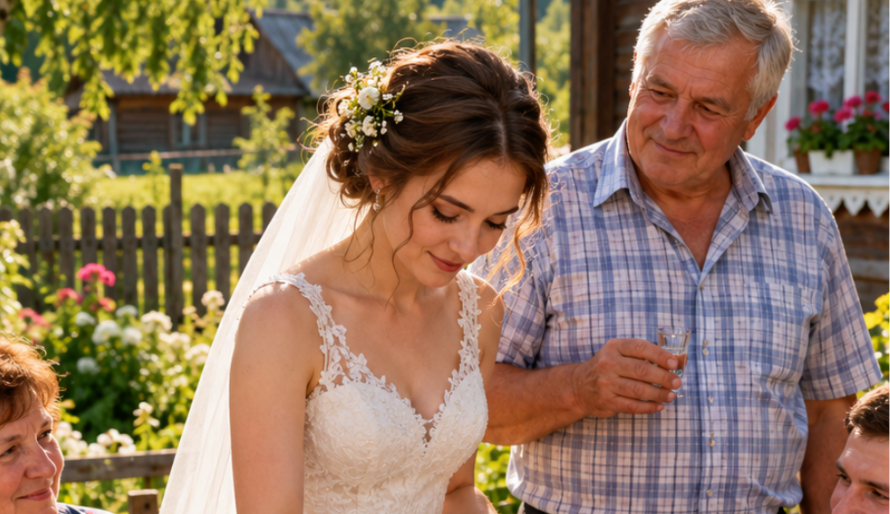
Karina appeared before the guests in a white wedding dress.
The dress was unexpectedly restrained and elegant—no enormous crinoline, excessive sparkle, or showers of rhinestones.
The bride truly looked beautiful.
Even the local aunties, who had previously studied the city girl carefully and rather critically, now nodded approvingly.
Andrey stood beside his bride and simply could not take his eyes off her.
The celebration gradually gathered momentum.
The guests shouted “Bitter!” to make the newlyweds kiss, made toasts, raised their glasses to the bride and groom, and then separately to their parents.
Galina Ivanovna kept crying with happiness and dabbing her eyes with the corner of her apron.
But Karina periodically glanced at the festive table.
It was obvious she was waiting for something.
Her friends also started whispering among themselves.
“Where are the oysters? You said they’d definitely have them.”
When the feast had already gone on for quite some time and the guests were beginning to grow a little tired, Sergey Petrovich suddenly rose from his seat.
Without saying a word, he stepped away from the table and headed toward the cellar.
The conversations gradually died down.
Everyone waited.
A few minutes later, Sergey Petrovich returned.
He walked straight and solemnly, carrying an enormous wooden platter in both hands.
On top of a layer of crushed ice prepared in advance lay neat rows of paper-thin strips of grayling—pale pink, translucent, decorated with fresh green dill.
Around the edges, Sergey Petrovich had arranged lemon wedges.
In the very center stood a small clay bowl containing the sauce he had prepared the previous day.
He approached the table and carefully placed the platter before the guests.
Then he calmly looked around at everyone and said loudly, without unnecessary ceremony:
“Here’s the promised treat. I told the bride there would be oysters, so here they are. Only our oysters are our own. Grayling, prepared our way. River fish—clean, caught with my own hands in our own river. Of course, it isn’t seafood, but I’ll tell you, it’s a worthy product all the same. So go ahead and try it.”
For several seconds, the table fell completely silent.
Karina’s city friends craned their necks with curiosity, trying to get a better look at the unusual dish.
The bride herself stared at it with wide eyes.
Her face revealed one emotion replacing another.
First came genuine surprise.
Then a flicker of disappointment—after all, these were not the oysters she had imagined.
Then curiosity appeared.
And after that came something else.
Something warm and unexpected.
A feeling Karina herself did not seem to have expected.
“Sergey Petrovich,” Karina said quietly. “Did you… prepare all this yourself?”
“Myself,” he confirmed with a nod. “All with my own hands. Our river, our grayling, and my own hands too. Just try it first. Don’t be afraid.”
Karina carefully picked up her fork.
The table became so quiet that the buzzing of bees among the flowering branches of the bird cherry tree could clearly be heard.
The bride picked up a thin strip of fish, lightly dipped it in the sauce, and put it into her mouth.
She closed her eyes.
Chewed slowly.
Then she suddenly smiled.
Widely and completely sincerely—the same smile that had impressed Andrey so much two years earlier when they first met amid the noise of the big city and its endless concrete buildings.
“Oh my God,” Karina breathed. “This is… unbelievably delicious! This is much better than any oysters! I swear!”
The guests burst into applause.
Andrey was glowing with happiness, looking from his wife to his father and back again.
After seeing Karina’s reaction, her friends also gathered their courage and reached toward the wooden platter with their forks.
Five minutes later, it was completely empty.
Not a single slice of grayling remained.
Sergey Petrovich stood a little to the side with his arms folded across his chest. In his narrowed eyes, surrounded by deep wrinkles, there was a quiet, restrained pride.
He said nothing more.
There was no need.
Everyone present had understood perfectly well what he wanted to show them.
By evening, the guests gradually began heading home.
Karina approached her father-in-law.
She had already taken off her high-heeled shoes and now stood barefoot on the warm June grass. Not long ago, she had looked like a true city princess who had somehow wandered into a completely foreign world, but now it was as though, for the first time, she could truly feel this land beneath her feet.
“Sergey Petrovich,” Karina began, then hesitated. “I wanted to apologize to you. About the oysters. And about everything in general. I behaved like… well, you know. And you did so much. You put in so much effort. All for me.”
Sergey Petrovich looked carefully at his daughter-in-law.
His gaze remained serious, but there was no sternness in it.
“You don’t need to apologize,” he replied. “You didn’t say any of it out of malice. You just don’t know our way of life yet. That’s all right. You’ll learn with time. You’re our bride now. A village bride. And we don’t begrudge anything for our own people. Understand?”
Karina silently nodded.
A heavy lump suddenly formed in her throat, and she could not answer immediately.
“And one more thing,” Sergey Petrovich continued.
A familiar hint of mischief suddenly appeared in his voice.
“If you want our oysters again, just say so. The river isn’t going anywhere. But next time, you’ll come with me. I’ll teach you how to fish.”
“I’ll come,” Karina replied immediately.
Then, surprising even herself, she stepped toward her father-in-law and hugged him tightly.
“I definitely will.”
Sergey Petrovich was clearly unaccustomed to such displays of affection.
For several seconds, he seemed confused, and then awkwardly patted Karina on the back with his large hand, roughened by years of work.
Something barely perceptible trembled in his eyes.
Then the man’s face seemed to soften.
Three years have passed since that wedding.
Now, every summer, Karina goes to the river herself.
Instead of designer shoes, she wears rubber boots, and in her hands is the fishing rod Sergey Petrovich gave her.
She has never asked for real oysters again.
Whenever someone remembers that story, Karina simply smiles and says:
“Why would I need them when we have our own?”
At moments like that, Sergey Petrovich watches his daughter-in-law, who now handles a spinning rod quite confidently on the river rapids, squints contentedly, and says to Andrey:
“You found yourself a good wife, son. She may be a city girl, but now she’s one of us. And that’s the most important thing.”
Andrey only nods.
Because he knows perfectly well that his father was right once again.