The last gift Vera ever received from her mother was when she was eleven: blue mittens with a white snowflake on the back.
Her mother knitted them in the evenings at the hospital, between IVs. Vera would visit after school, sit at the edge of her mom’s bed, and watch the knitting needles flashing back and forth. Her mom was so thin her wedding ring dangled on her finger, but she still held the needles with confidence.
“These are for you for winter,” her mom said when she finished. “So your hands won’t get cold.”
Her mother passed away that October. Vera wore the mittens for three winters, until the big thumb tore. She didn’t throw them away, but stored them in a shoebox. That box has traveled with her to every apartment since then.
Two years later, her father remarried. Stepmother Irina Borisovna was not a mean woman, but she was cold. On Vera’s birthdays, she’d give her an envelope with exactly a thousand rubles, no card, and say, “Buy yourself something.” Vera hadn’t received a gift just because, with no special occasion, in about fifteen years.
That’s why, when Valentina Sergeevna brought her some towels the very first month after the wedding, Vera nearly burst into tears.
The towels were waffle-textured, white, three pieces. In the corner of each, the letter “V” was embroidered in blue thread.
“I made them myself,” said her mother-in-law, unpacking the bag in the hall. “I embroidered them. ‘V’ is for Vera. So you’d have your own and wouldn’t mix them up with Romka’s.”
Vera stood there holding the towels, not knowing what to say.
“Thank you,” she finally managed to say. “Valentina Sergeevna, thank you. This is so… so lovely.”
“Oh, don’t mention it,” her mother-in-law waved her hand. “It’s nothing. Wasn’t hard for me.”
Later, Vera spent a long time looking at those towels in the bathroom. The little blue ‘V’ in the corner. Someone had stitched her initial, just for her. Someone had thought of her.
Then Valentina Sergeevna brought over a set of food containers—twelve in total, all different sizes with brightly colored lids. “I got them on sale, so you can take homemade lunches to work,” she said. Next came a blouse from the market, pink with tiny flowers: “This will look good on you, your eyes are so light.” Then some fridge magnets from a trip to visit her sister in Yaroslavl. And finally, a mug that read “To My Favorite Daughter-in-law.”
The gifts weren’t expensive. Vera knew this well. The blouse was made of synthetic fabric and after a month, little pills appeared all over it. The containers cracked after their second run in the dishwasher. But Vera truly didn’t care how much they cost.
To her, it felt warm. Like she had been accepted. Like she had a mother again—maybe not quite a real mom, but almost. Someone who’d embroider her initial onto a towel.
She really wanted to become like a daughter to Valentina Sergeevna. She used her full name when speaking, but in her mind, she called her “Mom Valya.” She would bake her favorite cabbage pie. She’d call every Sunday, just to ask how she was doing.
The first request came a week after the containers.
“Verotchka,” Valentina Sergeevna called on Wednesday. “Are you free this Saturday? I could use some help tidying up the yard at the dacha. Raking leaves, clearing branches. It’s hard for me to do alone, you know, my back.”
“Of course, Valentina Sergeevna,” Vera said. “I’ll come.”
Vera showed up. For six hours, she raked leaves, dragged branches to the fire pit, cleared the pathways. Her mother-in-law sat on the veranda with a cup of tea, pointing out where needed more work.
That evening, Vera rode home on the train, blisters on her palms, thinking: well, that’s only right. After all, her mother-in-law gave her containers, embroidered towels for her. It’s only fair to help out.
Then there was the robe. Terry cloth, turquoise, with a hood. “You always get cold after showers—Romka told me,” Valentina Sergeevna said. Vera was touched almost to tears.
Three days later, her mother-in-law called again:
“Verotchka, I need to go to the cardiologist at the clinic on Thursday. Could you drive me? You have a car.”
Vera took time off from work. She drove her mother-in-law, then waited in the clinic corridor for two hours: first the line, then the cardiologist, then tests. Afterwards, Valentina Sergeevna said since they were already in town, they should pop by the Pension Fund for a form. Then to the government office for subsidy paperwork. Then to the market for cottage cheese—“My friend the old lady there makes the best.”
Vera didn’t get home until almost eight in the evening. She had spent the entire day, having left work early, driving her mother-in-law around the city.
On Vera’s birthday—she turned thirty—Valentina Sergeevna gave her a pair of earrings. Silver, with blue cubic zirconia, in a small velvet box.
“These are for you. They match your eyes.”
Vera put them on immediately, right at the table. She kissed her mother-in-law on the cheek.
Two days later, on Monday evening, Valentina Sergeevna called:
“Verotchka, don’t make any plans for this weekend. We’re going to the dacha. The windows need washing before winter. And the shed needs to be cleared out—it’s been piling up junk for ten years.”
“Valentina Sergeevna, I have theater tickets this weekend. My friend and I have been planning for ages…”
A pause on the line. Long and heavy.
“The theater,” her mother-in-law said. Her voice had gone cold. “I see. So I’ll do it myself, then. With my back, alone. Well. I thought…”
Vera canceled her tickets and told her friend Nastya she was sick. On Saturday, she ended up washing all the windows at her mother-in-law’s country house—six of them, frames and sills included. Sunday was spent cleaning out the shed: old skis, rusty rakes, cans with dried-up paint, and bags filled with who knows what.
She didn’t wear her cubic zirconia earrings that day. They stayed at home in their velvet box.
This went on year after year. The gifts changed, the requests changed, but the pattern was always the same.
Gradually, Vera started to notice a connection.
At first it was vague. Then it became clearer and clearer.
Every present, every little thing, every sweater from the market—within a few days, there was a request. Sometimes it was small; other times, she’d be needed the entire weekend. And if Vera tried to say no, Valentina Sergeyevna would get upset. She wouldn’t shout or make a scene. She would just fall silent on the phone, then say in an icy tone:
“I’ve given you towels, a robe, even those earrings. And you can’t help me just once.”
Or:
“I do so much for you, and you…”
Or, with a sigh in front of Roman:
“Romochka, I give Vera everything. From the heart. But she just turns up her nose.”
Vera realized that these gifts weren’t really gifts at all. They were like receipts, sent later to be paid off. Take the containers—now you owe yard work. Wear the robe—drive me to the clinic. Put on the earrings—wash the windows.
She tried talking to Roman.
“Roma, it’s hard for me. Your mom asks for something every single week. I spend all my weekends at her place. I even missed the theater because of her. Maybe you could help her out sometimes too?”
“Vera, come on,” Roman was surprised. “My mom does everything from the heart. She gives you presents. She loves you. And you’re upset over nothing? So you went once, so you washed some windows—what’s the big deal?”
“It’s not just once, Roma. It’s every single week.”
“So what? She tries so hard for you. Don’t be ungrateful.”
And there was something else Vera noticed: Valentina Sergeyevna almost never asked her son for help. Almost never. “Romochka gets tired, his job is tough.” “He needs to rest on weekends.” “I don’t want to bother him—his back.” Digging in the garden, driving to the clinic, washing the windows, cleaning the shed—all of it was for Vera. In five years of marriage, Romochka went to his mom’s country house maybe five times, and that was just for barbecues.
Her mother-in-law purposely came to her. Not to her son. To her daughter-in-law. Because the daughter-in-law owed her. She had been given gifts.
In the middle of October, Vera had a rough week.
She worked as a dispatcher at a taxi service, pulling shifts, and with a coworker out sick, she worked three nights and two days in a row. She slept in short bursts—three or four hours at a time. By Friday, she was barely holding it together.
On Thursday, Valentina Sergeyevna called:
“Verочка, on Saturday I need to go to the social security office, then the dentist, then shopping on Severnaya. Can you drive me?”
“Valentina Sergeyevna,” Vera replied, “I can’t this Saturday. I had a really tough week and barely slept. I need to rest. Maybe Roma could take you?”
“Roma?” Her mother-in-law sounded surprised. “Romochka is resting on Saturday. He’s tired.”
“I’m tired too, Valentina Sergeyevna.”
Her mother-in-law fell silent.
“Alright,” she said. Then hung up.
On Friday evening, around eight, the doorbell rang.
Valentina Sergeyevna stood at the door, holding a large bag. She walked into the hallway without taking off her shoes and handed the bag to Vera.
“Here. This is for you.”
Inside the bag was a blanket. It was fleece, gray, checkered, with a tag that read “sale — 499 rubles.”
“So you don’t get cold,” said her mother-in-law. “You work nights, you must get chilly.”
Vera stood in the hallway, holding the blanket. She already knew what was about to happen.
“Thank you, Valentina Sergeyevna.”
“Oh, don’t mention it.” Her mother-in-law finally took off her boots, went to the kitchen, and sat down at the table. Roman was in the living room, watching TV. “So, Vera, here’s the deal. Tomorrow at seven in the morning, we’re heading to the dacha. The beds need to be dug over for winter. Six of them. And we have to move those old planks out from behind the shed, there’s a whole mountain. I can’t do it alone, you know that. Bring gloves.”
“Valentina Sergeyevna,” said Vera, standing in the kitchen doorway, still clutching the blanket. “I told you yesterday. I can’t this Saturday. I want to sleep in. I’m not going.”
Her mother-in-law looked at her. First surprised, then with a slight, almost amused smirk.
“You’re not going?” she drew out. “Well, well. She’s not going, she says.”
She leaned back in her chair.
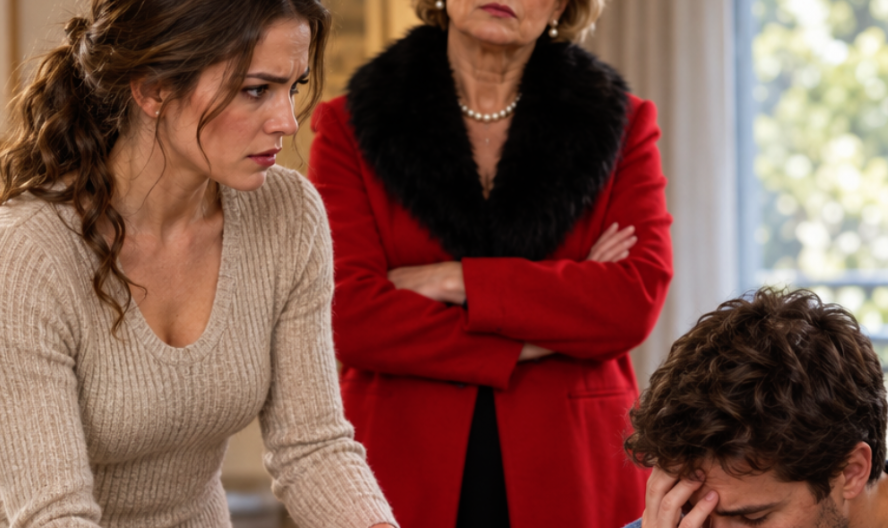
“But you took the blanket, didn’t you? There it is, right in your hands. Wearing my robe? Yes, you are. I saw it hanging in the bathroom. My earrings, right there in your ears. My towels, my containers, my cardigan. You keep the ‘Favorite Daughter-in-law’ mug on the shelf. That means you’re obligated. You don’t have the right to refuse me, Vera. I don’t give you these things for nothing. I spend on you. From my heart. And what do you give me? ‘I’m not going’? Oh no. Tomorrow, seven o’clock. And don’t forget your gloves.”
Vera stood in the kitchen doorway, watching her mother-in-law.
Her mother-in-law sat at the table, smiling. Confident, calm. As if she were explaining something obvious. As if she were talking about a loan that needed to be paid off, and Vera had simply forgotten the installment.
Vera glanced at her husband. Roman had come out of the living room when he heard the voices and stood in the hallway.
“Roma,” Vera said.
“Come on, Vera,” Roman said. “Mom’s right. Just go. She even brought you a blanket.”
Her mother-in-law left half an hour later. As she walked out the door, she said,
“So, tomorrow at seven, Vera. I’ll be waiting.”
Vera closed the door behind her. She stood in the hallway for a moment.
Then she went to the bathroom. She took three waffle towels with a blue “V” in the corner off the hook and folded them.
She entered the kitchen, opened a cupboard, took out a stack of plastic containers with colorful lids—the ones that hadn’t cracked yet. She took the ‘Favorite Daughter-in-law’ mug off the shelf.
In the bedroom, she opened the wardrobe. She took out a pink floral cardigan, bobbled with wear, and removed a turquoise hooded robe from the hanger.
She took the magnets off the refrigerator. Yaroslavl, Kostroma, Suzdal.
She opened the jewelry box on her dressing table, took out a velvet case, removed the earrings with blue cubic zirconia, put them in the case, and closed it.
She picked up the blanket, which was still lying on the hallway cabinet, tag showing “sale — 499 rubles.”
She packed everything into a large ‘Lenta’ shopping bag. It was almost full. Five years of marriage, and everything fit into a single bag.
She took the bag to the living room, where Roman was once again watching TV, and set it down on the coffee table in front of him.
“Take it back to your mother,” she said. “I’m done paying for her so-called ‘kindness.'”
Roman looked at the bag. Then at his wife. Then back at the bag.
“Are you serious?” He laughed, a bit unsure. “Vera, what are you doing? These are gifts.”
“They’re not gifts, Roma.”
“How are they not gifts?” He pulled a robe from the bag. “Look, a robe. My mom gave this to you. And these towels—she embroidered them herself, Vera! Herself! And you want to give them back? That’s just ungrateful. You’ll really hurt her.”
“Rom…”
“No, listen to me.” He threw the robe back in the bag. “Over what? A five-hundred-ruble blouse? A blanket? That’s nothing! Was it really so hard to go to the dacha just once? Why make such a scene over a few cheap things?”
Vera sat down in the chair across from him.
“Roma. It was never about the price. Not once. I didn’t care how much those towels cost. When your mom brought them, I nearly cried. No one had given me anything just because for fifteen years. Not since my own mother died.”
Roman fell silent.
“I thought she loved me,” Vera said quietly. “That she accepted me. But then I realized that every one of her ‘gifts’ came with a price. The containers meant I should tidy up the yard. The robe—drive her to the clinic and then three other places. The birthday earrings—two days later I had to wash windows and clear the shed. That five-hundred-ruble blanket—tomorrow at seven, I should dig six garden beds. You heard what she said yourself. ‘You owe me. You have no right to say no. I spent money on you.’ For five years, Roma, five years, I paid for those containers and blouses with my weekends. With my time, my back. I missed out on going to the theater, on sleep. I just don’t want to do it anymore.”
Roman stared at her in silence. You could tell from his face he didn’t understand a word. He just saw a bag of cheap things—only cheap things.
“You know what,” he finally said. “You’ll apologize to my mom. Tomorrow. And you’ll go to the dacha like she asked. And you’ll go on helping her, just like before. She’s old now. She’s sixty. Who’s going to help her if not us?”
“‘Not us,’” Vera repeated. “Roma, why is ‘us’ always just me?”
“What do you mean?”
“Why does your mom never ask you for help? You’re her son. Why am I the one digging in the garden instead of you? Why am I the one taking her to the clinic, cleaning windows at the dacha? You’ve been to her dacha five times in five years, and only for barbecues. Meanwhile, I go every week. Why, Roma?”
Roman opened his mouth, then closed it again.
“Well…” he said. “I work.”
“I work too. At night.”
“But my back—”
“I’ve got a back too, Roma. After digging six garden beds, my back hurts too.”
He said nothing. He didn’t have an answer.
The fight dragged on for several days.
Roman wouldn’t give in. Every evening he came back to the same point. His mother was crying. She couldn’t sleep. She said Vera had humiliated her. In normal families, things aren’t like this. A daughter-in-law should respect her mother-in-law. Help out. Appreciate gifts. He demanded Vera apologize and go back to “normal life.” That everything returns to how it was before.
The bag of gifts remained by the wall in the living room. Roman didn’t touch it. Neither did Vera.
On the fourth evening, Vera sat in the kitchen and watched as Roman paced back and forth, repeating the same things over and over. He talked about his mother. About being ungrateful. About how things had always been done in his family.
“How things are done in their family.” A gift means you owe something. His mom asks the daughter-in-law, not the son. The son sits on the couch with his back turned, while the daughter-in-law pays for new blouses from the market with her own weekends.
Vera realized she couldn’t keep living like this. She didn’t want to. She couldn’t. Not now, not in a year, not in ten years.
On the fifth evening, Roman finally said it out loud.
He stood in the middle of the kitchen, his face red, fists clenched.
“You know what, Vera. I can’t do this. I can’t live with a woman who hurts my mother.”
Vera looked at him. Calmly, without tears.
“Alright, Roma,” she said.
“What do you mean, ‘alright’?”
“Alright. Let’s not live together then.”
He froze. It seemed like he expected her to get scared. To cry. To say, “Romochka, I’m sorry, I’ll visit your mom tomorrow.”
She didn’t say any of that.
A week later, Roman moved back in with his mother. They had both rented the apartment, but the lease was in Vera’s name, so she stayed. Roman packed his things in one evening. As he was leaving, he stopped in the hallway and glanced at the Lenta shopping bag still sitting in the living room.
“Should I… take this?” he asked.
“Take it,” Vera replied.
He grabbed the bag. Stood in the doorway for a moment, like he wanted to say something. Then he left.
They didn’t have any children together, and Roman didn’t argue about the divorce. Three months later, they quietly got divorced at the registry office.
Later, Vera found out from a mutual friend that Roman brought the bag to his mother that same evening. People said Valentina Sergeevna cried for a long time over the embroidered towels and told all the neighbors what an ungrateful wife her son had.
In March, a month after the divorce, Vera had a birthday. Thirty-one.
Her friend Nastya—the one she once skipped the theater with—invented her to a cafe. They sat together by the window, eating pastries and chatting about silly things. At the end, Nastya pulled a small package wrapped in kraft paper with some string from her bag.
“This is for you,” she said. “Happy birthday.”
Vera unwrapped the paper. Inside was a book she’d wanted for ages but never bought: an album of watercolor paintings by Carl Larsson. Swedish houses, gardens, children at the table. It was expensive, heavy, with a hard cover.
Vera looked down at the book. Then, before she could stop herself, she blurted out:
“Nastya. Do I owe you anything for this?”
Nastya stared at her.
“What do you mean, owe me?”
“Well…” Vera blushed. “I don’t know. Should I help you with something? Go somewhere with you?”
Nastya looked at her for a long time. Then she burst out laughing. Not to make fun of her, but in a way that was both sad and warm.
“Verka, you’re such a fool,” she said. “You don’t owe me anything. It’s a gift. Just because. Because it’s your birthday. And because you wanted this book—I remember, you looked through it for half an hour in the store last year.”
Vera sat with the book in her lap. Then she lowered her head so Nastya wouldn’t see that her eyes were wet.
“Thank you,” she said.
“You’re welcome,” Nastya replied and pushed a pastry toward her. “Come on, eat.”
In the evening at home, Vera placed the photo album on the living room shelf. Next, she took an old shoebox down from the top shelf, opened it, and gazed for a long time at a pair of blue children’s mittens with a white snowflake, torn at the thumb. Then she closed the box and put it back.