Vasily Rubtsov was known for his calm and quiet nature. He rarely showed his emotions, but when hurt, he felt it deeply and never forgot easily. His work ethic amazed everyone—he put so much effort into everything he did. By the age of thirty-six, the skin on his strong, sinewy hands was permanently stained with machine grease, so much so that it was impossible to wash off completely. His gray eyes looked at the world steadily and confidently, and his reputation was spotless: people in the area knew him as the go-to mechanic who would never turn down a request for help and could fix even the toughest breakdowns.
At the motor depot that kept the forest settlement running, everyone addressed Vasily formally by his patronymic—Stepanych. Although he was still fairly young for such a title, no one thought it was odd. Whenever a skidder broke down deep in the forest, or a logging truck loaded with timber had its gearbox jammed tight, managers didn’t waste time searching for certified specialists from town. They called Rubtsov right away.
And Vasily always set out wherever his skills and hands were needed. No winter blizzards, muddy autumn roads bogging machinery down to the axles, or sweltering summer heat with clouds of relentless mosquitoes could stop him. He lay down on frozen logs, crawled under heavy, multi-ton machines, broke loose stuck-on nuts, worked with welding tools, repaired mechanisms, and adjusted fuel systems. He was reliably paid for his main work, but the local men were also happy to pay him cash for any extra jobs. Everyone understood: logging equipment should be hauling timber, not sitting idle by a stream slowly rusting away.
Every bit of money Vasily earned, he brought home to his family, never hiding anything away or saving just for himself.
Eleven years ago, he married Marina, who was considered the most attractive girl in the entire settlement at the time. On their wedding day, Vasily truly believed fate had blessed him with incredible happiness. His wife was slender, with striking dark eyebrows, a clear ringing voice, and a lively spirit. Marina worked as an office administrator in the local town hall.
When their daughter Polina was born, whom they affectionately called Polinka at home, Vasily seemed to find new energy. He wanted to work even harder so that his wife and child would never be in need.
Over the years, Vasily almost completely renovated the old house inherited from his parents. First, he replaced the rotting lower beams with sturdy larch wood, then updated the exterior siding. Later, he installed a modern water heating system with a high-quality German pump, drilled a deep well, and brought water into the house. His pride and joy was a warm bathroom featuring a shower cabin and beautiful tile work. Not everyone in town—even those living in well-equipped apartments—could boast of such comforts.
There was a sturdy, well-built sauna on their property, crafted with real dedication. In the garage stood a five-year-old Korean car that Vasily had personally taken apart and restored, practically down to the last bolt, making every part run like new.
Marina never lacked beautiful things. She kept up with fashion, regularly ordering clothes from city boutiques, and every couple of weeks she went to the regional center for a manicure and a new hairstyle. Little Polinka wore bright, comfy overalls, and their fridge was always packed with quality meat, red fish, fresh fruit, and other great food.
Vasily, on the other hand, didn’t care about his own wardrobe at all. Year after year, he wore the same comfortable work pants, a dark gray windbreaker, and a simple plaid shirt. He never asked for new outfits, believing those purchases were an unnecessary luxury.
“I’m always tinkering with metal anyway—why would I need fancy clothes?” he would usually say whenever the topic turned to what he wore.
Vasily truly believed his family lived a happy and comfortable life. The house was warm, the kitchen stocked with food, his wife was well cared for, and their child wanted for nothing. What more could someone want for a peaceful life?
The local men would often gather near the village store and talk enviously about how hardworking Vasily was for his family.
“Ruptsov would pull a star from the sky for his Marina!” they’d say. “His wife lives like a queen—she has no worries and wants for nothing.”
But about two years ago, Vasily started to notice a change in his wife’s mood. Marina more and more often furrowed her thin eyebrows in frustration, spending her evenings sitting for long stretches with her smartphone. She would scroll through photos of former classmates now living in big cities, sighing heavily as she compared their lives to hers.
“Look, even Sveta from the other class is off to the Maldives again,” Marina would say irritably, quickly flicking through the photos on her screen. “Her husband owns his own restaurant, just bought her a sable fur coat. And what about us? We’re stuck in this backwater, wasting our lives away. No real restaurants, no way to get to the sea. I’ve spent my whole youth in this dump!”
Vasily would just give her a guilty smile in reply. In those moments, he’d usually be sitting next to their sleeping daughter, gently stroking her fair hair with his big, rough hand.
“Marisha, it’s not the right time to go to the sea,” he would try to explain kindly. “I’ve taken extra shifts at the sawmill. Need to replace the pump station, and I should really get the roof covered with new metal before winter. But next year, I promise—I’ll take you and Polinka to the Black Sea. You’ll really get to relax.”
“More empty promises,” his wife would grumble, waving him off. “All you ever think about is work and engine oil.”
Real trouble struck in the last days of October.
That evening, the village was swallowed by chilly, damp twilight. Powerful winds rocked the bare birch branches, as rain mixed with wet snow lashed against them with relentless force. The weather was so wild outside that nobody wanted to step out of their homes for any reason.
Vasily was working at a remote logging site. Suddenly, the diesel generator broke down, forcing him to rush over and fix the problem. He expected to spend most of the evening on repairs and didn’t plan on getting home before midnight.
But this time, things went unexpectedly fast. In just three hours, Vasily managed to find the damaged section of wiring, reconnect it, adjust the fuel flow, and get the generator running again. Power was restored, and the halted shift could continue their work.
The site manager, truly grateful for Rubtsov saving the business from a long shutdown, counted out thirty thousand hryvnias in fresh, large bills for him. Then he ordered that Vasily be driven home in the company SUV.
Once he arrived at the district center, Vasily decided to use the unexpected free time to make his girls happy.
Near the bus station, he stopped by a pastry shop and chose a large sponge cake decorated with lush cream roses—the kind Marina especially loved. Afterward, he visited a stationery store and spent a long time looking at art supplies.
In the end, he bought his ten-year-old Polina an expensive set of watercolor paints in a beautiful wooden case. His daughter could spend hours with her sketchbook and brushes, lost in her art. Drawing had become her true passion, and she already dreamed of growing up to be an artist.
Vasily arrived at home just after seven in the evening.
He left the car by the gate so the engine’s noise wouldn’t catch his family’s attention. He wanted to surprise his wife and daughter with his gifts and see the joy on their faces.
He quietly climbed the steps to the porch, carefully inserted his key into the lock, and turned it slowly. Once on the veranda, he took off his heavy work boots, trying not to let them scrape the wooden floor. Every step was nearly silent, so he wouldn’t give away his return too soon.
But inside, the house was bustling with unusual activity.
From the kitchen came the clinking of glasses, loud female voices, and bursts of cheerful laughter. The rooms were filled with a rich aroma of chicken fried with garlic.
Vasily immediately guessed that Marina was hosting her close friends. Most likely, Zhanna, who worked as an accountant at the local council, and Svetka, the village nurse, were there. Both women had been friends with his wife for years and often dropped by for visits.
As for Polina, she didn’t seem to be home. Most likely, their daughter had gone to visit her grandmother, who lived on the next street over.
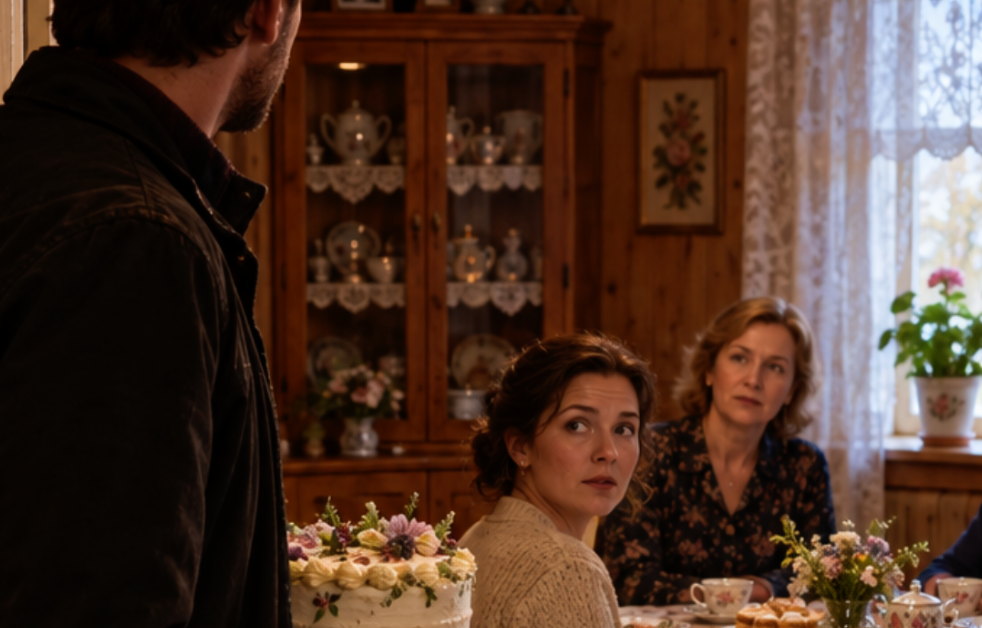
Vasily was just about to step from the entryway into the hallway, holding a box with a cake. He was ready to greet the women cheerfully and announce his unexpected return.
But suddenly, voices from the kitchen stopped him in his tracks—Marina said something that made him freeze on the spot.
His wife was speaking loudly, her voice edged with a raw, slightly tipsy bitterness. There was so much irritation in her tone that Vasily couldn’t help but listen more intently.
“Girls, you can’t even imagine how sick I am of this never-ending poverty!” Marina exclaimed, clearly upset. “I’m completely worn out! I have no strength left to live like this! I have to count every penny, deny myself everything, save on everything!”
Zhanna—who also sounded like she’d had a bit to drink—objected in surprise to her friend:
“Oh, come on, Marina! You really shouldn’t complain about your fate. You have everything you need! A wonderful house, a good car, Vasily doesn’t drink, and he gives everything he earns to the family. Just look at my hopeless one: he rarely brings his pay home, and nobody knows where the rest goes…”
“What good is this house to me?!” Marina suddenly interrupted her, voice sharp.
Her words were bursting with biting, almost choking anger, and Vasily tensed. From the kitchen came the metallic clatter of a fork tossed onto the table.
“Just a regular wooden tomb! What joy do I get from these logs if I’m too embarrassed to show my face among decent people? Other women’s husbands move to big cities, start their own businesses, make real money, wear beautiful suits! And who do I have? A spineless oaf! An eternal pauper with greasy, oil-stained hands! He crawls home in the middle of the night, puts a few pathetic bills on the dresser, and thinks he’s made my life complete! It’s been two years since I’ve managed to buy myself a decent pair of boots! I’m so ashamed in front of city women! I’ve wasted all my youth and beauty with this useless mechanic! No nice jewelry, no expensive fur coat, no decent life! I sit in this backwater like some old owl next to a husband who can’t earn a thing! If I’d known what kind of fate awaited me with him, I never would’ve married him! I would’ve run away without looking back!”
After those words, suddenly there was silence in the kitchen.
Even Marina’s friends seemed shocked to hear such raw anger and contempt for her own husband. The women fell silent, clearly sensing the awkwardness that followed those harsh and merciless confessions.
All this time, Vasily stood motionless in the dim entryway, unable to take a single step.
Inside, it felt like something had snapped. There wasn’t a loud crack or sharp pain—just a sense, deep in his chest, that the thick metal cable holding his whole life together had suddenly broken. The air turned cold and heavy, each breath a struggle. Vasiliy lowered his eyes to the box with a large cake, topped with creamy flowers, then glanced at the set of watercolors he’d bought for his daughter. Memories flashed before his eyes: all those hours lying on the frozen ground under a broken-down tractor, how his back would stiffen so much after work that he couldn’t straighten up, how his joints ached from the icy metal. He remembered the years of denying himself even the smallest pleasures—even a cup of hot coffee at a roadside diner felt too luxurious. Marina needed new boots; Polinka needed a warm jacket.
And after all that, he was just a poor loser? A weak-willed oaf? A man who brought home nothing but pitiful scraps?
Vasiliy didn’t shout. He didn’t charge into the kitchen, didn’t slam the door open, didn’t throw the cake in the faces of the women sitting there. He didn’t even want to demand explanations or start a humiliating argument. Instead, something stern awoke in him—a sense of dignity passed down from his ancestors—which wouldn’t let him stoop to hysterics or petty quarrels. If everyone in this house thought he was a worthless pauper, if his honest labor, which he gave everything to, only brought shame and scorn from his own wife—then there was no reason for him to stay here any longer.
He gently set the cake box down on the table by the entrance. Next to it, he placed the wooden case of paints for Polinka.
Then, quietly, almost walking on tiptoes, he headed for the bedroom. Voices still drifted in from the kitchen, dishes clinked. It sounded like Marina had already started singing a song.
Vasiliy opened the wardrobe and took down a large, sturdy black plastic bag left over from a supermarket trip. He gathered his documents: passport, military ID, college diploma, and employment book. Into the bag, he put two sets of clean underwear, warm wool socks, and his old sweater.
Next, he walked over to the dresser. From his pocket, he took out all thirty thousand he had earned today fixing the generator at the logging site and carefully placed the money on the furniture. Then he pulled out his bank card, where his main paycheck from the auto depot was deposited.
For a moment, Vasiliy stared at his own hand. Then, slowly, he removed the simple silver wedding band he had worn since his wedding and placed it on top of the bank card. Next to them, he left the house keys and his car remote.
He decided to take only his passport, driver’s license, and the five hundred hryvnia tucked into the pocket of his work pants. That should be enough to get him on his way.
Bag in hand, Vasiliy headed for the exit—but stopped in front of the children’s room.
He carefully peeked inside and stood in the darkness for a few seconds. His daughter’s neatly made bed was in its usual spot. Polina wasn’t home right now, and that made the empty room feel even quieter. The man clenched his teeth so tightly his jaw ached.
Forgive me, Polina, he thought to his daughter. When you’re older, you’ll understand. I’ll never abandon you. But if I stay here, I’ll destroy myself completely.
He went back to the porch, carefully opened the front door and stepped outside. As he closed it behind him, Vasily held the handle so it wouldn’t slam. The lock clicked softly, as if putting a final period on the life he’d only recently considered happy.
The cold autumn rain kept pouring down outside. Vasily pulled his hood tight, passed through the gate, and stepped onto the muddy road. Warm light from the windows spilled onto the wet ground, but he didn’t look back. He strode confidently toward the highway, leaving behind the house he’d invested eleven years of work and hope in.
Forty minutes later, Vasily was already seated on an intercity bus heading for a major railway station.
Around midnight, he was sitting on a lower bunk in a train carriage. The train carried him far north, to a big industrial city where a massive gas-chemical complex was under construction. This project was always looking for experienced mechanics, welders, and fitters, and Vasily knew that, with his skills, he’d never be out of work.
Marina didn’t notice her husband was gone until after midnight, closer to one in the morning, when her tipsy friends finally left for home.
After seeing the women off to the hallway, she suddenly noticed the festive cake and a beautiful set of paints on the table. The tipsy confidence immediately vanished from her face.
“Vasya?” she called uncertainly, listening to the silence.
There was no answer.
Marina hurried to the bedroom and flipped the light switch. Bright light filled the room. On the dresser, she immediately spotted neatly stacked cash, a bank card, keys, and a silver wedding ring.
Next to them was a small sheet of paper, torn from a notebook. Written in Vasily’s familiar, tidy handwriting—the same he used for technical notes and drawings—were just three words:
Live richly. Vasily.
Marina threw open the closet. The shelf where her husband kept his things was almost empty. His work clothes were gone, as were his important documents.
For a while, the woman stood motionless, staring blankly at the silver ring. A sharp sense of impending trouble pricked her chest. But the fear didn’t last long. Her usual stubbornness and wounded pride quickly took over.
“Well, isn’t this something!” Marina snorted loudly, tossing the note to the floor in annoyance. “He’s actually offended! He overheard a women’s conversation and now wants to show some backbone? Where exactly do you think you’re going, you fool? Who needs you at thirty-something with your nuts and bolts? Go stay with your buddies at the depot for a few days, cool off a bit, and you’ll come running back yourself! You’ll end up begging for forgiveness on your knees!”
continued in the comments
But Vasily didn’t come back.
Three days went by, then a whole week, but Marina still received neither a call nor any news from him.
Eventually, she set off for the depot herself. She arrived flustered, her hair a mess, and demanded to know where her husband was.
The garage manager greeted her with such a cold stare that Marina stopped in her tracks.
“Rubtsov isn’t here,” he said curtly. “He quit. Handed in his resignation of his own will and asked for his documents to be mailed. You should head home, Marina. We already know everything. The whole settlement knows how you treated your husband. You ought to be ashamed! We lost such a hard worker, such a good man… and you’ve driven him out of his own home.”
Marina was at a loss for words.
A month passed. Then a second, and a third. Autumn completely gave way to the harshness of winter.
That was when the comfortable, easy life Marina had always taken for granted began to fall apart rapidly. Everything she’d once thought stable and reliable was collapsing one by one, like a flimsy house of cards blown over by a strong wind.
She soon realized that a large, well-equipped house needed constant care and attention. Heating, water supply, and other systems just refused to work properly on their own.
In December, when temperatures dropped to thirty below, the heating boiler suddenly stopped. The radiators cooled down, and the temperature in the rooms started dropping fast.
Terrified, Marina rushed around the neighborhood, searching for someone who could fix the equipment. She asked all the handymen she knew, pleaded with neighbors for help, but no one wanted to touch the complicated system Vasily had once installed himself.
Finally, the local repairman Misha showed up. He demanded five thousand just to take a look. After fiddling with the boiler and a wrench for a while, he ended up damaging the threads on one of the valves instead of repairing it.
After that, he simply shrugged helplessly.
“This part is special, German-made. Vasya custom-machined it himself back in the day. I can’t make a replacement like that.”
The house grew colder and colder. Soon, the rooms felt like a damp, frozen basement. Marina had to remember the old stove, which she had barely used for years. She hauled in damp firewood from outside, struggled to get a fire going, but the stove didn’t work well without proper care. Smoke sometimes seeped right into the living areas, and despite all her efforts, the warmth she desperately hoped for never came.
The car that Marina used to be so proud of soon became useless. It sat in the yard, slowly disappearing under a blanket of snow. The battery was completely dead, and the brake pads were stuck. Marina had no idea how to change a tire or top up the coolant by herself. Getting the car towed to the district center would cost nearly half her monthly salary.
Her savings were disappearing at an alarming rate.
Twice a month, funds continued to arrive on the bank card Vasily had left at home. Each transfer came with the exact same note: ‘For the support of daughter Polina.’
The money always came on time, without a single delay. The amounts were quite substantial, since Vasily sent exactly one-third of his good earnings from the construction job up north. It was more than enough to cover their daughter’s needs.
But at the same time, he sent a strict message through the bank: these transfers were meant exclusively for their daughter, and all expenses must be backed up with receipts.
Marina herself received only her usual salary from her job at the local administration. For the first time, she truly realized how much the family’s well-being had depended on Vasily.
Without his steady income, she had to give up regular trips to the city, expensive clothing orders, and many other purchases. Even good meat, which had almost always been in the fridge before, now appeared on the table much less often.
However, the financial difficulties weren’t the hardest part.
Much more painful for Marina was realizing that those around her were slowly turning their backs on her.
The very same friends in front of whom she had once felt so free to belittle her own husband were now gossiping maliciously about her situation behind her back.
“So, did our beauty finally get what she wanted?” the women whispered among themselves. “She’s left with nothing now. Her husband was a treasure, but she always called him a poor loser. Now she’s the one covered in soot from morning till night.”
Marina heard such conversations and had nothing to say in response.
But what hurt the most was how much all this affected Polina.
The little girl became quiet and withdrawn. At night, she often cried into her pillow so her mother wouldn’t hear her sobs. The watercolor paint set her father had left that fateful evening was now Polina’s most treasured possession.
Sometimes Vasily would send letters to his daughter via general delivery. They didn’t come often, but each was filled with warmth and care. Polina kept these messages as carefully as she did her father’s gift.
Over a few short months, Marina herself changed noticeably. She lost a lot of weight, her face grew gaunt, and she seemed to age by a decade almost overnight.
Every morning, she had to get up early to stoke the stubborn stove. Constantly working with icy water left her hands cracked and painful, her skin rough and dry.
It was in these moments that she found herself thinking of Vasily most often.
She could almost see his calm gaze again, and his familiar, gentle voice echoed in her ears:
“Marisha, don’t worry. I’ll handle everything myself and take care of it all.”
Now Marina remembered so many little things she had never paid attention to before.
Like how her husband would quietly bring her a freshly brewed cup of hot tea. Or how he got up before dawn to clear snow from the yard so she could leave the house without dirtying her pretty boots. How he would fix anything that broke without a word, always looking after the comfort of the family and never asking for thanks for his hard work.
Before, all this felt like ordinary, natural parts of life to her. But now, every single memory hurt with painful regret.
Gradually, Marina realized what she had been so stubborn to ignore before.
Their family was never poor. They always had everything they needed for a good and respectable life. Vasily worked honestly, cared for his wife and daughter, providing them with comfort and peace.
Real poverty had never been in their wallet.
It was Marina’s own soul that turned out to be poor, pitiful, and unable to see her own happiness.
Three years had passed since that autumn evening.
By now, Marina was thirty-seven. The woman who was once considered the most beautiful in the village and used to look down on everyone was almost unrecognizable. Her confident posture was gone, her shoulders noticeably drooped, and her eyes always showed tiredness, guilt, and a hunted sadness. Over these years, Polinka had also grown up and was now in seventh grade.
In March, circumstances forced Marina to go to a large industrial city in the north of the republic. The district administration sent her for a two-week training course. After her quiet forest village, the city seemed huge and unusually noisy. Cars streamed non-stop along wide avenues, tall apartment blocks rose over the streets, and bright, colorful signs caught the eye with their flashing lights.
One day, when she had a free day, Marina went out to the city’s outskirts. A friend had asked her to run a small errand: to pick up a part needed for the village generator. The spare part was at a large company that repaired trucks and heavy equipment.
After going through the security checkpoint, she found herself in a spacious workshop. The high ceilings amplified every sound, and the constant metallic clatter made her ears ring. The air was filled with the smells of welding, hot metal, and machine oil. Huge dump trucks and powerful tractor-trailers, built for the harsh northern conditions, stood on sturdy lifts. Mechanics in neat blue overalls chatted with each other, tools banged somewhere, and pneumatic wrenches roared loudly from time to time.
“Ma’am, who are you looking for?” a young worker in a protective helmet called out to her.
“I need to find the senior workshop supervisor,” Marina said hesitantly. “They told me he has the invoice for the generator part.”
“So you’re looking for Rubtsov?” the young man clarified. “He’s right over there, by the third repair bay. He’s inspecting the Ural tractor right now.”
For a moment, Marina felt as if her heart had stopped beating.
She froze, unable to believe what she’d just heard. The surname spoken by the unfamiliar worker hit her with such sudden pain that she could barely take another step.
Slowly, she started moving forward, passing by machines and repair stations. Everything around her felt like a surreal dream.
Beside the massive three-axle truck with its hood raised stood a man.
It was Vasily.
In three years, he hadn’t changed much. If anything, he’d grown even stronger—his broad shoulders looked more imposing, and at his temples, silver hair hinted at a calm maturity. He was dressed almost the same as at home: his familiar dark gray storm jacket, a checkered shirt, and dark jeans. In his large, work-roughened hand, Vasily gripped a hefty wrench.
But Marina immediately sensed there was something much more important that had changed than just his appearance.
His entire demeanor was different. Every movement radiated confidence, inner calm, and the habit of making decisions on his own. He looked like a man who truly understood the value of his skills and knowledge.
Standing beside him was the shop manager in a white safety helmet. The supervisor listened closely to Vasily’s explanation, nodding respectfully from time to time.
“Got it, Stepanovich,” the manager said. “We’ll do exactly as you suggest. When it comes to diesel engines, nobody knows more than you, that’s for sure.”
With that, the manager walked off to another repair post, and Vasily bent again over the open engine.
“Vasya…” Marina breathed out, barely audible.
Her voice suddenly broke, the quiet call nearly drowned out by the constant noise of the busy shop floor.
But Vasily heard her.
He flinched slightly, then slowly straightened up and turned his head.
Their eyes met.
Marina took a hesitant step forward. In the next moment, tears streamed from her eyes, leaving dark streaks of cheap mascara down her cheeks. Her lips trembled, and she could barely speak:
“Vasinka… my dear… my love… I finally found you…”
Vasily didn’t back away or try to turn aside. His face showed no irritation or displeasure. He simply stopped, lowering his hand clutching the heavy wrench.
Marina looked into his familiar gray eyes, and with horror realized she couldn’t see anything she’d hoped for. No spark of anger, no old resentment, not even hatred. His gaze stayed steady, distant, and hauntingly empty.
It felt as if she was standing not in front of the man she’d lived with for eleven years, shared family joys with, and raised a daughter together, but in front of a total stranger who had ended up at this factory by pure chance.
“Hello, Marina,” Vasily said calmly. “You came for the invoice? It’s on the table. Take it and sign.”
“Vasya!” the woman cried out.
She rushed toward him, trying to grab the sleeve of his jacket, but with a barely noticeable, gentle movement, the man shifted his arm aside.
“Vasenka, please, forgive me!” Marina started speaking, choked with tears. “For the love of all things holy, forgive me! I didn’t understand anything then! How stupid, blind, and ungrateful I was! The biggest fool! Everything fell apart without you, Vasya! The house freezes in winter, the roof leaks, people in the village laugh at me! I can’t sleep at night, I cry, I look at your pillow and have no idea how to keep living! Come home, my love! Come back for Polinka, for everything good we had between us! If you want, I’ll get down on my knees for you! I’ll never say a harsh word to you again, I’ll listen to you in everything! I love you, Vasya! I love you! Only when I lost you did I realize how much!”
Her words poured out in a chaotic torrent. Marina sobbed, tried to catch her breath, then began pleading again. Her voice rang with such despair and humble begging that several workers from nearby stopped what they were doing and turned to watch.
But Marina no longer noticed the curious glances. She didn’t care at all who heard her confessions or what strangers might think.
Vasily remained silent the entire time.
His face stayed motionless and sternly calm, as if it was carved from hard northern stone. He didn’t interrupt Marina, didn’t try to stop her, and didn’t respond to her tearful pleas.
Only when she finally fell silent, breathing heavily after her long monologue, did Vasily slowly pick up a rag, carefully wipe the grease from his fingers, and quietly say:
“No, Marina. You don’t love me. You’re just cold without me.”
“Vasya…” she whispered plaintively.
“It wasn’t me you loved,” he continued in the same steady tone, looking straight into her tear-filled eyes. “You liked having a comfortable life, not worrying about anything, having everything I provided for you. But me, you despised. Always. You hated my hands covered in oil, my work, my simple clothes. You were ashamed that I didn’t wear expensive suits. I heard everything back then, Marina. Every last word. And each one stayed with me forever. But you weren’t wrong about one thing. I really am just a regular mechanic. I’ve spent my life working with metal, fixing machines. That’s who I am, and I won’t become someone else. But you needed a wealthy gentleman to show off to your friends.”
“Vasya, I’d been drinking that night!” Marina sobbed even harder. “I honestly don’t know what came over me! It was like some wicked force was pulling my tongue! I said such foolish things, not thinking!”
“No, Marisha,” Vasily replied calmly. “The alcohol just helped you finally say out loud what you’ve been carrying in your head for a long time. So for eleven years, you’ve suffered by my side. You believe you lost your best years because of me, ruined your youth. So why would you come back to someone you called a poor loser? Now you’re free. Live the life you’ve always wanted.”
“But what about Polinka?!” Marina suddenly cried out, holding onto her last argument. “Have you forgotten about your daughter? How will she manage without her father?!”
At the mention of his daughter, a fleeting warmth appeared in Vasily’s gray eyes. A deep, carefully hidden sadness slid across his face. But in a moment, his expression returned to being composed and unreadable.
“Don’t drag Polya into this,” he answered firmly. “She’ll come stay with me this summer for her vacation—we’ve already planned it, even bought tickets to the seaside. I’m getting the apartment here ready for her. When she finishes school, she’ll live with me, and I’ll help her get an education. Polinka isn’t ashamed of her father. But as for you and me, Marina, our paths split for good. Back then, three years ago. That night when I stood on the porch listening to your words.”
He didn’t add anything more.
Vasily turned away toward the open hood of the truck, lifted the heavy wrench again, and without looking back said quietly:
“Take your invoice and go, Marina. I’ve got work to do, my shift isn’t over yet.”
The woman stood alone in the middle of the vast production hall.
All around, the usual workday hustle and bustle continued. Mechanics walked by, tools clattered, metal clanged on the machines. Sparks burst from the spinning disk of an angle grinder, and an engine was humming somewhere in the background.
But Marina barely heard any of it.
Before her, it was as if a tall, utterly impenetrable wall had appeared—one she could neither go around nor destroy. The most frightening thing was realizing that she herself had built this barrier long ago. With her arrogance, unfair accusations, harsh words, and contempt for the man who had given her everything he had for so many years.
Now Vasily was only a few steps away from her, but the old closeness was already impossible to bring back.
Marina slowly walked over to a small table. With trembling fingers, she picked up the paper she needed and, head down, made her way toward the exit.
When she left the noisy workshop, she found herself in a completely different world.
A bright spring sun shone over the city. Drops of melted snow fell musically from rooftops, thin streams trickled along the roadsides. The cool air was filled with the fresh scent of thawing earth, wet asphalt, and the promise of approaching warmth.
Nature was waking up after a long winter, as if promising a new beginning to everything alive.
But Marina no longer felt any of that joy.
She walked down the sunlit street, realizing there was no return to her old life. The man she once saw as a worthless pauper had managed to find his own place, earn respect, and learn to live without her.
She didn’t just lose a husband, the one who provided for their family and cared for their home.
She destroyed, with her own hands, the love of a man who was ready to face any difficulty for her. And only now, when all hope of reconciliation between them was finally gone, did Marina realize the true cost of her cruelty.
Spring was arriving all around, bringing light, warmth, and renewal.
But for her, this new life felt endlessly empty.