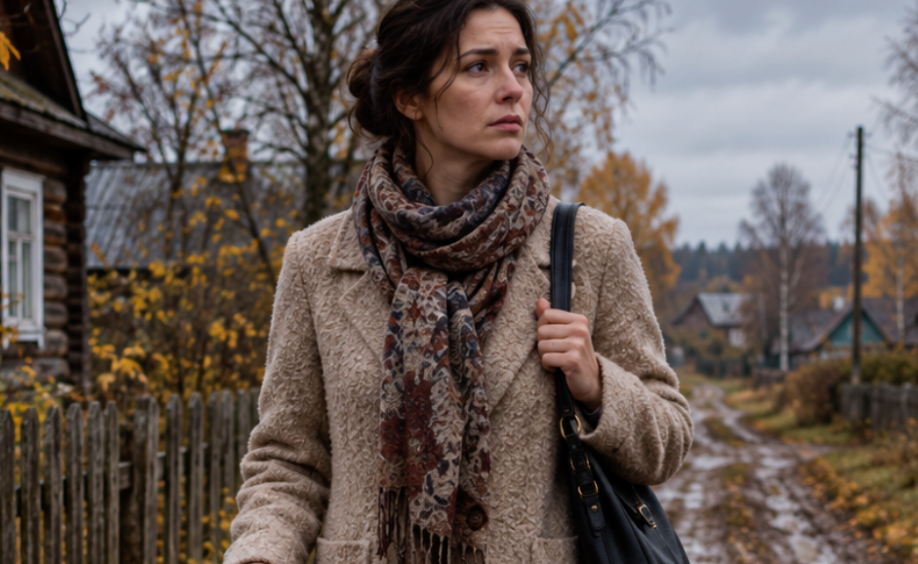
November in the north is a harsh, gloomy, and damp month. The birches have long since shed their last leaves, the river below the steep, crumbling bank has turned a dark, leaden gray, and above the cold, clay road, tiny sharp snowflakes swirl through the air, mixing with a chilly drizzle.
Struggling along the muddy ruts, slipping often on the thin heels of her stylish city ankle boots, a woman made her way forward with difficulty. Larisa wrapped her fitted beige coat tighter around herself, but its high collar was no match for the icy wind sweeping in from the taiga. The little wheels of her old dark blue suitcase kept getting stuck in the sticky mud, building up clumps of wet grass. Her fingers, numb inside her thin gloves, stung from the cold as the metal handle burned her palm.
She hadn’t set foot in this place for three years. Exactly three years had passed since she left.
Larisa lifted her head and looked up at the hill. Beyond a weathered wooden fence, darkened by endless autumn rains, stood a spacious five-walled house with a sturdy gabled roof. Stepan’s house. Her house. Well, once upon a time, it had been hers too.
She stopped to catch her breath. Her heart was pounding furiously somewhere in her throat—fast and erratic, like a trapped bird desperately flapping in a snare.
“It’s nothing to worry about,” she reassured herself, tucking stray light chestnut curls back under her scarf. “Stepan has a forgiving nature. He loved me more than life itself, always treated me like a queen. Sure, he’ll yell at first, maybe break a few dishes for show, but in the end, he’ll cry and forgive me. Men in the village get wild pretty fast without a woman around, and Stepan wouldn’t last at all without me. Who here would care about his planks and planes and woodworking plans?”
She remembered the day she left perfectly. Three years ago, November was just as raw and cold. Stepan went off to a remote logging site to find the best pine trees. For five whole years, he had been saving up for his own sawmill and a used tractor. His dream was to open a small carpentry shop, make carved window frames, sturdy furniture, build log houses.
In an old tin box that once held Indian tea, hidden under a beam in the cellar, he kept neat bundles of large bills. A total of one million two hundred thousand rubles. Every bit of that money came from Stepan’s hard work—earned with calloused hands, sweat, and sleepless nights.
But Larisa had grown sick of village life long ago. She was annoyed by the smell of manure, the smoke from the stove pipe, the never-ending need to wear rubber boots, and the neighbors’ endless conversations about potato harvests. She had just turned thirty-five, considered herself a true beauty, and was convinced she was meant for something completely different—luxurious dresses, fancy restaurants, and the wide boulevards of the city.
When contractor Artur showed up in the district center, ready to sign a big road contract, Larisa noticed him right away. He was confident and polished, sporting a gold signet ring, driving a massive black SUV, and making sweet promises of an easy life by the sea. She didn’t hesitate for long.
While Stepan slogged through thick clay on a remote job site, Larisa snuck into the cellar, gathered every last bit of their money, packed her best clothes into a suitcase and walked out forever. She didn’t leave a note, not even a simple goodbye.
Stepan came back to a cold, empty home. Later, neighbors said he sat motionless on the porch for two whole days, his glassy eyes fixed on the river. He didn’t drink, didn’t yell, didn’t give in to despair. He just sat there, and his face grew dark and thin, as if it had been burned in a blazing oven.
But Larisa’s beautiful fairy tale ended far sooner than she had hoped.
Artur turned out to be just another con man and compulsive gambler. The money Stepan had spent years saving for his dream vanished in just six months. Lavish restaurants, rented apartments in the city, casinos, and meaningless parties—all ate up huge sums. When the savings ran out, Artur’s tender feelings vanished with them.
At first, he disappeared for a few days at a time, and then for weeks. Soon he became violent, and one night packed his things and simply threw Larisa out of their rented apartment, announcing he wasn’t going to pay for her stay anymore.
The next two years became a never-ending grey stretch for her, with no escape in sight. Larisa got a job as a clerk in a 24-hour kiosk and rented a tiny room from a cranky old lady on the city outskirts. She had to count every penny, choosing between bread and cheap tea. Her health worsened, her face became gaunt, her hair dye faded, and fear of poverty settled permanently in her brown eyes.
And that’s when she remembered Stepan.
Images of his broad shoulders, steady reliability, the warm Russian stove, a cellar full of homemade preserves, and the smell of fresh-baked bread filled her mind. Everything she once took for granted now felt like true wealth.
“He’ll take me back,” Larisa whispered to herself, sitting in the stuffy train carriage. “Where would he go? We lived together for ten years, heart and soul! I’ll apologize, get down on my knees if I have to. I’ll tell him I was out of my mind, that slick city guy tricked me. But now I’m back. Here I am, his lawful wife…”
Larisa pushed open the gate. It swung easily and silently—someone had recently oiled the hinges. The fence looked well-tended, not a single board loose.
What Larisa saw in the yard left her speechless. Everything was perfectly in order—better than she ever remembered, even in the best years of their life together. Under the shelter, there was a neatly stacked pile of birch firewood, nearly twice the height of a person, sturdy and straight like a fortress wall. Every single log was in its perfect place. Next to the shed stood a brand-new tractor, gleaming with fresh blue paint, a plow attached and ready.
The air didn’t have a trace of neglect or emptiness. Instead, everything smelled of fresh pine shavings, dry hay, and something delicious, warm, and wonderfully homey.
Larisa walked up the wide, carefully swept wooden steps to the porch. She paused at the door, took a deep breath, and tried to make her face look as pitiful and touching as possible. Then she knocked softly with the iron door knocker.
She heard light, quick footsteps from inside.
“Styopushka, did you get home early today?” a pleasant, melodic woman’s voice called from the hallway. “I’m just pulling a lingonberry pie from the oven. Hold on a minute, let me wipe my hands!”
Larisa jerked back suddenly, as if she’d been slapped in the face with stinging nettles.
The heavy larch door swung open.
Polina stood on the threshold.
She looked no older than thirty-four—petite, trim, perfectly proportioned, with a clean, open face untouched by city makeup. Her light-blond hair was neatly tied back in a low ponytail. She wore a simple, warm dress of pale gray jersey, topped with a dark blue linen apron that had a roomy pocket.
From the house came an amazing aroma of vanilla, hot baked milk, and fresh pastries.
But what truly shocked Larisa was something else entirely.
Beneath the soft fabric of her dress, Polina’s large, round belly was obvious—she was seven months pregnant. She stood in the doorway, one hand supporting her lower back, gazing at the unfamiliar woman with clear blue eyes full of genuine surprise and kindly interest.
“Hello! Who are you here to see?”
Larisa froze on the bottom step of the porch. Her fingers clutched the handle of her suitcase in a panic, and her throat felt as if she’d swallowed a handful of sharp glass shards.
“I…” she began, swallowing with difficulty. Underneath the faded layer of city makeup, her cheeks flushed with shame. “Is Stepan home?”
Polina paused for a moment. Her eyes took in the stranger’s worn-out coat, dirty ankle boots with their thin heels, and the old suitcase she struggled to drag behind her. There was no dislike or fear in the young woman’s blue eyes. For a brief moment, deep feminine understanding flashed there, but it was quickly replaced by the calm dignity of the woman of the house.
“Stepan is in the workshop behind the bathhouse, working on winter window frames—putting in glass,” Polina answered calmly and evenly. “And you… are you Larisa?”
Larisa lifted her chin, trying to reclaim her old confidence and air of superiority.
Yes, Larisa! And I’m his wife, by the way! His legal wife! We even got married in church at the district center! And who are you, really? What are you doing in my house?!
Polina didn’t even flinch. She gently placed her hand over her rounded belly, as if shielding her unborn baby from the angry yelling. In that simple gesture, there was such deep, unshakable maternal strength that Larisa instinctively stopped in her tracks.
“Stepan filed for divorce through the courts two years ago,” the young woman replied just as calmly. “Once you were declared missing, the marriage was legally ended. As for this house… He built it himself, with his own hands. When you took every last penny and left, Stepan was lying here on bare floorboards, thinking he would never get up again. I took care of him then. Remember? I was the local paramedic in our area, coming by to give him injections when he got really sick with pneumonia.”
“Polina?..” Larisa breathed out in surprise, struggling to recall the quiet girl from the local clinic she had barely noticed before. “So it was you?!”
“Yes, it was me,” Polina answered, offering no further explanation. “Come up onto the porch, it’s cold outside. Stepan will be back soon, he’s bringing in firewood for dinner. You can talk to him then.”
Just then, the sound of heavy footsteps crunching in the snow echoed around the corner of the house.
Stepan appeared from behind the firewood pile.
At forty-one, he looked even stronger and more solid than before. His broad shoulders were wrapped in a dark gray, roughly knitted wool sweater. Gray was already starting to show at his temples among his dark hair, like an early morning frost. His face was wind-burned with strong cheekbones, and his deep gray eyes looked straight ahead, calm and steady. In his arms, he carried a big bundle of fragrant birch logs.
When Stepan saw Larisa, he stopped abruptly, as if he’d run into an invisible wall.
The firewood in his arms didn’t even waver. Not a single muscle in his face twitched, nothing betrayed what he might have been feeling inside. Only the muscles in his jawline tightened for a moment, then slowly relaxed.
Larisa dropped her suitcase right into the mud and hurried toward him. She took a few steps, threw up her hands, and finally the tears streamed down her face. This time, they were real—bitter, angry, filled with belated regret and despair.
“Styopushka! My darling!” she cried, wringing her hands. “Stepan, forgive me! The devil took hold of me, I lost my mind completely back then! He took everything from me, then threw me out into the street like a stray dog! For three years I suffered, living in hell! Every day I thought of you and cried! I’m ready to kiss your feet if only you forgive me! I’m back, Stepan! This time for good! Get rid of that… that stray! We were married in church, pledged before God to be husband and wife! Forgive me, my love!”
She tried to throw herself into his arms, to press herself close, to wrap her arms around his strong shoulders and cling to his sweater sleeves.
Stepan stayed completely still. He didn’t pull away, didn’t push her aside, didn’t threaten her with the armful of firewood. He just looked at the woman who had once meant everything to him.
And that look was more terrifying than any blow could ever be.
His clear gray eyes held neither hatred, nor fury, nor any wish to take revenge for the pain she’d caused. There wasn’t even a hint of resentment left. There was only cold, absolute emptiness. It was like the way you look at last year’s dry grass poking through melting spring snow, or at a leaning, broken fence on the other side of the village that nobody cares about anymore.
“Hello, Larisa,” Stepan said quietly.
His voice was deep, even, and remarkably calm.
“Styopa…” she stammered and fell silent, feeling more afraid of his lack of emotion than she would have been of yelling or harsh words. “Why are you like this? Aren’t you glad to see me at all? I’ve come back!”
Stepan slowly turned his gaze to Polina, who was still standing on the porch.
And suddenly his whole expression changed. His eyes filled with such tenderness, care, and worry that Larisa felt her own heart flip.
“Polyushka, why are you outside barefoot? Come back inside, you’ll catch a cold. There’s a draft along the floor.”
“I’ll come in right now, Styopa,” Polina replied softly.
She didn’t move from her spot, only gave her husband a small, almost invisible smile. In that smile was so much trust and warmth that Larisa felt unsettled.
Stepan turned back to his ex-wife. Without hurry, he put the armful of birch firewood into the special box by the porch and carefully brushed small bits of bark from his hands.
“You’re too late, Larisa,” he said, looking somewhere past her head, toward the darkening forest beyond the river. “Three whole years too late.”
“Too late?” she cried in despair, gasping the cold air. “But I’m right here, standing in front of you! I’m alive! I understand everything now! And the money… I’ll earn it back and pay you every last ruble! Do you hear me? I’ll pay you back!”
Stepan let out a rueful smile.
“Money? Let that money go to hell. It’s just paper, nothing more. I never lost any sleep over it, not for a single day. I earned it all over again. See, there’s the tractor, the workshop is running, and there are five guys working in the cooperative, each earning their bread by their own craft. So it’s not about the money, Larisa.”
He took a step towards her and looked into her tearful, frightened eyes.
“It wasn’t the money you took from me back then. You took my soul with you. You packed it in your bag with those bundles of cash and threw it at the feet of your Artur. For half a year after you left, I barely even lived. At night, the pain was so bad I could have torn the walls apart with my teeth. I kept asking myself, why? What did I do wrong? Didn’t I love you enough? Didn’t I do enough for you? And then… Then Polina appeared.”
Stepan paused for a moment, as if remembering that time when his life was hanging by a thread.
“She didn’t come for my money, or for pretty dresses, or for wealth. She came into an empty hut, when I couldn’t even chop firewood for myself anymore. She fed me hot soup from a spoon. She wasn’t afraid of my dirty, weak hands—she took them in hers and kissed them. She pulled me out of a pit so deep I couldn’t even see a way out. She gave me back the will to live. Helped me feel like a person again.”
Stepan raised his hand and pointed to the windows of the five-walled house, from which soft golden light was streaming out.
“That’s my wife. My real, lawful wife, the one sent to me by God. In two months, we’ll have a son. A new owner will be born in this house. And you… You’re just a stranger to me now. You used to be Larisa, but that Larisa is gone. To me, she died on that November day when you stepped through the door with stolen money and vanished, without even leaving a note.”
“Stepa…” Larisa whispered, barely audible.
Her lips had turned blue from the cold, and a shiver ran through her body—a mix of fear and despair.
“Where am I supposed to go now?” she asked. “It’s already getting dark… There are no more buses to the city… I have no money, no friends here…”
Stepan was silent for a while. Then he reached into his pants pocket, pulled out a leather wallet, and took out two five-thousand bills.
He didn’t drop the money at her feet, didn’t throw it in her face, and didn’t humiliate her with harsh words. He simply walked over to the suitcase and gently placed the bills on its wet top.
“Here, this is for your journey. It’ll be enough for a ticket, and you can stay overnight at the hotel in the district center. It’s a half-hour walk to the highway from here, and you can try to hitch a ride there. But I won’t let you into the house. Don’t you dare cross this threshold. It’s pure here now. Love lives here.”
After saying this, Stepan turned his back on Larisa and climbed the wooden steps to the porch with ease. He put his arm around Polina’s shoulders, gently pulled her close, shielding her from the damp autumn wind. Together, they entered the warm entryway.
The heavy larch door closed behind them with a soft, muffled click of the latch.
Larisa was left standing alone in the middle of the yard.
From the sky, the first real winter snow began to fall thick and heavy. Large flakes settled on her worn city coat, clung to her damp, light-brown hair, and slowly dusted over the two new bills left on top of the old suitcase.
Warm amber light glowed in the windows of the house. Through the glass, Larisa could make out Stepan seating his wife at the table, pouring her tea into a big mug, and then sitting beside her. He gently rested his broad, rough hand on her rounded belly. They spoke softly, smiled at each other, and looked truly happy.
Larisa slowly bent down. Her numb fingers trembled as she picked up the two banknotes and tucked them into her coat pocket.
Then she grabbed the suitcase handle, turned around, and started walking back toward the gate.
Behind her were the light, the warmth of home, and the happiness that once belonged to her but now was lost to her forever. Ahead stretched a dark, chilly country road disappearing into the thick November snowfall.