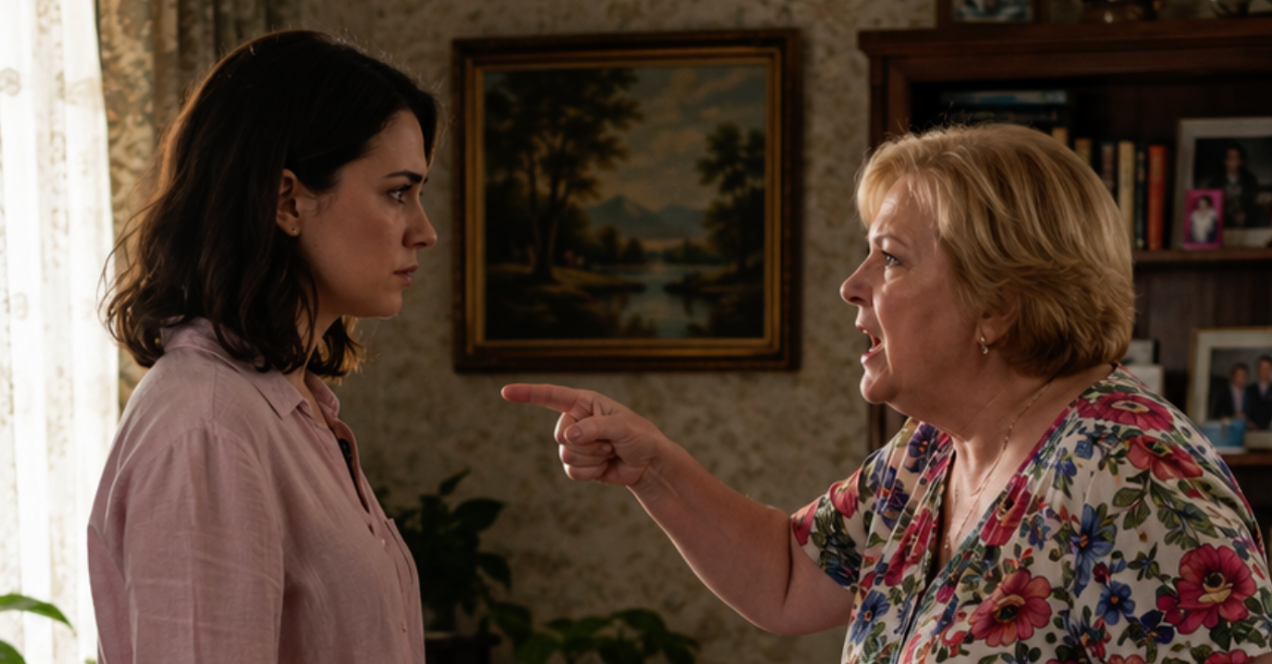
The champagne glass froze in midair. Around me, people were laughing and clapping, while I sat there, unable to move.
“Repeat what you just said.”
My mother-in-law smiled radiantly.
“I’m leaving the apartment to Marina. She is my own daughter, after all, not just some daughter-in-law. Right, son?”
Viktor, my husband, looked away.
Fifteen years. For fifteen years, I had taken care of this woman. I drove her to doctors, bought her medicine, cooked her diet soups. I cleaned her apartment every weekend while her “own daughter” was sunbathing in Turkey.
And this was my reward. Public humiliation at my mother-in-law’s seventieth birthday.
“Lara, don’t be offended,” Anna Grigoryevna said, patting my hand. “You understand, blood is thicker than water. Marina is closer to me.”
Marina sat across from me, shining like a polished samovar. Beside her was her husband Igor, a successful businessman with a beer belly and a gold chain around his neck.
“Mommy, you’re the best!” my sister-in-law sang. “We were just thinking about expanding. A two-room apartment in the city center is a dream!”
I am forty-six. I work as a senior librarian at the district library. My salary is forty-two thousand, but I love my job. Viktor and I live in a one-room Khrushchev-era apartment that he received from the factory before our wedding. Our daughter Nastya is in college, and our son Pasha is twelve.
When we got married, Anna Grigoryevna promised, “The apartment will be yours. You’re the ones taking care of me.” For fifteen years, I believed those words.
“Vitya,” I turned to my husband. “Did you know?”
He coughed.
“Lar, let’s not do this here…”
“No, let’s do it here. In front of everyone. Did you know your mother had changed her mind?”
“Well… she told me… but I thought you wouldn’t be upset. We have our own apartment.”
“A one-room apartment. For four people. And Marina has a three-room apartment. And now she’ll have a two-room apartment in the center too.”
Marina snorted.
“Larisa, don’t be jealous. Mom decided this herself. It’s her right.”
“Of course it’s her right,” I said, slowly setting my glass down on the table. “To give apartments to those who never lifted a finger. And those who drove her to hospitals for fifteen years can go empty-handed.”
“Lara, why are you saying it like that?” Anna Grigoryevna pretended to be hurt. “I never forced you. You helped because you were kind.”
“Because I was kind? You called and demanded every time. ‘Lara, come over, my blood pressure is up.’ ‘Lara, I feel awful, come urgently.’ ‘Lara, why isn’t Marina answering? Call her yourself.’”
“I’m a mother. I have the right to ask for help.”
“To ask, yes. But why was it always me? Why not Marina?”
My sister-in-law rolled her eyes.
“I have work, Larisa. A business. I can’t just drop everything.”
“And what do I have, an eternal vacation? I work too. But every weekend I dragged myself across the whole city to wash your mother’s floors.”
“Nobody forced you!”
“Exactly. And nobody will anymore.”
I got up from the table. Viktor grabbed my hand.
“Lar, sit down. Don’t make a scene.”
“A scene?” I leaned toward him. “Your mother made the scene. She publicly announced that I am nobody. Fifteen years thrown to the wind.”
“It’s just an apartment…”
“It’s not about the apartment, Vitya. It’s about the attitude. And I heard it loud and clear.”
We drove home in silence. Viktor tried to speak, but I turned toward the window.
Inside, I felt empty. Not hurt, exactly—empty. As if someone had turned off the light in a room where I had been living for fifteen years.
“Lar, stop sulking already,” my husband finally said. “Mom is old. She has her quirks. She didn’t mean any harm.”
“Didn’t mean any harm? For years, she said the apartment would be ours. Years! And now suddenly it’s for Marina.”
“Well, Marina is her daughter too…”
“Marina has visited her about fifteen times in ten years. On holidays. With a cake and kisses. I was there every week. With medicine, groceries, and a mop.”
Viktor sighed.
“Larisa, what can I do? It’s her apartment, her decision.”
“You can talk to her. Explain that it’s unfair.”
“She won’t listen. You know Mom.”
I did know her. Anna Grigoryevna had spent her whole life doing whatever she wanted, while everyone around her adjusted.
“Fine,” I said. “Then I’ll make a decision too.”
“What decision?”
“You’ll find out.”
The next day, I did not go to my mother-in-law’s place. For the first time in fifteen years.
The phone rang at ten in the morning.
“Lara, where are you? I’m waiting.”
“Anna Grigoryevna, I’m not coming.”
A pause.
“What do you mean, you’re not coming? What about the cleaning? And the groceries?”
“Ask Marina. She is your heiress now, so let her help.”
“But Marina is busy! She has a business!”
“And I have a family. Two children. A job. A husband who can’t even iron his own shirt.”
“Larisa, this is blackmail!”
“No. This is fairness. The apartment goes to Marina, and so does the care. Logical, isn’t it?”
I hung up.
Viktor found out that same evening. His mother called him in hysterics.
“Lara, what are you doing?!” he burst into the kitchen. “Mom is in tears! She says you abandoned her!”
“I didn’t abandon her. I passed the baton to Marina.”
“What baton, for God’s sake? Marina lives outside the city. It takes her an hour to get there!”
“It took me an hour and a half. And somehow I managed.”
“But you’re used to it! You know how to handle her!”
“Then let Marina learn. She is her own daughter. Blood is thicker than water, remember?”
Viktor dropped onto a chair.
“Lar, this is cruel.”
“Cruel?” I turned away from the stove. “Cruel is using a person for fifteen years and then throwing them away like garbage. Cruel is humiliating your daughter-in-law in front of the whole family. Cruel is demanding help and giving nothing in return.”
“She gave you things! Gifts on holidays, money sometimes…”
“Money? Five thousand for New Year? In fifteen years, seventy-five thousand at most. And the apartment is worth six million. Do you feel the difference?”
He said nothing.
“Vitya, I’m not asking you to choose between me and your mother. But I will no longer be an unpaid caregiver for a person who doesn’t value me.”
“And what if something happens to her?”
“Then Marina will come. Or you. You’re her son. Her own blood too.”
“I work!”
“So do I. But for some reason, I always found the time. You didn’t. Maybe it’s time to start?”
The first week passed in phone calls. Anna Grigoryevna called every day—me, Viktor, or both of us.
“Lara, I can’t go to the store by myself! My legs hurt!”
“Order delivery. All the stores deliver now.”
“But that’s expensive!”
“Cheaper than the gasoline I spent for fifteen years.”
“Larisa, you’re heartless!”
“Maybe. But I’m learning from the best.”
In the second week, Marina got involved.
“Larisa, this is going too far,” my sister-in-law’s voice rang with anger. “Mom complains to me every day. She says you abandoned her.”
“I didn’t abandon her. I made room for you.”
“What room? I live outside the city! I have a business!”
“Marina, when your mother had pneumonia three years ago, I stayed overnight with her for two weeks. I took time off work, used unpaid leave. You came once—for half an hour.”
“I had a deal falling apart then!”
“And I had a family. But somehow I managed.”
“That’s different!”
“Of course it’s different. Your affairs are important. Mine are not.”
Marina snorted.
“You’re just taking revenge. Because of the apartment.”
“No. I’m restoring justice. You get the inheritance, so you carry the obligations. That’s normal.”
“We’ll see about that!”
She hung up.
A month later, Anna Grigoryevna fell. It was nothing serious—she twisted her ankle, slipped while leaving the bathroom. But the noise she made could have shaken the whole building.
Viktor rushed to my workplace.
“Lar, Mom is in the hospital! We have to go!”
“Go.”
“And you?”
“I’m not going.”
“But she’s Mom! My mother!”
“Exactly. Yours. Not mine.”
He stared at me as if he were seeing me for the first time.
“Are you serious? She’s an old woman, she’s unwell, and you…”
“I was there for fifteen years whenever she was unwell. For her, for you, and for your whole family. Now that’s enough.”
“Larisa, this is inhuman!”
“Inhuman is when a person serves faithfully for fifteen years and then gets publicly humiliated. That is inhuman.”
Viktor left, slamming the door.
In the evening, he came back gloomy. He dropped onto the sofa and stared at his phone.
“Marina came,” he finally said. “She caused a scandal with the doctors, then with Mom. She said Mom had fallen on purpose to get attention.”
“And what did Anna Grigoryevna say?”
“She cried. Said nobody needed her. That even her own daughter didn’t want to help.”
“Interesting. When I helped, it was taken for granted.”
Viktor looked at me.
“Lar, you’ve changed.”
“No. I just stopped pretending.”
“Pretending?”
“That I didn’t care. That I wasn’t hurt. That I was ready to tolerate any treatment as long as there was peace in the family.
“For fifteen years, I closed my eyes to the unfairness. To the way your mother singled out Marina. To the way you silently agreed. To the way everyone treated my help as something natural.
“Enough. I deserve respect. Not because of the apartment, but because of my labor. Because of the years I gave to your family.”
Viktor was silent for a long time.
“Mom said she’ll reconsider the will. If you come back.”
I laughed.
“I come back—and then what? She changes her mind again in a year? In five years? At the next anniversary, she announces that everything is going to the neighbor?”
“She promises…”
“Her promises mean nothing, Vitya. I understand that now. Late, but I understand.”
Six months passed. Anna Grigoryevna hired a caregiver. It turned out she had savings. Considerable ones, by the way.
Marina stops by once a month. With a cake and kisses. Just like before.
My mother-in-law no longer contacts me. She does not call or invite me to holidays. She complains to Viktor that I am a “traitor” and “ungrateful.”
“Mom, what exactly should you be grateful for?” Nastya once asked. “You did so much for Grandma, and she betrayed you.”
“Nastenka, Grandma is old. She has her own views…”
“Old doesn’t mean right. You deserved respect, Mom. And she insulted you.”
My daughter is eighteen. She understands what I only understood at forty-six.
Viktor changed. At first, he was offended and stayed silent for weeks. Then he started talking. Then he started thinking.
“Lar,” he said one day. “I was wrong. All this time. I saw how you worked yourself to exhaustion for Mom, and I thought it was normal. I never thought about it.”
“And now?”
“Now I have thought about it. When Marina threw a tantrum at the hospital, when Mom cried, when the caregiver sent the monthly bill… I realized how much you did. For free.”
“And?”
“And I’m ashamed. That I stayed silent. That I didn’t defend you then, at the birthday party.”
I looked at my husband. Forty-nine years old, gray at the temples, wrinkles around his eyes. Twenty years together—and only now had he begun to see the obvious.
“Vitya, I don’t expect apologies from your mother. She won’t change. But from you, I do.”
“Forgive me, Lar. For everything.”
“I forgive you. But I won’t go back to the way things were.”
“I’m not asking you to. Just… thank you for staying. For not leaving.”
“I stayed for our family. For the children. For us. Not for your mother.”
He nodded.
Recently, Marina called me. For the first time in six months—on her own, without a scandal.
“Larisa, we need to talk.”
“Talk.”
“I’m… tired. Mom demands attention every day. The caregiver is expensive. Igor gets angry that I spend time going to see her.”
“Welcome to my life for the past fifteen years.”
“I didn’t think it was so hard…”
“Of course you didn’t. You came on holidays with a cake. I did the dirty work.”
“Larisa, maybe we could divide it somehow? Take turns…”
“No, Marina. The apartment is yours. The obligations are yours too. That’s fair.”
“But that’s unfair!”
“Really? And when you got the apartment and I got nothing, was that fair?”
She was silent.
“Marina, I pulled that cart for fifteen years. Now it’s your turn. Maybe you’ll understand why I was hurt.”
“Mom says she’ll reconsider the will…”
“I don’t care. It’s no longer about the apartment. It’s about how I was treated.”
I hung up.
That evening, I sat in the kitchen, drinking tea. Outside, it was getting dark, and the streetlights were coming on.
For fifteen years, I believed that if you gave a lot, you would receive something in return. Gratitude, respect, recognition. It turned out that wasn’t true. What you receive is habit. People get used to the fact that you are always there, always ready to help. And they stop valuing it.
Now I have weekends. Free weekends. My own. I take the children to the movies, walk with my husband in the park, read books. I no longer rush across the city with groceries and medicine.
Anna Grigoryevna got what she wanted—her own daughter nearby. Marina got what she fought for—the apartment. And I got freedom.
And as it turned out, that was the best inheritance I could have received.
Would you be able to step back once you realized you were being used—even if it was by family?