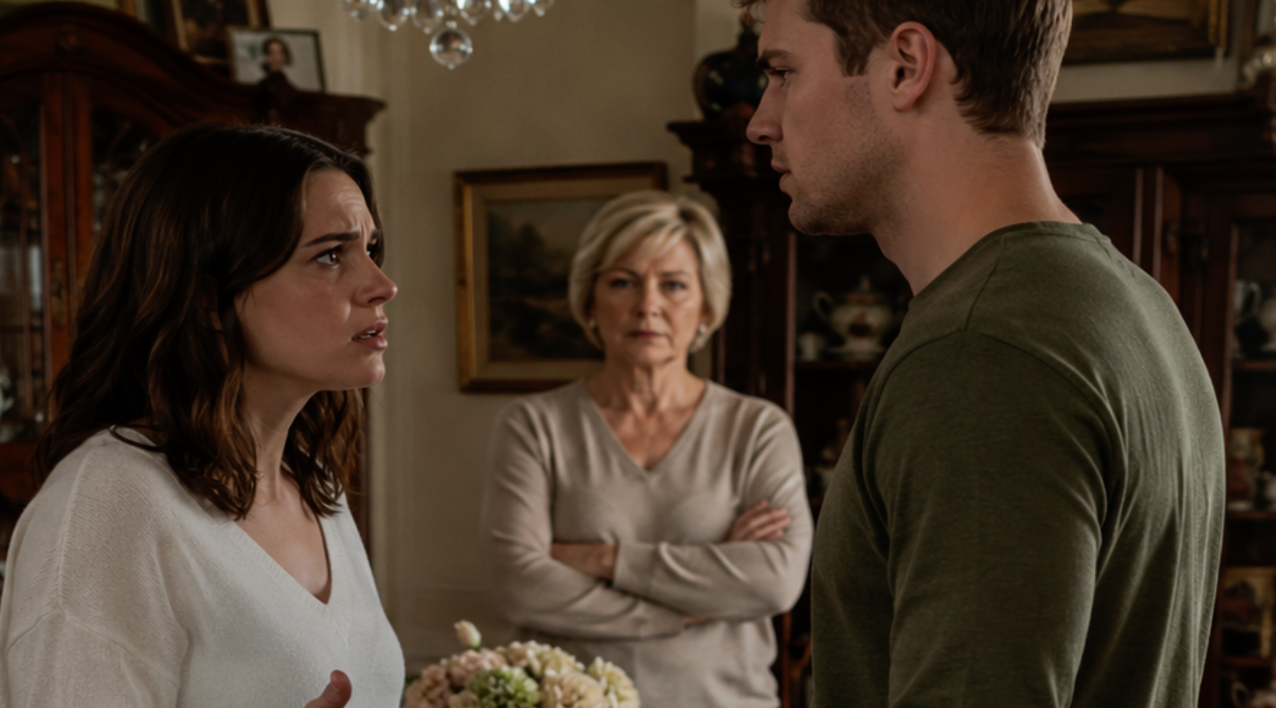
“Why is your mother here?” Ksenia asked her husband.
“Please don’t get angry, but Mom has made a very strange decision,” Nikita said quietly, sorting through drawings of acoustic panels on the massive oak table. “She called me in for a talk and said she had decided to sign over her two-room apartment to Olga.”
Ksenia, who had been carefully studying new samples of biodegradable plastic for her architectural models, slowly raised her head. There was no condemnation in her eyes, only an attempt to understand what she had just heard. She had always believed that family was a complicated mechanism, where every element required special handling and enormous patience.
“Why is it strange?” Ksenia asked calmly, putting down her tweezers. “Irina Mikhailovna has every right to dispose of her property as she wishes. It’s her apartment. What exactly is bothering you?”
Nikita sighed heavily, his fingers nervously sliding along the edge of the drawing paper. He worked as a hall acoustics specialist, a man for whom any false note grated on the ear. And in his mother’s words, he had heard precisely such a false note.
“That’s the reason, Ksyusha. She says Olga needs support. You see, her husband Anton is a wonderful guy—smart, gentle, polite. But he is completely incapable of earning money. He writes articles on entomology, studies his weevils, and has no financial instinct whatsoever. Mom adores Anton because he never speaks rudely to her, but she considers him helpless. So she decided she must sacrifice herself for her daughter.”
Ksenia walked over to her husband and lightly touched his shoulder. Her movement showed hope that the conflict could be prevented through calm dialogue. She knew Nikita was hurt. He was not claiming a share of his mother’s apartment, but the very fact that the inheritance was being divided secretly, as if they were carving up the hide of a living bear, left an unpleasant aftertaste.
“Nikita, listen to me,” Ksenia said in an even, warm voice. “You feel hurt right now, and that is completely normal. But let’s look at things soberly. We have this three-room apartment. I invested money from two inheritances from my grandparents into it, and we did excellent renovations. We have a place to live. We are independent. If your mother thinks it’s necessary to help Olga this way, then let her help. We don’t need to quarrel over someone else’s square meters.”
The next day, Ksenia decided to visit her mother, Svetlana Yuryevna. She worked as a paleobotanist, spent most of her time in a laboratory among ancient fossils, and had a pragmatic view of human destinies. After listening to her daughter’s story, she merely shook her head.
“Ksenia, don’t even think about sticking your nose into this,” her mother said categorically, carefully brushing dust from a stone with the imprint of an ancient fern. “Inheritance is a heavy and unpredictable thing. Especially when it concerns a gift deed made during someone’s lifetime. Your husband’s resentment is understandable, but you must be wiser. Forget what is happening at your mother-in-law’s place. You and Nikita have your own life.”
Ksenia agreed. In her heart, she sincerely hoped for understanding. She believed that if they did not interfere in her mother-in-law’s decision, they would preserve peace in their own relationship. Gentleness and diplomacy seemed to her the best weapons against the approaching family storm.
A month later, Nikita came home from work unusually gloomy. He silently hung up his jacket, went into the kitchen, and poured himself some water. Ksenia, who was working on her laptop on a new park-zone project, immediately sensed the tension.
“She did it after all,” Nikita said dully. “Today Mom told me the documents have been completed. The apartment officially belongs to Olga.”
Ksenia put down her mouse and looked at her husband attentively.
“Nikita, we discussed this. It’s her choice.”
“Do you know what hurts the most?” His voice trembled, revealing a deeply buried childish jealousy. “This isn’t the first time. Several years ago, Mom signed her car over to Olga in exactly the same way. And what did my sister do? She sold it two months later, and the money disappeared into nowhere. And now the apartment.”
Once again, Ksenia showed angelic patience. She walked over to her husband, hugged him, and began speaking words of comfort, reminding him that they could manage on their own. She thought that they simply had to get through this moment, and then everything would return to its usual course.
The following weekend, they went to visit Irina Mikhailovna. Ksenia expected to see a happy person who had performed a noble deed. However, as soon as she crossed the threshold, she froze in surprise. The apartment, which had previously seemed like a fairly ordinary two-room flat, was unbelievably cluttered. Stacks of old magazines, boxes of useless ceramics, and bundles of fabric were piled along the walls. Ksenia caught herself thinking that, for some reason, her architect’s eye had previously skimmed over this chaos.
Irina Mikhailovna was sitting in the living room, and across from her was her longtime friend Valentina Nikolaevna, who worked as a tea taster and always had an opinion on every subject.
“Just think what self-sacrifice!” Valentina Nikolaevna proclaimed, theatrically rolling her eyes. “Irochka gave up everything for her daughter’s happiness. It’s an act of heroism!”
Irina Mikhailovna modestly lowered her eyes, accepting the praise as if it were a deserved medal. Nikita sat silently, his jaw clenched tightly from inner tension. Soon Olga herself appeared. She came alone, without Anton and little Nina. From the doorway, Olga began showering her mother with gratitude, repeating about ten times how much she valued her mother’s selflessness.
“Mommy, we’ll start renovating here soon,” Olga announced, looking around at the junk-filled corners. “We’ll do everything at the highest level.”
Trying to maintain a neutral tone, Ksenia asked a perfectly logical question:
“Irina Mikhailovna, where will you live while the renovation is going on?”
Her mother-in-law had not managed to open her mouth before the talkative Valentina Nikolaevna answered for her.
“Oh, Ksyusha, why are you asking such questions? Irochka will rent an apartment. These days, renting a place is no trouble at all.”
Something inside Ksenia tightened at the absurdity of what was happening. To own property, give it away, and move into a rented apartment contradicted every law of logic. But remembering the advice of her mother, Svetlana Yuryevna, Ksenia kept her thoughts to herself. Disappointment was only beginning to take root in her soul, but she was still trying to find an excuse for someone else’s carelessness.
Three months passed. The absurdity of the situation gradually began to take on financial shape. One evening, Nikita, avoiding his wife’s direct gaze, began talking about his mother.
“Ksyusha, here’s the thing… Mom is renting an apartment, but her pension is too small for such expenses. I’ve been trying to help, but paying her rent every month is too much for me.”
Ksenia felt anxiety begin to rise inside her.
“What are you getting at?” she asked, although she already guessed the answer.
“Mom will probably have to move in with us. It’s temporary!” Nikita added quickly, noticing how his wife’s face had changed. “Only until Olga finishes the renovation. You understand, my sister has a small child, Anton is always buried in his articles, and the renovation is going slowly.”
A firm refusal was on the tip of Ksenia’s tongue. However, she held herself back. Her character was still dominated by the desire for peace. The next day, she met with her close friend Inessa. Inessa worked as an oceanologist, was used to studying hidden currents, and possessed a clear mind. After listening to the story, her friend shook her head.
“Ksyusha, this sounds like some kind of trap,” Inessa said. “I also have experience dealing with my husband’s relatives. I’ve been married for five years, and I can say one thing: don’t act rashly, but set strict boundaries. Agree on clear rules and deadlines. And the most important condition: under no circumstances agree to register anyone in your apartment, not even temporarily.”
Ksenia thought about it. In recent months, she had had a tremendous amount of work: creating bio-architectural projects drained all her strength. Coming home and dealing with housework, cooking, and cleaning had become a real burden. Nikita assured her that Irina Mikhailovna would earn her keep: she would take over the kitchen and maintain order while this mythical renovation lasted.
When Ksenia returned home, she agreed to her husband’s proposal. She hoped that adults were capable of being responsible for their words. It was a compromise based on the remnants of trust.
Irina Mikhailovna moved into their three-room apartment the following week. The first month really did go smoothly. Her mother-in-law behaved quietly, cooked soups, and tried not to interfere. Ksenia, completely immersed in her drawings, even felt relieved. However, every time she asked Nikita how the renovation at Olga’s place was progressing, he replied with vague phrases: the process was underway, materials were being purchased, workers were working. Ksenia’s disappointment gradually transformed into suspicion.
The long autumn weekend arrived. Tired of the uncertainty, Ksenia decided to act cunningly. Anger had already begun to heat her thoughts, but outwardly she remained completely calm.
“Nikita, I need to go to the center for new samples of textured paper,” she said at breakfast. “Let’s go together. We can take a walk, buy you the jacket you wanted, and on the way stop by Olga’s to see how the renovation is progressing. As an architect, I’m simply curious to look at their design choices.”
Nikita, not expecting a trick, readily agreed. He was confident in his words—or perhaps he himself had become a victim of his sister’s illusions.
They drove to the familiar neighborhood, went up to the right floor, and rang the doorbell. Olga opened the door. She looked confused and clearly had not expected guests.
Ksenia stepped into the hallway and looked around the space. There was no renovation whatsoever. The apartment looked exactly as it had three months earlier, except there was even more junk. Boxes were still piled in the living room, and the old furniture stood in the same places. Anton was peacefully sitting in an armchair, studying an encyclopedia of microbiology, while two-year-old Nina played with building blocks on the old, worn carpet. There was no construction dust, no bags of plaster mix, no new wallpaper.
Ksenia felt the last remnants of her softness and patience burn to ashes. She had been deceived in a brazen, shameless way. They had taken advantage of her kindness, the resources of her apartment, and her personal time.
When they went outside and headed toward the car, the air between the spouses turned icy.
“I understand everything, Nikita,” Ksenia said in a flat, emotionless voice. “Your mother must move out of our home.”
Nikita began fussing, muttering excuses.
“Ksyusha, wait, you misunderstood everything. Olga is just still planning. They’ve had a delay with the crew. She hasn’t started the renovation yet, but soon…”
“Three months, Nikita,” Ksenia cut him off. “Three months is a huge amount of time just to strip the wallpaper. You lied to me. You turned my apartment into a free hotel for a woman who voluntarily gave away her own home. I no longer intend to participate in this.”
All the way back, Nikita tried to persuade his wife to soften, begged her to consider the situation, and emphasized that Anton could not hire expensive workers. But Ksenia was unshakable. A cold, measured decision had formed in her soul. She would no longer allow people to wipe their feet on her.
When they returned home, Ksenia went straight to the room occupied by Irina Mikhailovna.
“Ksyusha, stop, don’t you dare talk to her right now!” Nikita tried to stop her, blocking her path in the hallway. “Let me do it myself! I’ll talk to Mom.”
Ksenia stopped and looked at her husband coldly.
“Fine. Go and talk. But there must be only one result: she packs her things.”
Nikita disappeared into his mother’s room. Ksenia did not hear what they discussed there, but it did not last long. The door suddenly flew open, and Irina Mikhailovna burst into the hallway. Her face was twisted with anger. She literally attacked Ksenia with a stream of words, seething quietly and shifting into a threatening whisper that was ready to break into a scream.
“How dare you throw me out onto the street!” her mother-in-law hissed. “I cook for you, clean up after you while you sit there shuffling your papers! I have no home. I gave everything up for my granddaughter! You are a heartless, calculating woman!”
Ksenia withstood this assault with absolute calm, although inside she was boiling at such human impudence.
“NO,” Ksenia said loudly and clearly. “I was deceived. There is no renovation and none is expected. You had your own apartment, which you generously gifted to Olga. So go to your daughter. GET OUT of my home. Right now.”
Without waiting for an answer, Ksenia went into her mother-in-law’s room, opened the wardrobe, and began methodically taking out her things and placing them on the bed. Irina Mikhailovna stood in the doorway, choking with indignation, unable to believe she was truly being shown the door.
Then Nikita rushed into the room. Realizing that a catastrophe was unfolding, he decided to take the position of defender. He found it unbearably shameful before his mother that he could not defend her rights in someone else’s apartment.
“ENOUGH!” Nikita exclaimed. “She is not going anywhere! She will stay here until everything is resolved!”
Ksenia straightened. Her anger at her mother-in-law now shifted to her husband, who had turned out to be a traitor incapable of appreciating her kindness.
“I said NO,” Ksenia repeated in an icy tone. “This woman is moving out today. She will not be here.”
And then Nikita, blinded by emotion and the desire to prove his importance, made the most fatal mistake.
“In that case,” he said defiantly, “if my mother leaves, I leave with her!”
He expected Ksenia to get scared, begin apologizing, and beg him to stay. But Ksenia’s face did not even change. She walked over to the corner wardrobe, took out two large suitcases, and placed them in front of her husband.
“Your things are in the walk-in closet. Pack.”
Nikita was stunned. Anger and wounded pride prevented him from thinking clearly. Silently, he began throwing his sweaters and shirts into the suitcase, while Irina Mikhailovna, with tears in her eyes, packed her belongings. Forty minutes later, they were both standing in the hallway. Ksenia opened the front door.
“Goodbye,” she said briefly.
Nikita and his mother went down in the elevator and stepped outside. The autumn wind chilled them to the bone. Nikita left his mother downstairs by the entrance with the bags, saying he would go back up and try to fix everything, claiming that Ksenia had simply become overwrought. In reality, once he found himself in the cold air, he suddenly realized the full catastrophe of his situation.
The apartment truly belonged to Olga now. A two-room Khrushchev-era flat. Olga, Anton, and little Nina lived in one tiny room. The second room was now filled with junk. And that was where his mother and he himself were supposed to go. Five people in a cramped, dusty space. He realized that he had committed a ridiculous, destructive stupidity by betraying the wife who had given him comfort, silence, and support.
Nikita flew up the stairs and rang the doorbell. Ksenia opened almost immediately. In her hands, she held a thick plastic bag.
“Ksyusha, I…” he began, trying to appear remorseful. “I lost my temper. Let’s talk…”
But Ksenia silently handed him the bag.
“Your work flash drives and razor are in here. You forgot them,” she said evenly. “You can collect the rest of your things tomorrow. I’ll write to you what time.”
He tried to ask for forgiveness and began saying how wrong he had been, but Ksenia slowly and confidently closed the door in his face. Hearing the click of the lock, she leaned her back against the cool surface of the door and exhaled deeply. It was at that very moment that the completely clear realization came to her: she had done absolutely the right thing. Clean air filled her lungs, and ahead of her lay a free, peaceful life without other people’s lies.
And Nikita slowly went down the stairs, walking toward his own collapse. His mother’s attempt to play the noble martyr had turned into a complete failure for everyone except Ksenia. Nikita had lost a good apartment, a devoted wife, and now he faced incredible financial expenses and an unbearable life in a two-room flat with an irritated sister, her husband detached from reality, a crying child, and an eternally dissatisfied mother. For him, the comfortable life he had failed to preserve was over forever.