The Wealthy In-Laws Thought I Was Poor, and I Did Nothing to Correct Them. I Came to Dinner in a House Dress—and Turned the Entire Evening Upside Down
Friday evening began not with choosing an outfit, but with the troubled look in my son’s eyes.
Dima stood in the bedroom doorway, nervously fiddling with the cuff of his new shirt. The shirt was expensive—I noticed that immediately. It was not the sort of quality sold in ordinary stores, but thick cotton with double stitching. Whether it was a gift from his future in-laws or another purchase made on credit, I did not yet know.
“Mom, just don’t wear anything shiny,” he said, trying to make his voice sound casual. “They keep things simple. You know what I mean.”
I understood perfectly.
“Of course, Dimochka. I’ll dress modestly.”
He exhaled with obvious relief and left, while I remained standing in front of the open wardrobe.
“Nothing shiny.”
“Keep it simple.”
Behind those words lay a simple and cruel truth: my son was ashamed of me in front of his fiancée’s wealthy parents.
I had known it for a month, ever since the day I overheard him awkwardly describing me to his Katya over the phone.
“My mother works in accounting,” he had said, lowering his voice even though I was sitting in the next room.
Not, “My mother owns a business.”
Not, “My mother advises major corporations.”
Not even, “My mother is the head of a department.”
She simply worked in accounting. Like an ordinary employee. Like a woman who counted other people’s pennies while waiting for payday.
I did not correct him.
I had chosen my own parenting strategy many years earlier, when my husband died and left me alone with a five-year-old child and debts greater than everything we owned.
Back then, I had sworn to myself that my son would not grow into a spoiled, lazy freeloader. He would learn to value hard work because he would see it with his own eyes. He would learn what money was worth because we would live modestly.
And that was exactly how we lived.
A standard two-room apartment in a residential district. An old car. Clothes from discount stores.
The years passed. My business grew. My monthly income had exceeded one million rubles long ago, yet nothing changed outwardly. I did not move to a larger apartment or replace the car.
Dima sincerely believed we were barely making ends meet, and that illusion made him work, study, and rely only on himself.
I had achieved my goal.
It was only late in the evening before the meeting with Katya’s parents that I suddenly realized I had gone too far.
My son had not merely grown independent.
He had begun to feel ashamed of his own mother.
Now I stood in front of the wardrobe, deciding what to wear when meeting my son’s future in-laws.
There was another knock at the door. This time Dima peered inside cautiously, as though checking whether he had offended me.
“Mom, we’re leaving in forty minutes. Are you ready?”
“Almost.”
He glanced at the clothes laid out on the bed and visibly relaxed.
No jewelry. No expensive fabrics.
I had chosen the simplest house dress I owned, bought three years earlier at a clearance sale for fifteen hundred rubles. It was soft and comfortable, with a faded pattern along the hem.
I paired it with an old pair of low, sturdy heels that were probably older than Katya herself.
“You look great,” Dima lied.
I smiled faintly.
If only he knew how many times I had wanted to buy myself something beautiful, only to stop because it might ruin the illusion.
If only he had any idea that every month I put aside sums for his future that most people his age could not earn in an entire year.
But he would not learn any of that today.
Today, I had decided to play along.
The restaurant chosen by Katya’s parents was called Marseille.
It occupied two floors of a restored nineteenth-century mansion and was considered one of the most expensive establishments in the city.
I knew that firsthand.
Three years earlier, I had been invited there as a potential investor, and later I had indeed purchased a share in the business. The restaurant chain now provided me with a steady passive income, although no one among the staff except senior management knew me by sight.
Or rather, almost no one.
When Dima and I approached the entrance, the doorman in livery gave me a quick look. I noticed a moment’s hesitation, but he said nothing and opened the door wide.
A professional.
Well trained.
Inside, the air smelled of expensive perfume and truffle oil. Muted classical music played, candles flickered somewhere in the depths of the dining room, and the soft light from crystal chandeliers reflected off the highly polished parquet flooring.
The women wore floor-length evening gowns. The men wore custom-tailored suits.
Against all that splendor, I looked almost provocative.
My house dress attracted the attention of everyone whose gaze happened to pass over me. I heard two well-groomed women whispering behind my back and could easily guess what they were discussing.
Dima heard them too.
He blushed and quickened his pace, as though eager to hide me at the table where the others were already waiting.
The table had been set in a private section beside a panoramic window.
Katya’s parents had arrived early. The moment we approached, I assessed them both.
Viktor Andreyevich was a large man with a heavy stare and the manner of someone who behaved as though he owned not only his construction company, but everyone who entered his field of vision.
Inna Borisovna was his complete opposite in appearance—a glamorous, impeccably groomed blonde with perfectly styled hair—but inwardly, she was exactly like him.
She looked me over openly and without embarrassment.
Katya was sitting beside her mother. She was sweet and slightly frightened, dressed in a beautiful blue gown that appeared to cost an average manager’s monthly salary.
She smiled sincerely when she saw Dima, and somewhat less sincerely, though politely, when her gaze shifted to me.
“Good evening,” I said, sitting in the empty chair the waiter pulled out for me. “It’s very nice to meet you.”
“Likewise,” Inna Borisovna said through tightened lips, her eyes sweeping over my outfit.
The first half hour passed peacefully.
Appetizers. Light wine. General conversation about the weather and the city.
Dima sat stiffly but remained silent. Katya occasionally gave him encouraging looks.
I tried to behave as simply as possible, answering briefly and smiling when necessary.
Then the questions began.
“Elena, remind me where you work,” Viktor Andreyevich said, setting down his utensils and leaning back in his chair.
“I do some consulting for companies.”
“Are you retired?”
“Not yet.”
He smirked and exchanged a brief glance with his wife. She pursed her lips knowingly.
“Times are difficult in general,” he continued in the tone of a man who believed he knew exactly what hardship was and was certain I had never experienced it. “Especially for single women. It’s hard without a man’s shoulder to lean on. I understand.”
I smiled again and nodded.
Let them talk.
They were walking into the trap all by themselves.
Dima carefully avoided looking at me. His fingers nervously twisted the stem of his wineglass, and beads of sweat appeared on his forehead even though the restaurant was air-conditioned.
“Our Katenka has been accustomed to a certain standard of living since childhood,” Inna Borisovna said, taking a sip of wine. “My husband and I have always tried to give her the best. The best schools, the best resorts, the best clothes. I hope the young couple intends to live separately.”
“Of course,” I replied evenly.
“You see, there are situations in which the parents of one spouse later begin asking their children for financial assistance.”
She paused and looked directly into my eyes.
“It is terribly unattractive. We believe every generation should support itself.”
The table fell silent.
Dima hunched his shoulders. Katya lowered her eyes in embarrassment and began smoothing the napkin on her lap.
Deep inside me, a cold rage began to boil, but I kept my expression composed.
Calm.
Only calm.
They were tightening the noose themselves.
“I completely agree with you,” I said gently. “Children should not have to support their parents.”
Inna Borisovna nodded with satisfaction.
She had apparently expected me to object or make excuses, and my agreement momentarily unsettled her.
But not for long.
Then Viktor Andreyevich joined in.
“We have already bought the young couple an apartment,” he announced loudly, clearly hoping to impress me. “It cost almost twenty million rubles. Right in the city center. Panoramic windows. The renovation is nearly finished, and we’re having Italian furniture delivered. They should live like civilized people.”
He stopped speaking and looked at me.
“And what will you be able to give your son?”
It was a direct blow.
No evasiveness. No false politeness.
A frontal attack designed to crush and humiliate me.
Katya gasped.
“Dad, please don’t,” she whispered.
Inna Borisovna pretended to adjust her hair.
Dima did not move.
It was his silence that hurt most of all.
My son did not defend me.
He sat with his head lowered, pretending that what was happening at the table had nothing to do with him.
As though he was ashamed not only of my appearance, but of the very fact that I existed.
Something thin snapped inside me.
It was the thread connecting me to the illusion that I had raised my son correctly.
I suddenly realized that he had not grown into an independent man.
He had grown into a person willing to betray someone close to him merely to win the approval of strangers.
“I haven’t decided yet,” I replied evenly, looking Viktor Andreyevich directly in the eyes.
Inna Borisovna could not suppress a laugh.
“Well, at least you’re honest. That’s something.”
She raised her glass and took a sip, keeping her mocking gaze fixed on me.
Viktor Andreyevich exhaled noisily and began eating his dessert with the expression of a man who had just concluded an important negotiation in his favor.
At that exact moment, the restaurant manager approached our table.
I recognized him immediately.
Oleg Stepanovich was a forty-year-old man with military posture and impeccable manners. He had worked there for five years and was one of the few people who knew me by sight.
I had personally interviewed him when I was deciding whether to invest in the restaurant chain.
I had never regretted hiring him.
He approached confidently, but the moment his gaze fell upon me, Oleg froze.
Only for a second.
Then his face lit up with a smile of recognition—the sort of smile that could not be faked. It was the smile of someone genuinely pleased to see an important guest.
“Good evening, Elena Sergeyevna,” he said loudly and respectfully. “It is a pleasure to welcome you back.”
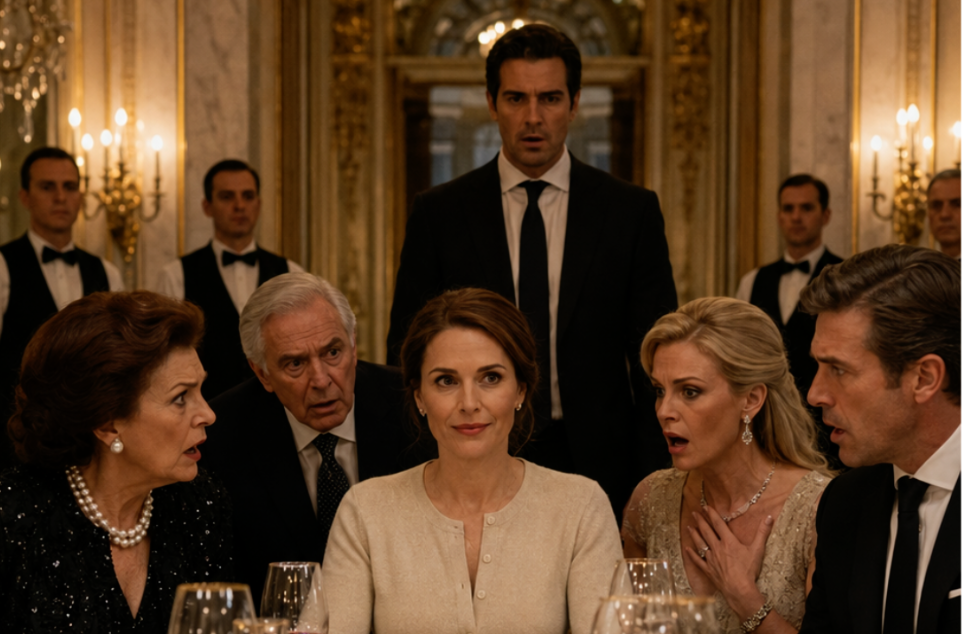
All conversation at the table stopped instantly.
I raised my head and gave him an almost imperceptible nod to show that I had heard him.
“Good evening, Oleg Stepanovich.”
He straightened even further, like a soldier reporting to a general.
“Your usual private room has been fully prepared. Just as you requested during your previous visit,” he continued clearly, pronouncing every word with precision. “Panoramic windows and a separate exit to the terrace. The chef has received your menu preferences. I would be happy to escort you personally.”
The silence became so complete that I could hear someone’s wristwatch ticking.
Viktor Andreyevich frowned.
His right eyebrow twitched—a reliable sign of extreme surprise in a man unaccustomed to being surprised.
He looked from me to the manager and back again, struggling to comprehend what he had heard.
“You know each other?” he finally managed.
Oleg Stepanovich turned toward him in surprise, apparently noticing the tense atmosphere at the table only then.
“Of course,” he replied calmly, not understanding the hidden meaning behind the question. “Elena Sergeyevna is one of the principal investors in our restaurant chain. We have been working together for several years.”
The wineglass slipped from Inna Borisovna’s hand.
It struck the edge of her plate and shattered with a sharp, almost musical sound. Red wine spread across the spotless white tablecloth.
Waiters rushed forward with napkins, but Inna Borisovna did not move.
She sat with her mouth open, staring at me as though she had just seen a ghost.
“An investor?” she repeated in a whisper, her voice breaking into a rasp.
Dima slowly—very slowly—turned his head toward me.
His eyes showed complete bewilderment.
It was the look of someone who had lived beside another person for twenty years and had suddenly realized that he did not know that person at all.
His lips moved, but no words came out.
Katya covered her mouth with one hand and looked from me to her parents.
I remained completely still, watching the scene with icy composure.
But I did not yet know the most important thing.
I had no idea that the evening’s most terrifying revelation was not going to happen at that table.
Because at the far end of the dining room, passing the frozen waiters and astonished guests, a man was moving quickly toward us.
A man no one present had expected to see.
He walked rapidly and almost silently despite his heavy build. His expensive suit fit him perfectly, and I immediately noticed that the material did not come from a mass-market store.
Clothes like that were made only by private tailors for people who understood the value of money and reputation.
An assistant followed half a step behind him, carrying a slim briefcase.
Two other men, clearly security personnel, stopped near the entrance to the dining room and blocked the view.
I recognized that stride instantly.
It was the walk of a man who had spent many years on construction sites before abruptly moving into ministerial offices.
His shoulders were squared and his head inclined slightly forward—a habit remaining from the days when he had personally inspected concrete floors and structural supports.
Igor Petrovich Danilin.
The same man I had pulled out of financial ruin almost ten years earlier.
When he saw me, he froze for a moment.
“Elena Sergeyevna?” Genuine surprise sounded in his voice. “What an unexpected meeting. I didn’t expect to see you here.”
“Good evening, Igor Petrovich,” I replied calmly, although my heart was already pounding in my throat. “I didn’t expect to see you either.”
Danilin looked at the table, and his expression changed.
It happened in a single second.
Surprise turned to recognition, and recognition turned to cold, calculated fury.
He stared at Viktor Andreyevich the way a person looks at an enemy he has searched for over many years and finally found.
“Well,” he said quietly but distinctly. “So the two of you are sitting at the same table. How interesting.”
Viktor Andreyevich turned pale.
I saw the fingers of his right hand, resting on the tablecloth, curl into a fist. Sweat appeared on his forehead.
He had recognized Danilin instantly, and judging by his reaction, the encounter promised him nothing good.
“Igor Petrovich,” he began, rising halfway from his chair. “What brings you here? It has been a long time. Perhaps we shouldn’t discuss anything in front of the ladies…”
“We should,” Danilin interrupted harshly. “We absolutely should.”
He stepped closer and planted his palms on the edge of the table.
People at neighboring tables began turning toward us. The hum of conversation became quieter. The waiters stood motionless, unsure whether to intervene or wait.
“You probably thought I was dead, Vitya,” Danilin said quietly, but in such a tone that every word seemed to strike the temples. “You thought I had vanished, disappeared, been written off. Ten years have passed. Who would remember, right?”
“I don’t understand what you’re talking about,” Viktor Andreyevich tried to object.
“You don’t understand?”
Danilin smiled, but his eyes remained icy.
“Then I’ll explain. Loudly enough for everyone to hear.”
He straightened and swept his gaze around the silent dining room.
“Ten years ago, this man”—he pointed at Viktor Andreyevich—“was my business partner. We were building a cottage development outside the city. The land was mine. The money was mine. The connections were mine. Vitya was responsible for the contractors and the paperwork. I trusted him like a brother. And what did he do? He forged my signature on the work-acceptance documents. He siphoned off fifty million rubles through shell companies. And when everything came to light, he disappeared, leaving me alone to face the tax authorities, the bank, and a criminal investigation.”
A whisper swept through the dining room.
Inna Borisovna clutched her chest and began gasping for breath.
“You’re lying!” she cried. “My husband would never…”
“Your husband,” Danilin interrupted, “stole fifty million rubles from me and framed me so thoroughly that I spent three years under investigation. I was acquitted, but my business collapsed, my family fell apart, and my health…”
He broke off and clenched his jaw.
“This is slander,” Viktor Andreyevich rasped. “You have no proof.”
“No proof?”
Danilin gave a crooked smile.
“Vitya, you have forgotten whom you crossed. I reopened the archives only yesterday. I found the original documents you worked so hard to hide. And do you know what’s interesting? The statute of limitations for large-scale fraud under Article 159 of the Criminal Code is ten years. Exactly ten years. And that period expires in three weeks.”
He paused and leaned closer to his former partner’s face.
“You have already breathed a sigh of relief, haven’t you, Vitya? You thought you had gotten away with it. I met with my lawyer today. We prepared the complaint. Tomorrow morning it will be placed on an investigator’s desk. And believe me, I will make sure the case is taken all the way this time.”
Inna Borisovna screamed.
It was not the theatrical cry she probably used during arguments with her husband.
It was a real, primal howl of terror.
“You!” She grabbed Viktor Andreyevich by the sleeve of his jacket. “You swore everything was clean! You said you had taken care of it! We already have a tax investigation hanging over us, our accounts are about to be frozen, and we have no money to repay the loan! And now this! You’re going to leave us destitute, you idiot!”
She struck his shoulder with her fists, paying no attention to the people around them.
Viktor Andreyevich sat motionless, his face turning gray like old plaster.
He understood that denying everything was pointless.
Danilin had not come unprepared.
He had come with documents, a lawyer, and precise timing.
Katya sat with her face hidden behind her hands. Her shoulders shook with silent sobs.
Dima tried to embrace her, but she jerked away.
“Don’t touch me,” she whispered. “Please.”
“Katya, I…”
“You don’t know anything,” she interrupted bitterly. “You don’t know anything at all about my family. And apparently, neither did I.”
Danilin turned toward me.
His expression softened. The fury disappeared, replaced by something resembling gratitude and respect.
“Elena Sergeyevna,” he said in an entirely different tone. “Forgive me for involving you in this scene. But when I saw you sitting at the same table as this man, I simply could not walk past. I had to warn you.”
“Warn me about what?”
“About whom you are dealing with. And about the fact that this man is dangerous. If he can deceive a partner with whom he worked side by side, what would stop him from deceiving his future relatives?”
Viktor Andreyevich flinched as though he had been slapped.
“So you’re a saint, are you?” he hissed through clenched teeth, looking at me. “You came dressed in rags and pretended to be a beggar, while all along you were an investor in restaurants. And your friends happen to be former partners who want to destroy me. Very clever! You sent your son after my daughter so he could gain our trust, sniff around, and then stab us in the back.”
I rose from my chair.
Slowly.
Very slowly.
Then I looked directly into his eyes.
“Listen to me carefully, Viktor Andreyevich,” I said calmly, but every word rang like metal. “I came here in a house dress because my son asked me not to stand out. I did not know that you and Igor Petrovich had an old conflict. Until recently, I did not even know you existed. And I certainly did not send my son after anyone. My son fell in love with your daughter. That is the only truth here that matters.”
I took a breath and continued.
“As for my friends, Igor Petrovich did indeed come to me for help many years ago, when he was on the verge of ruin because of you. I helped him examine the documents, locate the authentic originals, and restore his reputation. And do you know something? I have never regretted it.”
“It’s true,” Danilin confirmed. “If it had not been for Elena Sergeyevna, I would have gone to prison while you celebrated your victory. She saved me, and I owe her a debt. But you, Vitya, owe me a debt you will never repay in your lifetime.”
He gestured to his assistant.
The man clicked open the locks of the briefcase and removed a thick folder of documents.
“These are copies,” Danilin said, throwing the folder onto the table in front of Viktor Andreyevich. “You can review them at your leisure. The originals are with the investigator. I had planned simply to mail everything, but when I saw you here tonight, I realized I needed to deliver it personally. So you would remember this evening. So you would remember the faces of everyone you tried to deceive.”
He turned toward Inna Borisovna, who was still sobbing and digging her fingers into her ruined manicure.
“Inna Borisovna, I advise you to think about the man you have been living with—and about the money that funded your so-called ‘certain standard of living.’ Soon you may have neither the standard nor the life you are accustomed to.”
Then he looked at Katya, and for the first time that evening his voice became gentle.
“None of this is your fault, young lady. Just remember that your father is not the man he appears to be. And when you decide whom to build a future with, judge him not by the size of his wallet, but by his actions.”
Katya raised her tear-streaked face and looked at him.
Then she shifted her gaze to Dima.
She said nothing.
Danilin turned to me and inclined his head slightly.
“Elena Sergeyevna, I will come by to say goodbye before I leave. For now, please excuse me. Business cannot wait.”
“Of course, Igor Petrovich. Thank you,” I replied.
He nodded, gave his former partner one final, devastating look, and headed toward the exit.
The crowd of guests parted before him like water before the bow of a ship.
An oppressive silence settled over the dining room.
Viktor Andreyevich sat staring at a single point.
Inna Borisovna wept, smearing mascara across her cheeks.
Katya silently gathered her handbag.
Dima looked helplessly from one face to another.
Oleg Stepanovich approached the table again. He was pale, but maintained his professional composure.
“Elena Sergeyevna, your private room is ready, as I mentioned. Perhaps you and your companions would find it more comfortable to continue your conversation there, away from prying eyes?”
“Yes,” I replied. “I think that would be best.”
I looked at Dima.
“Son, help Katya. We’re going to the private room.”
Then I turned toward the bride’s parents.
“You two should remain here. It seems you have something to discuss.”
Inna Borisovna raised her head and hissed:
“You will pay for this. You destroyed our family.”
“Neither Igor Petrovich nor I destroyed your family,” I replied calmly. “It was destroyed by the man sitting beside you—the man who decided many years ago that other people’s money mattered more than honor.”
I picked up my handbag, straightened my dress, and walked toward the private room.
Behind me, Dima helped Katya to her feet.
She did not resist, but she walked like someone in a dream, staring at nothing.
I heard the noise rising behind us as Inna Borisovna began attacking her husband with accusations again.
But I no longer cared.
A different and far more difficult conversation awaited me.
A conversation with my son.
I did not know where to begin.
But I knew there was no way back.
Tonight, everyone’s masks had been torn away.
Including mine.