“How much longer do I have to put up with this cow? She’s completely crazy — it’s her money, her house, her business, and yet she has barely a penny’s worth of brains.”
That was what my husband wrote. To my childhood friend.
“Pack your things. Both of you. You have half an hour. After that, I’m calling the village security.”
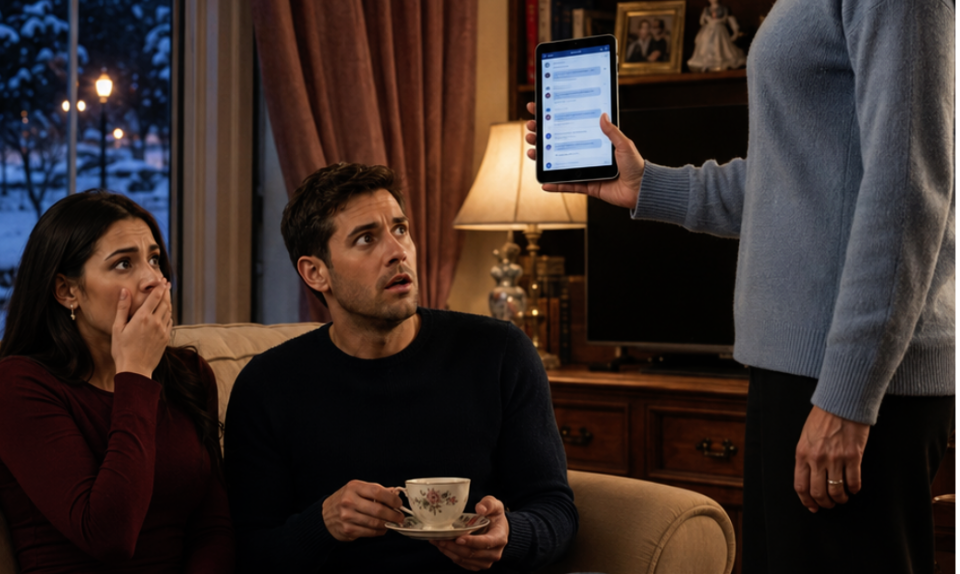
I said it very calmly. Without raising my voice. Without crying. Without trembling. I stood by the coffee table, holding a tablet in my hand, the screen facing them. On the screen was their own correspondence. Open. Highlighted. Proven.
Igor — my husband — turned so pale that I thought he was going to vomit right onto the carpet. The cup of tea trembled in his hand. Tea spilled onto his jeans. He didn’t even notice.
Karina — my “best friend” of fifteen years — opened her mouth, but no sound came out. Only her eyes, wide, heavily coated with mascara and framed by fake lashes, darted between me and Igor like those of a trapped animal.
“Liz…” Karina began.
“Be quiet,” I said. “You, Karina, will never speak in my house again. Never. Half an hour. Time starts now.”
I placed the tablet on the table and turned it so both of them could see the screen. So they would remember exactly what I had read.
Then I left the living room.
I went upstairs to my office. Closed the door. Sat down in the chair.
And only then did my hands begin to shake.
But I did not cry.
I opened my laptop. Logged into the bank. And methodically began transferring money from our joint account to my personal account. The one Igor didn’t know about.
Then I opened the file with the list of my lawyers. Chose a number. Dialed.
“Anna Sergeyevna. Good evening. This is Elizaveta. I apologize for calling so late. I’m getting divorced. Urgently. Can you see me tomorrow at ten in the morning?”
“Liza, I can. What happened?”
“I’ll tell you tomorrow. Prepare the documents. All the property is in my name, but I want everything legally airtight. And one more thing. The children stay with me. That is not up for discussion.”
“Liza, understood. I’ll be waiting at ten.”
I hung up. Looked out the window. Outside, January snow was falling quietly. Very beautiful.
From downstairs, I could hear Igor and Karina fussing as they gathered their things. Igor was muttering something. Karina was sobbing.
And I thought: what a pure feeling it turns out to be. When it doesn’t hurt anymore, but everything is clear.
But it had all started fifteen years earlier.
I met Karina at college. In our second year. I was studying food service technology and dreamed of opening my own pastry shop. Karina studied management. She had transferred from another university, ended up in my group for general lectures, and somehow we immediately clicked.
I was businesslike, goal-oriented, a bit boring. Karina was bright, easygoing, the life of the party. We complemented each other. At least, that was what I thought.
I was a simple girl from Podolsk. My father was a bus driver. My mother was a math teacher. Money was tight in our family. From my first year, I worked part-time — baking cakes to order, delivering them to acquaintances, then to acquaintances of acquaintances. By my fifth year, I already had a small but stable client base.
Karina was from Moscow. Her father was a businessman, something to do with auto parts. Her mother was a housewife. Karina had had everything since childhood: a car for her eighteenth birthday, an apartment in Sokol, trips abroad. She studied not for the diploma, but “to calm her mother down.” She got married in her fourth year to some spoiled rich boy from Rublyovka. Divorced him two years later. No children.
I got married in my fifth year. To Igor.
Igor studied law at a nearby university. We met at a mutual friend’s birthday party. Igor was serious, responsible, ambitious. That was exactly what I liked about him. Not a “prince,” not the “life of the party,” but a normal man with plans.
After college, I started my own business. I rented a tiny space in Podolsk. Twenty square meters. I baked myself, stood behind the counter myself, did the accounting myself. Igor worked as a lawyer at a small firm — the salary wasn’t great, but it was stable.
Three years later, I had two pastry cafés. Five years later, four. Eight years later, a small chain of six locations in the Moscow region, plus production in Podolsk. I hired people, delegated, and finally breathed out.
By the age of thirty-five, I could afford a house. And we bought it. More precisely, I bought it. Completely. With my own money.
By that time, Igor had… how can I put this gently… “stabilized career-wise.” A mid-level lawyer. A salary of one hundred and twenty thousand rubles. No career leaps. No ambition. But plenty of complaints.
I looked past it. I thought, yes, I earn more. So what? The main thing is family. A home. Children.
By then, we had two. Artyom was ten. Sonechka was six. Good children. Smart. Healthy. Artyom was calm, like me. Sonechka was sunny, a little chatterbox.
Igor was fine with the children. I wouldn’t say he was a very involved father, but he wasn’t bad either. Sometimes he helped with homework. On weekends, he took them skating. Not ideal, but not a disaster.
And Karina had been by my side all those years. My friend. My best friend. My beloved friend. She came over two or three times a week. Sat in our kitchen, drank wine, told me about her stormy personal life. I listened. Sympathized. Was happy for her when something worked out. Comforted her when it didn’t.
Karina was Sonechka’s godmother. Just think about that. I made her the godmother of my daughter. Properly. In church.
And all that time, she was sleeping with my husband.
There had been no signs. Well, almost none. Now, of course, I replay everything in my head and think: there were warning bells. I just didn’t want to hear them.
“Karina comes over a lot, don’t you think?” I asked Igor a year earlier.
“Liz, she’s your friend. What am I supposed to do, throw her out?”
“No, that’s not what I mean. It’s just… she’s started coming over often exactly when I’m on business trips or at production.”
“Liz. Coincidence. Don’t wind yourself up.”
I didn’t wind myself up. Or rather, I forced myself not to.
Also, Igor started coming home late. “Work.” Meetings. Clients. When I tried to clarify something about his work, he would get angry.
“Liz, if you don’t trust me, then don’t come near me at all.”
Another thing — he started reacting strangely to conversations about money. I suggested that, since he felt “left out,” he could invest in a new project and, with my help, open his own legal practice. He looked at me as if I had suggested he sweep the streets.
“Liz. I don’t need your handouts.”
“Igor, they’re not handouts. It’s our joint budget. I want you to have something of your own.”
“I already have everything of my own.”
Back then I thought: fine. Pride. I won’t pressure him.
Two months later, I accidentally found a receipt from an expensive restaurant in his jacket. For two people. For an amount higher than his weekly salary.
I asked:
“Igor, what is this?”
“I took a client there. For work.”
“And the client was a man?”
“Liza, what kind of interrogation is this?! What kind of suspicions?! Am I cheating on you or something?!”
He said it with such rage, such offense, that I immediately felt guilty.
And shut up.
Two months after that, the tablet fell.
It happened on a Sunday. In January. The children were with my parents in Podolsk for the weekend. In the morning, Igor said he was going “to work” — on a Sunday, yes, of course. I stayed home. Doing all sorts of house things: laundry, cooking, sorting out the wardrobe.
I went into the living room to vacuum. Walked up to the sofa. Lifted a cushion. And Igor’s tablet fell out from underneath. Hit the floor.
I picked it up. The screen turned on.
And on the screen was an open Telegram chat.
Karina. Karina Chernova. My “best friend.”
And the first message I saw at the top was:
“The fat cow has gone off on another business trip. Come over tonight. The kids are at her parents’. We have the place until morning.”
I froze.
Read it again.
“The fat cow.”
That was what my husband wrote about me. To his mistress. Who was my “best friend.”
I sat down on the sofa with the tablet in my hands and started scrolling up through the chat.
A whole year of messages.
An entire year.
I won’t retell everything. Because it’s disgusting. And because even now it makes me feel sick. But the main points were these:
They had been sleeping together since roughly last January. A year. Regularly. In my house, when I was away. Sometimes at Karina’s apartment. Once even at our family resort in Sochi, where we went together in the summer as a family: as it turned out, Karina had “coincidentally” booked a hotel in the neighboring building. Back then, I was surprised by the coincidence. In their messages, they laughed at my naivety.
They discussed me. For hours.
Igor wrote:
“How much longer do I have to put up with this cow? She’s stupid — her money, her house, her business, and barely a penny’s worth of brains. The main thing is to smile, agree with her, and she signs everything.”
Karina answered:
“Liza is kind, of course. But limited. All she can do is bake her little cakes. I’ve never met a more boring person. But don’t rush the divorce. First, let the business grow a little more. Then there’ll be something worth taking.”
They discussed my children.
Igor wrote:
“Artyom is slow at school, just like his mother. And Sonya isn’t even mine. Sometimes I even wonder whether she’s mine at all.”
Karina:
“Her brats are not our problem. The main thing is to turn them against her. When they hit their teenage years, they’ll come to you themselves. Especially if we’re together by then.”
They planned exactly how to “squeeze” the business out of me. Igor discussed with Karina how best to transfer part of the assets to his sister, for whom I was listed as a trusted representative because I had agreed “as family.” How to “persuade” me to sign a marriage contract I had previously refused to sign. What psychological techniques to use so I would start “doubting myself.”
Karina joked:
“Tell her she’s gained weight. Five times in a month. Casually. That hits women’s self-esteem the hardest.”
Igor:
“I already do. She’s already on a diet and suspects nothing. Hehe.”
I read.
For one hour.
For two hours.
I didn’t cry. Didn’t scream. Didn’t smash the tablet against the wall.
I simply read.
When I finished, I understood one thing.
This was not disappointment. Not hurt. Not “how could this happen?”
This was liberation.
Because right there, before my eyes, it was not my marriage and my friendship that had fallen apart. They had fallen apart a year earlier. I just hadn’t known.
And now I knew.
Which meant I was free.
I methodically — and I emphasize, methodically — took screenshots of the entire chat. Every page. Uploaded them to the cloud on my personal account, which Igor had no access to. Duplicated them onto a flash drive. Put the flash drive in my safe. Yes, I have a personal safe in my office. Igor didn’t know about it.
Then I called my mother.
“Mom. Let the children stay with you for another week. I’ll pick them up in a week. I can’t explain right now. Later.”
My mother, a wise woman, did not ask questions.
“Lizochka, of course. The kids are fine here. Artyom is sledding with Grandpa. Sonya is baking pies with Grandma.”
“Thank you, Mom. Love you.”
Then I put the tablet back where it had been. Under the cushion.
Then I took a shower. Made myself tea. Had dinner.
Then I changed clothes. A dark-blue sweater. Black trousers. Pulled my hair into a strict bun.
I was preparing for the performance.
Igor returned at ten in the evening.
With Karina.
Surprise — they arrived together. In her car.
“Liz, Karina and I happened to run into each other at the store. She dropped by for tea.”
“Happened to.” At the store. At ten in the evening. On a Sunday.
“Wonderful!” I smiled. “Come in. I’m just putting the kettle on. Karina, go into the living room, I’ll be right there.”
Karina, in a tight red dress — because of course that’s what she wore to the store — went into the living room. Igor followed her. I put the kettle on.
I brought in a tray with three cups, a teapot decorated with cornflowers — my mother’s wedding gift to us — a small bowl of candies, and a plate of cookies.
I placed the tray on the coffee table.
Sat across from them.
“Help yourselves.”
They exchanged glances. Igor sensed something. He wasn’t stupid, I had to give him that. But he still didn’t understand what exactly. Karina relaxed. Took a cup.
“Lizochka, thank you. You’re as hospitable as always.”
“I try, Karina. I try.”
I waited. Gave them time to take a sip.
And then I pulled the tablet from under the armchair. Placed it on the table. Turned the screen toward them.
“Igor. Karina. I have one question for you. Which of you was the first to come up with calling my children ‘brats’?”
Silence.
Complete silence.
Karina turned white. Igor turned green.
“Liza… what are you…” he began.
“Igor. I don’t ask rhetorical questions. I asked a specific one. Which of you was the first to use the word ‘brats’? According to the chat, it was Karina. On March second of last year. But I want you to confirm that you didn’t object. That you picked it up. That you repeated it later.”
Igor was silent.
“Fine,” I said. “Then the next question. Karina. What do you feel right now? Sitting in my house. Drinking my tea. From a cup my mother gave you for your birthday three years ago. Do you remember?”
Karina burst into tears. Very theatrically. Mascara ran down her face.
“Liza… you don’t understand… it was all… it was a game… we were joking…”
“Karina. For a year? You joked for a year? Sleeping together for a year was also a joke? You have interesting jokes. I didn’t appreciate them before. I thought you were a serious woman.”
I stood up. Walked to the window. Looked at the snow.
And very calmly said:
“Pack your things. Both of you. You have half an hour. After that, I’m calling the village security.”
Then I left.
After that, everything was technical.
Half an hour later, they were standing outside. With suitcases. More precisely, Igor had a suitcase. Karina had her bag and a fur coat thrown over her shoulders. It was minus eighteen outside. Karina’s car was parked outside the village gates. She hadn’t driven in because they no longer let her in without my permission — I had just called security and told them she was no longer on the list.
Igor knocked on the door. Rang the bell. Shouted:
“Liza! Open up! We need to talk! Where am I supposed to go?!”
I opened the second-floor window and said down to him:
“Igor. Wherever you want. To Karina. To your mother. To the train station. Not my concern. Tomorrow at ten, at my lawyer’s office. I’ll text you the address. If you don’t come, we’ll communicate through court.”
I closed the window.
Igor walked around the house for another twenty minutes. Then he and Karina went on foot toward the village gates. They walked in silence. Not speaking to each other. I watched from the window.
A wonderful picture. Very symbolic.
Two traitors walking through the snow — without a car, without a home, without a plan.
And I stood in the warmth.
In my house.
In my life.
The next morning, I was at the lawyer’s office at exactly ten.
Anna Sergeyevna, a fifty-year-old woman with a gray bob, a strict gray suit, and glasses on a chain, received me in her office on Bolshaya Nikitskaya. I laid out the documents in front of her: the property certificate for the house, in my name; business documents, all in my name — the LLC, where I was the sole founder; the children’s birth certificates; the marriage certificate; printouts of the correspondence. Anna Sergeyevna had asked me to print them in advance, so I arrived with a folder.
Anna Sergeyevna read the screenshots for about twenty minutes. Silently. Her face was stone. Only once did she snort — when she got to the fragment about the “brats.” Then she said:
“Liza, you have an almost ideal position for divorce. All the property is in your name. The property was not acquired jointly in the marriage, because both the house and business were either yours before the marriage or were registered during separate management of finances. Your husband acquired nothing significant during the marriage. The division will be minimal. As for the children, in principle, it’s not even a question — both stay with you. Considering the correspondence where he calls the younger one ‘not his’ and discusses turning the children against their mother, the court will practically automatically be on your side.”
“Anna Sergeyevna, what about child support from him?”
“Do you want to demand it?”
“No. I don’t need his child support. I want him gone and to have no rights to the children. None. I don’t even want him showing up at school meetings.”
“Liza, completely depriving him of parental rights is difficult. Russian law is reluctant to do that. But we can restrict communication. Arrange visits only in the presence of a psychologist. Prohibit him from taking the children away. That is realistic. Especially with such correspondence.”
“Do it.”
“We’ll do it.”
By lunchtime, we had filed the divorce petition in court. Anna Sergeyevna knew whom to contact so the case would be assigned quickly. At the same time, I filed a claim to restrict his parental rights, attaching the screenshots of the correspondence. Where Igor discussed how to “turn the children against their mother.” Where he called Sonechka “not his.” Where he discussed with his mistress a plan to “squeeze” my business out of me.
Anna Sergeyevna said:
“Liza, prepare yourself. He’ll come to his senses soon and start snapping back. He is a lawyer, after all. He’ll threaten, pressure, manipulate. Don’t react. All questions go through me.”
“Understood.”
I left the law office on Bolshaya Nikitskaya. It was noon. January. The sun was shining. The snow was white, clean, crunching under my boots.
I stood on the sidewalk for about five minutes.
And realized: for the first time in the past year, I felt good.
Truly good.
Without reservations.
By evening, Igor called.
About fifteen times.
I didn’t pick up.
Then the messages started.
First, aggressive ones:
“Liza, have you lost your mind?! It wasn’t what you thought! Karina — yes, I’m guilty, but the messages were jokes, we were messing around, you don’t understand our style of communication!”
I didn’t answer.
Then softer ones:
“Liz, forgive me. I was a fool. I love you. I love the children. It was all a delusion. Let’s talk.”
I didn’t answer.
Then tearful ones:
“Liz. I understand now. I understand everything. I’m ready to accept any conditions. Just don’t divorce me. Think of the children.”
I didn’t answer.
Then threatening ones:
“Liza. Do you understand that I am a lawyer? I will fight for half the property. I will win. You have no idea what I’m capable of.”
That one I answered.
With one message:
“Igor. All questions go to my attorney. Anna Sergeyevna Lobanova, phone number such-and-such. There is no need to communicate with me anymore. On any matter. I have screenshots of the correspondence. My attorney has them. The prosecutor’s office has them, just in case. The family court has them. And they are in the cloud. If anything happens to me or the children, the correspondence will automatically go to your legal association, your boss, your clients, and three Moscow newspapers. I am very glad you are a lawyer. It will be easier to explain things to you in your own language.”
Igor didn’t call again.
That evening.
Karina called two days later. From an unknown number, because I had blocked hers.
“Liz. Lizochka. It’s me.”
“I know who it is.”
“Liz. I’m guilty. I’m terribly guilty. I don’t know how it all happened. It was… an obsession. Igor, he seduced me. I didn’t want it. He persuaded me. It was all his initiative. I’m weak. I couldn’t handle it.”
I listened. Silently.
“Liz, forgive me. I’m ready to get on my knees. I’m ready to do anything. Just don’t throw me out of your life. You are my only friend. I have no one but you.”
I listened to the end. Then I said:
“Karina, I have only one question for you. Sonechka is my daughter. Your goddaughter. Remember? You baptized her. In church. Before God. You promised to care for her. Remember?”
“Liz…”
“And in the chat with Igor, you called her a ‘brat.’ And discussed how to turn her against her mother. And planned to live with her father on her mother’s money. That’s a godmother, yes? That’s a Christian woman, yes? That’s a friend?”
“Liz, I… I didn’t think… I just…”
“Karina, listen carefully. I will never let you into my life again. Never. I won’t take revenge on you — I can’t even be bothered. I’m simply crossing you out. From my life. From my children’s lives. From my parents’ lives. From the lives of my acquaintances. If you call my mother, or my brother, or anyone from my circle, I will file a harassment report against you. I have every reason to. Do you understand?”
“Liz, you can’t do this…”
“I can do everything. I have a house. I have a business. I have children. I have money. I have lawyers. And what do you have? A one-room apartment in Sokol, where you live on an allowance from Daddy? An ex-rich-boy husband who left you? Igor, who is now sitting on your sofa and wondering how to run away from you because you don’t have money, and I did? You lost, Karina. Completely. And you know what’s funniest? You outplayed yourself. I didn’t even have to lift a finger. Goodbye.”
I ended the call.
And blocked the number.
Karina never called me again.
The divorce was finalized in four months.
Igor hired his own lawyer. They tried to fight for half the house, a share of the business, “moral damages.” Anna Sergeyevna destroyed them at every hearing. All the documents were in my name. All the money was mine, either earned before the marriage or earned by me. Igor had invested zero in the house during the marriage. Zero in the business. His role had been “husband,” and as it turned out, he had performed that role very poorly.
Plus, the correspondence.
Anna Sergeyevna presented it at the second hearing. The judge read it. Read for a long time. And when he raised his eyes, he looked at Igor with such contempt that Igor shrank into himself.
The judge said:
“Defendant. I have one question for you. You have a legal education?”
“Yes, Your Honor.”
“So you understood that such correspondence with a third party, containing plans to alienate your spouse’s property through fraudulent schemes, could potentially constitute a criminal offense? Under the articles of fraud and attempted fraud?”
“Your Honor, I…”
“I did not ask you a question requiring an extended answer. Yes or no?”
“Yes, I understood.”
“Excellent. Then let us continue the hearing.”
After that, Igor’s ambitions noticeably decreased.
The house remained mine. Completely. The business remained mine. Completely. The car — the second one, which Igor drove — went to him voluntarily. I didn’t contest it. I did not demand child support. I didn’t want it.
The court partially granted the restriction of rights. Igor received the right to meet the children, but only twice a month, for three hours, in the presence of a child psychologist. Taking the children outside the Moscow region was prohibited. Overnight stays with Igor were prohibited.
Artyom and Sonechka went to those meetings for the first six months. Artyom because I told him: “He is your father. I won’t forbid you to think anything about him. Decide for yourself.” Sonechka because she was still little and didn’t understand.
Six months later, Artyom himself said:
“Mom, I don’t want to go to Dad anymore.”
“Why, son?”
“He tells me nasty things about you. I don’t want to listen to that. And also, Aunt Karina is there. She tries to hug me. It feels unpleasant.”
“Okay, son. You won’t go.”
I went to the lawyer. Anna Sergeyevna prepared everything. Artyom officially refused the visits. He was ten, and the court took his opinion into account. Sonechka’s visits were also gradually reduced: first to once every two months. Then once every six months. Then Igor himself stopped asking for visits.
Apparently, he was busy. He had his own life.
And Igor’s “own life” turned out interestingly.
Karina did not take him in permanently. Just as I had predicted. She let him live with her for a month while she “processed the situation.” Then everyday questions began: who would pay for utilities, for food, for her wants. It turned out Igor was used to me paying for everything. And his own salary was one hundred and twenty thousand, half of which went to rented housing — Karina lived in Sokol, expensive — part went to food, and almost nothing was left.
Karina quickly began complaining to acquaintances. And since we had mutual acquaintances, everything reached me:
“It turns out Igor is poor. Without Liza, he’s nobody. He lived on her money, ate her bread, went to her restaurants. And now he asks me for a thousand rubles until payday. I’m shocked.”
Igor complained to other acquaintances:
“Karina is a bitch. She used me. She wanted to get access to Liza’s business through me. And when she realized I wouldn’t lead her to Liza’s money, she started pushing me out.”
They broke up seven months after our divorce.
Karina went back to her mother in Sokol. Igor rented a room somewhere in the Moscow region. His salary remained the same — one hundred and twenty thousand. Apparently, people with that kind of moral stability don’t make careers.
I heard about it by chance through mutual acquaintances. It no longer affected me. It was someone else’s life. The life of strangers.
And my life after the divorce blossomed.
I discovered that without Igor, everything was easier. Freer. I could breathe more deeply. I expanded the business and opened two more locations in the first year. I earned more than I had in the previous five years with my husband, because before, so much energy had gone into “servicing” Igor, his moods, his grievances.
I started seeing my parents more often. I took the children to Podolsk every weekend. My father taught Artyom how to hammer nails and change a wheel. My mother taught Sonechka how to bake pies.
The children came alive. Both of them, it turned out, had been living under tension before, because their father was constantly dissatisfied with everyone, criticizing everything, saying everyone was “not right.” Now the tension was gone. Artyom started doing better in school. Sonechka stopped biting her nails.
Two years after the divorce, I met Andrey.
Andrey was my age, forty. Divorced, with two teenage children from his first marriage. They lived with their mother in Samara and saw their father during holidays. He was a construction engineer with his own small company. Calm. Reliable. Without ambitions to “change the world,” but with ambitions to “live honestly and work properly.”
We met through work — he was renovating one of my new locations. We communicated about work, discussing estimates, materials, deadlines. At some point, I realized: I felt good with him. Just good. Without drama. Without “chemistry with sparks.” Without “he’s the man of my dreams.” Just a normal person by my side.
We started dating. A year later, he moved in with me. A year and a half later, we registered our marriage. No wedding. We simply went to the registry office, signed the papers, and had dinner with the children at a café.
Andrey became a real father to Artyom and Sonechka. Not a “stepfather,” but exactly a father. Artyom calls him “Uncle Andrey.” Sonechka calls him “Papa Andrey.” She came up with it herself. We didn’t insist.
Andrey taught Artyom how to hammer nails, together with my father. Andrey takes Sonechka to dance class and picks her up afterward. Andrey discusses the business with me and helps with advice. Andrey has never said a single bad word to me. Never criticized me. Never mocked me. Never discussed me behind my back.
Once I asked him:
“Andrey, don’t you think I… feed you too much? I mean, I earn more. I’m the main one when it comes to money. Doesn’t that give you complexes?”
Andrey looked at me. Thought for a moment. Then said:
“Liz, you are talented. You built a business yourself. I’m proud of that. I have my own company, I also earn, I have enough for my life. And the fact that you earn more is not a reason for complexes. It is a reason for respect. If I were the kind of man who had complexes about that, I wouldn’t be right for you. So everything is fine.”
I almost cried then.
Because this was exactly what I had not heard from Igor in fifteen years. Not once.
All those years, Igor had quietly hated my success. Through gritted teeth, he called me “Mommy Businesswoman.” In front of his friends, he was embarrassed that I earned more. And in the end, he found Karina, with whom he could feel “in charge” because Karina lived at his expense.
Andrey does not see me as a threat.
He sees me as his wife. His partner. His ally.
That is a different level of man.
And I am grateful to him.
Recently, there was one scene. It happened after Andrey and I were already married.
Sonechka and I were walking through a shopping mall. Sonechka was already eight, a girl with braids, wearing a pink jacket. Artyom, twelve, had gone to the cinema with friends.
And suddenly, on the escalator, there was Igor.
With some woman. Not Karina — someone new. She looked about thirty-five, tired, wearing inexpensive clothes.
Igor saw us. Froze.
Sonechka saw him too and said loudly, across the whole shopping mall:
“Mom! Look! That’s Papa Igor. The one who used to be before Papa Andrey. Remember?”
Igor turned pale.
I smiled and said loudly:
“I remember, sweetheart. Don’t get distracted. Let’s go, we came to buy glitter for dance class.”
Igor passed by on the escalator. Said nothing. Didn’t wave. Nothing.
Sonechka calmly went with me to buy glitter. A minute later, she had forgotten about that encounter.
But I had not.
I thought: there it is. The result.
Nine years ago, this man called my children “brats.” And today, my daughter called him “Papa Igor, the one who used to be.”
And in that lies all the justice in the world.
I did not take revenge. I did not punish him. I did not create a scene.
Life itself simply put everything in its place.
He stands on the escalator with a tired woman, in an ordinary shopping mall, going down.
And I stand with my happy daughter and go up.
We are going to buy glitter. Then we will go home. Where my husband, who respects me, is waiting. My son, who loves me. Grandmother and grandfather, who have come to visit. A business that is growing. A life that is mine.
And Igor is going down.
And that is all you need to know about justice.
P.S. If you are reading this and thinking, “Something is wrong in my family too, but I don’t see it…” I have one piece of advice.
Check.
Sometimes you need to. Not out of paranoia. Simply out of self-respect.
If everything in the family is fine, you will find nothing bad and sleep peacefully. But if something is wrong, it is better to learn sooner rather than later. Because the later you learn, the more expensive the price.
I found out in time.
My daughter did not have time to grow up listening to herself being called a “brat.” My son did not have time to become like his father. They did not have time to “squeeze” my business out of me. The house remained mine.
And most importantly, I did not have time to completely believe that I was “the fat cow.”
I am Elizaveta. Thirty-eight years old. Owner of a chain of pastry shops. Mother of two wonderful children. Wife of a normal man. Daughter of good parents.
And I am good.
As for Igor and Karina — let them keep going down.
Each on their own escalator.
That is their choice.
Not mine.