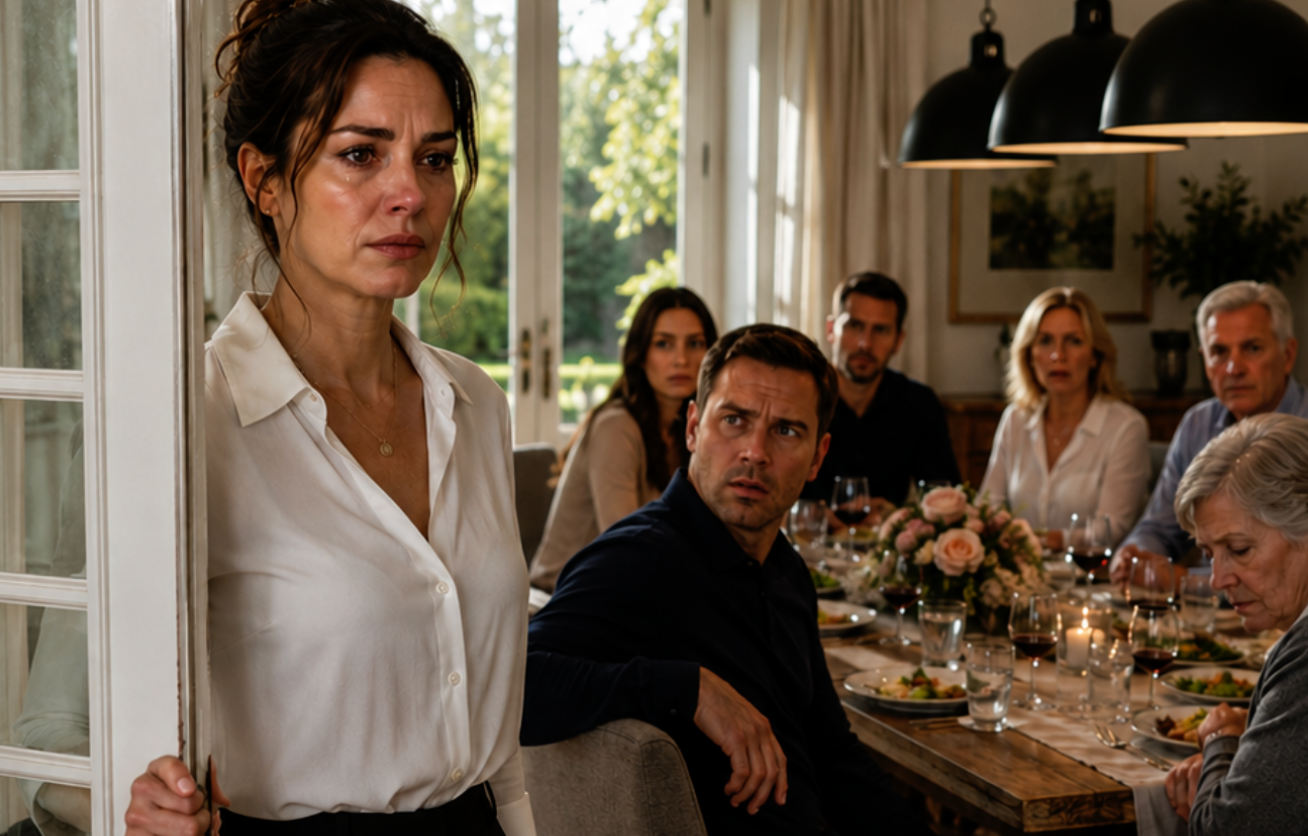
“Get the hell out of here!” he shouted in front of the guests. I stood up and left. Two days later, he discovered that I had taken something far more important than my belongings.
“Get the hell out of here!”
The glass slammed against the table. Beer splashed across the tablecloth—the same linen tablecloth I had ironed an hour before the guests arrived. Six people froze with their forks in their hands.
Roman stood at the head of the table, his face red from drinking and anger, pointing toward the door.
I sat on the edge of the bench. The Olivier salad I had been preparing since lunchtime stood in front of him, half eaten. Meat aspic, cabbage pie, layered herring salad. Six dishes for six guests.
I had been on my feet since nine that morning, and my legs were aching so badly that even while sitting, I could feel every stair I had climbed that day.
“Did you hear me? Out! While I’m still being nice!”
Six pairs of eyes stared at us.
Andrei, Roman’s coworker, placed his fork on the edge of his plate. His wife, Lena, looked past me toward the corner of the room, as though she had suddenly discovered something important there.
The other two couples were friends from Roman’s hunting club and their wives.
Nobody said a word.
Only the refrigerator hummed steadily in the kitchen, and somewhere outside, a car drove past.
I had been married to this man for ten years.
Ten years of sharing one kitchen, one bed, and one refrigerator.
And during eight of those ten years, I had lived with his shouting.
Once every two months, sometimes more often.
I kept count during the first three years. Then I stopped. There had probably been around fifty incidents, if I rounded the number.
Fifty evenings when it was impossible to breathe normally inside our apartment.
This time, the reason was beer.
I had taken it out of the refrigerator, but he wanted it warm.
Six bottles that I had bought after my shift, stopping at the store on my way home from the subway. Two hundred and thirty rubles per bottle—he drank only one particular brand.
But I had put them in the refrigerator.
Wrong.
In the wrong place.
I had failed to guess what he wanted.
“I’ve been teaching her for ten years, and she still can’t learn!” Roman looked around at the guests, and I saw that he was searching for their approval. “She’s a warehouse manager. She knows how to count boxes, but she can’t even serve beer properly at home.”
He smirked.
Nobody smirked back.
Andrei cleared his throat. One of the women—Vitaly’s wife—sighed loudly.
Under the tablecloth, my fingers twisted the edge of my apron into a tight knot.
It was an old habit.
Over eight years, it had become a reflex. Every time Roman raised his voice, I crumpled the fabric between my fingers.
But before tonight, he had always done it in private.
Or in front of his mother, who would simply shake her head and remain silent.
Or over the phone while I stood between the warehouse shelves, pressing the phone tightly against my ear so that my coworkers would not hear him.
Never in front of strangers.
Never in front of people who saw us once every three months and believed that we had a normal marriage.
Tonight was the first time.
I looked at the table.
The plates were arranged perfectly evenly—a habit from the warehouse, where everything had to be lined up precisely.
The napkins were folded into triangles.
I had polished the glasses with a kitchen towel until they squeaked.
Three hours of cooking.
Forty minutes of cleaning.
An hour and a half at the store.
All of it so that Roman’s friends could see how well he lived.
Comfortably.
With plenty of food and a spotless home.
“Have you gone deaf?” He slapped the table, and the glasses rattled.
I stood up.
Not suddenly.
Not dramatically.
I simply rose, removed my apron, and hung it over the back of the chair.
The kitchen smelled of pie and cooling tea, and that smell remained behind me as I walked into the hallway.
I opened the top drawer of the dresser.
The drawer Roman had never once looked inside because it contained my gloves and umbrella.
Beneath the gloves was a folder that had been lying there for four months.
I had collected everything slowly, in the evenings while he watched soccer.
Our original marriage certificate.
Copies of the contracts for the apartment and the country house.
Bank statements covering the previous three years.
Our entire married life, reduced to numbers and signatures.
I took my bag from the hook.
Put the folder inside.
Pulled on my boots.
There was silence in the kitchen.
Then I heard Andrei’s voice.
“Roman, that was too much.”
I pulled the door closed until the lock clicked.
I did not slam it.
I simply closed it.
The apartment hallway smelled of fried potatoes coming from a neighbor’s home. The elevator hummed somewhere above me.
I stood there and heard Roman snapping through the closed door:
“She’ll come back. Where else is she going to go?”
In the taxi, I took out my phone.
I found a contact I had saved four months earlier.
Beside the number, I had written:
“Legal consultation—from Svetlana K.”
When had I start collecting that folder?
When had I realize that talking to him would never change anything?
Or when had I stopped believing it ever could?
My mother’s apartment smelled of valerian drops and old wallpaper.
I sat on the sofa where I had slept as a child and stared at my phone.
The screen kept lighting up.
Eleven missed calls from Roman.
The first had come at seven that morning. The last had come twenty minutes ago.
Not a single voice message.
Roman never left voice messages. He considered them beneath him.
My mother stood in the kitchen doorway, drying her hands on a towel and looking at me the way people look at someone who has arrived without any luggage.
“Again?”
“Again, Mom.”
“But you’re going back, aren’t you?”
I did not answer.
Three years earlier, I had sat on this same sofa.
That time Roman had shouted because of the curtains. I had bought beige ones, while he wanted dark ones.
I left and stayed with my mother for four days.
On the fifth day, he arrived with a cake and said:
“Fine. Keep the beige curtains.”
I went home.
The curtains remained beige.
So did the shouting.
After that incident, I suggested that we see a psychologist.
Together.
He laughed so loudly that my mother could hear him from the kitchen.
“I’m normal,” he said. “You’re the nervous one.”
I never suggested it again.
My mother sat beside me.
Her fingers smelled of onions. She had been chopping them for soup when I called her at ten the previous evening.
“My dear, all men are like that. Be patient. You don’t throw away ten years of marriage.”
“Mom, he threw me out in front of six people.”
“He drank too much. It happens.”
I looked at her.
My mother had lived with my father for twenty-eight years.
My father did not shout.
He used silence instead.
For weeks at a time.
His silence was worse than shouting, but my mother would never admit it.
For her, endurance was not merely a habit.
It was a virtue.
She endured because she believed that was what a good wife was supposed to do.
And she wanted me to believe it too.
My phone lit up again.
The twelfth call.
I stood, walked into the kitchen, and poured myself a glass of tap water.
The water was warm because of the old pipes.
I drank it in one gulp and placed the glass in the sink.
The folder was inside my bag.
I did not open it.
There was no need.
I knew every document by heart.
The marriage certificate—series and number.
The contract for the apartment—a two-bedroom place on Lenin Street, purchased in 2017 and registered in both our names.
The country house—six hundred square meters of land in Krotovo, registered in Roman’s name but bought during our marriage.
The car was also registered to him.
The bank statements showed that over the past three years, he had spent more than one and a half million rubles on hunting and equipment.
Guns.
Ammunition.
Boats.
Fishing rods.
Annual hunting-club fees.
Forty or fifty thousand rubles every month for himself.
My salary as a warehouse manager was sixty-two thousand rubles.
More than forty thousand of that went toward utilities and groceries.
For eight years, I had lived at a loss.
Not financially.
Mathematically.
The amount he spent on himself exceeded the amount I spent maintaining our home.
And he considered that perfectly normal because he earned more money than I did.
I picked up my phone.
Scrolled past the twelve missed calls from Roman.
Found the contact labeled:
“Legal consultation—from Svetlana K.”
Svetlana worked as legal counsel for a company across the street from our warehouse.
We used to smoke together on the front steps. I quit two years ago, but back then I still smoked.
One winter day, she asked:
“Raisa, is everything all right at home?”
“Everything’s fine,” I said.
She studied me for a long moment.
“If things ever stop being fine, I have the number of a good legal office. They handle family cases.”
I saved the number.
It had remained in my contacts for four months, and I had never called.
Because I believed things would somehow work themselves out.
Now I pressed the call button.
A woman answered after the third ring. Her voice was dry and businesslike.
“Legal consultation. How may I help you?”
“Hello. My name is Raisa. I need help with a divorce and the division of marital property.”
There was a pause lasting one second.
“Can you come in tomorrow at ten?”
“Yes.”
“Do you have something to write down the address?”
I wrote it down.
Ended the call.
Ran my finger over my watch strap, an old habit whenever I needed to collect myself.
Inside me, everything was quiet.
It was the kind of quiet that comes when the decision has already been made and all that remains is to act.
My phone lit up.
Roman’s thirteenth call.
I declined it and turned off the sound.
The next morning at work, I arranged boxes of fasteners on the warehouse shelves and tried not to think.
I was not very successful.
My hands moved automatically, following the familiar route from pallet to shelf and from shelf back to pallet.
But my mind remained stuck in one place, like a jammed door.
Sergey, one of the loaders, brought over a cart carrying a new shipment.
He looked at me but said nothing.
Sergey had worked at the warehouse for seven years and knew better than to ask unnecessary questions.
I accepted the invoice, signed it, and checked the quantity.
One hundred and forty-four packages.
Everything matched.
At the warehouse, everything always matched.
At home, nothing ever did.
At ten in the morning, Andrei called me—the same coworker of Roman’s who had been sitting at our table on Saturday.
“Hi, Raisa. Roman asked me to tell you that… well, he lost his temper.”
“Uh-huh.”
“Maybe you could come back? He’s not himself.”
“Andrei, what did he tell you? That I left because of the beer?”
A pause.
“Well… something like that.”
“I understand. Thank you for calling.”
I hung up.
“Something like that.”
Ten years.
Fifty evenings of shouting.
Public humiliation in front of six people.
And it had been reduced to “something like that.”
At lunchtime, while I sat in the break room eating buckwheat from a plastic container, Roman appeared at the warehouse.
I heard his voice before I saw him.
He was arguing with the security guard at the entrance, using the same forceful tone that tolerated no objections.
The guard let him through.
Roman walked between the shelves, looking around like a man who had never entered a warehouse before and could not understand why there were so many racks.
I stepped out of the break room and stood beside the receiving counter.
He saw me and quickened his pace.
“Raisa. Where are the documents?”
Not hello.
Not how are you.
The documents.
“What documents?”
“Don’t play stupid. The marriage certificate, the contracts for the apartment and the country house. I searched everywhere. They’re gone.”
I looked at him.
Red face.
Jacket hanging open.
Fists clenched.
Two days earlier, he had stood exactly the same way, only then he had been at the dinner table in front of our guests.
Now he stood among boxes of screws and wall plugs.
Different scenery.
Same performance.
“They’re with me.”
“Give them back.”
“No.”
He stepped closer.
Sergey looked out from behind one of the shelves.
He did not approach us, but he did not leave either.
“Raisa, I’m not joking.”
“Neither am I, Roman. Go home. I have work to do.”
He stood there for another ten seconds.
Breathing heavily.
Then he turned and walked toward the exit.
At the door, he looked back.
“You’ll regret this.”
Sergey looked at me.
I shrugged and returned to my buckwheat.
It had gone cold.
I ate it cold.
It was not the first time.
Around lunchtime, my mother called.
She used the tone she always used when she had already made a decision on my behalf.
“Raisa, I spoke to Lyuba today.”
Lyuba was my mother’s neighbor, a woman who knew everything about everyone.
“Lyuba says Roman has been telling people at work that you left him for another man.”
I stopped between the shelves.
I was holding a twelve-kilogram box of screws.
“What?”
“He says you have someone else. That’s why you left.”
I placed the box on the shelf.
Carefully.
Evenly.
Directly on the marked spot.
The way I placed everything.
Carefully and evenly.
“Mom, he threw me out in front of people. In front of his friends. All six of them saw it.”
“People say all kinds of things. Maybe he was offended and said something without thinking.”
“Mom, do you hear yourself? He told me to get out in front of everyone. Now he’s saying I ran away to a lover. And you’re calling to ask whether it’s true?”
My mother fell silent.
“I’m not asking whether it’s true. I know it isn’t. I simply want you to go back and work everything out.”
“Work it out how? Apologize again because the beer was cold?”
“Raisa, you don’t throw away ten years of marriage. I lived with your father for twenty-eight years, and nothing happened. We had a normal life.”
I stood between the shelves.
The air smelled of metal and machine oil.
Somewhere in the warehouse, a forklift hummed.
Normal.
My mother had lived for twenty-eight years with a man who could refuse to speak to her for weeks.
And she called that normal.
“Mom, are you happy?”
Silence.
Long silence.
As long as the weeks my father used to ignore her.
“What does happiness have to do with anything, Raisa? Family is a responsibility.”
“I know. That’s why I left. Because I have a responsibility to myself.”
My mother sighed.
She did not answer.
She ended the call first.
She had never done that before.
I put away my phone and returned to the boxes.
Four hours remained until the end of my shift.
Tomorrow at ten, I had an appointment with the lawyer.
The folder was inside my bag, and I did not check once during the entire day to make sure it was still there.
Because I knew it was there.
Just as I knew that I would never return to Roman.
The legal office was located on the second floor of an old building near the market.
A hallway.
Linoleum.
A door with a small sign.
Inside were a desk, two chairs, and shelves filled with folders.
The lawyer was a woman of about fifty with short hair and glasses hanging from a chain.
She introduced herself as Irina Pavlovna.
I placed my folder on the desk.
Opened it.
Irina Pavlovna silently examined the documents for about three minutes.
Then she looked up.
“You collected all of this yourself?”
“Yes. In the evenings while my husband watched soccer.”
“The bank statements cover three years?”
“I downloaded them from our online banking account. We have a joint account, but I printed the transactions by category. His spending separately. Mine separately. Utilities separately.”
She nodded.
Removed her glasses.
“Raisa, you have a strong body of evidence. The apartment was purchased during the marriage, so it is marital property. The country house is also marital property, regardless of whose name is on the registration. The same applies to the car. Under the law, everything is normally divided equally.”
“Equally?”
“By default. However, a court may depart from an equal division if one spouse systematically spent marital funds in a way that harmed the family. Your statements show that your husband spent forty to fifty thousand rubles every month on personal interests while you covered the household expenses from your own salary. That is a valid argument.”
“There’s something else,” I said.
Irina Pavlovna raised an eyebrow.
“There were six people at the dinner when he threw me out. Four of them, as far as I know, are prepared to confirm that he shouted at me and ordered me to leave the apartment.”
She wrote something down.
“How do you know four of them are willing to testify?”
“Andrei, his coworker, called me himself and apologized. He said Roman had gone too far. I asked whether he would be willing to say that in court, and he said yes. Three other people—Andrei’s wife and two of Roman’s friends—sent me messages after that Saturday.”
Irina Pavlovna looked at me over the top of her glasses.
“You’re a calm client. That’s good.”
I did not explain that calmness was not part of my personality.
It was the result of eight years of training.
Eight years during which shouting had become the background noise of my life, and silence had become the only way to survive.
It took us an hour and a half to prepare the divorce petition and the claim for division of marital property.
Irina Pavlovna dictated the legal wording.
I signed.
The petition included the testimony of four witnesses, the bank statements, and copies of the contracts.
Outside the building, I took out my phone.
Sixteen missed calls over two days.
And one message from Roman, sent an hour earlier:
“Raisa what are you doing? Let’s talk normally.”
Normally.
In ten years, we had never had one normal conversation.
Not one conversation in which he listened without interrupting.
Not one in which his voice did not rise by the third minute.
I dialed his number.
He answered immediately.
He had clearly been waiting.
“Raisa! Finally. Where are you?”
“Roman, I filed for divorce.”
Silence.
Three seconds.
Four.
Five.
“Have you lost your mind? What divorce?”
“A regular one. Through the court. With division of property.”
“What division?! That’s my home! I bought it!”
“We bought it. During the marriage. I have the documents.”
“What documents? What are you talking about?”
“The ones that were inside the dresser drawer. Beneath the gloves. You never looked there.”
A pause.
I heard him breathing heavily through clenched teeth.
“Raisa, don’t do anything stupid. Come home, and we’ll—”
“Roman. You told me to get out. I listened.”
I ended the call and put the phone in my pocket.
It was warm outside.
June.
Thursday.
The middle of the day.
People walked past carrying grocery bags.
It was an ordinary day.
I smoothed the sleeve of my jacket with the familiar movement from wrist to elbow and walked toward the bus stop.
The court hearing took place two months later.
The courtroom was small, on the third floor of the district courthouse.
Rows of chairs.
The judge’s desk.
The state emblem on the wall.
Irina Pavlovna sat beside me with the folder open in front of her, colored tabs sticking out like a fan.
She presented the case calmly and precisely.
Every document was numbered.
Every figure was underlined.
Four witnesses testified:
Andrei, his wife Lena, Vitaly, and Vitaly’s wife Natalia.
All four confirmed that Roman had shouted at his wife in front of them and ordered her to leave the apartment.
Andrei spoke briefly and kept his eyes lowered.
Lena gave more detail.
She described how I had removed my apron, how quietly I had closed the door, and how none of the six guests had stood up to stop me.
Vitaly added that he had witnessed similar behavior from Roman before—during fishing trips and while Roman was speaking to me on the phone.
Roman arrived with a lawyer and a red face.
During the hearing, he spoke loudly, interrupted people, and slapped his palm against the table.
The judge warned him twice.
His lawyer attempted to prove that Raisa had provoked the conflict.
The alleged provocation was cold beer.
The judge listened and then turned to the bank statements.
One and a half million rubles spent on hunting over three years.
Forty to fifty thousand rubles per month spent on himself.
Utilities, groceries, and household expenses paid from his wife’s salary.
Irina Pavlovna presented the figures month by month, comparing his personal spending with my spending on the home.
In January, he purchased a new shotgun for eighty thousand rubles.
I paid twelve thousand for utilities.
In March, he paid his hunting-club membership fee.
I purchased winter tires for his car with my own money.
In May, he bought fishing rods and reels and traveled to the Volga River with his friends.
I paid to repair the kitchen faucet and bought three sacks of potatoes to last us through the winter.
Twelve months.
Thirty-six months.
The same pattern every time.
The judge studied the chart for a long time.
The decision was issued:
The apartment went to me.
I received a share of the country house.
Roman kept the car.
He left the courtroom without saying a word.
For the first time in ten years, he was silent.
His friends—the four people who had testified—were waiting in the hallway.
Roman walked past them without turning his head.
My mother did not call once during those two months.
Not after I filed the claim.
Not before the hearing.
Not after the ruling.
I did not know whether it was anger, shame, or something else.
I did not ask.
Perhaps she was still thinking about my question.
Or perhaps she simply did not know what to say.
Twenty-eight years of endurance—and a daughter who refused to repeat her life.
I moved back into the apartment one week after the court’s decision.
The two-bedroom apartment on Lenin Street.
The same apartment where, for ten years, a dining table had stood while Roman shouted about beer, curtains, dinner, water temperature, and forty-seven other reasons I had eventually stopped counting.
Now the apartment was quiet.
Truly quiet.
Not the kind of silence that comes before shouting, when the air grows heavy and you wait for the explosion.
It was the kind of silence you experience on a weekend morning when you have nowhere to go and nobody standing over you.
I threw away the linen tablecloth.
The one with the beer stain that had never washed out.
I bought a new cotton tablecloth with a small checkered pattern.
I placed one plate, one cup, and one fork on the table.
On my first evening alone in my apartment, I cooked borscht.
A simple borscht made with beef bones and garlic.
I poured it into a bowl and sat beside the window.
Outside, the sky was growing dark.
The room smelled of dill and fresh bread. I had bought the loaf on my way home, and it was still warm.
The borscht tasted good.
I ate it in silence.
But it was a different kind of silence.
Not the silence of being afraid to say the wrong thing.
The silence of simply having nothing that needed to be said.
He shouted at me to get out.
So I left in a way that meant the next time he called me back, it had to be through a court.