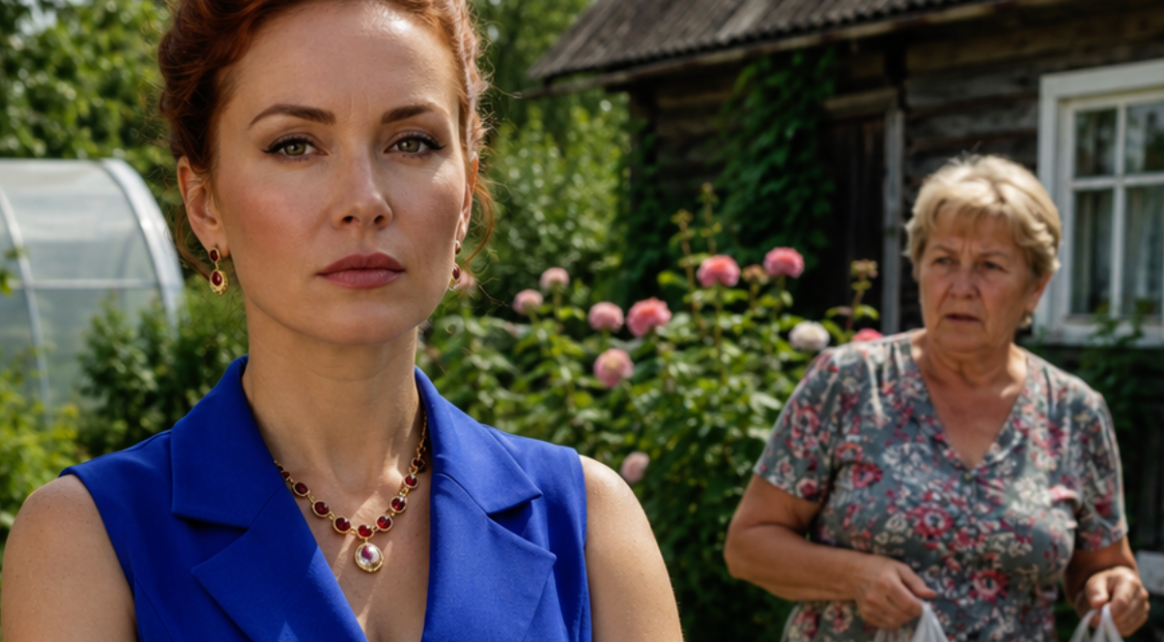
My mother-in-law had already been giving my homemade preserves away to her friends. But she did not get to play the generous hostess at someone else’s expense for long.
“Olya, watch where you’re stepping or you’ll break the jars!” Vera Nikolayevna’s velvety, slightly husky voice rang out from the entryway.
I came out of the kitchen, wiping my hands on a towel, and froze.
Five bulging shopping bags stood in a row in our narrow hallway like an honor guard outside a mausoleum. Glass clinked promisingly inside them.
Familiar screw-top lids peeked coyly from the bags: my pickled cucumbers with oak leaves, Bulgarian-style lecho, and the pride of the season—porcini mushrooms that Misha and I had walked a good ten kilometers through the forest to gather.
“Are you moving, Vera Nikolayevna?” I asked politely, leaning against the doorframe. “Or are we opening a branch of a food warehouse?”
My mother-in-law, a monumental woman accustomed to presenting herself to the world like a precious vase, majestically adjusted her silk scarf.
“Oh, listen to you—a warehouse! It’s Raisa Petrovna’s name day today, and our whole group is getting together. I can’t possibly arrive empty-handed. I’m a generous, hospitable woman. So I put together some treats for the girls from our family stores. You still have plenty of things down in the cellar.”
“From ‘your’ stores?” I raised an eyebrow. “The same ones you last visited three years ago, when you came to the country house to sunbathe in a deck chair?”
Vera Nikolayevna sighed condescendingly, making it clear with her entire appearance how exhausting it was to communicate with petty people.
“Olya, why keep accounts within the family? Besides, your strawberry jam is a little too runny. You should learn from the older generation. Real homemakers cook the syrup for five hours until a spoon can stand upright in it, instead of preserving this watery stuff.”
“If you cook strawberries for five hours, Vera Nikolayevna, the pectin breaks down, almost all the vitamin C disappears, and instead of a fresh berry flavor, all you have left is overcooked sugar,” I replied calmly, looking directly into her heavily lined eyes. “Food production technology is an exact science, not a collection of old wives’ tales.”
“You always act like such a know-it-all when someone is trying to help you! What an unbearable personality!”
Vera Nikolayevna flushed and pursed her lips like a mouse that had discovered an insulting gesture in the mousetrap instead of cheese.
At that moment, my husband Misha came out of the room, buttoning his shirt as he walked. He looked over the exhibition of glass jars, snorted, and turned to his mother.
“Mom, are you collecting empty bottles now, or distributing humanitarian aid? Those are Olya’s preserves. We spent entire weekends making them.”
“Misha, don’t disgrace your mother!” my mother-in-law exclaimed tragically, wringing her hands. “I already promised the girls some homemade food! They praised the last batch so much…”
That was when it dawned on me.
So this was not the first batch.
While I was working myself to the bone at the bread factory and Misha was driving through Moscow traffic, our good fairy had apparently been making regular visits to our country-house cellar with her spare key.
I did not shout. Hysterics are the weapon of the weak. I simply made a mental note.
“You may take one bag for Raisa Petrovna’s name day,” I said calmly, moving the other bags away from the door. “But these will have to go back. The charity warehouse is closed today.”
Vera Nikolayevna gasped indignantly, but Misha added in a tone that left no room for argument:
“Mom, Olya is right. Take one bag. I’ll help you carry it to the taxi. I’ll put the rest back in the storage room myself.”
My mother-in-law pursed her lips, convinced that her greedy children had mortally offended her. She picked up her burden and left, maintaining the expression of a suffering martyr.
We spent the following weekend at the country house.
It was one of those blessedly hot August days when the earth smells of tomato leaves and dill. Dressed in old shorts and a sunhat, I was tying up tomato plants in the greenhouse. Misha was trying to revive the water pump by the well.
The idyll collapsed at noon.
Two cars rolled up to our gate, raising a cloud of dust. Their doors opened, and a delegation stepped onto our sinful patch of earth.
It was a parade of hats, silk tunics, and heavy, expensive perfumes that instantly caused the local bees to lose all sense of direction.
Vera Nikolayevna marched at the front like an icebreaker. Behind her came Lyudmila Semyonovna, Raisa Petrovna, and two more ladies from her entourage.
“Come in, girls, come in!” my mother-in-law chirped, sweeping one arm dramatically over our six hundred square meters of land. “Here is my estate! This is where I rest my soul. Now I’ll show you where I grow those very cucumbers you all love so much!”
I came out of the greenhouse, leaned on my hoe, and prepared for the performance with a faint smirk.
“Verochka, you simply have golden hands!” exclaimed the stout Lyudmila Semyonovna, risking sinking her high heels into a freshly dug garden bed. “Your pickled garlic scapes are a masterpiece! My Eduard finished an entire jar in one evening and begged me to ask for the marinade recipe!”
“Oh, it’s nothing,” my mother-in-law simpered, adjusting her hairstyle. “The earth simply rewards those who put their soul into it.”
Raisa Petrovna, a woman with an impossibly complicated construction of hair on her head, thoughtfully raised one finger toward the sky.
“I immediately sensed the organic approach! You can taste the vermicompost in your vegetables, Verochka. After all, true agriculture requires planting strictly during the waning moon. Otherwise, nitrates become trapped in the root system and poison the liver!”
I could not take it anymore. I gently laid the hoe on the grass.
“Nitrates do not become trapped because of the phases of the moon, Raisa Petrovna,” I said loudly and clearly. “They accumulate because of excessive nitrogen fertilizers and fresh manure. Here, we strictly follow crop rotation and use white clover as green manure to improve the soil structure and enrich it with nitrogen.”
All the ladies turned their heads toward me in unison.
Raisa Petrovna looked me up and down contemptuously through her sunglasses.
“Verochka, your hired worker is behaving in an extremely ill-mannered way. Where did she even come from?”
She twisted her painted mouth as if she were an aristocrat who had been served warm beer instead of champagne at the Bolshoi Theatre.
Vera Nikolayevna turned pale. Her carefully constructed house of cards had begun to tilt dangerously.
“Raya, this is… this is Olya. My Mikhail’s wife,” my mother-in-law forced out, nervously fiddling with the strap of her handbag.
“The owner of this property and the person who personally preserved those very garlic scapes and cucumbers,” I clarified pleasantly as I approached them. “Good afternoon, ladies. Since you have come for a tour led by our chief agronomist, I suggest we move on to the practical portion.”
I went to the shed and brought out several plastic buckets.
“Vera Nikolayevna was just planning to conduct a practical lesson for you on collecting Colorado potato beetles. After that, we’ll weed the strawberry beds. Those so-called ‘family stores’ require daily manual labor. Please take a bucket.”
A heavy, sticky silence followed.
Lyudmila Semyonovna began backing toward the gate, trying not to look at my mother-in-law.
“Verochka, so… you didn’t make all of this yourself?” she asked in a crestfallen voice. “You said you stayed up all night standing over the stove…”
“Olya, stop this circus!” my mother-in-law shrieked, losing the last traces of her refined elegance. “We came for a barbecue! I promised the girls a couple of jars of porcini mushrooms each to take home! How dare you humiliate me?”
Just then, Misha came over from the well. His hands were stained with grease, and his eyes were cold and calm.
“Mom, no one is humiliating you. Olya is talking sense. There are mushrooms in the cellar. Fifteen hundred rubles per jar: hand-picked, processed, and including the cost of ingredients. No retail markup for your friends. We’re just short of money for a new pump. They can transfer the money to Olya’s card.”
The ladies exchanged glances.
The illusion of free generosity evaporated, leaving behind the bitter taste of someone else’s labor.
“I think we should leave,” Raisa Petrovna stated dryly, turning toward the cars. “Eduard seems to have high blood pressure today. Vera, I’ll call you later. Possibly.”
They disappeared as quickly as they had arrived. Vera Nikolayevna remained standing alone in the middle of the yard.
“You… you are heartless!” she hissed, looking at us with tear-filled eyes. “You humiliated me in front of my friends!”
“We brought you back to reality, Vera Nikolayevna,” I replied calmly, picking up the hoe. “By the way, Misha put a new lock on the cellar yesterday, so you may keep your key as a souvenir. From now on, you’ll have to hand out gifts from the nearest supermarket. I believe zucchini spread is currently on sale.”
My mother-in-law spun around and marched toward the railway station without saying goodbye.
Her back expressed all the sorrow in the world, but for some reason, I did not feel sorry for her at all.
Misha came up behind me, wrapped his arms around my shoulders, and rested his chin on the top of my head.
“Well then, hired worker, shall we go have some tea? With your strawberry jam. The one where the vitamins haven’t been destroyed.”
I smiled. The air above the garden beds trembled in the heat, the scent of tomato leaves drifted around us, and inside, I felt peaceful, light, and absolutely certain that justice had been served.