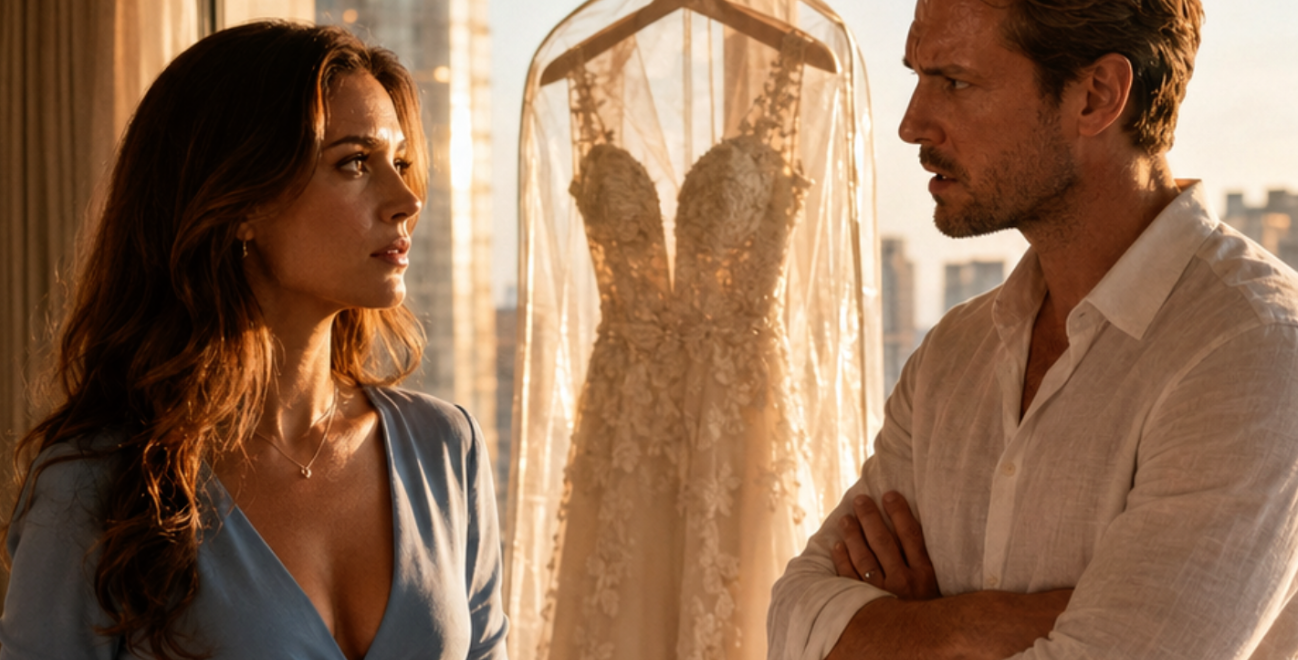
“The Man Is the Head of the Family. Start Getting Used to Obeying Me Now,” the Groom Declared a Week Before the Wedding. The Bride Silently Removed Her Ring
“The man is the head of the family. Start getting used to obeying me now,” Arthur said and leaned back in his chair as though he had just settled the matter once and for all.
Varvara did not answer immediately. She was sitting across from him in the kitchen of his rented apartment. Printed seating charts, the restaurant contract, and a list of tasks for the final week before the wedding were spread across the table. A warm July evening hummed outside the open window. Teenagers were laughing in the courtyard, a car door slammed somewhere nearby, and someone carried a child’s bicycle out of the neighboring entrance.
There were seven days left until the wedding.
For several seconds, Varvara studied Arthur so carefully that it was as though she were seeing his face for the first time without his familiar smile, polite tone, or the carefully practiced courtesy he displayed in front of her mother, her friends, and the registry-office staff.
He was not joking.
He was not testing her reaction.
He was not trying to soften what he had said.
He genuinely believed that his statement was perfectly normal.
“Say that again,” she requested calmly.
Arthur smirked.
“Which part?”
“All of it. With the same expression on your face.”
He frowned but repeated himself.
“The man is the head of the family. Start getting used to obeying me now. You’ll have to adjust after the wedding anyway.”
Varvara slowly removed the engagement ring from her finger. She did not yank it off, throw it, or hurl it into his face. She carefully placed it on the edge of the restaurant contract, beside the clause concerning the nonrefundable deposit.
The gold band made a quiet click against the paper.
At first, Arthur did not even understand what had happened. Then he straightened.
“What are you doing?”
“Marking the exact moment our marriage ended before it even began,” Varvara replied.
He gave a short laugh, but it sounded dry.
“Varya, don’t put on a performance.”
“I’m not. I’m closing the project.”
Arthur blinked.
He was accustomed to hearing Varvara use that businesslike tone, but it usually concerned work, paperwork, contractors, or household matters. Now she was looking at him the same way she looked at an unreliable supplier who had personally admitted to violating the terms of an agreement.
“What project?” he asked irritably.
“Our wedding. Seven months of planning, twenty-eight guests from my side, twenty-four from yours, a restaurant booked for Saturday, a host, a photographer, flowers, transportation for my grandmother, and hotel rooms for out-of-town guests. From this moment on, none of that is a celebration. It is a damage-control operation.”
“Have you lost your mind?” Arthur leaned forward. “Because of one sentence?”
Varvara picked up her phone, opened her notes, and swiped across the screen.
“No. Not because of one sentence.”
He immediately fell silent.
Arthur had indeed been changing over the past several weeks. At first, Varvara had blamed it on pre-wedding stress. He had suddenly rescheduled their meeting with the host even though they had agreed to attend together. Then he declared that her friend Yana was too loud and should be seated farther away from the newlyweds. After that, without consulting Varvara, he called the restaurant and tried to replace several dishes with ones his mother preferred.
When Varvara asked why he had made the decision alone, Arthur replied, “I’m the groom. I have the right to be involved.”
To be involved, yes.
To overturn their agreements, no.
Then he had begun talking about life after the wedding. Not warmly or dreamily, but like a man drafting internal regulations for an employee.
Varvara ought to travel less for work.
After they registered the marriage, they would need to “coordinate” her contact with her unmarried friends.
Her apartment was too large for one person, which meant his mother could occasionally come and “stay for a week or two.”
And of course Varvara would take his last name, because “otherwise, what is the point of getting married?”
Varvara had not confronted him sharply at first. She had asked questions. Clarified what he meant. Watched carefully to see where awkward bravado ended and his true character began.
Today, Arthur had made everything clear.
“You gave me the instructions in advance,” she said. “I heard them.”
“What exactly did you hear?” He slapped his palm against the table but quickly withdrew it when he noticed Varvara looking at his fingers. “I’m talking about a normal family. About order.”
“Order is when two people make decisions together. Submission is when one person gives orders and the other remains silent. You want the second.”
“I want my wife to respect her husband.”
“Respect is not handed out after a marriage certificate is signed. It has to be earned beforehand.”
Arthur stood abruptly, paced across the kitchen, and stopped beside the window. He was wearing a light-colored T-shirt, an expensive watch he had bought especially for the wedding, and the expression of a man who had been unfairly denied an obvious privilege.
Varvara looked at him without regret.
She felt unpleasant, but it did not hurt the way it might have a year earlier. Something like a barrier quickly rose inside her. On one side were their former plans. On the other was cold calculation.
She stood and began placing the papers into a folder.
“Don’t touch those,” Arthur said. “Those are our documents.”
“Not anymore. The restaurant contract is in my name. So are the agreements with the host and photographer. I paid for the dress myself. You bought your own suit, so that remains your problem.”
“Are you seriously going to cancel everything?”
“I’m not going to. I’ve already started.”
Arthur pulled out his phone.
“I’m calling your mother.”
“Go ahead. Just think carefully about what you’re going to tell her. That the bride left because she refused to start obeying you in advance?”
He froze.
Varvara saw his jaw tighten.
Arthur cared deeply about the impression he made on other people. He could be harsh in private, but around others he became attentive, noble, and mildly humorous. He liked it when acquaintances told Varvara, “You’re lucky. He’s a serious man.”
For years, he had built the image of a man beside whom a woman should feel protected.
Only now did Varvara understand that he had not planned to protect her.
He had planned to protect his right to make decisions for her.
“You’ll regret this,” he said more quietly.
“Possibly. But I would regret marrying you far more.”
She picked up her bag. Arthur stepped toward the door.
“We haven’t finished this conversation.”
“We have. You stated your position. I made my decision.”
“Varya, the wedding is in a week! Can you imagine the humiliation?”
Varvara stopped in front of him.
“The humiliation would be marrying you because I was afraid of what the guests might think. Canceling the wedding in time is a preventive measure.”
He looked at her with growing irritation.
In the past, she would have tried to smooth things over, find a neutral phrase, or postpone the discussion. But the man standing before her now was not a beloved partner having a difficult moment.
He was someone who had interpreted her agreement to marry him as an agreement to submit to him.
“Move away from the door,” she said.
“And if I don’t?”
Varvara took out her phone and unlocked the screen.
“Then I’ll call emergency services and say that someone is preventing me from leaving an apartment. Do you want the week before our canceled wedding to begin with the police arriving?”
Arthur stepped aside.
Not out of remorse, but calculation.
He understood perfectly well that the neighbors would hear, that he would have to explain himself, and that his mother might learn a version of events different from the one he intended to prepare.
Varvara walked out into the stairwell without slamming the door.
It was stuffy on the landing. She walked down from the fourth floor even though the elevator was working. She needed movement that was clear and simple.
One step.
Another.
A turn.
The railing.
The exit.
Outside, the July air smelled of heated asphalt, linden trees, and dust. Varvara got into her car, placed the folder on the passenger seat, and only then allowed herself to slowly stretch her fingers. They had gone stiff from gripping the handle of her bag so tightly.
There were no tears.
She was not trembling.
There was only anger—dense, controlled, and useful.
The kind of anger that did not break a person but switched on her ability to think.
Varvara worked as a cost-estimating engineer for a construction company and was accustomed to calculating everything: deadlines, risks, expenses, and the consequences of someone else’s carelessness.
She was not a romantic young girl who believed that everything would somehow improve after the wedding. She was thirty-two years old. She had paid off a mortgage early without anyone’s help, renovated her own apartment, completed several difficult projects, and survived one long relationship with a man who had spent three years promising to “become ready” while she carried the relationship for both of them.
Things had started differently with Arthur.
He was attentive. He courted her beautifully. He knew how to listen.
They had not met in a café or at work, but in line at a service center, where they had both brought in phones damaged during a severe rainstorm. Arthur had let her go ahead of him at the counter and then helped her find a taxi because the city streets were flooded.
Two days later, he sent her a new phone case by courier with a note:
“For the next flood.”
Varvara laughed and agreed to meet him.
For a year and a half, he had seemed mature, dependable, and not petty. He did not pressure her, create scenes, or interfere with her finances.
That was why she accepted his proposal.
He gave her the ring in early spring at an observation point overlooking the river. It was beautiful and peaceful, without a crowd or cheap theatrics.
Varvara said yes not because she was afraid of being alone, but because at the time she truly believed they were partners.
The first warning signs appeared after they filed the marriage application.
It was as though the fact that the registration was approaching had flipped a switch in Arthur’s mind. He began saying “I think” instead of “we’ll decide.” Instead of asking, “What would be convenient for you?” he said, “This is how it should be.”
Varvara was not naive.
She did not confront him immediately because she wanted to understand the scale of the problem.
One incident was an accident.
Two were a habit.
Five were a system.
Today, the system had named itself.
When she arrived home, Varvara placed her bag on the floor, switched on the entryway light, and immediately took out her laptop.
Her apartment was in a new building near a park. She had purchased it before meeting Arthur, and it belonged entirely to her. Arthur was supposed to move in after the wedding, but she had never given him a key.
He joked about it and sometimes acted offended, saying Varvara was too controlling.
Now she mentally awarded herself a separate checkmark for that decision.
No key given meant no wasted nerves, no changed lock, and no explanations.
She opened the wedding-planning spreadsheet.
One column contained the contractors’ contact information, another listed the deposits, and a third explained the cancellation terms.
Varvara did not begin calling people in hysterics.
First, she organized everything.
Restaurant: part of the deposit would be lost, but the remaining amount could be transferred to another banquet within three months.
Photographer: the deposit was nonrefundable, but the wedding shoot could be changed to an individual photo session.
Host: he would keep a small percentage and refund the rest.
Florist: the flowers had not yet been purchased, so cancellation was possible.
Dress: finished and fully paid for. It could be sold or kept.
Invitations: already sent. The damage would be reputational, but survivable.
Varvara drafted a brief message for the guests on her side:
“Dear friends and family, the wedding has been canceled. The decision is final. I will not discuss the details, and I ask you to respect that. Anyone who has already paid for travel or accommodation should contact me privately, and we will resolve the matter.”
She read it three times, removed anything unnecessary, and sent it to her mother first.
Nadezhda Sergeyevna called one minute later.
“Varya, what happened?”
Her mother sounded worried but not hysterical. Varvara respected that about her. Her mother could feel things deeply, but she rarely lost her head.
“Arthur informed me that the man is the head of the family and that I should start getting used to obeying him.”
The other end of the line went silent.
“Those exact words?”
“Word for word.”
“Where are you?”
“At home.”
“Is he there?”
“No. And he doesn’t have a key.”
“Good,” her mother said after a pause. “I’m coming over.”
“You don’t need to. I can handle it.”
“I know you can. But I’m coming anyway. Not to rescue you. Just to be there.”
Varvara closed her eyes for a second.
That was why she loved her mother. When the road became difficult, her mother did not try to seize the steering wheel from her.
“Come over,” she said.
While her mother was driving, Varvara sent messages to the contractors. Her wording was polite and precise, without vague explanations that “things had not worked out.”
Then she wrote to Yana, her closest friend:
“The wedding is off. I’m fine. Arthur showed me the constitution of our future family ahead of schedule.”
The answer came almost immediately.
“Should I come?”
“Not now. Tomorrow, help me call the guests if they start asking questions.”
Yana sent back one brief reply:
“Proud of you.”
Arthur called forty minutes later.
Varvara watched the screen until the call ended.
Then he wrote:
“You’re behaving like a child.”
A second message followed:
“We’ll talk once you’ve calmed down.”
Then:
“My mother already knows. She’s in shock.”
One minute later:
“Do you even understand what people are going to say?”
Varvara opened the chat and typed:
“My decision is final. I will communicate only about canceling the wedding and returning personal belongings. Tomorrow at noon, I will send you a list. No personal discussion is necessary.”
Arthur replied immediately:
“You don’t have the right to decide this alone.”
Varvara looked at the message and smiled.
Only yesterday, those words might have hurt her. Today, they merely confirmed that she had made the right decision.
She wrote:
“I have the right to withdraw my consent to marriage at any moment before registration. I have exercised that right.”
Then she muted the notifications.
Her mother arrived with a bag of apricots and a bottle of mineral water. She did not rush to hug Varvara.
She removed her shoes, walked into the kitchen, washed her hands, and began arranging the fruit in a bowl.
Varvara watched her and suddenly felt grateful for this simple normality.
The world had not ended.
A wedding was merely being canceled because the man she was supposed to marry had revealed too early who he intended to become afterward.
“Tell me everything from the beginning,” her mother said.
Varvara told her.
No embellishment.
No tears.
No attempt to portray Arthur as a monster.
Only facts: the changes in his behavior, the decisions he made without consulting her, his demands concerning her last name, the idea of his mother staying in her apartment, and today’s declaration.
Nadezhda Sergeyevna listened without interrupting. Only once, while cutting an apricot, did she grip the knife so tightly that the pit clicked sharply against the cutting board.
“It’s good that it happened now,” she said at last.
“I think so too.”
“The relatives will talk.”
“Let them.”
“His mother might come here.”
“She can try. I haven’t invited her into my apartment, and I won’t.”
Her mother nodded.
“Good. He never received a key?”
“No.”
“Does he have any of your documents?”
“Nothing important. The wedding organizer might have had a copy of my passport for the contract, but Arthur didn’t. I’ll check tomorrow.”
“Good girl.”
For the first time that evening, Varvara smiled tiredly.
“Mom, you sound as though I didn’t cancel a wedding but passed a fire-safety inspection.”
“That was an inspection. Only it wasn’t the restaurant that was burning. It was your future life.”
Varvara barely slept that night.
Not because she doubted her decision.
There were no doubts.
But her mind kept working: whom to inform, where to recover money, and how to prevent Arthur from reaching the guests first with his version of events.
She knew he would try.
People like him rarely remain silent when they lose control. They begin telling everyone that the woman “overreacted,” “worked herself up,” or “became frightened of responsibility.”
Varvara got up at seven the next morning.
She showered, put on a light linen dress, tied her hair in a low ponytail, and opened her call list.
She contacted the restaurant first.
When the administrator heard that the wedding had been canceled, she began speaking carefully, almost sympathetically.
Varvara quickly redirected the conversation toward practical matters.
“Can part of the deposit be used for another event?”
“Yes, within three months.”
“Excellent. Then we won’t cancel completely. We’ll change the format. Is it possible to hold a dinner for twenty people on the same date?”
“Yes, in the smaller hall.”
Varvara looked out of the window.
The summer was bright, sunny, and almost insolently cheerful. The Saturday on which they had planned to marry no longer looked like a black hole in the calendar.
“Reserve the smaller hall,” she said. “It will be a family dinner. No wedding decorations. I’ll revise the menu today.”
After hanging up, she was surprised by how much she liked the idea.
Why should she lose money and hide at home on the day of her canceled wedding?
Why should the restaurant booking be surrendered to emptiness while Arthur enjoyed believing that he had ruined her celebration?
No.
She would not marry him.
But she would gather the people she loved and celebrate narrowly avoiding a terrible mistake.
When Yana heard the idea, she went silent at first and then said:
“Varya, that is brutally beautiful.”
“It’s economically rational.”
“No, it is definitely brutally beautiful. I’ll wear my best dress.”
“Just don’t give a funeral speech.”
“Of course not. I’ll give a toast to removing the ring in time.”
By lunchtime, the offensive from Arthur’s side began.
His mother, Inessa Viktorovna, called first.
Varvara did not answer.
A long message followed:
“You are destroying my son’s future because of your pride. A woman should be wiser. Arthur lost his temper, but instead of calming the situation, you staged a public humiliation.”
Varvara read the message and forwarded it to Yana with the caption:
“It begins.”
Then she answered Inessa Viktorovna:
“The wedding has been canceled. The decision is final. I see no reason to discuss my personality. Arthur will receive separate information concerning organizational expenses.”
Ten minutes later, Varvara’s aunt Galina called. Galina had always considered herself an expert in preserving relationships.
“Varenka, what are you doing? Men sometimes say foolish things. You have to let it pass.”
“I did let it pass. Right past my life.”
“But the wedding! People have been invited!”
“They’ll receive a message.”
“What about the dress?”
“The dress is unharmed.”
“And love?”
Varvara looked at the folder containing the contracts.
“Love ended where the instructions on obedience began.”
Aunt Galina sighed as though civilization itself were collapsing before her eyes.
“You’re too harsh.”
“Today, I’ll take that as a compliment.”
That evening, Arthur came to her building.
Varvara saw him from the window. He was standing outside in a white shirt, holding a bouquet of cream-colored roses.
He looked exactly as he needed to look for accidental witnesses: a heartbroken groom who had come to reconcile.
He called her.
Varvara answered while watching him from above.
“I’m outside,” he said.
“I can see you.”
“Come down. Let’s talk normally.”
“No.”
He raised his head toward her windows but did not immediately understand which one she was standing behind.
“Varya, I brought flowers.”
“I didn’t order any.”
“Are you completely cold?”
“No. Flowers simply don’t erase the meaning of what you said.”
Arthur sharply lowered the bouquet.
His face changed. The gentle mask slipped, revealing angry impatience.
“Do you understand how deeply you humiliated me?”
“I’m not required to marry you to protect your reputation.”
“I’ve already told everyone that you had a breakdown because of stress.”
“That was unwise. On Saturday, my guests will hear the exact reason.”
He fell silent.
“What do you mean, on Saturday?”
“I’m not canceling the restaurant completely. I’m holding a dinner for my family and friends.”
“Are you mocking me?”
“No. I’m making use of a resource that has already been paid for.”
Arthur remained silent for several seconds.
Varvara could see him trying to adjust his strategy.
He had expected tears, pleading, and chaos.
Instead, he had received a spreadsheet of expenses and a revised event concept.
“So you’ve decided to publicly shame me?”
“Arthur, you overestimate your importance. The dinner isn’t about you. It’s about the fact that my life did not collapse because the wedding was canceled.”
“I’m coming upstairs.”
“I wouldn’t advise it. I won’t let you inside. If you make a scene, I’ll call the police. There will be no conversation at the door either.”
He squeezed the bouquet so tightly that several petals fell onto the pavement.
“You were always unnaturally independent.”
“And you simply realized too late that marriage wouldn’t cure it.”
She ended the call.
Arthur remained outside for another fifteen minutes. Then he threw the bouquet into a trash bin and walked away.
Varvara took a photograph from the window.
Not for revenge.
For her own protection.
In case he later claimed that he had calmly brought her flowers while she created a scene.
Everything accelerated over the following days.
Varvara sent out messages, canceled the wedding-specific arrangements, and revised the restaurant order.
She collected the wedding dress from the salon and hung it in her wardrobe. She did not sell it immediately—not because she was sentimental, but because she believed expensive items should not be disposed of in the heat of the moment.
The photographer agreed to replace the wedding shoot with a personal portrait session at the end of August.
The host refunded part of the money.
The florist sounded almost relieved when she explained that the flowers had not yet been purchased.
Rumors began spreading from Arthur’s side.
People repeated them to Varvara carefully.
He claimed that she had “become frightened of family responsibility,” that she “did not have the personality for marriage,” and that she was “too accustomed to living alone and controlling everything.”
Varvara did not defend herself.
Whenever someone asked directly, she simply answered:
“He told me that the man was the head of the family and that I should start getting used to obeying him. I decided not to get used to it.”
That sentence was enough.
People either became silent, laughed awkwardly, or said, “I see.”
Women, in particular, understood very quickly.
Two days before the canceled wedding, Arthur demanded reimbursement for half of the wedding expenses.
Varvara had expected it.
She opened the spreadsheet in which she had already recorded every payment: who paid, when, what it covered, and under which contract.
Arthur had contributed toward his suit, the rings, and part of the videographer’s services.
She offered to return the rings by courier and contacted the videographer separately.
The suit remained with Arthur.
He had no claim on the expenses Varvara had paid.
She replied:
“Send confirmation of the expenses you personally paid that relate to shared services. We will discuss reimbursement based on documentation. Expenses without proof will not be considered.”
Arthur wrote:
“You even turn a breakup into accounting.”
Varvara smiled but did not answer.
He wanted emotion.
He received order.
That infuriated him more than any outburst would have.
On Saturday morning, the day she was supposed to become a wife, Varvara woke early.
Sunlight streamed through the windows so confidently that it was as though the city had no idea that today was supposed to be tragic.
She made coffee, opened her wardrobe, and selected not the wedding dress but a dark blue trouser suit without unnecessary details.
She put on garnet earrings—the ones she had bought for herself after completing a difficult project.
The woman looking back at her from the mirror was not an abandoned bride.
She was a woman who had read the fine print in time.
Her mother arrived at two o’clock.
“You look beautiful,” she said.
“Not too severe?”
“Exactly right. Like the director of your own destiny.”
The restaurant welcomed them with air-conditioned coolness, the scent of fresh fruit, and polished wood.
The small hall looked peaceful. There was one long table, simple summer flowers without elaborate wedding decorations, light-colored napkins, and pitchers of water with lemon.
Not everyone attended, and Varvara was comfortable with that.
Her mother was there, along with Yana, her cousin Yegor and his wife, Aunt Galina, who had ultimately decided to support her, several close friends, and her colleague Lidiya Pavlovna, a sharp-minded woman with a habit of telling the truth without wrapping it in polite packaging.
At the beginning of the dinner, everyone behaved cautiously.
Nobody said the word “wedding.”
Then Yana raised a glass of lemonade.
“I’d like to propose a toast. Not to what didn’t happen, but to what happened at exactly the right time. To Varvara, who heard the phrase ‘start getting used to obeying me’ and decided not to wait until after the registry office to discover how much worse it could become.”
Someone smiled.
Someone else breathed more freely.
Varvara lifted her glass.
“Thank you. But I want to add something. I do not consider myself a victim. I wasn’t abandoned, deceived at the altar, or rescued by kind strangers. I was shown the terms of the contract in advance. I refused to sign.”
Lidiya Pavlovna nodded approvingly.
“Now that is what I call a properly handled termination.”
Aunt Galina rotated her glass in her hands.
“What if he really was simply nervous?”
Varvara looked at her without irritation.
“A nervous person says, ‘I’m afraid,’ ‘I’m exhausted,’ or ‘Let’s think this through.’ He doesn’t inform someone else that she must obey him. Those are different things.”
Yegor supported her.
“Arthur always liked ordering people around. He just disguised it as concern. Remember when we were at the country house and he decided where everyone should sit around the fire? He even moved the owner of the property.”
“At the time, I thought he was organized,” Varvara said.
“He is organized,” Yegor replied. “He simply wanted to organize every part of you.”
The atmosphere at the table became livelier.
The guests stopped worrying about saying the wrong thing.
Varvara could see the tension lifting from everyone.
The canceled wedding was transforming from a humiliation into a story about common sense.
At that exact moment, Arthur appeared at the entrance to the small hall.
He was not alone.
Inessa Viktorovna stood beside him in a light-colored suit, wearing the expression of a woman who had arrived to restore justice.
The confused administrator followed behind them, clearly unsure whether she should intervene.
The conversations at the table stopped.
Arthur looked at Varvara.
Satisfaction flashed in his eyes.
Now there were witnesses.
Now there would be a scene.
Now she would not be able to avoid the conversation.
But Varvara did not immediately stand.
She calmly placed her napkin beside her plate, just as she had placed the ring beside the contract one week earlier.
Then she turned to the administrator.
“These people are not on the guest list for my event.”
Arthur smirked.
“Your event? This was supposed to be our wedding.”
“It was supposed to be. It isn’t.”
Inessa Viktorovna stepped forward.
“Varvara, you are obligated to at least listen to Arthur. You have staged a public humiliation of my family.”
Varvara stood.
She spoke quietly, but the hall was silent, and everyone could hear each word.
“Inessa Viktorovna, one week before our marriage was to be registered, your son informed me that I should start getting used to obeying him. After that, the wedding was canceled. Today’s dinner is a private event for my family and friends. You were not invited.”
“How dare you?” Inessa Viktorovna’s face lengthened. “Arthur put his heart and soul into this!”
Yana gave a quiet snort, but Varvara did not even turn her head.
“He may take his heart and soul home with him. Financial matters will be resolved through documentation.”
Arthur turned red.
“You gathered all these people specifically to discuss me?”
“No. You came here yourself because you wanted to be seen.”
The sentence struck precisely.
Several guests exchanged glances.
Arthur quickly understood that the situation was not developing in his favor.
He had counted on her embarrassment, his mother’s pressure, and the guests’ confusion.
Instead, he received a calm refusal in front of witnesses.
“Varya,” he said, changing his tone and becoming gentler. “I admit that I expressed myself badly. But you know I love you. I wanted a normal family.”
“A normal family does not begin with a warning about submission.”
“That isn’t what I meant.”
“It was exactly what you meant. You repeated it twice.”
Inessa Viktorovna turned sharply toward her son.
Apparently, she had not known that part.
“Twice?” she whispered.
Arthur gave his mother an irritated look.
“Mom, not now.”
Varvara saw that look and became completely calm.
Everything was in its proper place.
He did not only disrespect his future wife.
He respected people only for as long as they supported his version of reality.
“Leave,” Varvara said. “Now.”
“And if I don’t?” Arthur asked quietly.
The administrator went pale.
Yegor rose from his chair.
Lidiya Pavlovna placed her fork down and looked at Arthur in a way that made even Yana stop smiling.
Varvara took out her phone.
“Then the restaurant management will call security or the police. You entered a private event without an invitation and are refusing to leave. Think carefully, Arthur. Do you really want that to be the final photograph of this story?”
He stood there for several more seconds.
Then he abruptly turned and walked toward the exit.
Inessa Viktorovna remained for one moment longer.
“You’ll eventually understand what you lost.”
“I already have,” Varvara replied. “That is why I’m not picking it back up.”
After they left, nobody spoke for several seconds.
Then Lidiya Pavlovna picked up the pitcher and calmly poured herself a glass of water.
“Good dinner,” she said. “And entertainment too.”
The laughter did not begin immediately, but when it did, it removed the last traces of tension.
Varvara smiled as well.
Not loudly.
Not demonstratively.
She simply felt the final heaviness inside her disappear.
After dinner, they stepped outside into the summer evening.
The sun was already approaching the horizon, and the glass façades of the buildings reflected the orange light.
Yana linked her arm through Varvara’s.
“Do you realize that this was the best non-wedding of the year?”
“The important thing is that it remains the only one.”
“Agreed. But the standard has been set very high.”
Her mother walked beside them in silence.
When they reached the car, she suddenly said:
“I’m proud of you. Not because you left him, but because you left without chaos.”
Varvara looked at her.
“Chaos would have benefited him.”
“Did you understand that immediately?”
“Yes. If I had shouted, he would have told everyone I was hysterical. If I had cried, people would have felt sorry for him. If I had begged, he would have negotiated. So I calculated.”
Nadezhda Sergeyevna nodded.
“You really are tough.”
“I’m normal. I simply understood in time.”
One month later, Varvara learned from mutual acquaintances that Arthur had quickly begun dating another woman—a quiet, younger woman of the kind who laughed at every joke a man made and never interrupted him on their first dates.
Varvara felt no jealousy.
Only brief sympathy for the stranger and a hope that she, too, would hear the necessary sentence in time.
Arthur collected the ring through a courier service.
Varvara never met him in person.
She resolved every financial matter through receipts and bank transfers, without scandals.
In August, she sold the dress to a young woman who arrived with her mother and spent a long time turning in front of the salon mirror.
Varvara handed it over without difficulty.
Someone else’s wedding was not responsible for the failure of her own.
She went ahead with the photo session.
Not in a bridal look, but in city clothes: a white shirt, wide trousers, her hair tied back, and a calm smile on her lips.
The photographer captured her on a bridge over the river at the end of summer, when the wind lifted the edges of her shirt and the city glowed behind her.
In one photograph, Varvara looked directly into the camera.
Not gently.
Not harshly.
Clearly.
She later set that photograph as the background on her work laptop.
Not as a reminder of the man she had escaped, but as proof to herself that sometimes a life-changing decision looks completely ordinary.
No dramatic music.
No tears at the altar.
No running away in the rain.
Just a woman removing a ring, placing it on a restaurant contract, and realizing that self-respect does not become less valuable simply because the wedding has already been paid for.
In the autumn, Varvara ran into Arthur by chance near a shopping center.
He was alone, talking on the phone, and looked irritated.
When he saw her, he lost his train of thought.
Varvara could have walked past him.
Instead, she stopped for one second.
“Hello,” she said.
Arthur moved the phone away from his ear.
“Are you pleased with yourself?”
She looked at him carefully.
The question was exactly like him. It was not truly about her. It was an attempt to return her sense of guilt.
“Yes,” Varvara replied. “Very.”
Then she continued walking.
He said something after her, but she did not understand the words and did not turn around.
Ahead of her was an ordinary evening: the store, home, plans for tomorrow, a work report, a call to her mother, and a weekend meeting with Yana.
There was no great dramatic ending.
No villain standing behind her, punished by fate.
There was simply a life from which she had removed, just in time, a man who had decided to appoint himself its ruler.
And that was the entire victory.
Not becoming a wife at any cost.
Not preserving a beautiful picture for the guests.
Not proving to everyone that she was strong.
Simply choosing herself at the moment when she was offered the opportunity to become accustomed to someone else’s authority.
Varvara did not tolerate it.
She did not wait until after the wedding for Arthur to enforce his rules through shared living arrangements, keys, relatives, and speeches about duty.
She did not allow him into her apartment, her finances, her decisions, or her future.
Sometimes, the most rational decision a woman can make looks cruel to the people around her.
In reality, it is simply an accurate assessment of risk.