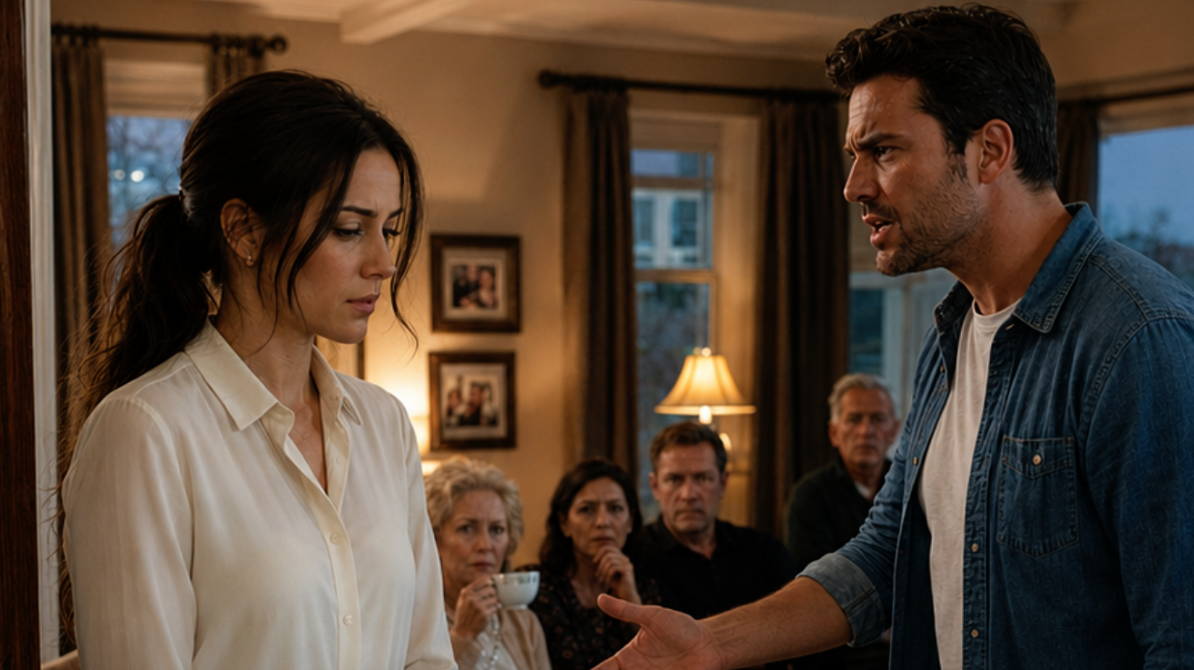
My Mother-in-Law Was “Just Joking” When She Called Me Old in Front of the Guests. I Quietly Left, and My Husband Demanded That I Apologize to Her
I was rolling out the pastry for the Napoleon cake at four in the morning because during the day the kitchen turned into a passageway, and cake layers needed silence and cold hands. By seven, the apartment smelled of melted butter. By nine, I had assembled the cake and placed it in the refrigerator beneath an upside-down saucepan so that no one would break off a corner ahead of time.
I covered the table with a white tablecloth decorated with delicate openwork along the edges—the same one I had inherited from my grandmother and brought out only three times a year.
The guests were expected at two. It was not my anniversary, but my father-in-law’s. Viktor Stepanovich was turning seventy. Yet, as always, I was the one doing all the cooking.
Tamara Petrovna, my mother-in-law, was “supervising.” She sat upright on a kitchen stool and told me which ingredients should be sliced more thinly and which ones I should not be stingy with.
“You should have dressed the salad right before serving it,” she said, watching me transfer the Olivier salad into a crystal bowl. “You mixed it all together this morning. It’ll become soggy.”
“I dressed two portions,” I replied. “I left the main batch dry. I’ll add the dressing when everyone sits down.”
She grunted. Whether it was approval or disapproval, I could not tell. With Tamara Petrovna, both sounded exactly the same.
Meanwhile, my husband, Andrei, was carrying crates of mineral water and wine in from the car. As he passed me, he kissed my temple.
“Marina, you’re a genius. It smells just like my childhood.”
“In your childhood, that smell came from your mother,” Tamara Petrovna remarked.
“In my childhood, it came from Marina, Mom. We’ve been married for twenty years.”
He said it lightly, without emphasizing the point, and went back outside for another crate.
At the time, I thought, Good. He defended me.
It was a foolish thought. Defending someone casually at the dinner table and truly standing up for them were two different things. I learned that by the end of the evening.
The guests arrived almost on time. My father-in-law’s brother came with his wife, along with two neighboring couples Viktor Stepanovich had been friends with since his factory days. Then Lenka arrived—Andrei’s younger sister—with her new husband, whom she was introducing to the family for the first time.
Lenka was eleven years younger than me. She wore a tight fuchsia dress and smelled of something sweet and expensive.
“Marinochka!” she exclaimed, hugging me without touching her cheek to mine so she would not smudge her lipstick. “You’re still running around doing everything. At least let me set out the plates.”
“Go ahead,” I said, handing her a stack.
A minute later, she was sitting beside her husband, whispering something into his ear, while the plates remained untouched in the corner of the table.
I arranged them myself.
We sat down. Viktor Stepanovich gave the first toast. He spoke about having lived long enough to see his grandchildren and how family was the most important thing in life.
Everyone drank.
I poured the second round, checked that everyone had bread, carried an empty salad bowl into the kitchen, and returned with a full one.
It was ordinary work. Familiar work.
Over twenty years, I had learned how to be a guest, a hostess, and an invisible servant at the table all at the same time.
Meanwhile, Lenka was explaining to her husband—his name was Kirill—who everyone at the table was.
“That’s Uncle Gena, Dad’s brother. Those are the neighbors, Aunt Valya and Uncle Slava. They live on the fourth floor. And that’s Marina, Andryusha’s wife.”
Lenka lowered her voice, but not enough to stop me from hearing her.
“She’s the domestic one in our family. She does absolutely everything herself.”
“Well done,” Kirill said politely.
“Sure,” Lenka drawled in a tone that turned “well done” into something else entirely.
I pretended not to hear.
Over twenty years, I had learned not to hear many things. It was like the background hum of a refrigerator. You became accustomed to it and eventually stopped noticing.
Only sometimes, late at night, that hum suddenly became deafening.
Viktor Stepanovich tapped his fork against his glass.
“Well, we’ve already drunk to the birthday boy. Let’s go around the table and have everyone say something. Gena, you start. You’re the eldest.”
Uncle Gena gave a long, confused speech about the factory, their youth, and how he and his brother had built garages together.
Aunt Valya kept hers brief.
“Good health to you, Vitenka.”
Then it was Lenka’s turn. She raised her glass and chirped about what a wonderful family she had and how happy she was to see everyone.
After that came Tamara Petrovna.
She stood, adjusted the large brooch with the fake ruby pinned to her chest, and looked around the table as though she were counting everyone present.
“I want to say something about our family,” she began. “Vitya, you’ve done well. We have good children. Look at the handsome man Lenka brought home. God bless them. Andryusha, too…”
She paused and looked at me.
“Our Andryusha is a one-woman man. He chose Marina and has stuck with her. Even though I always used to tell him, ‘Look carefully, son. She looks older than she really is. Sit her next to Lenka, and you won’t be able to tell which one is the other’s mother.’”
Someone at the table laughed.
Lenka snorted into her napkin.
Her new husband smiled politely, clearly not understanding what was happening.
Tamara Petrovna sat down with a satisfied expression, as though she had made an excellent joke.
I was holding a fork.
I remember that very clearly—the fork, the small piece of herring under a fur coat balanced on its tines, and the way that piece suddenly became unbearably heavy.
I was forty-three. Lenka was thirty-two.
And yes, I did not dye my hair fuchsia or have my lips enhanced. But the comment about not knowing “which one was the mother” had been made in front of eleven people. In front of a stranger who had been brought to meet the family. In front of neighbors who would spread the story throughout the building the next day.
I looked at Andrei.
He was sitting opposite me, between his father and his uncle.
He had heard it.
There was no possibility that he had not.
I waited—one second, two, three—for him to say something.
“Mom, that’s enough.”
“Mom, Marina is beautiful.”
Anything at all.
Instead, he picked up the bottle and began pouring wine for his uncle.
That was it.
Three seconds of silence, and then he reached for the bottle…
The continuation is just below, in the first comment.