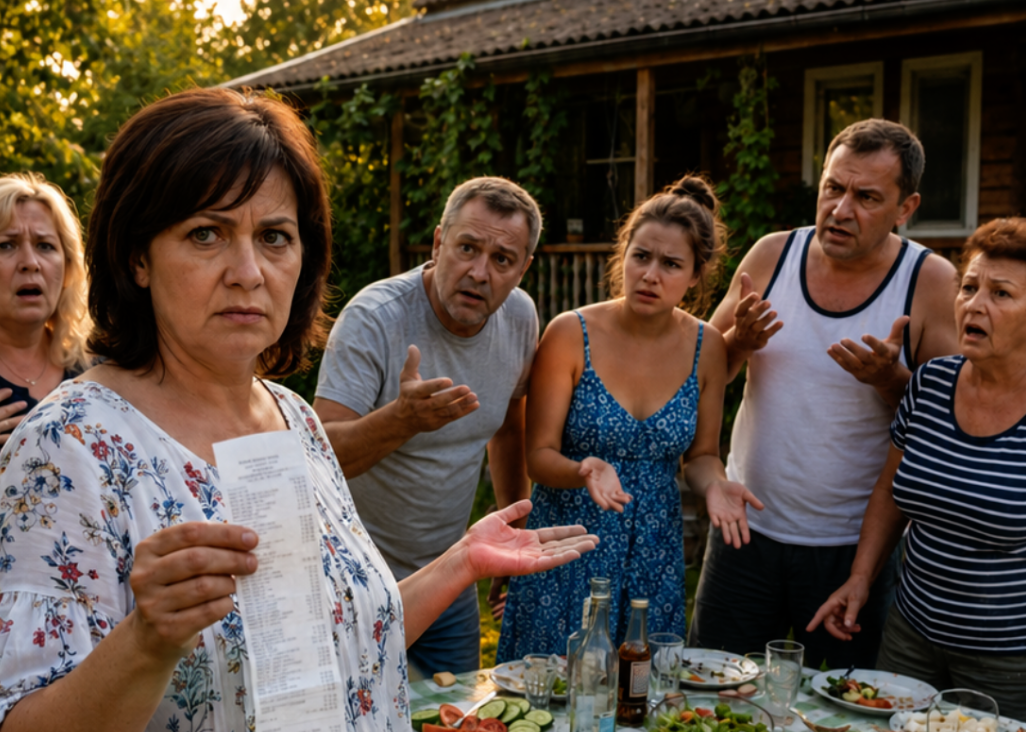
“You’re the ones who invited yourselves over for barbecue. So why am I supposed to buy the meat, charcoal, and groceries again?” the owner of the country house asked
At the beginning of June, Larisa finally understood why people bought country houses.
Not for the garden beds that demanded attention before the alarm clock even went off. Not for the endless repairs, not for neighbors capable of discussing someone else’s fence longer than their own children. And not even for strawberries that had to be defended from birds, slugs, and relatives who showed up unexpectedly.
A country house was needed for peace and quiet.
Larisa had bought a small house forty kilometers outside the city the previous autumn. The house was sturdy, the plot was level, two old pine trees grew along the edge, and behind the back gate a path led toward a lake. All winter she had been putting the rooms in order. In spring, she ordered a new pump, repaired the porch, and placed a large wooden table under the awning.
By June, everything looked exactly the way she wanted: clean, simple, and free of things that had been stored for years “just in case.”
Larisa’s husband, Andrey, had been fairly indifferent to the purchase. He didn’t interfere and occasionally helped, but he wasn’t particularly enthusiastic. He liked arriving somewhere where everything had already been done: the water was running, the grill was ready, the grass had been cut, and groceries were waiting in the refrigerator.
The first warning signs appeared at the end of May.
Her mother-in-law, Valentina Petrovna, saw photographs of the country house and immediately became animated.
“Nice place. Spacious. The whole family could get together here.”
Larisa said nothing at the time. She knew that tone far too well. Valentina Petrovna never asked for anything directly. She simply stated what she wanted as though the decision had already been made, after which everyone around her somehow began searching for extra chairs and additional plates.
Two days later, Andrey’s sister Oksana called.
“We were thinking that before summer is over, we absolutely have to come to your place for barbecue. The kids can run around outside, Mom can relax. Let’s do next Saturday.”
“Who exactly is ‘we’?” Larisa asked.
“Well, me and Pasha, the kids, Mom, Aunt Nina, and maybe Igor will come too. He doesn’t know yet.”
Larisa calculated quickly. That made nine people, not including herself and Andrey. And in her husband’s family, the phrase “maybe” usually meant two additional unknown guests and one dog.
“All right,” she said. “I’ll create a group chat and we’ll discuss everything there.”
Oksana had clearly expected a different answer.
“What is there to discuss? We’ll arrive around noon. Just send me the address.”
“We’ll discuss the food.”
“Oh,” Oksana drawled. “Fine.”
That same evening, Larisa created a chat called “Barbecue, June 15” and added everyone her sister-in-law had mentioned.
Her first message read:
“There will be at least eleven of us. So no one has to rush to the stores at the last minute, I’m dividing up the shopping. Oksana and Pavel — meat and marinade. Valentina Petrovna and Aunt Nina — vegetables, herbs, and bread. Igor — charcoal and fire starter. Andrey and I — water, dishes, sauces, and preparing the property. Everyone brings their own drinks.”
Everyone read the message.
Only Valentina Petrovna replied.
“Larochka, you know I can’t carry anything heavy.”
Larisa wrote:
“I wouldn’t call vegetables and bread heavy. You can have them delivered to Oksana’s house and she can bring them in the car.”
A minute later, Oksana appeared in the chat.
“Why do WE have to buy the meat? There are already four of us. We have more expenses than anyone else.”
“And you have more mouths to feed than anyone else,” Larisa replied.
Oksana reacted with an unhappy emoji.
Then Igor wrote:
“I’ll probably be without a car.”
“They sell charcoal along the way. You can ride with Oksana.”
Igor said nothing else.
Andrey was sitting beside Larisa on the sofa, watching the exchange.
“You’ve organized an entire command center.”
“Otherwise your family will organize my wallet.”
“Come on. They don’t visit every day.”
Larisa put her phone aside.
“Last year they came to our rented country house three times. All three times I bought the groceries. Oksana brought one packet of cookies, your mother brought a container with six boiled eggs, and both times afterward they took the leftover meat home.”
“It was twice.”
“Three times.”
Andrey thought for a moment and said nothing.
A week before the trip, the group chat became completely silent. Larisa deliberately didn’t remind anyone. She wanted to see who would take initiative without constant supervision.
No one did.
On Wednesday, Oksana sent a photograph of inflatable swimming rings for the children.
“Is the lake far from your house?”
Larisa replied that it was a ten-minute walk.
“Great. Then maybe we’ll stay overnight.”
“No,” Larisa wrote.
A few seconds later, Oksana sent a question mark.
“There are two bedrooms in the house. One is ours, and the other is currently being used for storage. Overnight guests weren’t part of the plan.”
“The kids can sleep on the sofa.”
“They can’t.”
After that, Oksana called Andrey.
They spoke in the kitchen, but Larisa could hear almost everything. First, her sister-in-law complained that Larisa had become too bossy. Then she reminded him that the children were his “own flesh-and-blood nephews.” Finally, she suggested that Larisa was simply being stingy with space.
Andrey responded vaguely, promised to discuss it, and repeatedly said, “Well, you have to understand her too.”
When the call ended, he entered the room wearing the cautious expression of a man preparing to transfer somebody else’s request onto a more responsible adult.
“Maybe we really could let them stay overnight. Just once.”
“No.”
“Why immediately no?”
“Because I don’t want to step over mattresses in the morning, make breakfast for four people, and then collect wet towels from all over the property.”
“Oksana will do everything herself.”
Larisa looked at her husband.
“Did you seriously just say that?”
Andrey smiled, but the smile quickly disappeared.
In fifteen years, Oksana had never even cleared away her own cup if someone nearby could be asked to do it for her. At family gatherings, she brought the children, relieved herself of all responsibility, and by evening was sincerely exhausted from watching other people take care of them.
“Fine,” Andrey said. “No overnight stay.”
On Friday evening, Larisa opened the group chat again.
“Please confirm that everyone has bought what they were assigned. There are stores along the way tomorrow, but I’m not planning to stop at any of them.”
Valentina Petrovna replied first:
“I thought you had vegetables growing in your garden.”
Larisa smirked. The garden contained some dill, green onions, and eight tomato plants about twenty centimeters tall.
“No. The vegetables need to be bought.”
Ten minutes later, Oksana wrote:
“We didn’t buy the meat. Pasha will be home late tonight. You buy it, and we’ll transfer you the money afterward.”
Larisa looked at the screen and calmly placed her phone on the table.
Then she took out the notebook where she kept track of expenses for the country house and opened the page from last year’s trips.
The entries included:
Pork — 3,400
Vegetables — 960
Charcoal — 620
Drinks — 2,100
Opposite the section for transfers from relatives, there were only blank lines.
She photographed the page and sent it to the group chat.
“Last time you also promised to transfer the money. It never arrived.”
Oksana answered almost immediately.
“You don’t have to count every last kopeck. We’re family.”
Larisa typed:
“Exactly. That’s why I’m suggesting we divide the expenses fairly.”
Everyone read the message, but no one wrote anything else.
Later, Valentina Petrovna called.
“Larisa, why did you show everyone all those numbers? Oksana is upset now.”
“Numbers can’t upset people. They only show who paid how much.”
“You can’t measure everything in money.”
“Then let Oksana buy the meat not for money, but for the sake of the family.”
There was a pause on the other end.
“She has two children.”
“I know.”
“Pasha has a mortgage.”
“I’m also paying a loan on the country house.”
“But you earn good money.”
Larisa stood up from the table and walked to the open window. Someone nearby was mowing the grass, and the warm air smelled of dust.
“Valentina Petrovna, my income does not make me the officially appointed sponsor of everyone’s weekends.”
“No one appointed you as a sponsor. You’re simply the hostess.”
“The hostess provides the place. Guests bring food when they’re the ones who invited themselves.”
“So you didn’t invite us?”
“No. It was Oksana’s idea.”
Valentina Petrovna pursed her lips so loudly that Larisa could almost hear it through the phone.
“I see. So your relatives are a burden to you.”
“Relatives who arrive empty-handed and leave carrying containers of leftovers are indeed not especially convenient for me.”
Valentina Petrovna hung up.
Andrey learned about the conversation five minutes later. His mother had already called him and given him her version, in which Larisa had refused to allow an elderly woman onto the property because of two cucumbers.
“You could’ve been gentler,” he said.
“I could have. But then tomorrow I’d be buying everything myself again.”
“I can buy the meat.”
“With what money?”
“My own.”
“We have a shared budget.”
Andrey fell silent.
“Then what are we supposed to do?”
“Nothing. Either they bring the food or there won’t be any barbecue.”
“But everyone is already looking forward to it.”
“People looking forward to barbecue usually buy meat.”
On Saturday, Larisa woke at seven in the morning. It promised to be a hot day. She opened the windows, made coffee, and packed a bag with a towel and sunscreen.
Andrey watched her from the kitchen.
“Where are you going?”
“To the lake.”
“What about cooking?”
“Cooking what?”
“Well, for when everyone arrives.”
“We have cheese, eggs, and bread. That’s enough for two people.”
“They’re still going to come.”
“Then they’ll bring what they promised.”
At nine in the morning, a message from Oksana appeared in the chat.
“We’re leaving in about an hour. We’ll look for meat on the way if there isn’t a line.”
Larisa replied:
“Don’t come without the meat.”
A minute later, Oksana called.
“Are you serious?”
“Absolutely.”
“The kids are already ready.”
“You can explain to the children that barbecue is made from meat, and meat has to be bought.”
“Pasha says there’s a good store near your place.”
“There is.”
“Well, there you go. We can stop there together.”
“I’m not going anywhere.”
“Larisa, why are you starting this first thing in the morning?”
“I’m not starting anything. I finished yesterday. Everyone knew the conditions a week ago.”
Oksana changed her tone.
“Pasha is sitting next to me. It’s unpleasant for him to hear this.”
“Let him buy the meat, and the unpleasantness will be over.”
A man’s voice sounded in the background. Pavel said something about stinginess but didn’t take the phone.
“Fine,” Oksana snapped. “We’ll figure it out.”
“Excellent.”
By eleven, Larisa was already swimming in the lake.
Her phone lay in her bag on the shore. She didn’t check her messages, wait for calls, or speculate about what was happening.
If her relatives bought the groceries, they would eat peacefully.
If they didn’t, they would gain some useful experience.
When she returned to the property, two cars were parked outside the gate.
Valentina Petrovna was sitting on a bench in front of the house, fanning herself with an advertising leaflet. Aunt Nina was walking along the flowerbed examining the flowers. Oksana’s children were spraying each other with a hose. Pavel was fussing around the barbecue grill, while Andrey carried plates out of the house.
There were two shopping bags on the table.
One contained a loaf of bread, three cucumbers, and a package of tomatoes.
The other contained a bottle of sweet soda and a bag of sunflower seeds.
There was no meat.
There was no charcoal either.
Oksana came toward Larisa wearing the expression of someone who had been waiting a long time for the guilty party to arrive.
“Finally. We’ve already been here for an hour.”
“I see.”
“There was a line at the store along the way. We decided not to waste time.”
“Good decision.”
Larisa walked toward the house, placed her bag on the porch, and shut off the faucet from which the children had already emptied half a barrel of water onto the pathway.
“Aunt Larisa, when are we having barbecue?” her younger nephew asked.
“When the adults buy meat.”
Oksana frowned.
“Don’t drag the children into this.”
“I answered his question.”
Pavel straightened up beside the empty grill.
“Enough of this circus. Let’s go now. Andrey, come on.”
Larisa looked at her husband.
He was already reaching for the car keys.
“No,” she said.
Andrey stopped.
“Why?”
“Because I clearly wrote that I’m not going shopping. Oksana has a car. The store is seven kilometers away.”
Pavel jerked his shoulder irritably.
“I’ve had a beer.”
Larisa looked at Oksana.
“Then Oksana can go.”
“I don’t know the way.”
“The navigation app does.”
Oksana folded her arms.
“I’m not leaving the children.”
“Their father is here. Their grandmother is here. Aunt Nina is here. Andrey is here.”
“They came here to relax, not to drive around shopping.”
Larisa slowly looked over the table, the empty grill, and the guests who had already made themselves comfortable on her property.
“You’re the ones who invited yourselves over for barbecue. So why am I supposed to buy the meat, charcoal, and groceries again?”
No one answered.
Valentina Petrovna stopped fanning herself with the leaflet.
Aunt Nina turned toward the flowerbed as if something extremely important had suddenly appeared among the marigolds.
Andrey put the keys back on the shelf beside the door.
Oksana spoke first.
“Because it’s your country house.”
“Exactly. My country house — not a free vacation resort with meals included.”
“We’re guests.”
“Guests are invited. You invited yourselves.”
Pavel smirked.
“You’ve got a nice arrangement here. You showed off the house, put out a table, and now you’re counting every kopeck.”
Larisa looked at him closely.
“Pasha, you’re standing on my property, you drank beer from my refrigerator, and now you’re standing beside my grill without either meat or charcoal. Tell me again who has the nice arrangement here.”
Aunt Nina couldn’t help coughing to hide a laugh.
Pavel turned red.
“We can just leave, you know.”
“You can.”
Her answer was far too calm.
Apparently, everyone had expected Larisa to stop them, soften her position, or at least offer sandwiches.
She did none of those things.
Instead, she took a container of salad and two chicken cutlets from the refrigerator, set them on a small table beneath the pine tree, and called Andrey over for lunch.
“Is that all there is?” Valentina Petrovna asked.
“That’s our lunch.”
“What about the children?”
“The children have parents.”
Oksana abruptly opened her car and pulled out a bag.
“I brought yogurt for them, actually.”
“Then they won’t go hungry.”
The next ten minutes passed in a strange flurry of activity.
Oksana distributed yogurts to the children. Pavel tried to start a fire using dry branches without charcoal. Valentina Petrovna followed Andrey around and quietly urged him to “handle the situation like a man.”
Larisa ate her salad and watched.
She wasn’t gloating.
She was simply curious to see how long it would take a group of adults to acknowledge the obvious: food did not materialize out of family relationships.
Aunt Nina was the first to give in.
“I can drive to the store if someone gives me a car.”
Oksana immediately handed her the keys.
“Just don’t buy expensive meat.”
Larisa looked up.
“Everyone pays for their own share.”
Oksana exhaled irritably.
“How are we supposed to divide it?”
Larisa took out her phone.
“Very easily. The meat is Oksana’s family’s responsibility because she promised to buy it. The charcoal was Igor’s responsibility, but he didn’t come and didn’t even warn anyone. So the charcoal will be divided among the people who want barbecue. The vegetables are already here. Everyone was supposed to bring their own drinks.”
“Why is the meat all on us?” Oksana protested.
“Because you agreed to it a week ago. You could have refused immediately, and then we would have divided things differently.”
“I never agreed to anything.”
Larisa opened the chat and showed her the screen.
Below the message assigning everyone’s responsibilities was Oksana’s reaction — a thumbs-up.
Oksana stared at her own reaction and looked away.
“I was just saying I’d read it.”
“There’s a check mark for reading. A thumbs-up means agreement.”
Pavel unexpectedly laughed.
“Oksana, you put it there yourself.”
“You keep quiet. You could have gone to the store yesterday.”
“And you could have ordered delivery.”
The conversation quickly turned into a family argument.
Larisa didn’t interfere.
That was exactly what she wanted: for responsibility to stop flowing in her direction and return to the people who had been avoiding it.
Eventually, Aunt Nina drove to the store with Andrey.
They bought meat, charcoal, lavash, and water.
The receipt was placed on the table.
“Should we divide it among all the adults?” Andrey asked.
“No,” Larisa said. “We already bought and ate our food. The people who wanted barbecue pay for the barbecue.”
Valentina Petrovna raised her eyebrows indignantly.
“Andrey is going to eat too.”
“If he does, he’ll pay his share from his personal money.”
Andrey looked at his wife, then took out his phone and transferred his share to Aunt Nina.
After that, everyone else had to transfer theirs too.
Oksana paid last.
She spent a long time recalculating the amount, tried to deduct the price of the bread, and argued that children ate less than adults.
Larisa silently watched her sister-in-law haggle over three hundred rubles, even though only a week earlier she had expected Larisa to pay for everything.
The barbecue was finally ready by four o’clock.
Gradually, everyone’s mood improved.
The children ran around until they were tired, Aunt Nina told funny stories about her neighbors, and Pavel stopped sitting in demonstrative silence.
Only Valentina Petrovna maintained an offended expression and remarked several times that “families used to be closer.”
Larisa didn’t argue.
She cleared away only her own dishes and went to read in a lounge chair.
When the guests finished eating, the usual phase began: everyone stood up at once and headed off to relax.
Greasy plates, plastic cups, a cutting board covered with leftover meat, vegetable peelings, and sticky soda stains remained on the table.
Larisa closed her book.
“Oksana, the garbage bags are under the sink. Pavel, the grill needs to be cleaned once it cools down. Andrey, you and your mother can wash the dishes together. Aunt Nina, you don’t have to do anything. You already went to the store.”
Everyone froze.
“I’m a guest,” Valentina Petrovna reminded her.
“Today, all the guests are taking care of themselves.”
“I wash enough dishes at home.”
“Then Andrey will help you finish faster.”
Her mother-in-law looked at her son.
Andrey sighed heavily but went to the sink.
Oksana tried to limit herself to gathering up the empty cups.
Larisa calmly directed her back toward the table.
“Clear the leftovers too.”
“We’re taking them home.”
“Then put everything into containers first.”
“Where are the containers?”
“You didn’t bring any?”
Oksana looked confused.
Previously, Larisa had always packed the leftovers into her own containers, which were returned several months later — or never returned at all.
“Then wrap everything in bags,” Larisa said.
“That’s inconvenient.”
“But it’s free.”
Pavel laughed again, openly this time.
By seven in the evening, the property was clean.
The guests prepared to leave.
Oksana approached Larisa while everyone else was getting into the cars.
“You know, you could have made everything much easier.”
“I could have.”
“Then why did you have to put on this whole performance?”
“So I don’t have to repeat it.”
“Repeat what?”
Larisa looked at her.
“So that when you come here to relax, you relax together with me — not at my expense and not through my labor.”
Oksana looked as though she wanted to respond sharply, but she didn’t.
Apparently, too much had been demonstrated that day without any need for further explanation.
Valentina Petrovna said goodbye coldly.
Pavel, on the other hand, unexpectedly shook Larisa’s hand.
“Next time, I’ll buy the meat myself.”
“Next time, we agree on the date first.”
“Deal.”
When the cars disappeared around the bend, Andrey sat down on the porch step.
“Tired?”
“No.”
“I am.”
“For the first time after a family picnic, you washed dishes.”
“And almost cleaned the grill.”
“Almost doesn’t count.”
Andrey was quiet for a moment, then smiled.
“You know, they really have gotten used to you doing everything.”
“Not just me. Your mother used to do it. Then she decided to pass the position on to me.”
“And you refused.”
“I didn’t even submit a resignation letter.”
He laughed.
For the next two weeks, no one asked to come to the country house.
Then Pavel wrote to Larisa privately:
“Can we come over sometime in July? We’ll buy the meat, charcoal, and everything else. Just tell us in advance how many people.”
Larisa read the message but didn’t answer immediately.
She checked her calendar, chose a free Saturday, and wrote out the conditions: no overnight stay, no more than six people, and everyone cleaned up after themselves.
Pavel replied:
“Accepted.”
Oksana didn’t interfere in the conversation.
They came again in July.
This time, the trunk was packed with food, the children had their own towels, and Valentina Petrovna brought a large bowl of vegetables and placed it on the table herself.
No one called Larisa stingy.
No one waited for her to drive to the store.
After the meal, Pavel washed the grill grate, Oksana collected the garbage, and Andrey cleared away the dishes.
Her mother-in-law sat beneath the pine tree watching everyone with mild bewilderment, as though she were discovering for the first time that a family gathering did not necessarily have to depend on the unpaid labor of one woman.
Before leaving, she approached Larisa.
“Things went well today.”
“Because everyone participated.”
Valentina Petrovna nodded, although it was obvious that admitting this wasn’t easy for her.
Larisa wasn’t waiting for an apology.
She didn’t need one.
An apology could be spoken and then forgotten.
But new rules, once people had been forced to follow them with their own hands, were much easier to remember.
That evening, Larisa closed the gate, returned to the table, and ran her palm across its smooth wooden surface.
The country house was quiet again.
And most importantly, everyone now understood:
There was hospitality here.
But there was no service.