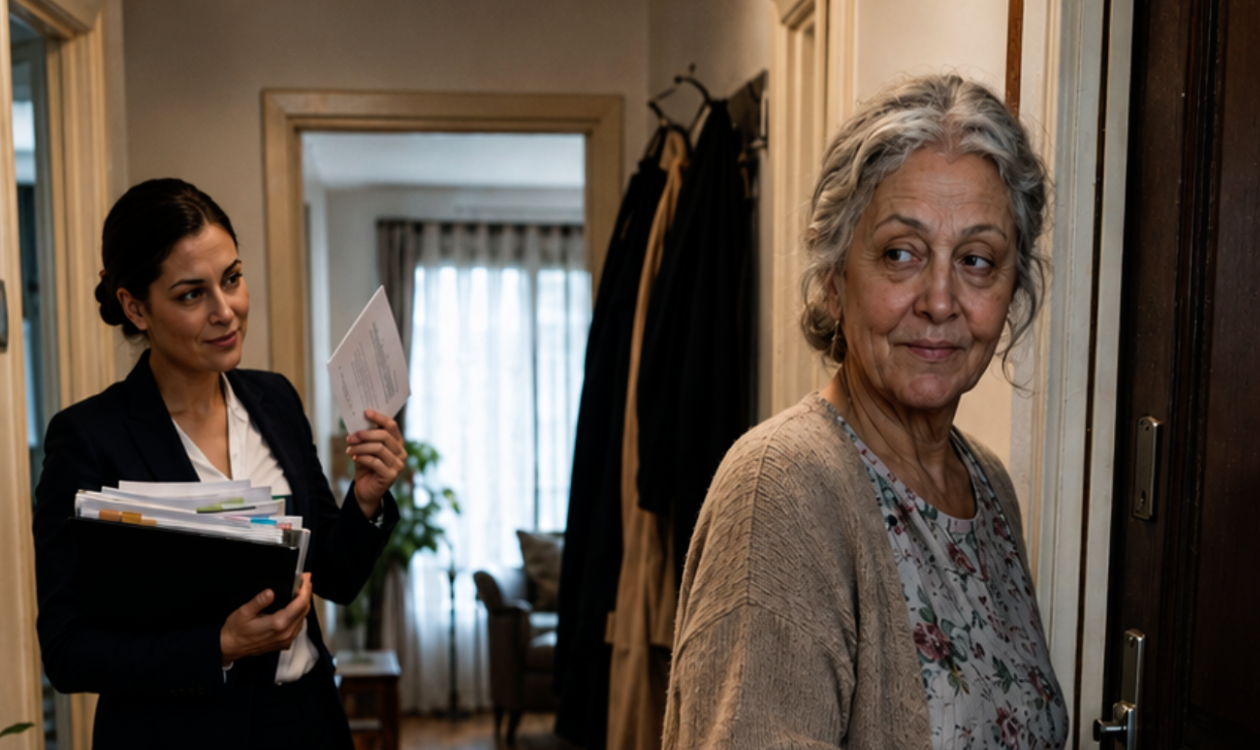
“There Was a Daughter-in-Law, But She’s Gone Now,” the Mother-in-Law Sneered While Changing the Lock, Unaware That the Accountant Kept Every Single Receipt
“Pack your things. Starting tomorrow, my daughter will be living in this apartment. And you can go wherever you want.”
Ksenia froze in the doorway of her own kitchen, unable to believe what she had just heard. Her mother-in-law was sitting at the table in Ksenia’s favorite chair, drinking tea from her cup and looking as calm as if she were talking about the weather. There was someone else’s pot on the stove. In the hallway stood a pair of unfamiliar women’s high-heeled shoes.
“Tamara Ivanovna,” Ksenia tried to keep her voice steady, even though everything inside her was trembling, “you must be confused. This is Artyom’s and my apartment. We bought it together.”
“Together?” her mother-in-law scoffed, setting her cup aside. “Sweetheart, you didn’t put a single kopeck into it, yet you act like you own the place. Artyom agreed. Oksana and her child have nowhere to live, and you have two empty rooms. So you’ll just have to make some space.”
Ksenia felt her fingers turn cold. Oksana was her husband’s sister—the same woman who had gone off to warmer places three years ago with yet another boyfriend and had now apparently returned. Ksenia had seen her only twice, at most: once at the wedding and once at Tamara Ivanovna’s birthday. All she remembered was her sharp, hostile stare and her permanent dissatisfaction with everything around her.
“Where’s Artyom?” she asked.
“At work,” her mother-in-law snapped. “And don’t call him. He’s busy. This is a family matter. And you know perfectly well what you are in our family. An outsider.”
A baby’s crying came from deeper inside the apartment. Then Oksana herself appeared, wearing Ksenia’s robe, her hair loose, a baby in her arms.
“Oh, look, the lady of the house has arrived,” she drawled, looking Ksenia up and down. “Listen, don’t worry. We’ll stay here for a little while, until I get back on my feet. What, are you really going to begrudge us a couple of rooms? It’s not like you have children.”
The last sentence hurt more than anything else.
Without a word, Ksenia turned around, stepped out onto the landing, and called her husband. The phone rang for a long time before the call was rejected. She tried again.
“The subscriber is unavailable.”
She stood outside the door of her own apartment—the apartment she had just been thrown out of—and could hardly believe this was happening to her.
Ksenia had married Artyom four years earlier. He had seemed to her the embodiment of reliability: an engineer at a factory, calm, quiet, with kind eyes. She had fallen in love with his steadiness, with the way he planned for the future, with how he always said “we” instead of “I.”
At the wedding, her mother-in-law had smiled, kissed her daughter-in-law on the cheek, and called her “my daughter.” Ksenia had been delighted. She thought she was lucky. Mothers-in-law and daughters-in-law so often fought, but here there seemed to be warmth.
How naïve she had been.
That warmth lasted exactly one month.
“Why are you frying the cutlets in this oil?” Tamara Ivanovna had appeared at the door of their apartment without ringing, carrying shopping bags. “Artyom has been used to a different kind since childhood. Move aside. I’ll do it myself.”
Ksenia had been confused and surrendered the frying pan.
After that, her mother-in-law started coming over more and more often. She rearranged dishes in the cupboards, rehung the curtains, and commented on every purchase.
“You paid too much.”
“You washed it wrong.”
“You don’t cook properly.”
Artyom simply brushed it off.
“Mom just wants to help. Don’t pay attention.”
So Ksenia didn’t.
She had grown up without a father, while her mother had raised her alone and worn herself out working three jobs. Her mother had passed away when Ksenia was sixteen. Ksenia had never known her father.
She was used to managing everything on her own, never burdening anyone, enduring whatever came her way. At first, she had regarded her mother-in-law as a substitute for the maternal care she had missed so badly.
But that care turned out to be a noose.
They bought the apartment a year and a half after the wedding. It was a bright two-bedroom apartment in a newly built building. Ksenia had paid almost the entire down payment. She had been saving since she was eighteen, working as an accountant and taking extra jobs at night.
Artyom contributed less but celebrated the loudest.
“Finally, our own little nest!”
They registered the apartment in his name. Ksenia’s credit history had been damaged by an old loan she had once taken out to pay for her mother’s medical treatment.
“We’ll add your name later,” Artyom had promised. “We’re a family. What difference does it make?”
As it turned out, the difference was enormous.
Ksenia spent the entire night at her friend Marina’s place. She couldn’t sleep. She stared out the window, replaying everything that had happened in her head.
In the morning, she called her husband again.
This time, he answered.
“Ksyusha, why are you making such a big deal out of this?” His voice sounded tired and irritated. “Oksana really has nowhere to go. She has a small child. What am I supposed to do, throw my own sister out onto the street?”
“So throwing me out is fine?” Ksenia tightened her grip on the phone. “Artyom, that is our apartment. Our home. Do you even understand that your mother literally threw me out?”
“No one threw you out,” he muttered. “You can stay with Marina for a while. You’re always running over to her place anyway. We’ll sort everything out later.”
“Sort it out?” Ksenia gasped with outrage. “When were you planning to tell me? Or were you not planning to tell me at all?”
Silence.
“Mom said it would be better for everyone,” he finally managed to say.
There it was.
Mom said so.
Always Mom.
With frightening clarity, Ksenia suddenly realized that her husband was not really a grown man at all, but an overgrown child his mother could manipulate however she pleased.
And that child had just betrayed her without hesitation.
“I’m coming over tonight,” she said. “I’m collecting my things. And you and I are going to have a serious conversation.”
“Ksyusha, just don’t make a scene, okay? Mom is there…”
She hung up before he could finish.
That evening, Ksenia returned to the apartment with her key.
It didn’t fit.
They had changed the lock.
She rang the doorbell.
Tamara Ivanovna opened the door and stood in the doorway with her arms crossed.
“What are you doing here? You were already told.”
“I came to get my belongings,” Ksenia said firmly, although her heart was pounding. “Let me in.”
“You’ll survive. We’ll bring your things out when we have time. Oksana’s baby is sleeping right now, so there’s no need for you to stomp around.”
Artyom appeared behind his mother. His hair was disheveled, he was wearing house slippers, and guilt was written all over his face.
“Mom, just let her get her things,” he mumbled.
“Be quiet,” his mother snapped at him. “Stay out of this. I’ll handle it.”
And in that moment, Ksenia saw everything clearly.
She saw her adult husband lower his eyes and fall silent like a schoolboy who had misbehaved. She saw that he couldn’t say a single word to defend his wife.
His mother made every decision for him.
“Artyom,” Ksenia called quietly. “Look at me. Are you really okay with me being thrown out of my own home?”
He didn’t raise his eyes.
“Ksyusha, it’s only temporary…”
“Temporary,” her mother-in-law repeated with a sneer. “And don’t get your hopes up about this apartment. Whose name is on the documents? Artyom’s. You’re nobody here. There was a daughter-in-law, but she’s gone now.”
Something inside Ksenia broke.
And strangely enough, she felt lighter.
It was as if a veil that had covered her eyes for four years had finally fallen away.
“Fine,” she said calmly. “If I’m nobody, then there’s nothing left for us to discuss. But you’re bringing my belongings out today. Otherwise, I’ll call the police and explain that I’m being denied access to an apartment where I’m officially registered.”
Tamara Ivanovna flinched.
Apparently, she had forgotten about Ksenia’s registration.
Half an hour later, two bags containing Ksenia’s belongings were placed on the landing. They had been packed carelessly, things thrown in any which way.
Ksenia picked them up without a word and walked away without looking back.
For the first week, Ksenia lived as though she were in a fog. She went to work, returned to Marina’s apartment, lay down, and stared at the ceiling.
Artyom texted her a couple of times.
“How are you?”
“Maybe we can make up?”
She didn’t answer.
Tamara Ivanovna, of course, was triumphant.
But eventually, the numbness gave way to anger.
Cold, clear anger that gave Ksenia strength.
She made an appointment with a lawyer. The lawyer was a middle-aged woman with tired but sharp eyes who listened carefully to Ksenia’s entire story.
“So the apartment is registered in your husband’s name, but it was purchased during the marriage?”
“Yes.”
“Then it is jointly acquired marital property. It doesn’t matter whose name is on the documents. In a divorce, you are entitled to half. And if you can prove that the majority of the down payment came from you personally, you may be able to claim an even larger share.”
For the first time in a week, Ksenia felt solid ground beneath her feet.
“What about evidence?” she asked cautiously.
“Bank statements, transfers, receipts. Anything that confirms how much you contributed.”
And then Ksenia smiled for the first time in many days.
Because she had been an accountant all her life.
And the habit of keeping every scrap of paper, every receipt, was in her blood.
“I have it,” she said. “I have everything.”
At Marina’s apartment, Ksenia spread an entire archive across the table.
Bank statements from her account clearly showing transfers to the property developer. Screenshots from her online banking. A copy of the shared construction agreement in which she had prudently asked to be listed as one of the payers.
Artyom had brushed it off at the time, but the manager had included her name.
There was even a message exchange in which her husband had thanked her:
“Ksyusha, thank you for taking care of the down payment. You’re my rock.”
She assembled the folder methodically, as if preparing an annual financial report.
And with every document she added, she felt more confident.
Several days later, she unexpectedly received a call from an unfamiliar number.
“Ksenia? This is Valentina, Artyom’s aunt. His father’s sister.”
Ksenia tensed. She had barely interacted with her husband’s relatives.
“I’m listening.”
“Please don’t hang up,” the woman said quickly. “I know what Tamara is doing, and I don’t like it. She has always been like this—grabbing everything for herself. Oksana didn’t come back for no reason. She has debts. She lost her apartment. And Tamara came up with this plan: move her into your place, and then transfer your apartment to Oksana. To hide it from her creditors.”
Ksenia went cold.
“Transfer it? But the apartment is in Artyom’s name.”
“He’ll sign anything you put in front of him. You know what her precious little son is like,” Valentina sighed. “Tamara already took him to a notary. They wanted to draw up a deed of gift. To Oksana. I overheard them by accident. They weren’t even trying to hide it when I was around.”
“A deed of gift,” Ksenia whispered. “They want to give away my apartment.”
“Don’t let them do it, girl,” the aunt said firmly. “I’m on your side. If necessary, I’ll testify in court that I heard their conversation. I’ve had enough of that woman. She’s controlled the entire family for years.”
With trembling hands, Ksenia saved her number.
For the first time since everything had started, she realized she wasn’t completely alone.
The next day, Ksenia filed for divorce and simultaneously filed a claim for the division of marital property, requesting that the court place a restriction on the apartment.
Her lawyer explained that while the case was pending, the property could neither be sold nor gifted.
She acted just in time.
Literally one day later.
Artyom received the court summons.
And then the chaos began.
His mother called first. Ksenia had deliberately unblocked her number.
“What the hell are you doing, you ungrateful bitch?!” Tamara Ivanovna shrieked into the phone. “You put a restriction on the apartment! Have you no conscience? We accepted you into our family, and this is how you repay us!”
“Accepted me?” Ksenia asked calmly. “You threw me out of my home. Now I’m simply protecting what belongs to me.”
“Nothing there belongs to you! Artyom will prove that to you in court!”
“We’ll see,” Ksenia replied and hung up.
An hour later, her husband called. His voice was trembling.
“Ksyusha, why are you doing this? Let’s settle this peacefully. Mom is offering… well, we’ll give you back the money you invested.”
“How much?” she asked matter-of-factly.
“Well… three hundred thousand. That’s fair, isn’t it?”
Ksenia laughed quietly.
She had invested almost two million.
“Artyom, do you even remember how much I paid?”
Silence.
“Mom said three hundred,” he finally muttered.
“Mom said,” Ksenia repeated. “You know, Artyom, that’s your entire problem. You’ve spent your whole life living according to whatever your mother says. You even betrayed your wife because she told you to. I’ll see you in court.”
The hearing was scheduled for three weeks later.
Ksenia prepared for it as if it were the most important exam of her life. Her lawyer helped her draft the claim, organize the documents, and develop their legal strategy.
On the day of the hearing, Ksenia put on a formal suit, tied back her hair, and entered the courtroom with her back straight.
Artyom and his mother were already sitting on a bench. Tamara Ivanovna was whispering something in her son’s ear, and he kept nodding like a puppet.
Oksana sat behind them, nervously fiddling with the strap of her handbag.
And Valentina was there too.
She sat on Ksenia’s side of the courtroom and gave her an encouraging nod.
The judge, a stern-looking middle-aged woman, opened the hearing.
Artyom’s lawyer spoke first. He sounded confident.
The apartment, he claimed, had been purchased with the defendant’s money. The plaintiff had contributed nothing financially, had behaved improperly, and had spent family funds on her personal needs.
Tamara Ivanovna nodded enthusiastically.
When the judge asked if she wished to add anything, the mother-in-law jumped to her feet.
“Your Honor! This woman is a freeloader! She came into our family with nothing and lived entirely off our son! She didn’t invest a single kopeck!”
The judge frowned.
“Please sit down. The plaintiff may speak.”
Ksenia stood.
Her heart was pounding, but her voice remained steady.
“Your Honor, I have documents.”
She handed the folder to the court clerk.
Bank statements.
Payment orders.
Screenshots of transfers to the property developer—all made in her name.
A copy of the contract listing her as a payer.
“The initial down payment of one million two hundred thousand rubles was paid from my personal bank account,” Ksenia explained calmly and clearly, as though presenting an annual report. “I paid another seven hundred thousand over the following two years from my salary. Here are the statements. Here are the transfers. And here…”
She paused.
“…is my correspondence with my husband.”
She handed over a printed copy.
The judge read it aloud.
“‘Ksyusha, thank you for taking care of the down payment. You’re my rock.’ Signed: Artyom.”
Silence fell across the courtroom.
Artyom turned crimson and stared at the floor.
Tamara Ivanovna opened her mouth but couldn’t find anything to say.
“It’s… it’s fake!” the mother-in-law finally shouted.
“The bank statements have been certified by the bank, Your Honor,” Ksenia replied calmly. “As for the messages, I am prepared to submit my phone for forensic examination.”
The judge nodded and made a note.
“I have something else,” Ksenia continued. “I learned that the defendant, under pressure from his mother, intended to execute a deed of gift transferring the apartment to his sister in order to remove the property from the marital division. I ask that the witness be called.”
Valentina stood.
“I am the defendant’s aunt,” she said firmly. “And I personally heard my sister-in-law, Tamara Ivanovna, discussing with her son how they would transfer the apartment to Oksana. She said directly: ‘We’ll transfer it before that idiot files a lawsuit.’ She meant Ksenia.”
Tamara Ivanovna turned pale.
“Valya! You… you traitor!”
“You’re the traitor, Tamara,” the aunt replied calmly. “You’ve spent your whole life grabbing everything for yourself. Enough.”
The judge called a recess.
In the corridor, Tamara Ivanovna swooped down on Ksenia like a hawk.
“You’ll regret this! I’ll make your life hell! You think you’ve won? I’ll…”
“Tamara Ivanovna.” For the first time in four years, Ksenia looked directly into her eyes without looking away. “Stop. It’s over. You didn’t lose because I’m more cunning than you. You lost because I’m more honest. I didn’t keep those documents because I was preparing for a war. It’s simply a habit of mine. But you’ve spent your entire life lying—and eventually you got tangled up in your own lies.”
Her mother-in-law gasped but said nothing.
Artyom was standing nearby.
Suddenly, he spoke quietly.
“Ksyusha… forgive me. I really… I didn’t think it would turn out like this.”
Ksenia looked at the man she had once loved.
And she felt neither anger nor pain.
Only exhaustion and a strange, gentle pity.
“You didn’t think, Artyom,” she said softly. “That’s the whole problem. You never think for yourself. Your mother does your thinking for you. And you know what? I feel sorry for you. I really do. But I can no longer live with a man who betrays me the moment his mother tells him to.”
She turned and walked down the corridor, feeling as though a burden she had carried for years was falling from her shoulders with every step.
The court issued its ruling a month later.
The apartment was recognized as jointly acquired marital property. Considering Ksenia’s documented personal contribution, she was awarded a two-thirds share.
Artyom was ordered either to pay her compensation or to sell the apartment and divide the proceeds.
They had to sell it.
He didn’t have enough money to buy out her share.
Oksana moved out, grumbling angrily.
For a long time afterward, Tamara Ivanovna spread stories among the relatives that “the daughter-in-law had robbed her poor little boy.”
But Valentina and the other relatives, who had finally seen Tamara’s true nature, simply dismissed her complaints.
Ksenia received her share of the money.
With it, she bought a small one-bedroom apartment.
It was modest, but completely hers.
For the first time in her life, she had a home where no one could tell her:
“You’re nobody here.”
She renovated it with her own hands. She painted the walls a warm sandy color, hung light curtains, and placed pots of violets on the windowsill.
In the evenings, she drank tea in her kitchen and could hardly believe that all of it belonged only to her.
Artyom called several times.
He apologized, said he had moved away from his mother, and insisted that he had “finally understood everything.”
Ksenia listened calmly, without anger.
“I’m glad you understood,” she told him during their final conversation. “I really am. But what we had is in the past. Live your own life now. Only this time, make sure it’s yours—not your mother’s.”
And she hung up.
For good.
Almost a year passed.
Ksenia found a new job as the chief accountant at a good company.
There she met Dmitry, the head of the logistics department.
He was calm, dependable, and had a kind sense of humor. He didn’t rush things and treated her gently.
Most importantly, he had a mind of his own and respected her boundaries.
One weekend, they were walking along the waterfront. The autumn sunlight turned the water golden, and the wind played with the fallen leaves.
“You know,” Dmitry said, “I keep thinking about something. You went through so much, yet you didn’t become bitter. How did you manage that?”
Ksenia smiled.
“What’s the point of staying angry? Anger is like rust. It doesn’t eat away at the person you’re angry with—it eats away at you. I simply decided that I would keep living. And I would build a life in which people respected me.”
“You did,” he said quietly, taking her hand.
Ksenia didn’t pull her hand away.
That evening, when she returned to her small, warm apartment, she made herself some tea, sat by the window, and watched the sunset.
A year earlier, on an evening just like this one, she had been thrown out of her home, called a nobody, and humiliated.
And now she was sitting within her own walls.
Free.
Calm.
Alive.
Her phone vibrated.
A message from Dmitry:
“Thank you for today. You’re amazing. Get some rest.”
Ksenia smiled and typed back:
“Thank you too. For seeing me.”
She put the phone aside and looked around the room—her room.
The violets on the windowsill.
The warm glow of the lamp.
The silence, free of her mother-in-law, accusations, and fear.
“I made it,” she thought. “I rebuilt myself. And now I’m not a daughter-in-law, not a freeloader, not a nobody. I’m Ksenia. And that is enough.”
Outside the window, the last light of the sunset faded.
An entire life lay ahead of her.
And at last, that life was in her own hands.