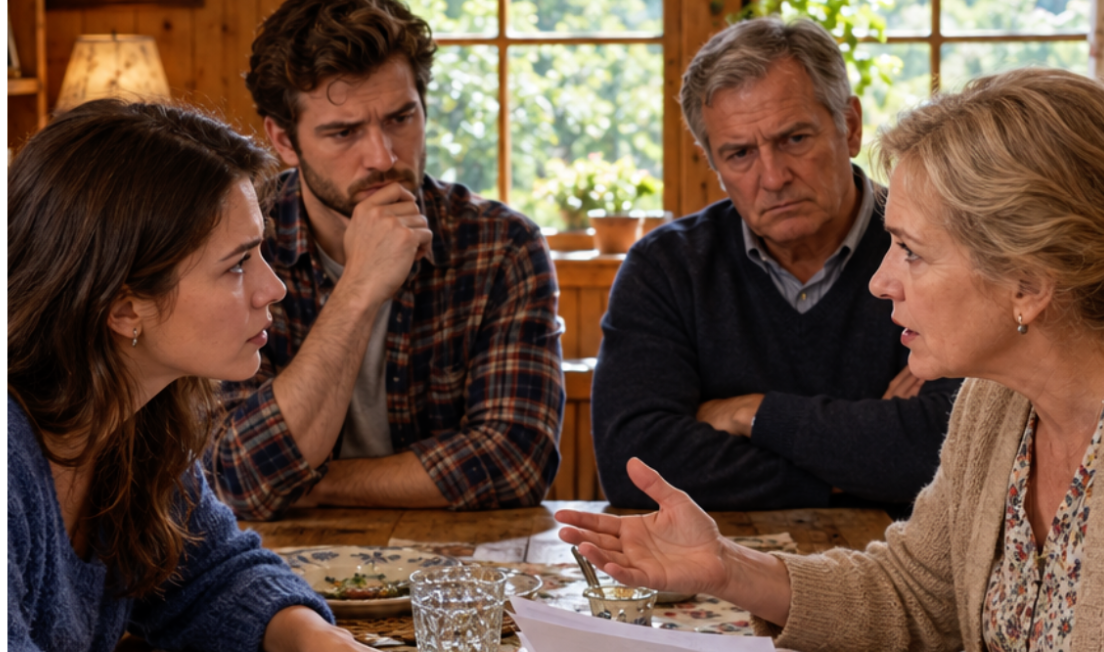
The loan application form was lying on the kitchen table next to the sugar bowl. Under ‘Borrower,’ her surname, first name, and patronymic were already filled in, carefully written in her mother’s neat, rounded handwriting.
Elena stared at those lines and couldn’t figure out why she felt so cold. It was hot in her mother’s kitchen, with cabbage pies cooling on the stove, and the radio humming softly with hits from the eighties. But inside, she felt like she was shivering from a draft.
“Don’t worry, Lena,” Tamara Nikolaevna said, sliding a cup toward her. “I just filled it out for convenience. So you wouldn’t have to mess around at the bank.”
“Mom, what bank? What loan?”
“Sit down, I’ll explain everything.”
Elena sat down. Her father, Gennady Pavlovich, was by the window, staring intently at the yard as if something incredibly important was happening there. He didn’t even turn around when his daughter came in. Elena didn’t like that either.
“Kostya is getting married,” her mother announced, ceremoniously, as if she were announcing a space launch. “To Vika. She’s a good girl, from a respectable family. The wedding’s set for September.”
“I know, Mom. He told me.”
“But here’s what you don’t know. Vika’s parents had a condition. They won’t let their daughter move into a rental apartment. They want them to have their own place. Even if it’s just a little one-bedroom, it has to be theirs.”
Elena was beginning to see where her mother was going with this. But she still hoped she was wrong.
“So you decided…”
“We decided to help,” Tamara Nikolaevna interrupted. “Kostya will get a mortgage, obviously. But he’s short by about 1.2 million for the down payment. The bank won’t give your father and me a loan, we’re pensioners. Kostya’s got a grey paycheck, so he’ll get turned down too. But you—your job is official, you’re an accountant, you have a long work history. You’ll get approved in a day.”
“So the loan would be in my name.”
“Officially in yours,” her mother waved her hand like shooing away a fly. “But we’ll make the payments. Every month. And in the fall we’ll sell the dacha and pay everything off early. You won’t even notice.”
Elena glanced at her father. He was still looking out the window.
“Dad, what do you think?”
Gennady Pavlovich coughed and rubbed the bridge of his nose.
“Your mother’s done all the math,” he said quietly. “She knows best.”
That’s how it always was. Her mother made decisions, her father agreed, and Elena adjusted. Ever since she was a child.
She remembered giving her new bike to Kostya when she was ten, because ‘he’s little, he needs it more.’ At sixteen, she’d stayed home with him instead of going to her school dance, because ‘you’re the oldest.’ For her graduation, they bought her a dress from the market, but a month later Kostya got a computer. ‘You’re strong, you can handle it,’ her mom would say. And Elena always did. Always.
“Mom, I need to think about it,” she said. “And talk it over with Sergey.”
Tamara Nikolaevna pursed her lips.
“What’s there to think about? Your brother is getting married. He needs help. Aren’t we family?”
“We are, Mom. That’s why I want to discuss it with my husband.”
“Just don’t take too long. The developer is holding the apartment only until the end of the month.”
Elena folded the application form in half and tucked it into her bag. She never even tried the pies.
At home, the smell of fried potatoes lingered in the air. Sergey was at the stove, wearing the apron their daughter gave him for February 23rd, the one with ‘Best Chef in the Neighborhood’ written on it. Masha sat at the table, surrounded by her schoolbooks.
“Oh, Mom’s home!” Masha lifted her head. “Mom, I took my social studies practice exam today and scored eighty-six!”
“That’s my smart girl,” Elena kissed her daughter’s head and felt some of her worries melt away. At least a little.
Masha was in the eleventh grade and dreamed of moving to St. Petersburg. She didn’t just dream—she was working for it. Two years of tutors, courses, and competitions. She wanted to study journalism, and everyone in the family knew this wasn’t just a whim—it was her real goal.
Elena and Sergey had been saving for her education ever since she started eighth grade. They put aside money bit by bit, skipped vacations by the sea, and Sergey was driving the same old car for the third year in a row, rattling over every bump. All for one purpose. If Masha didn’t get a tuition-free spot, she’d have a chance to attend on a paid basis. And she could rent a room in a new city without having to count every penny.
After dinner, when Masha went to her room, Elena took out the form and placed it in front of her husband.
Sergey read it. Then read it again. He took off his glasses and rubbed his eyes.
“Lena, you do understand what this means, right?”
“I do.”
“No, listen to me.” He spoke calmly, but Elena could see the tension in his jaw. “The loan is in your name. The bank will come to you for payments. If your parents can’t pay, if something goes wrong with the summerhouse, if anything else happens, you’ll be the one responsible. Promises aren’t part of the contract.”
“Mom said they would pay.”
“And what’s their combined pension?”
Elena stayed silent. Her parents’ pension was modest. Paying twenty-five thousand a month on a loan would mean they’d have to barely scrape by.
“And another thing,” Sergey placed his hand on hers. “If you have a 1.2 million loan hanging over you, no one will approve us for anything. And if Masha doesn’t get a free spot? What if we urgently need money? We’ll end up trapped.”
“I know, Sergey. I know all of that.”
“Then why didn’t you just say no right away?”
Elena gazed out the window for a long while. Then, softly, she said:
“Because all my life I’ve been taught you can’t say no to family. That it’s shameful. That a good daughter doesn’t act that way.”
Sergey hugged her.
“It’s your decision. But I’m here for you, no matter what you choose.”
Two days later, Kostya called. Her brother sounded cheerful and carefree, as always.
“Hey, Lenuś! Hi! Listen, Mom mentioned you’re hesitating about the loan. Why? It’s just a formality! Sign it and that’s it. Vika and I already picked an apartment—the view is amazing, you’d be blown away!”
“Kostya, it’s not just a formality. It’s 1.2 million for five years.”
“So what? The parents will pay. They’ll sell the summerhouse and pay it all off. Lena, you know how important this is for me. Vika won’t marry me unless we get an apartment; her parents are set on that.”
“Haven’t you thought about saving up? Working another year, maybe renting for a while?”
Kostya sighed, as if his sister had just said something incredibly foolish.
“Lena, I’m turning thirty soon. I don’t want to keep jumping from one rented place to another. You have your own apartment, a husband, everything. Am I worse off than you?”
Elena wanted to remind him that she and Sergey had spent twelve years paying off their own apartment. That no one had helped them. That she worked two jobs when Masha was a baby. But she held her tongue.
“I’ll think about it, Kostya.”
“Think faster, sis. Time is running out.”
That evening, Dad called. It was surprising, since he rarely called and never called on his own about anything serious—he always handed the phone to Mom for that.
“Lena,” his voice was soft, as if he was speaking from another room where Mom couldn’t hear. “About the loan… don’t rush into it.”
“Dad, did something happen?”
There was a pause. Long and heavy.
“Nothing. Just don’t rush. Think it through carefully.”
“Dad, if you know something, please tell me.”
“Alright, honey. Mom’s calling me. Bye.”
He hung up. Elena sat for a long time with her phone still in her hand. Her father knew something—something he either couldn’t or wouldn’t tell her. The feeling of anxiety became almost unbearable.
On Saturday, Elena went to the dacha. Earlier in the month, her mom had asked her to pick apples before they started falling, and Elena decided this was a good excuse to be alone and think things over.
The dacha was old, but cherished. Six hundred square meters, a cozy little house with a veranda, apple trees planted by her grandfather. Elena had spent her entire childhood here. She’d taught Masha to ride a bike there. It was always peaceful and lovely.
She was picking apples into a bucket when their neighbor, Zinaida Ilyinichna, peeked over the fence. Energetic and talkative, she knew everything about everyone in the garden community.
“Hello, Lenochka! I haven’t seen you in ages! Did you come here alone?”
“Just me, Zinaida Ilyinichna. Picking apples,” Elena replied.
“Go ahead and pick them while you can. They say the new owner is planning to redo everything over here.”
Elena straightened up.
“What new owner?”
“Why, Kostya, of course!” The neighbor raised her eyebrows in surprise. “He came by with some papers in the spring, showed them to the chairman. Said the dacha is his now—his parents gifted it to him. He wants to replace the fence and build a sauna. Didn’t you know?”
The bucket slipped from Elena’s hands. Apples scattered across the grass.
“No,” Elena said quietly. “I didn’t know.”
She didn’t remember finishing picking the apples. She didn’t remember how she got back to the city. All she could remember was one thought spinning in her head the whole way: Spring. The dacha was signed over to Kostya in the spring. But her mother had said they’d sell it in the fall to pay off the loan.
That evening, Elena logged onto the government services portal and ordered a property registry extract. It arrived two days later. A dry official document, stating in black and white that in March of this year, the dacha had been transferred to Konstantin Gennadyevich via a gift agreement.
Elena sat at the kitchen table with the printout in her hands, feeling something collapse inside her. It wasn’t the loan that scared her now—it was something else. Her mother had looked her in the eyes and promised to sell the dacha, when it wasn’t even theirs anymore. Her mother knew. And said it anyway.
So no one was actually planning to pay off the loan early. It would have all fallen on her. For five years. Maybe even more.
Sergey read over the extract and stayed silent for a long time.
“So that’s how it is,” he finally said. “That’s why your dad called.”
“He knew, Seryozha. He knew and just couldn’t tell me directly.”
“Or maybe he was afraid.”
Masha was standing in the kitchen doorway. Elena hadn’t heard her come in.
“Mom,” her daughter’s voice trembled. “I heard. About the loan. About grandma.”
“Mashenka, these are grown-up matters…”
“Mom, I’m not a little kid.” Masha sat down next to her mother and took her hand. “If you need to help Uncle Kostya, I understand. Really. I can go to university here in our city—we have a journalism program too. It’s not a big deal.”
Elena looked at her daughter. At her serious face, her ink-stained fingers. At the textbooks piled up in the room, reaching toward the ceiling. At the two years of hard work, sleepless nights, practice tests, and tears over every single grade.
And suddenly, she realized something simple. Her whole life, she’d always stepped aside for others—she was raised that way. And now her own daughter, just seventeen, was ready to do the same. To give up her dreams for someone else’s convenience. Because she’d watched her mother do it.
No. This needs to stop now.
“No, Masha,” Elena said firmly. “You’re going to Saint Petersburg. Just like we planned. This isn’t up for discussion.”
“But Grandma…”
“I’ll handle Grandma myself.”
On Sunday, Mom hosted a family dinner. She invited everyone. Kostya, Elena and Sergey were there. Vika didn’t come—she said she was busy. The table was covered with salads, roasted chicken, and mom’s famous apple pie. It felt like a holiday.
The application form was sitting at the edge of the table. A pen lay next to it.
“Well, Lena,” Tamara Nikolaevna smiled, although her smile looked forced. “Have you made up your mind? Kostya is meeting with the developer tomorrow, so we need the money ready.”
Elena slowly took a folded sheet out of her bag and placed it next to the application form.
“I’ve thought about it, Mom. Here, look.”
Her mother took the document and read it. First her face went pale, then blotchy red patches appeared.
“Where did you get this?”
“From the State Services website. It’s public information, Mom. Anyone can order it.”
Silence hung over the table. Father lowered his head. Kostya shifted his confused gaze from his mother to his sister.
“Mom, you said you’d sell the dacha and use the money to pay off the loan,” Elena’s voice was calm, though inside she was shaking. “But the dacha has belonged to Kostya since March. How were you planning to sell it?”
“Lena, you don’t understand…”
“Then explain. I really want to understand.”
Tamara Nikolaevna put the document aside and straightened up. Something familiar sparked in her eyes—the same determination she always used to end an argument once and for all.
“Fine. I’ll tell you. Yes, we gave the dacha to Kostya. Because he’s our son. He needs to get on his feet. You already have everything. An apartment, a husband, a job. Kostya has nothing. He’s a man, he needs to build a family!”
“So you decided I should pay for his apartment? Without telling me the truth?”
“We would have paid! As much as we could!”
“As much as you could, Mom. And the rest?”
Mother fell silent.
Then Kostya spoke up. Quietly, and uncertainly.
“Mom, wait. You told me Lena knew about all this. That she knew about the dacha and agreed.”
Elena turned to her brother.
“You thought I knew?”
“Well, yeah!” Kostya blushed all the way to his ears. “Mom said she talked to you about everything. That you didn’t mind, because you have plenty of money and don’t need the dacha. I would never have… Lena, I honestly didn’t know.”
For the first time all evening, Father raised his head and looked his wife straight in the eye.
“Toma, enough,” he said quietly, but so firmly that everyone fell silent. “I told you in the spring—you can’t do this. You can’t deceive one child for another’s sake.”
“Gena, why are you getting involved?”
— You know, I’ve kept quiet for thirty years. I always gave in to you. But I can’t do it this time. This is Lena. This is our daughter. She’s never once asked us for anything. And now we want to take away the last thing she has.
Tamara Nikolaevna looked at her husband as if she was seeing him for the very first time.
Elena felt tears welling up in her throat. But she didn’t let them fall.
— Mom, please listen to me. — She spoke slowly, carefully choosing her words. — I love you. And Dad, and Kostya. I’ve always helped you and I always will. I’ll come if you need me. I’ll stay if you get sick. I’ll bring groceries, drive you wherever you need. But I’m not a bank. And I won’t keep sacrificing my own family just so things are easier for someone else.
— Your own family? What are we to you then, strangers?
— You’re my family. But I have a husband and a daughter. Masha is starting college in a year. We’ve been saving for her education for six years. If I take out this loan, everything falls apart. Her dream, our plans. And you know what she told me two days ago? That she’d give up studying in St. Petersburg. For Uncle Kostya. Because she’s seen me always giving up everything for everyone else.
Her mother opened her mouth, then closed it again.
— I don’t want my daughter to grow up like me, — Elena continued. — Always afraid to say ‘no.’ Always feeling guilty for wanting to live her own life. So my answer is no. I won’t take the loan.
She stood up and grabbed her bag. Sergey got up too.
— Lena, — her mother called after her. Her voice was no longer commanding, but lost. — You’ve always been so strong. You always managed everything.
Elena paused in the doorway.
— Yes, Mom. I’m strong. That’s why I’m saying ‘no.’ I couldn’t before, but I can now.
The first week, the phone was silent. Then the second week too. Out of habit, Elena would reach for her mother’s number, but every time she stopped herself.
It was hard. Waves of guilt crashed over her, especially in the evenings. She remembered her mom’s pies, her hands, her voice when Elena was a sick child. She remembered the good. And there was so much good.
— You didn’t do anything wrong, — Sergey said. — You just stopped letting yourself be taken advantage of. That’s not the same thing.
— I know. But why does it still feel so sad?
— Because you love them. But loving someone and agreeing to everything are not the same thing.
A month later, Kostya called. His voice was different. There was no usual bravado, none of his ‘Lenusya.’
— Lena, can I come over? I need to talk.
He came in the evening with a cake and a bouquet of chrysanthemums. He shifted awkwardly in the hallway until Elena invited him into the kitchen.
— I wanted to apologize, — he said, not meeting her eyes. — I truly didn’t know that Mom hadn’t told you about the summer house. But that doesn’t excuse me. I should have spoken to you myself. Instead, I just felt relieved that everything would get resolved without me.
Elena silently poured him some tea.
— Vika and I talked about everything, — Kostya continued. — I told her how it really happened. I thought she’d leave me. But she said she’d rather live in a rented apartment with an honest man than in her own place bought on someone else’s back. By the way, her parents backed down too when they found out. They said what matters most is that we have our heads on our shoulders.
— So what did you decide?
We’ve rented a one-bedroom not far from her job. I picked up a second job, and on weekends I’m hauling freight. We’ll start saving on our own. Should have enough for the down payment in three years, maybe sooner.
What about the dacha?
Kostya gave a little smile.
I offered to sign the dacha back over to Mom, but she refused. She said a gift is a gift. But I’m not selling it. It was Dad’s place—the apple trees were Grandpa’s. Let it stay in the family. Come by with Masha in the summer, there’s plenty of room for everyone.
Elena looked at her brother and saw something different in him. It’s like he had grown up in that one month. For the first time, he really had to take responsibility for his own choices. And honestly, it seemed to suit him.
Kostya, how’s Mom doing?
Her brother was quiet for a moment.
She’s upset. Gets angry, feels hurt, cries. Keeps saying everyone betrayed her. But Dad talks to her a lot. He’s really changed, Lena. You know, he even made his own appointment at the clinic and went by himself recently—without Mom. She was shocked.
For the first time in a long while, Elena smiled.
Spring arrived quietly. Masha was taking exams—she looked pale and thin, but determined. Elena barely slept during those weeks, worrying even more than her daughter.
The results came in at the end of June. Masha burst into the kitchen with her phone in her hand and shouted so loudly the neighbors probably thought something had happened.
Mom! Dad! Two hundred eighty-one! I got in on a free spot!
Sergey picked his daughter up and twirled her around the kitchen. Elena stood at the stove and cried with relief, happiness—all of it at once. All those years, all the savings, all the sacrifices. It had all been worth it.
That evening, her father called.
Lena, is it true? Did Mashenka get accepted?
It’s true, Dad.
I’m so happy, sweetheart. Really happy. He paused. Can I come by? I want to congratulate my granddaughter.
He arrived an hour later, carrying a box of chocolates and an envelope.
This is for Masha, he said, handing over the envelope. For her to get started. I’ve been putting money aside little by little. Don’t tell your mother.
Dad, you don’t have to…
I do, Lena. Her father looked at her for a long moment. I owe you. Not with money. I should’ve stood up for you back then, when you gave your bike to Kostya, when you missed out on the disco to stay with him. I saw it all and kept quiet. Thought it was easier that way. Forgive me.
Elena hugged her father. Tight, just like she used to as a little girl.
What about Mom? she asked quietly.
Mom… Gennady Pavlovich sighed. She’s proud. Hard for her to admit when she’s wrong. But every day she asks how Masha is, how the exams are going, where she applied. Pretends she’s just making conversation. Give her time.
Masha was leaving in late August. The station was loud and busy, the air thick with the smell of coffee and pastries. Sergey hauled the suitcases, Masha checked for the hundredth time that she had her documents. Elena stood by, fighting back tears.
Mom, come on, Masha gave her a hug. I’ll call every day. And I’ll be back for the holidays.
I know, sweetheart. It’s just… you’ve grown up so much already.
Someone coughed quietly behind her. Elena turned around.
Her mother was standing there on the platform, wearing her old beige coat and holding a bag. Her father was beside her, Kostya and Vika just behind.
Tamara Nikolaevna walked up to her granddaughter and handed her the bag.
“Here are some pies,” she said, without looking at her daughter. “With cabbage. And with apples. You can eat them on the way. You never know what food they serve on the train.”
“Thank you, Grandma,” Masha said, giving her a hug.
Then her mother turned to Elena. They gazed at each other for a long time. Elena noticed how much her mother had aged over the past year. New wrinkles at the corners of her eyes, her temples streaked with gray.
“I was wrong, Lena,” Tamara Nikolaevna said softly—so quietly that only her daughter heard. “I shouldn’t have lied to you. I always thought you could handle anything. And that Kostya wouldn’t make it without me. I never considered that things could be difficult for you, too.”
Elena felt her tears finally break free.
“It is hard for me, Mom. Very often.”
“Now I know,” her mother said, awkwardly taking her hand. “Forgive me, if you can.”
The train sounded its horn. Masha waved to everyone from the compartment window, clutching the bag of grandma’s pies. The train started moving, gradually picking up speed, and soon disappeared around the bend.
They all stood together on the platform. For the first time in a long time, all of them together. Dad held mom’s arm. Kostya hugged Vika. Sergey stood next to Elena.
“Why don’t you all come over?” Elena suddenly suggested. “Let’s have some tea. I bet Mom baked enough pies for everyone.”
Tamara Nikolaevna smiled. Shyly, a little uncertain, but truly.
“I did,” she said. “A whole bag full.”
As Elena walked along the platform, she thought about how much had changed in the past year. She had learned to say “no.” She’d learned how to set boundaries and not apologize for them. She realized that loving your family doesn’t mean you have to sacrifice yourself. And that broken trust can be rebuilt—slowly, bit by bit. But it is possible.
And most important of all: her daughter was heading toward her dream. She didn’t give it up for someone else’s comfort. Because her mother showed her that it’s okay to choose yourself and still be a loving person.
Sometimes the bravest thing you can do for your family is to say a simple, firm word—even if it’s the hardest thing to say.
What do you think: is it possible to forgive a mother who lied to one child for the sake of another? Or is trust lost for good—no matter how many pies she bakes? Share your thoughts in the comments, especially if your family had a “favorite child,” too.